Forestry

Beyond the Razor Grass — Part Two, 11th July 2026
Beyond the Razor Grass — Part Two

A forest revealed!

The first Global Works team had broken through the barrier. They reopened the way into a part of the forest that had been inaccessible since Hurricane Maria and helped us rediscover trees planted many years ago. But reaching the planted trees was only the beginning.

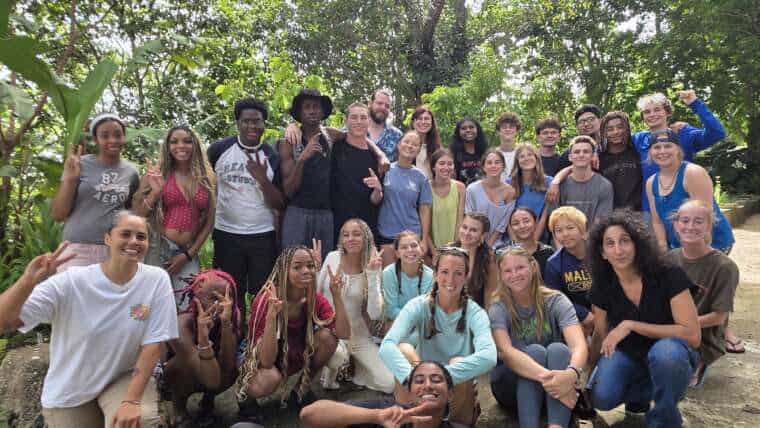
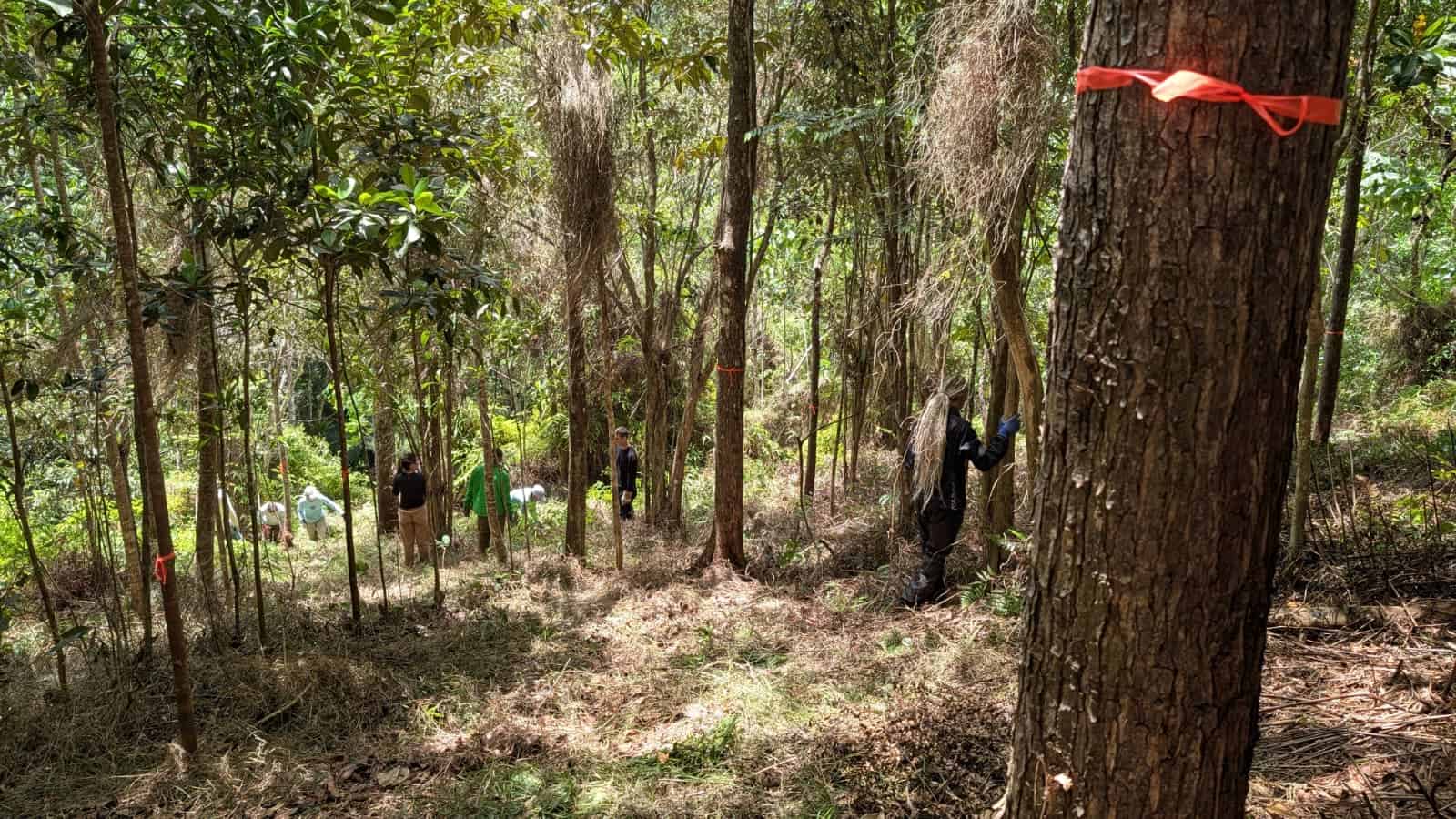
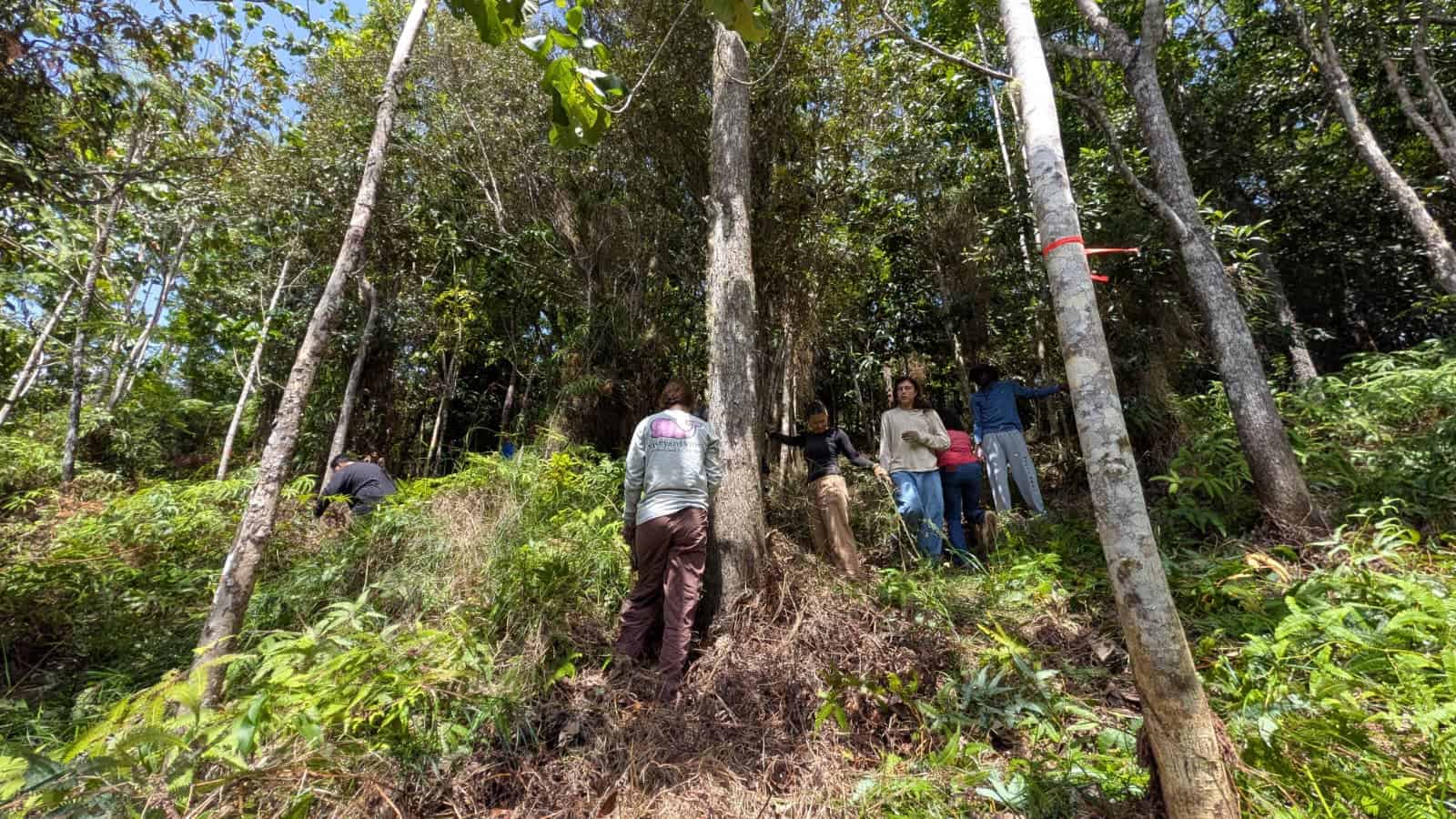
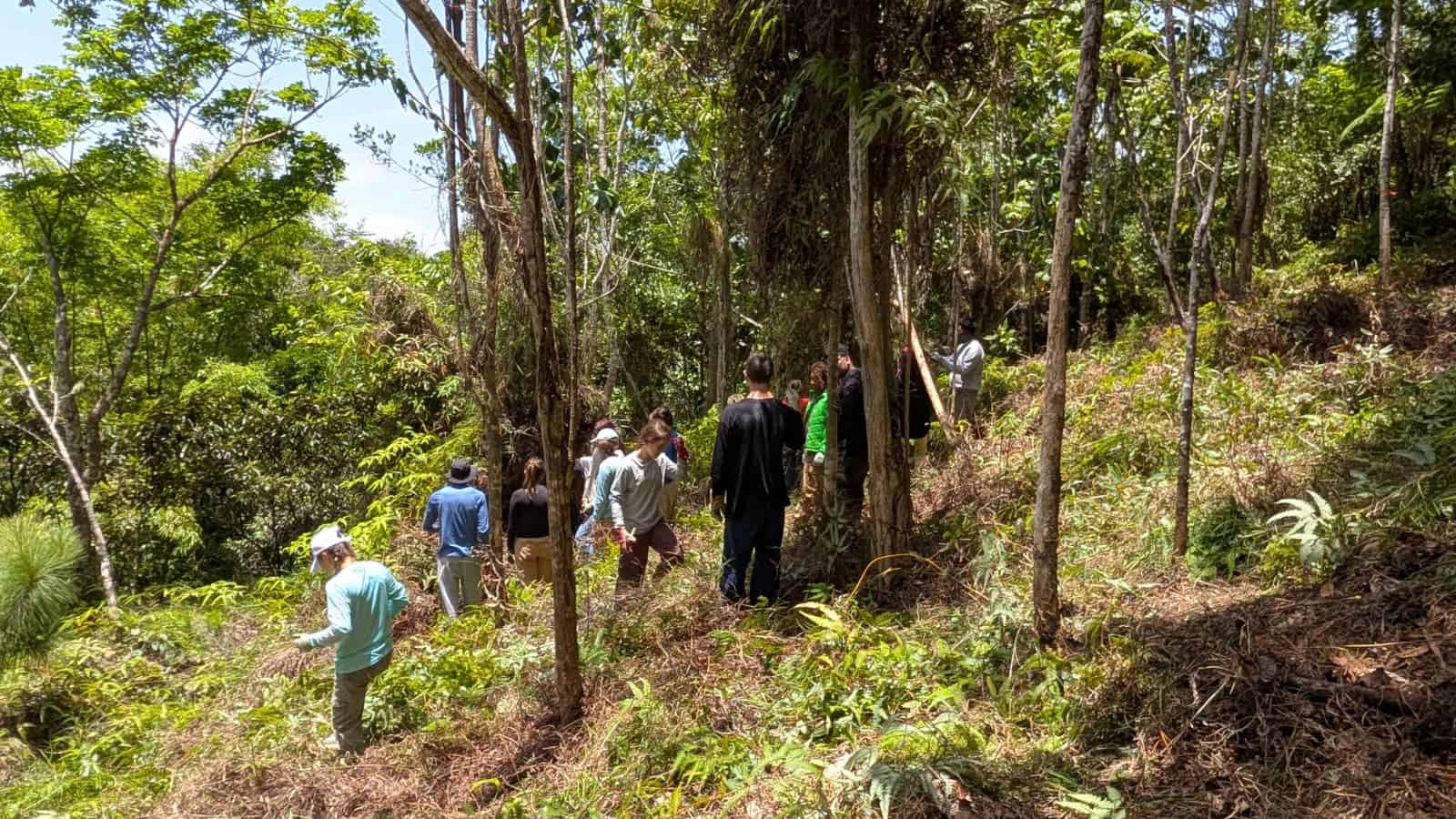
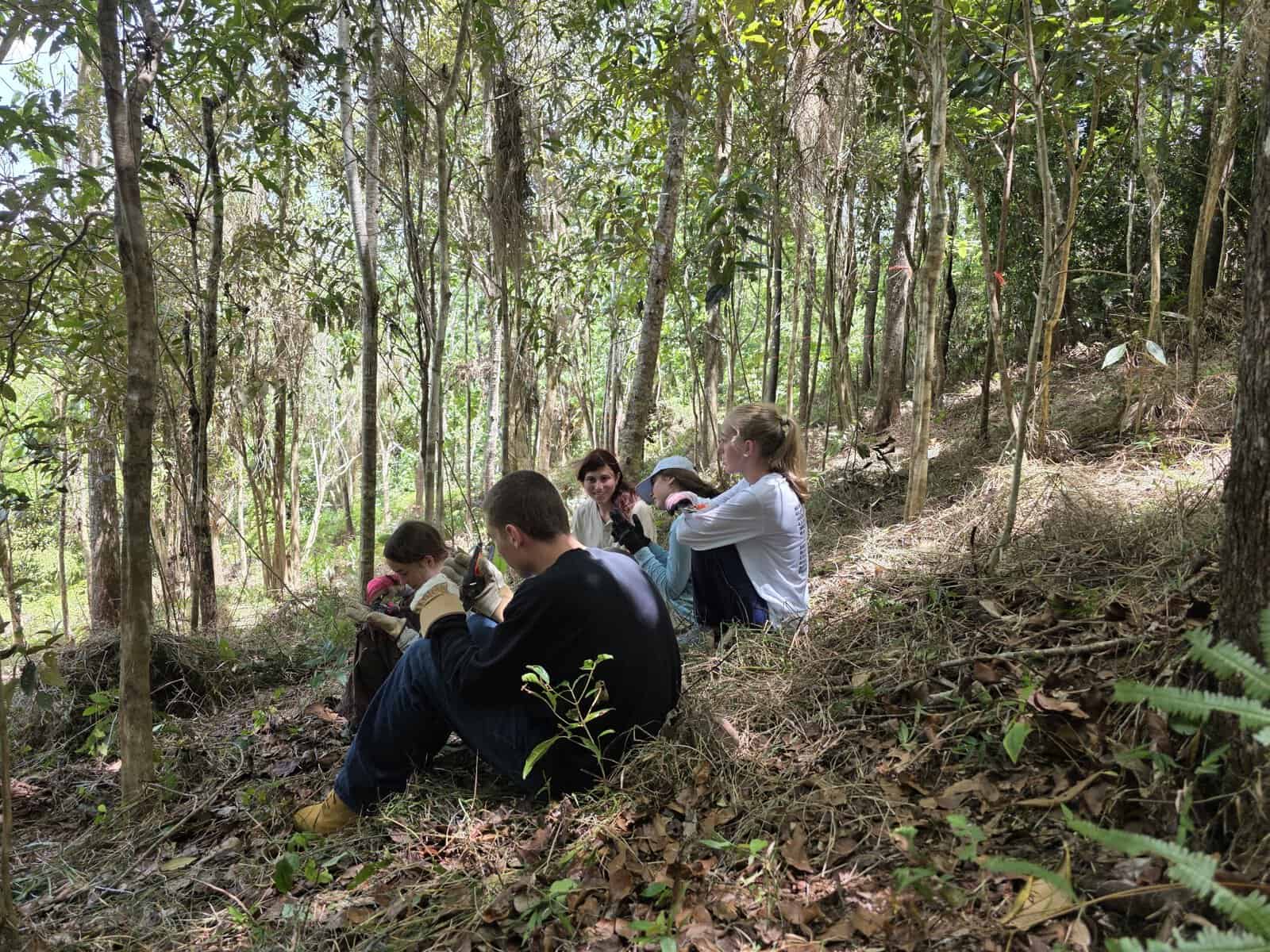
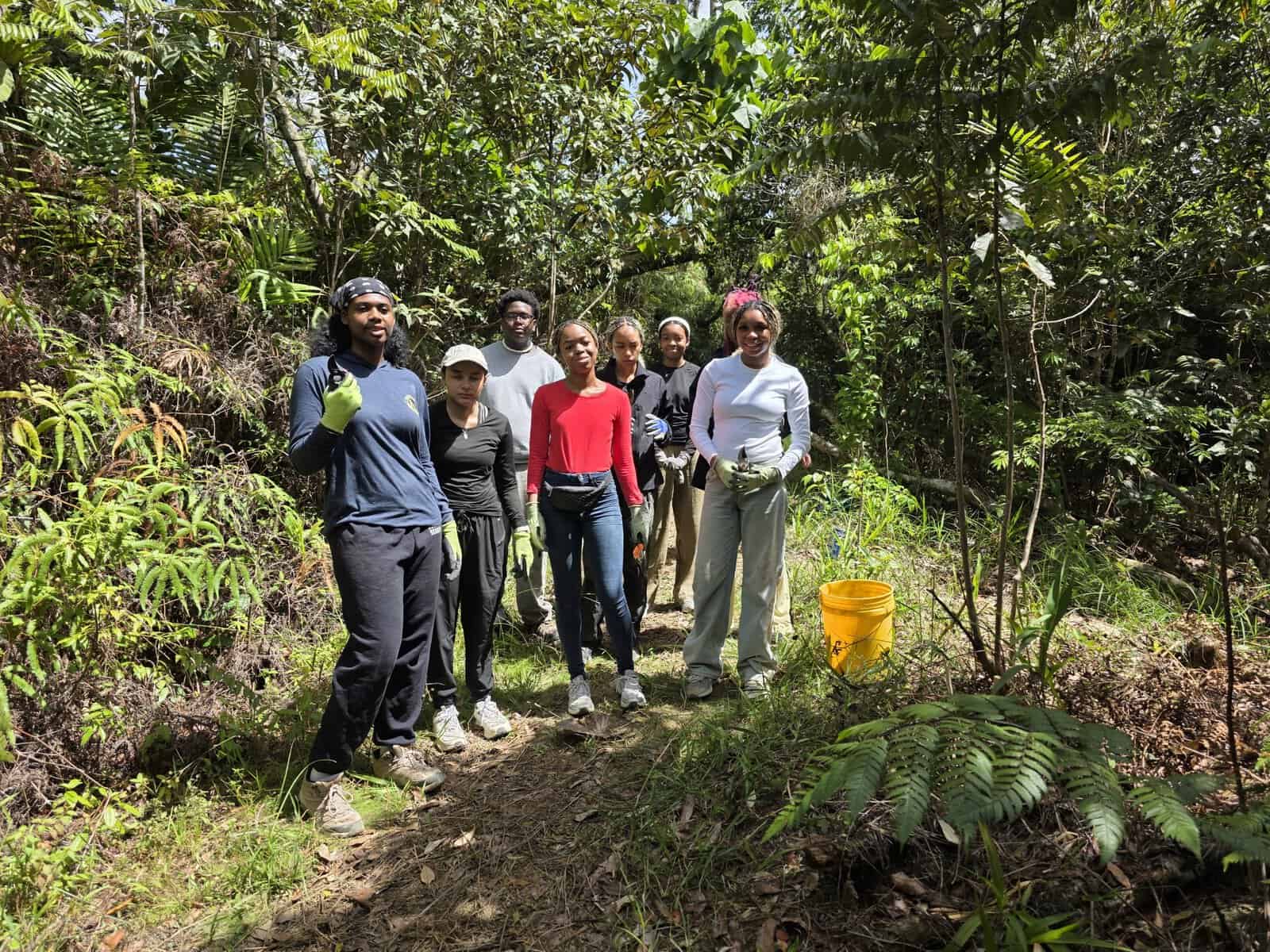
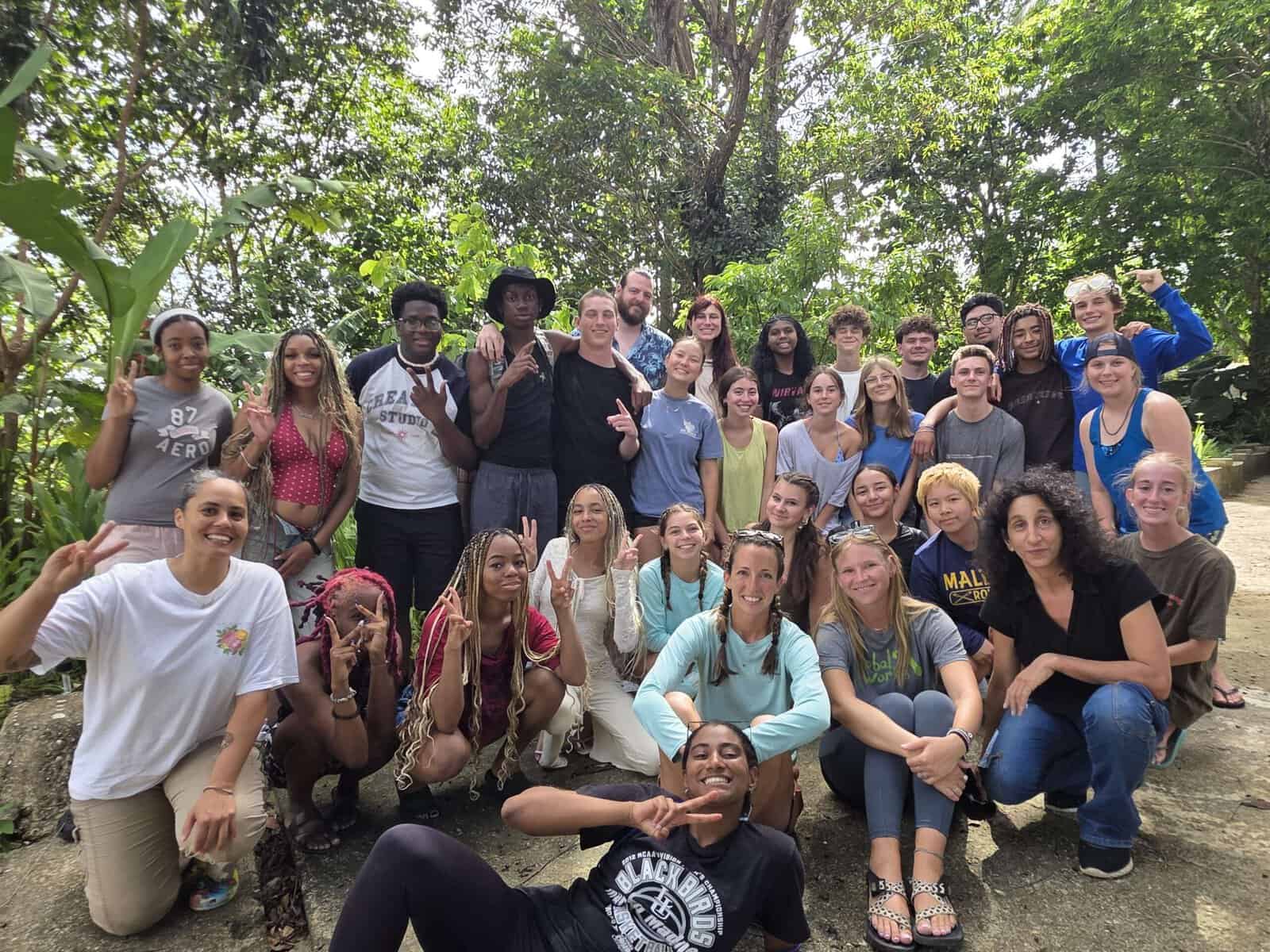
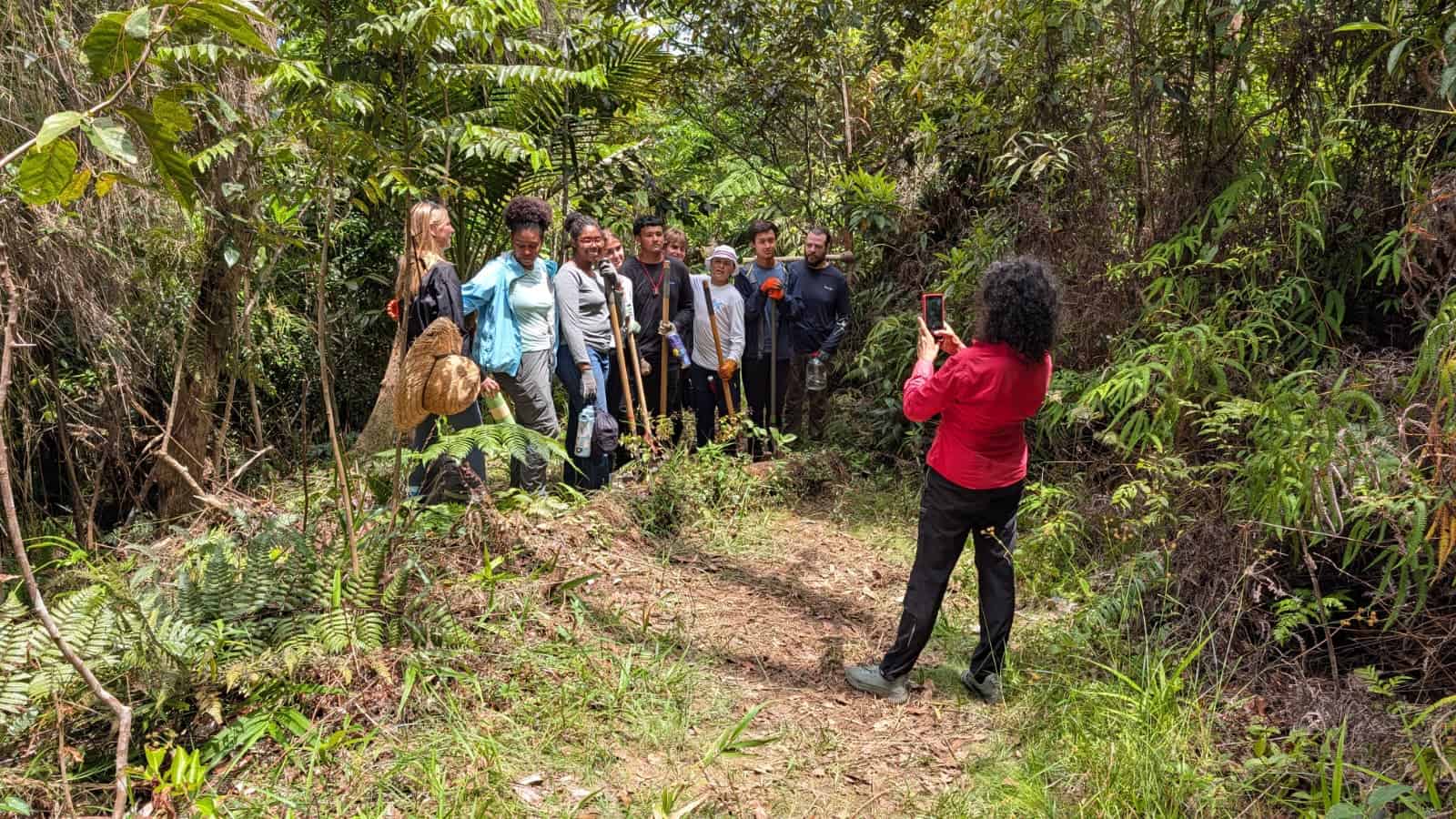
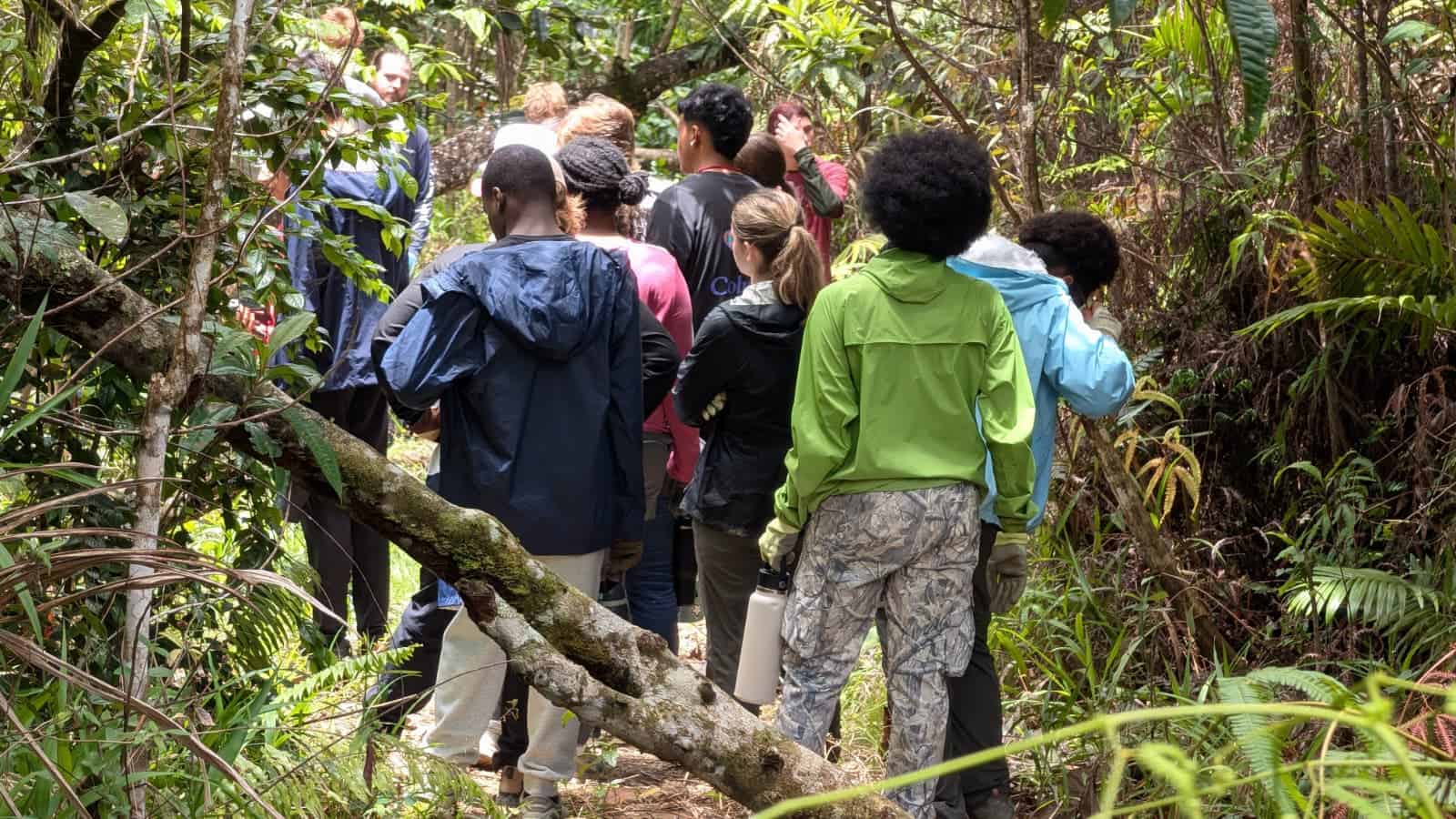
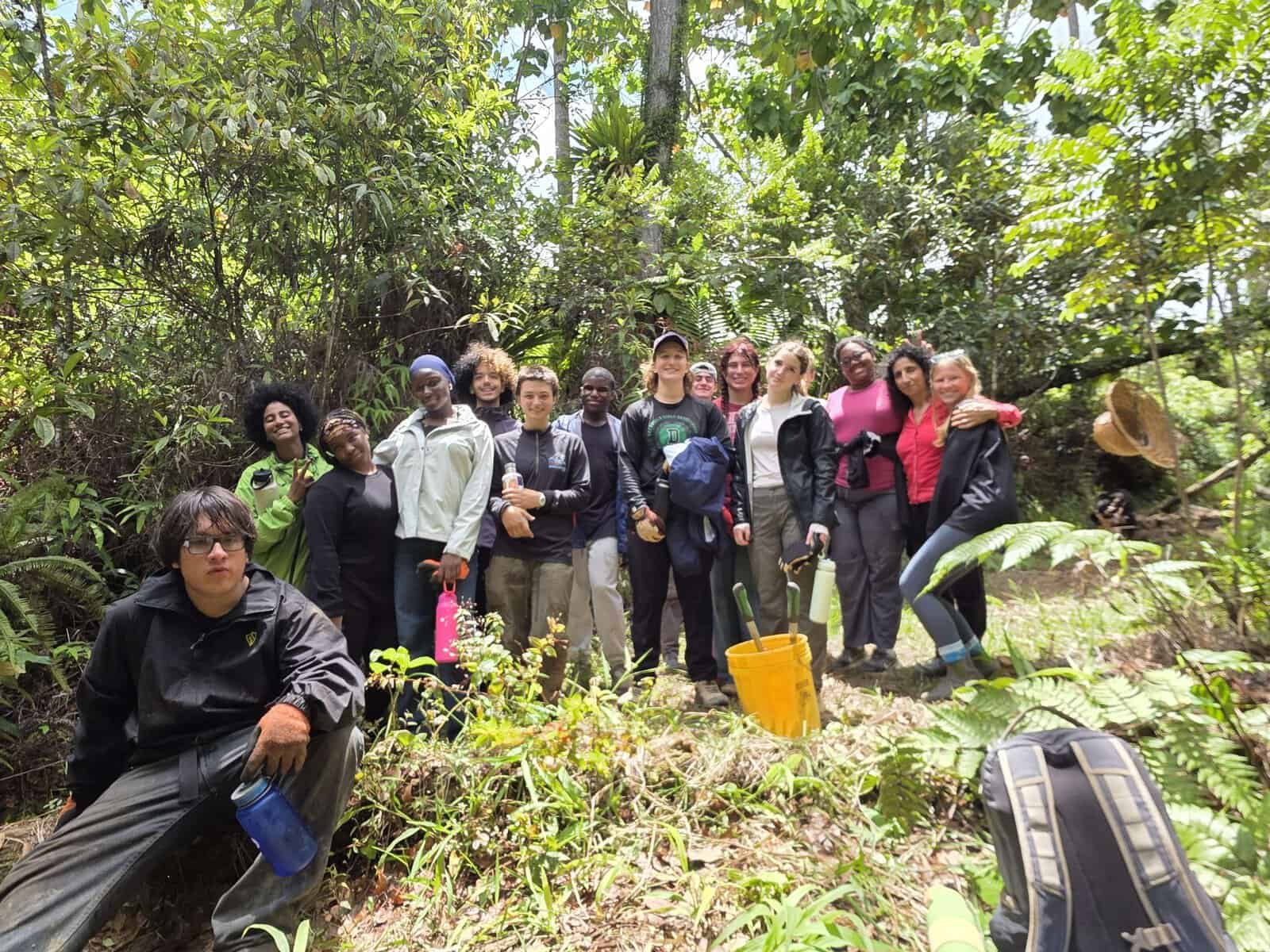
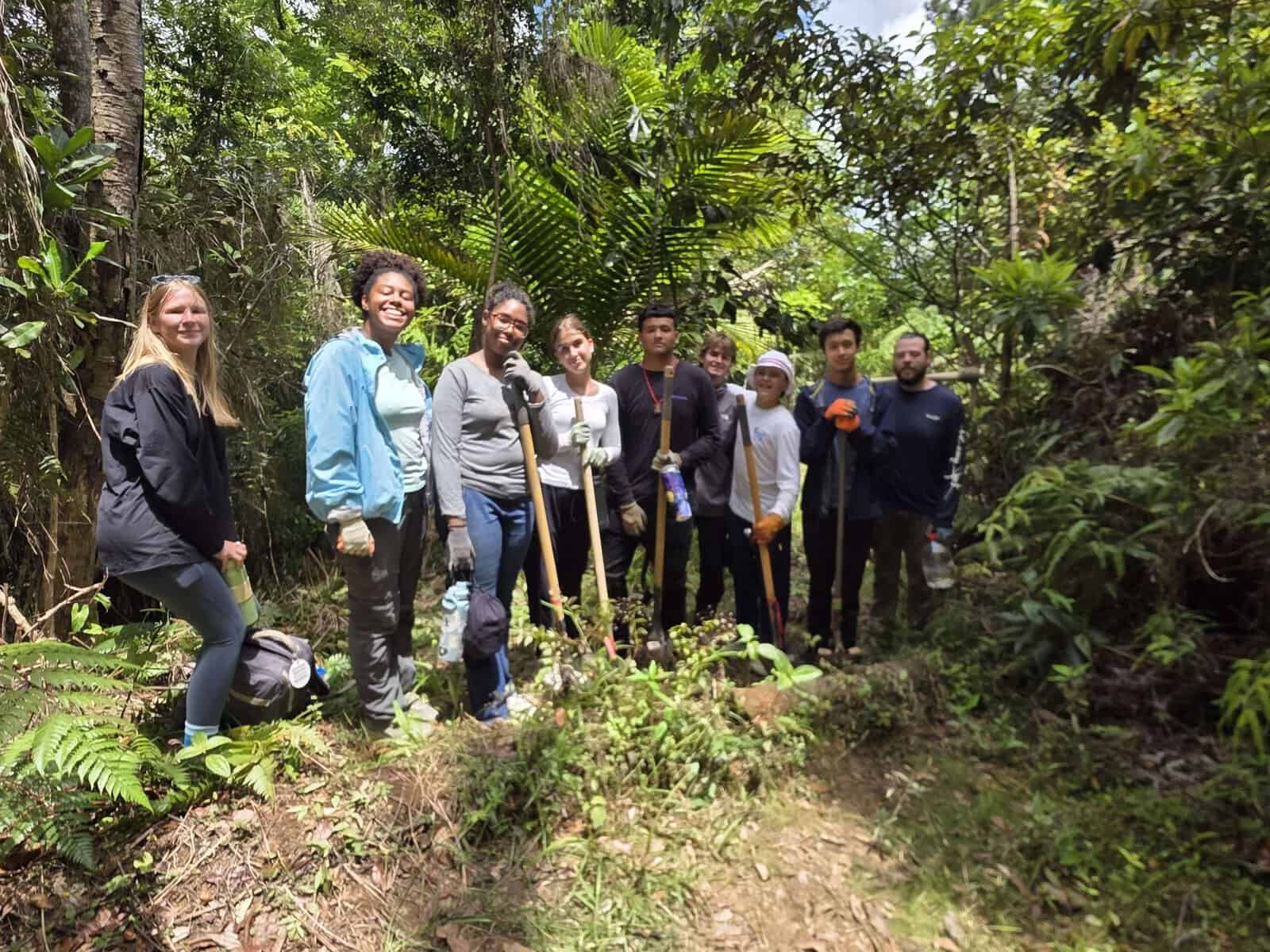
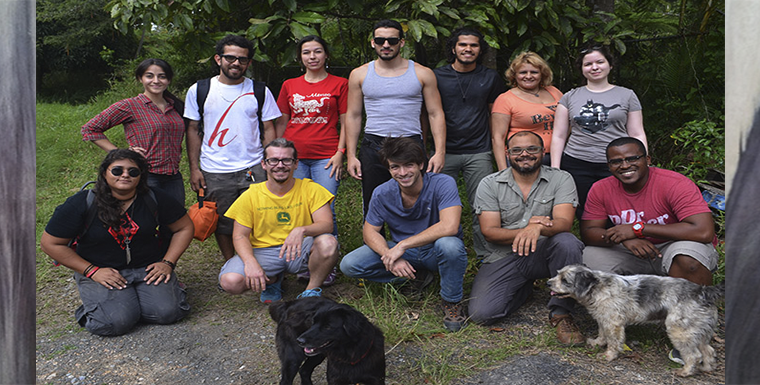
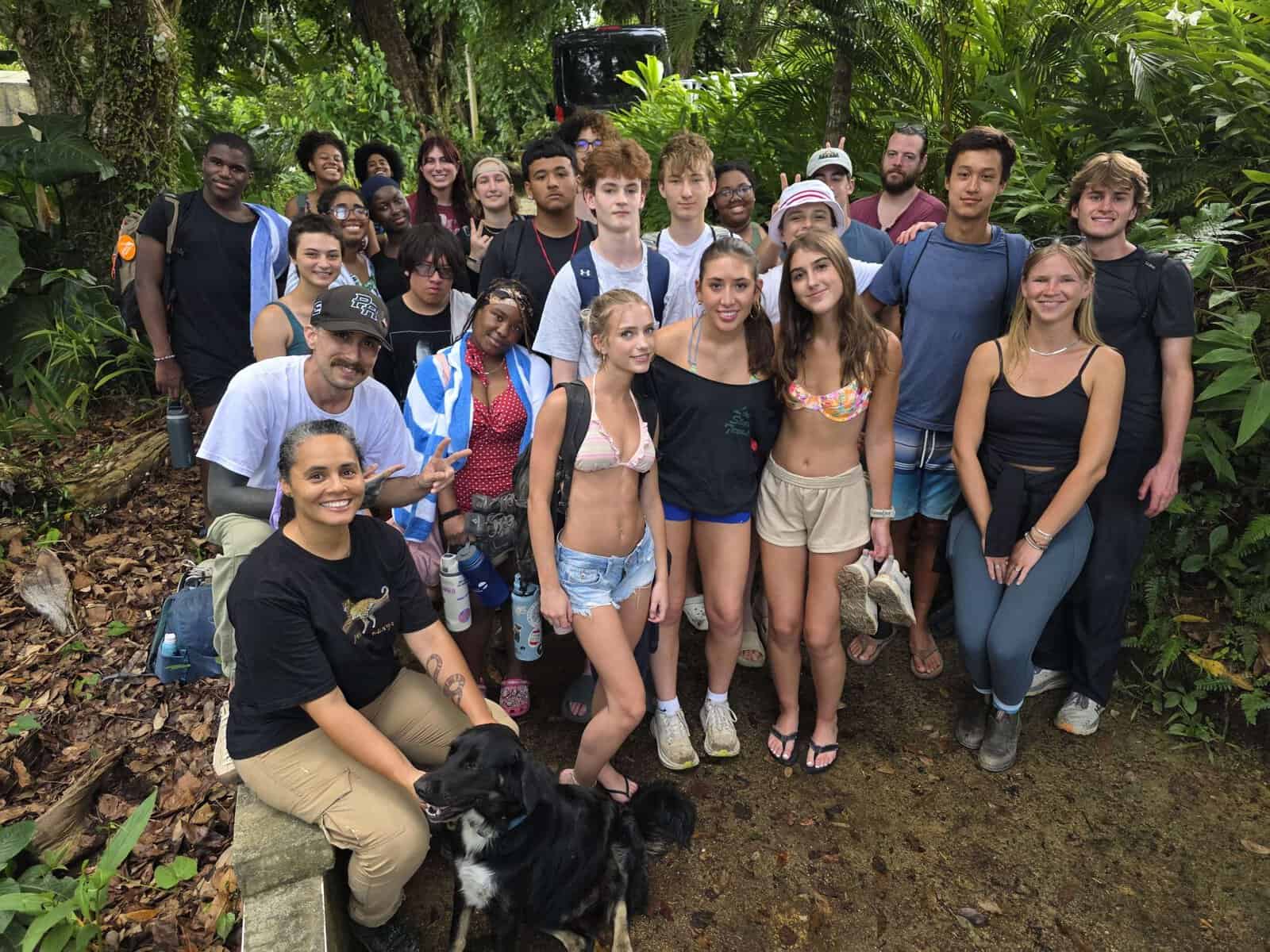
A second Global Works team—25 teenagers accompanied by staff members Lauren, Sam, and Darielys—arrived on 11th July ready to continue the work. Led in the forest by 3t Vakil and Jon Warwick, the group moved beyond the newly opened access route and deeper into the area where Swietenia x aubrevilleana (Mahogany), Manilkara bidentata (Ausubo), and Hibiscus elatas (Blue Mahoe) trees had been planted on land that was regaining secondary forest. Shade at an early age was imperative for the growth of these tropical hardwoods.

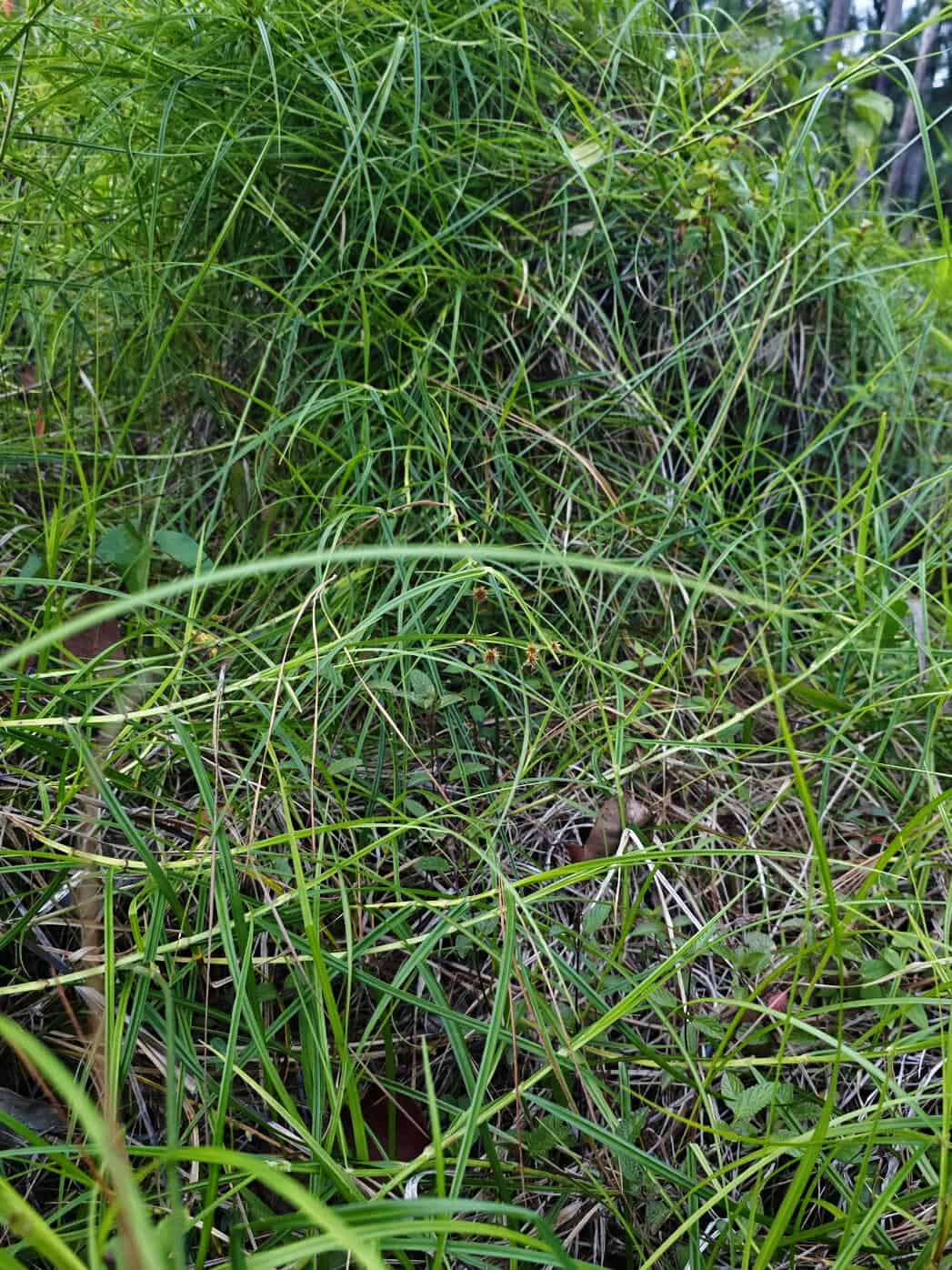
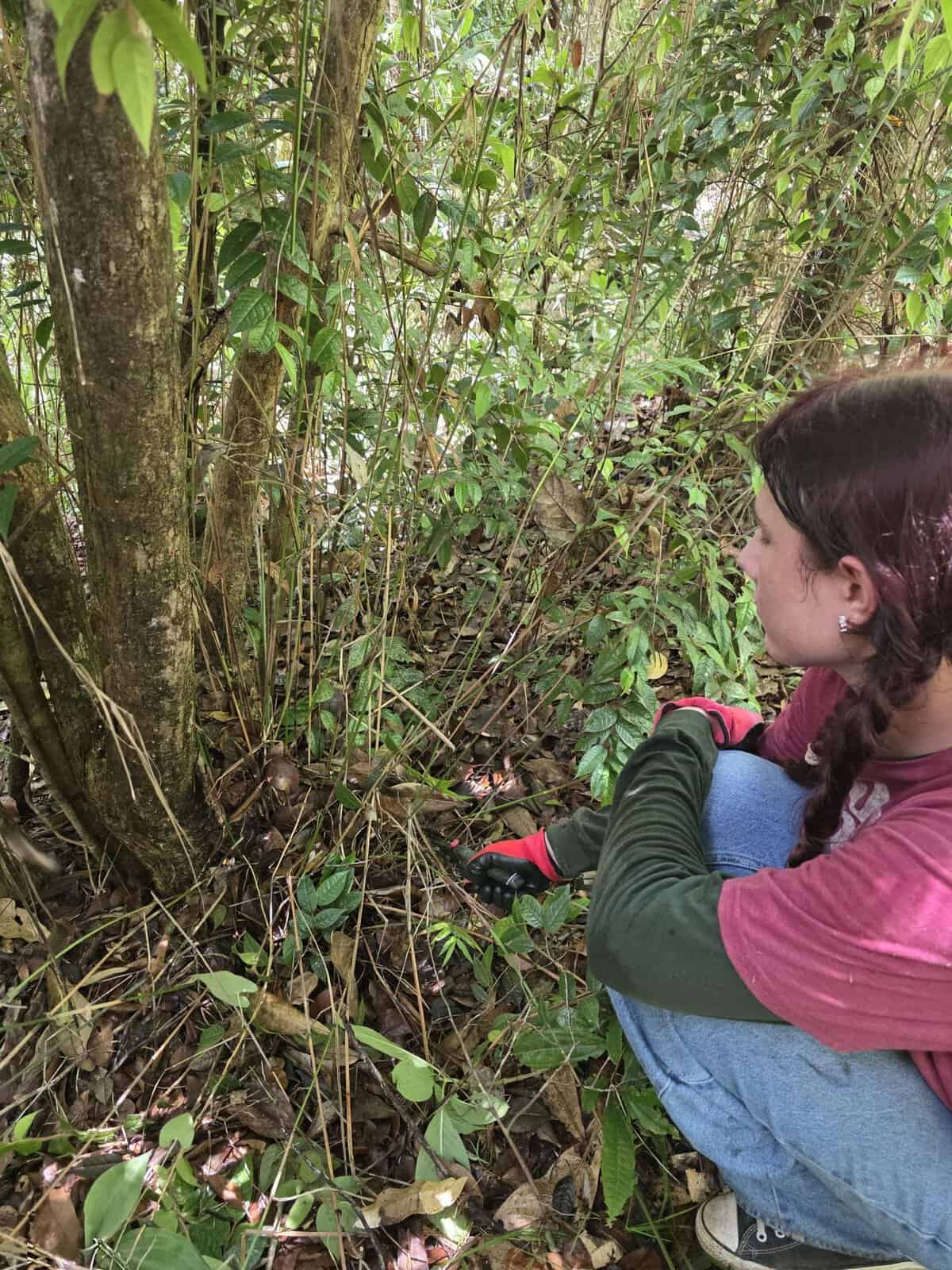
Scleria secans is a large, scrambling sedge native to tropical America. Unlike a true grass, it belongs to the sedge family, Cyperaceae. Its triangular stems and long leaves have razor-sharp, saw-like margins capable of cutting exposed skin—hence the fitting name “razor grass.”Scleria is a genus of approximately 200 flowering plant species, commonly known as nutrushes. They are found mainly throughout the tropics, although some species extend into temperate regions. The genus name comes from the Greek word for “hardness,” referring to the plants’ characteristically tough seeds.

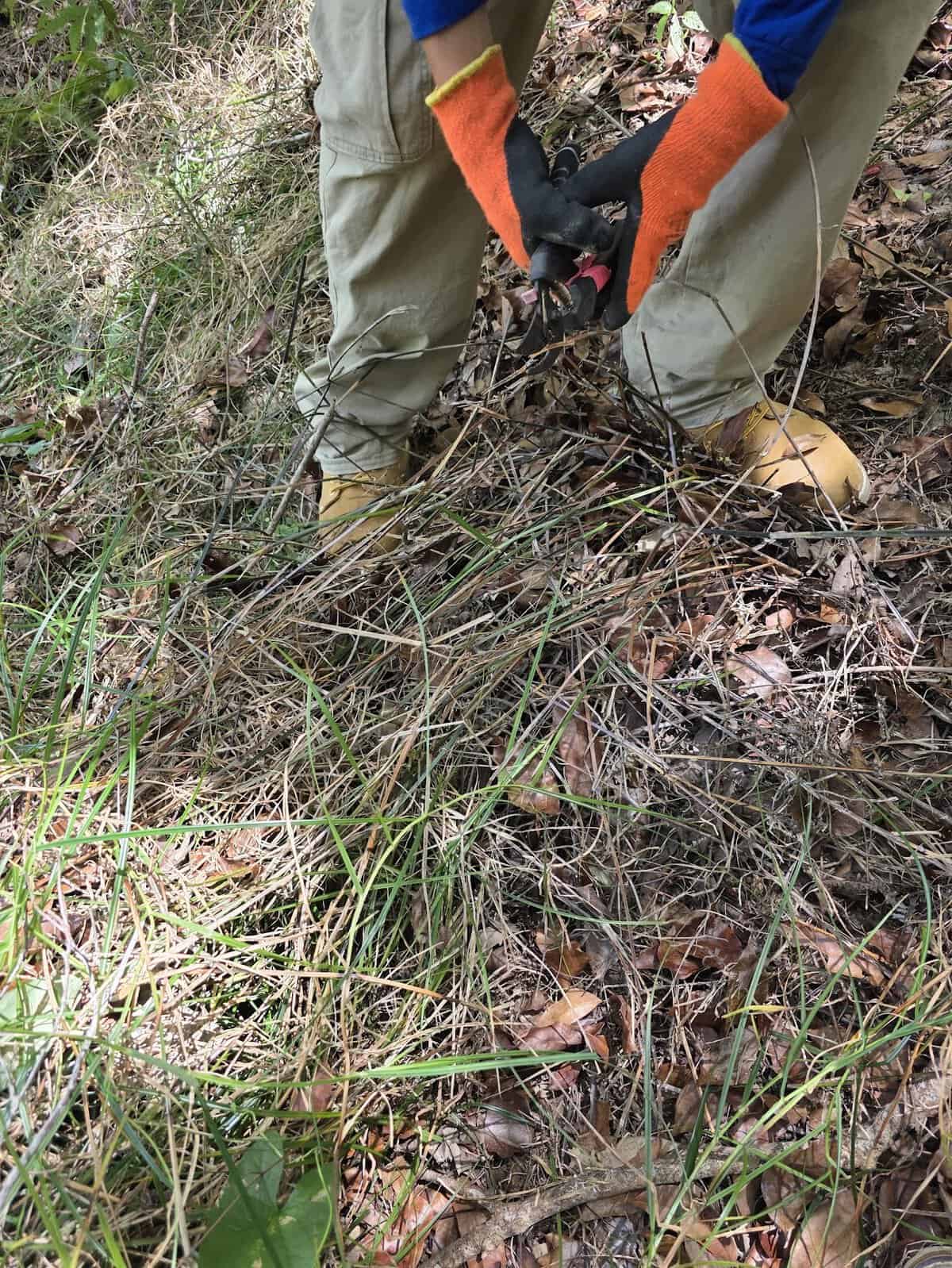
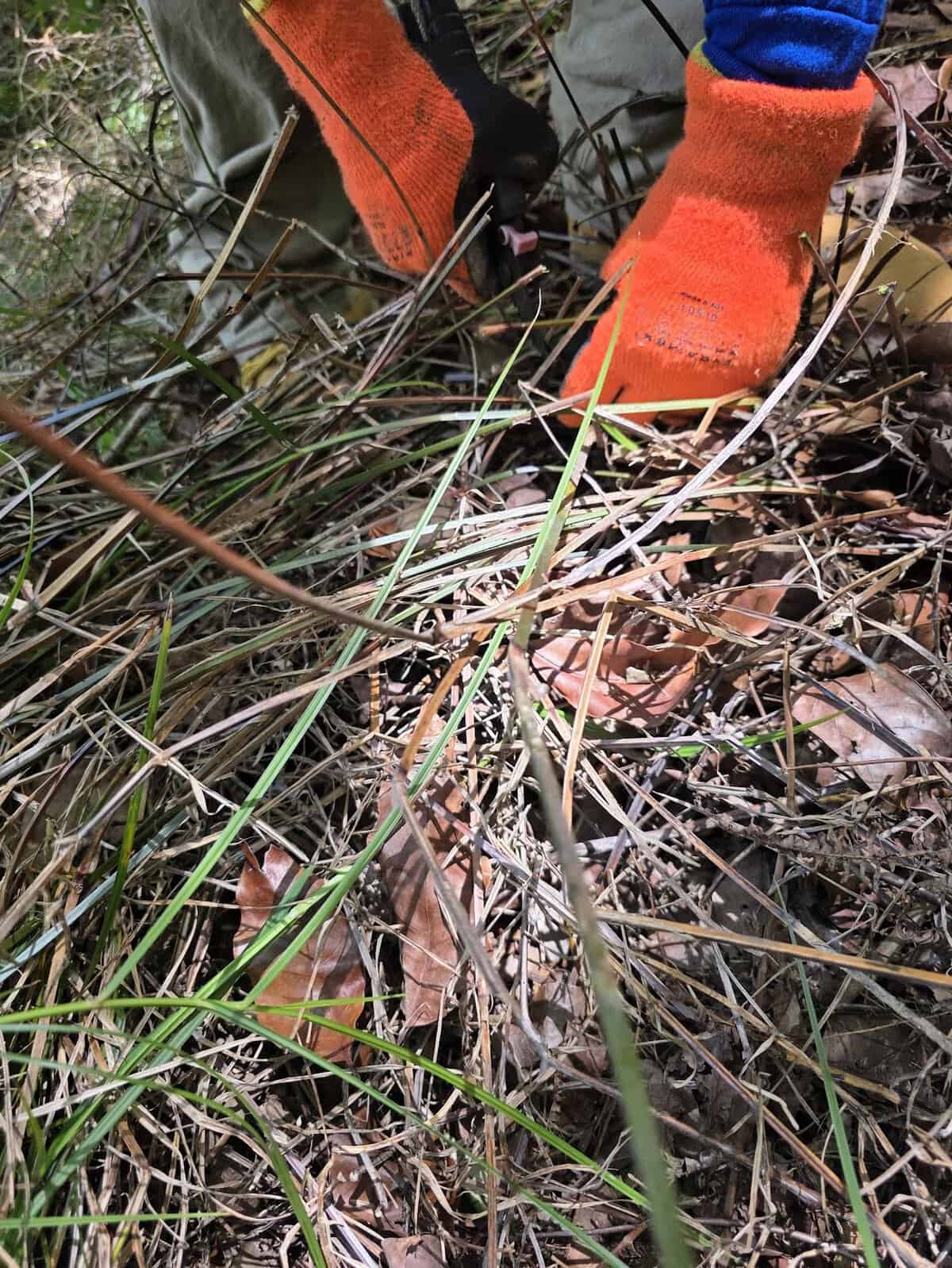
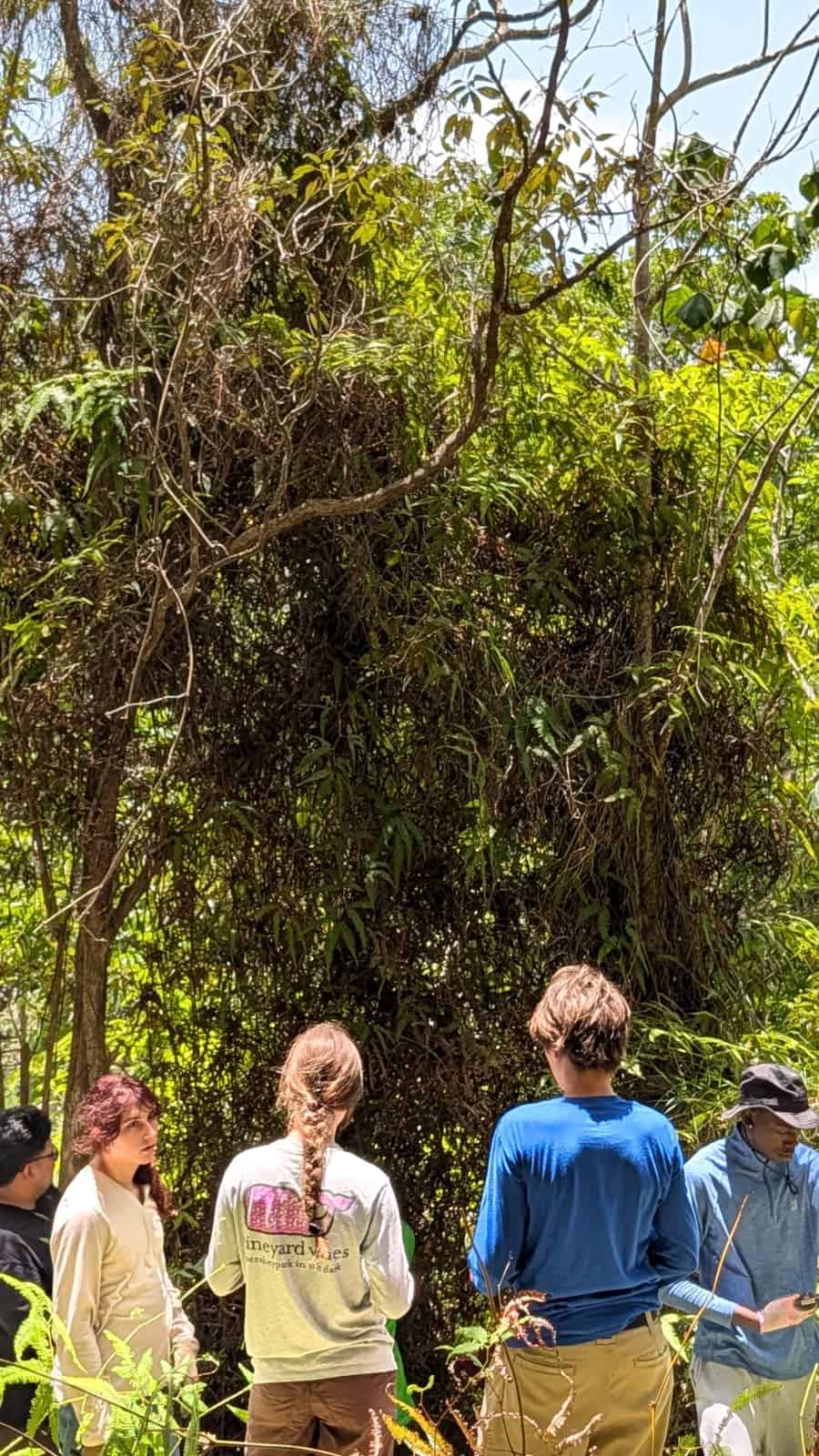
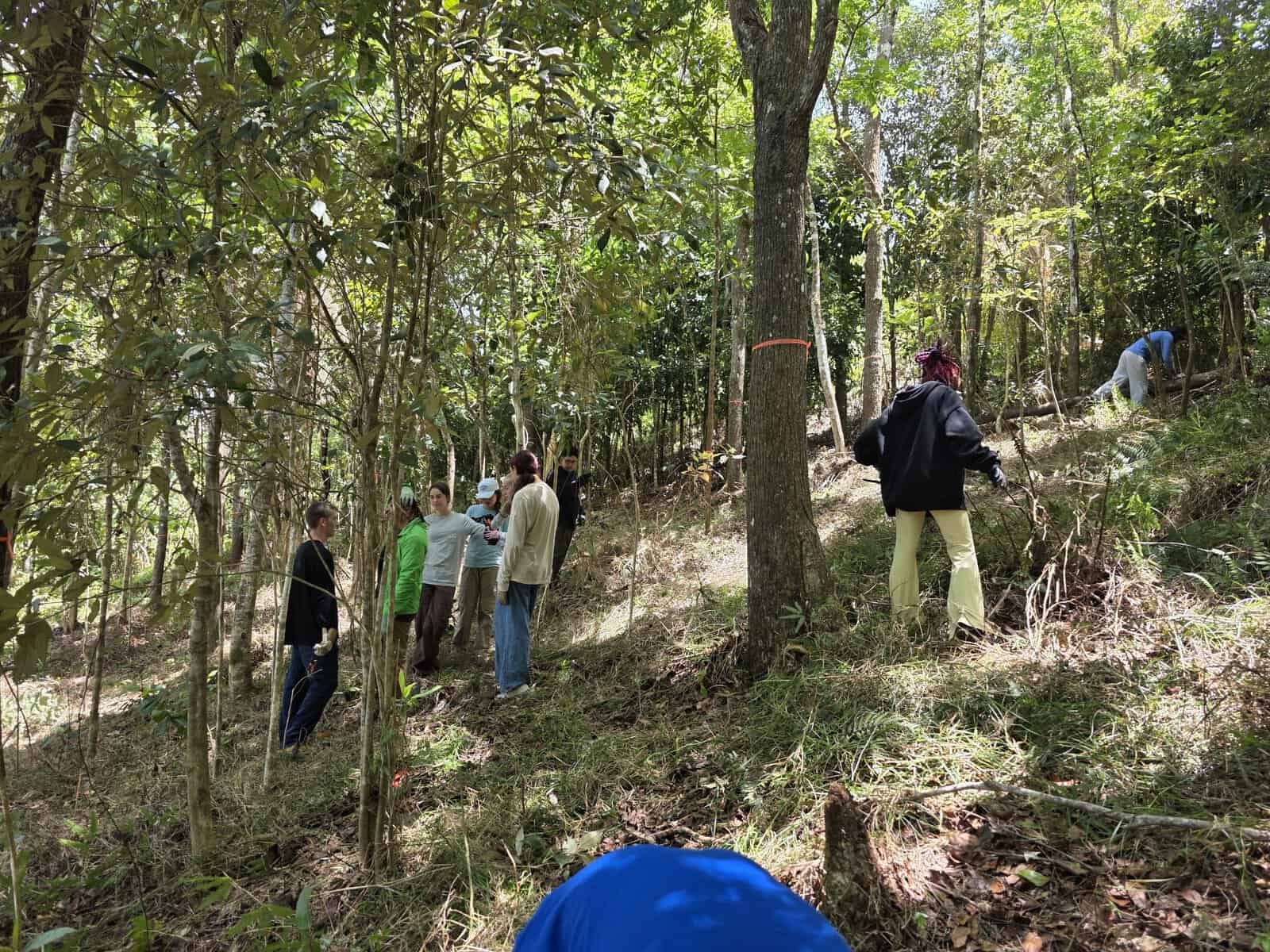
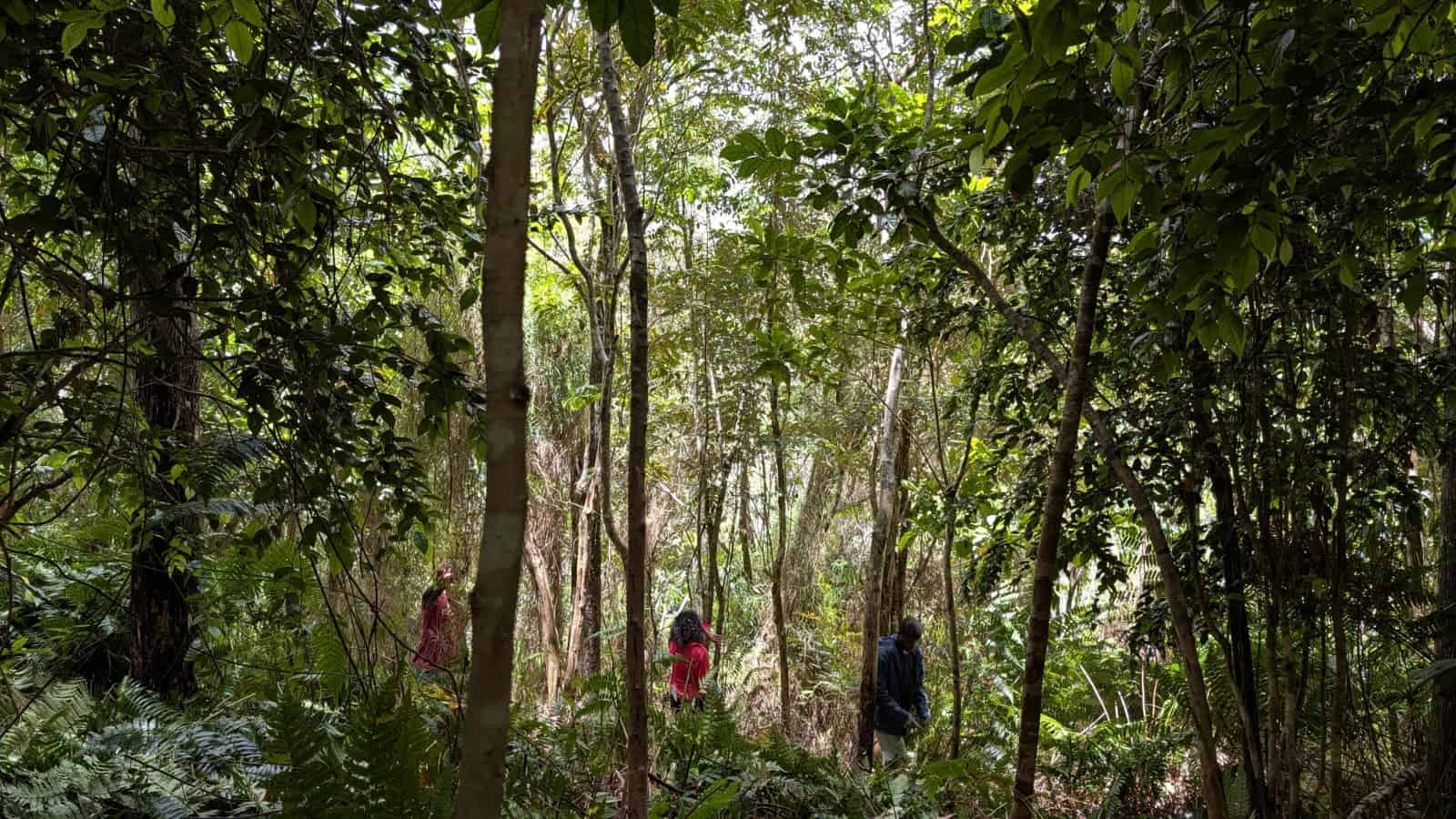
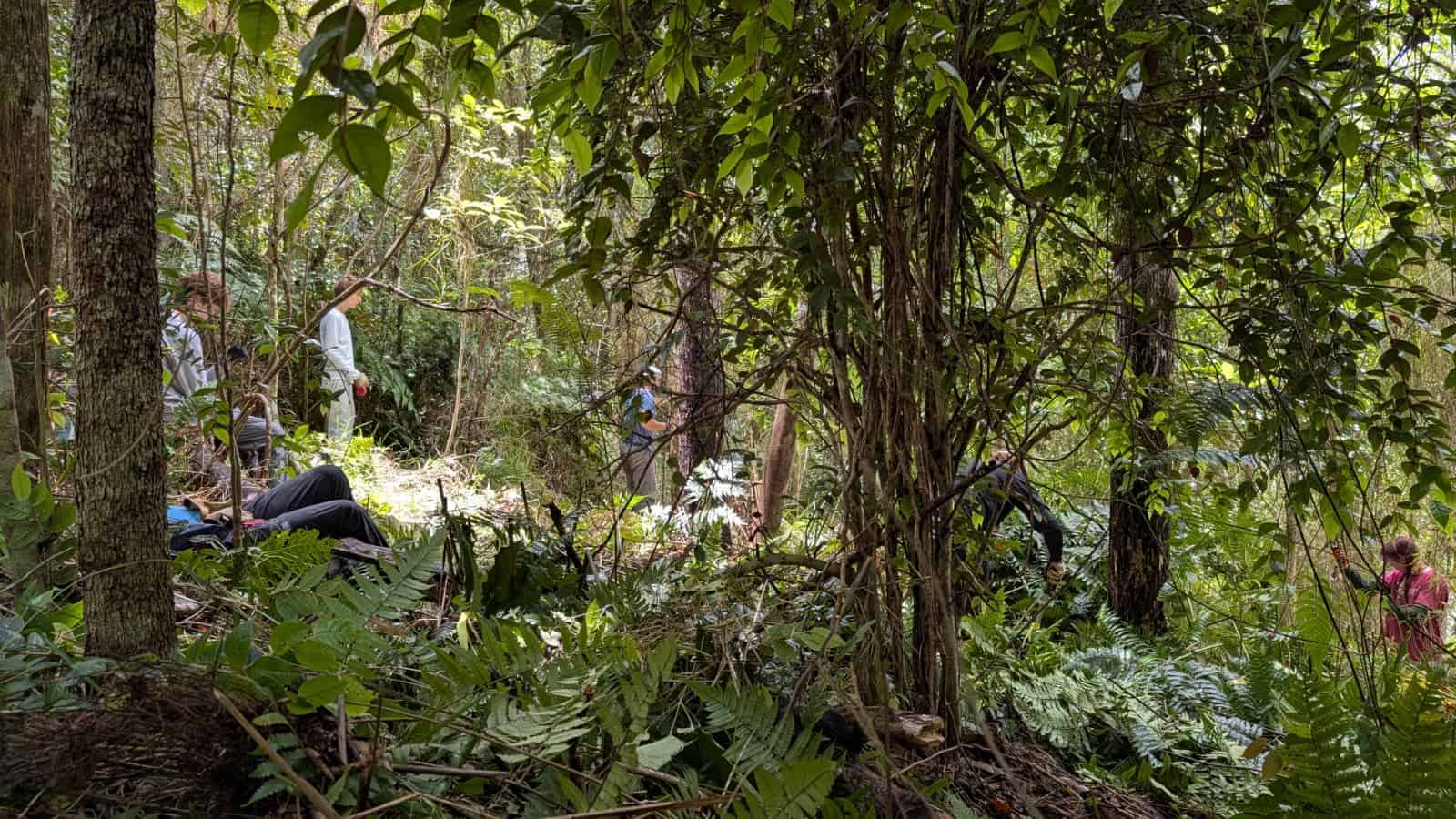
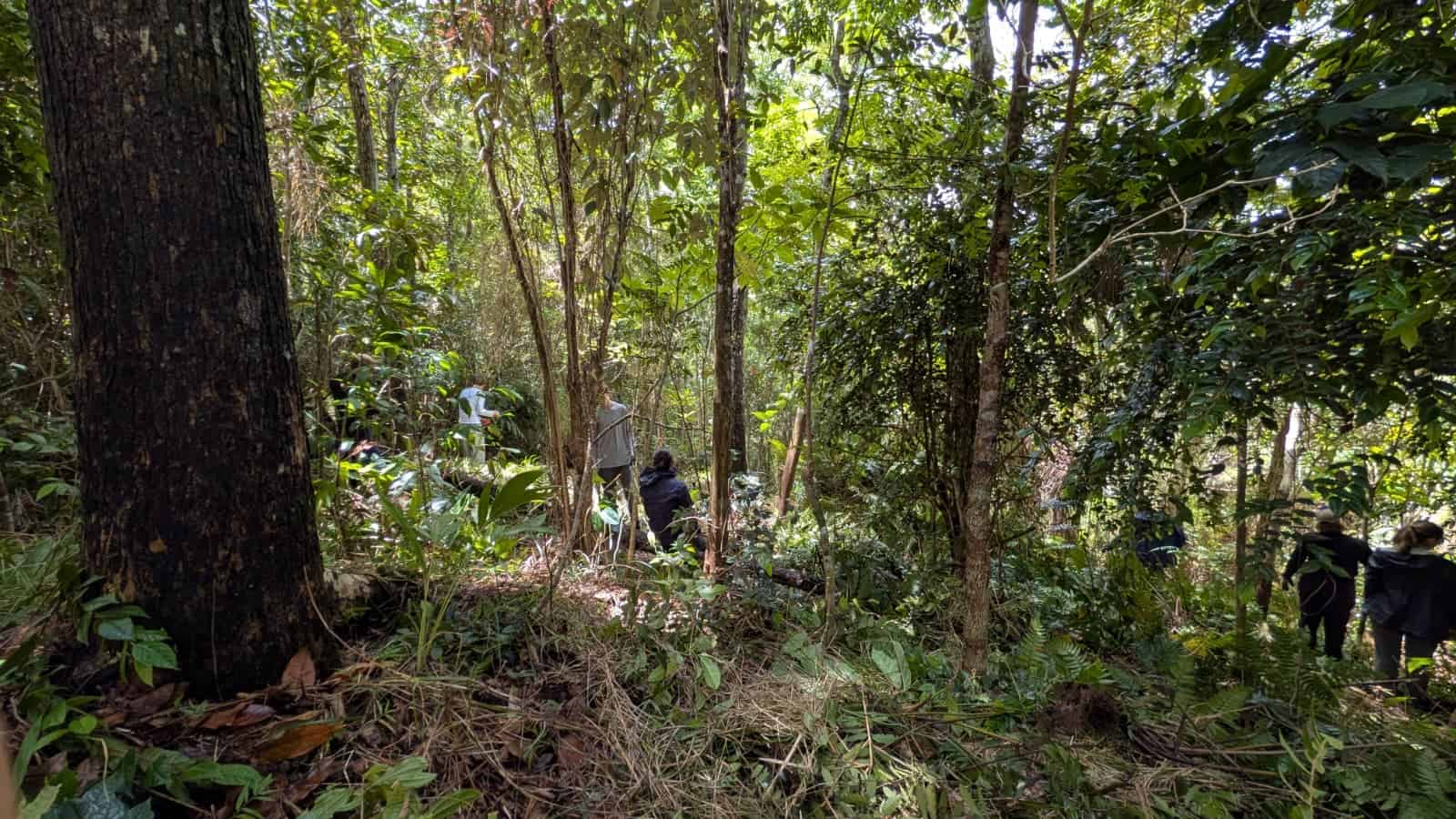
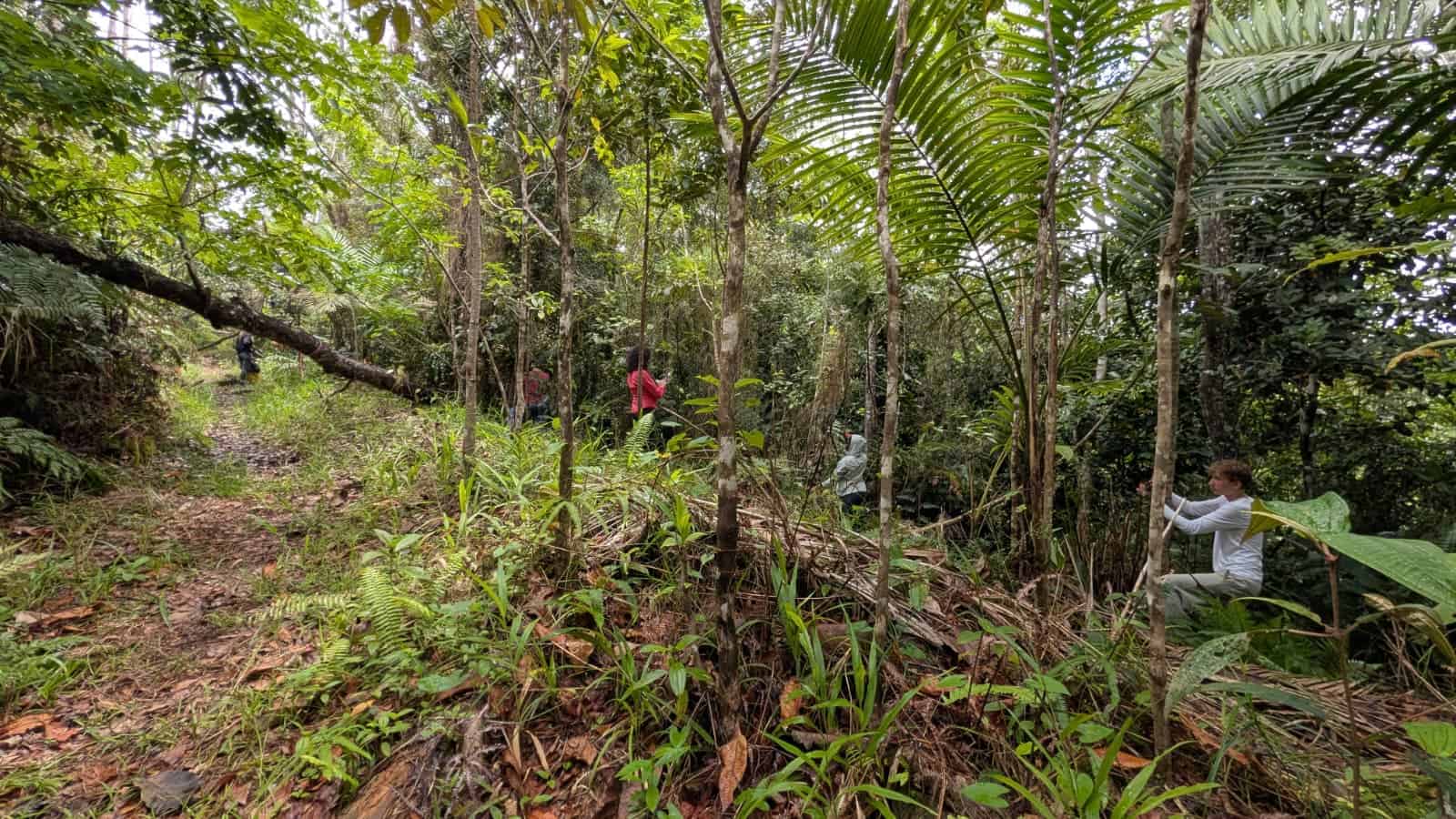
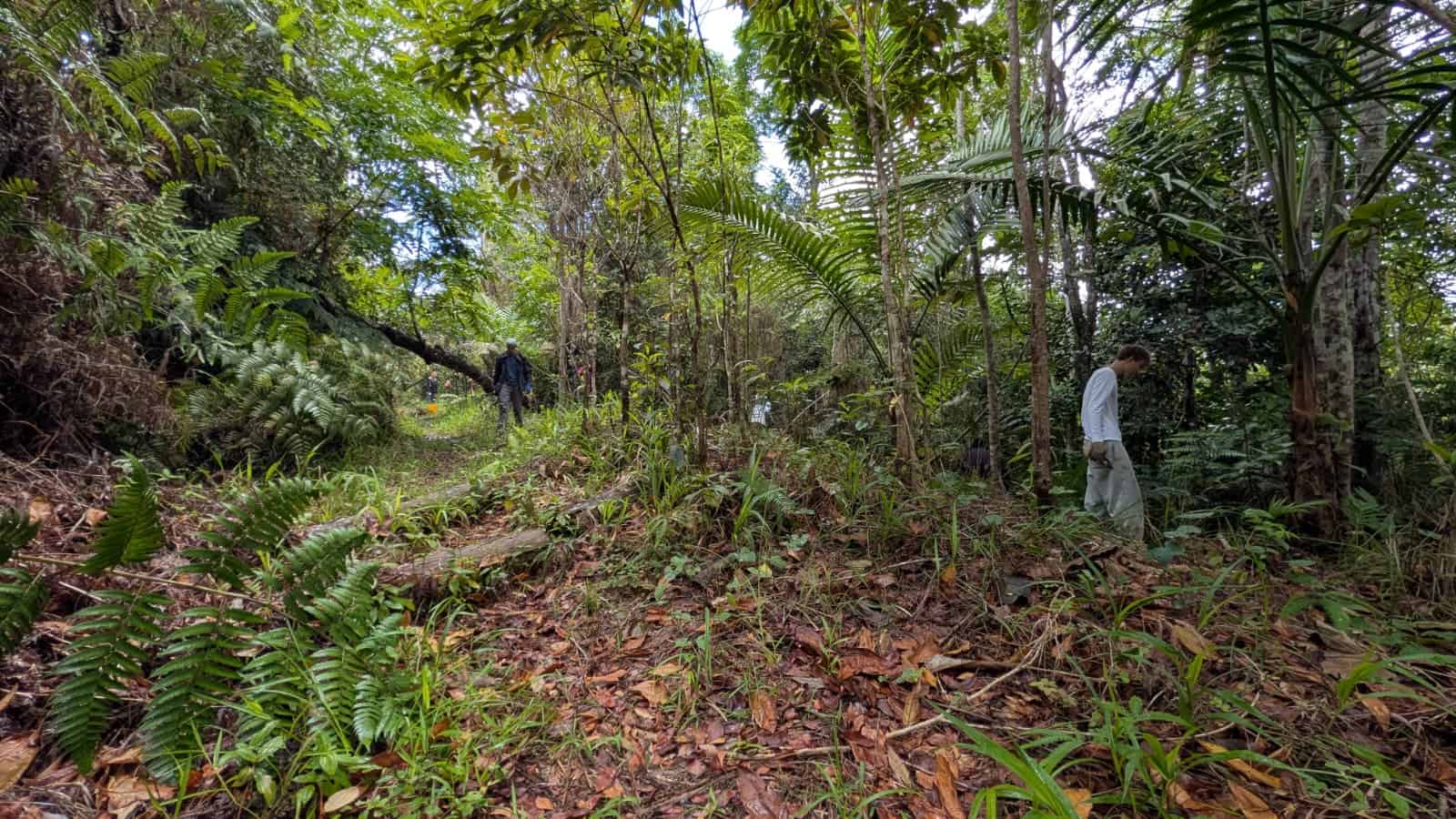
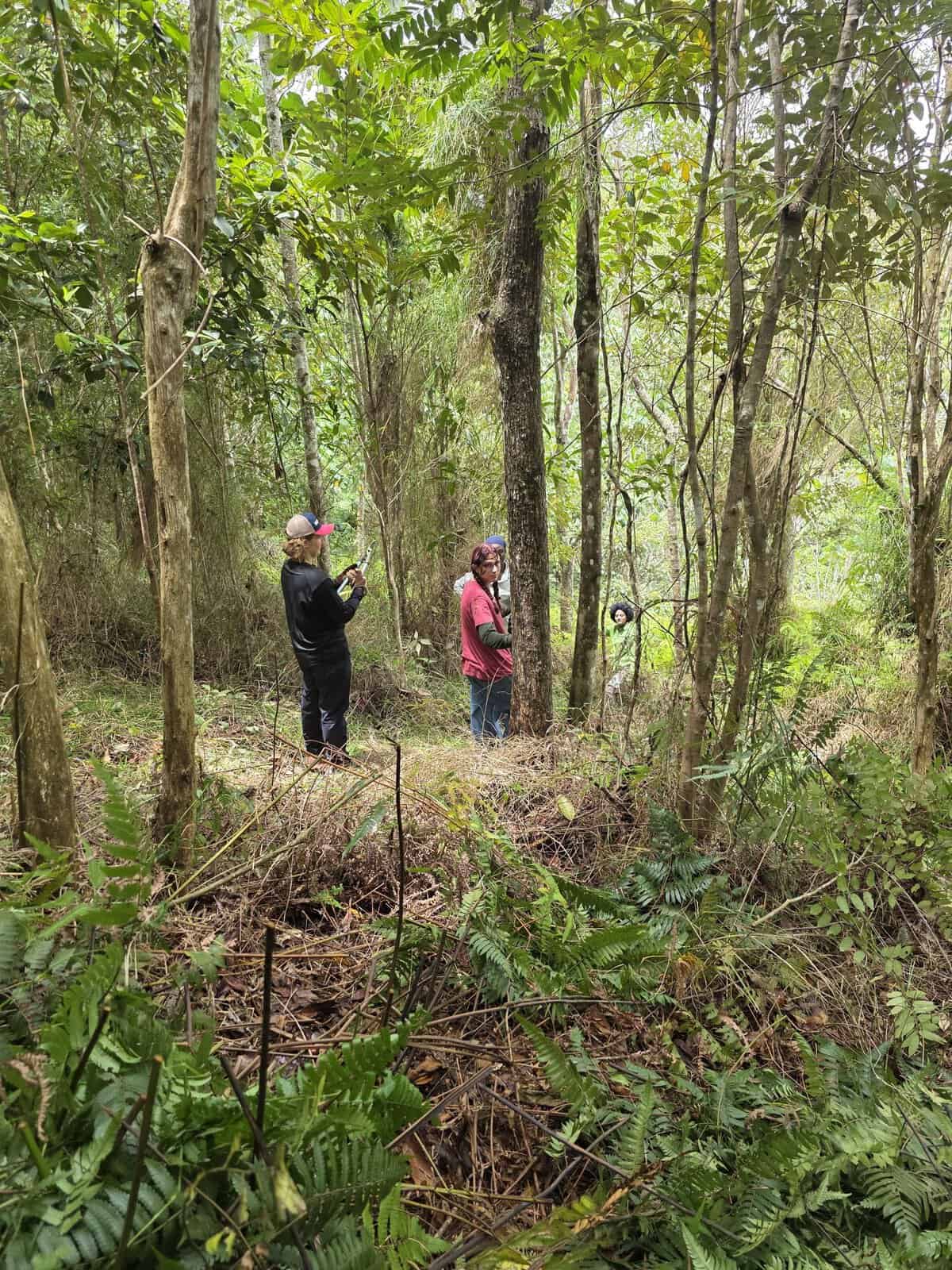
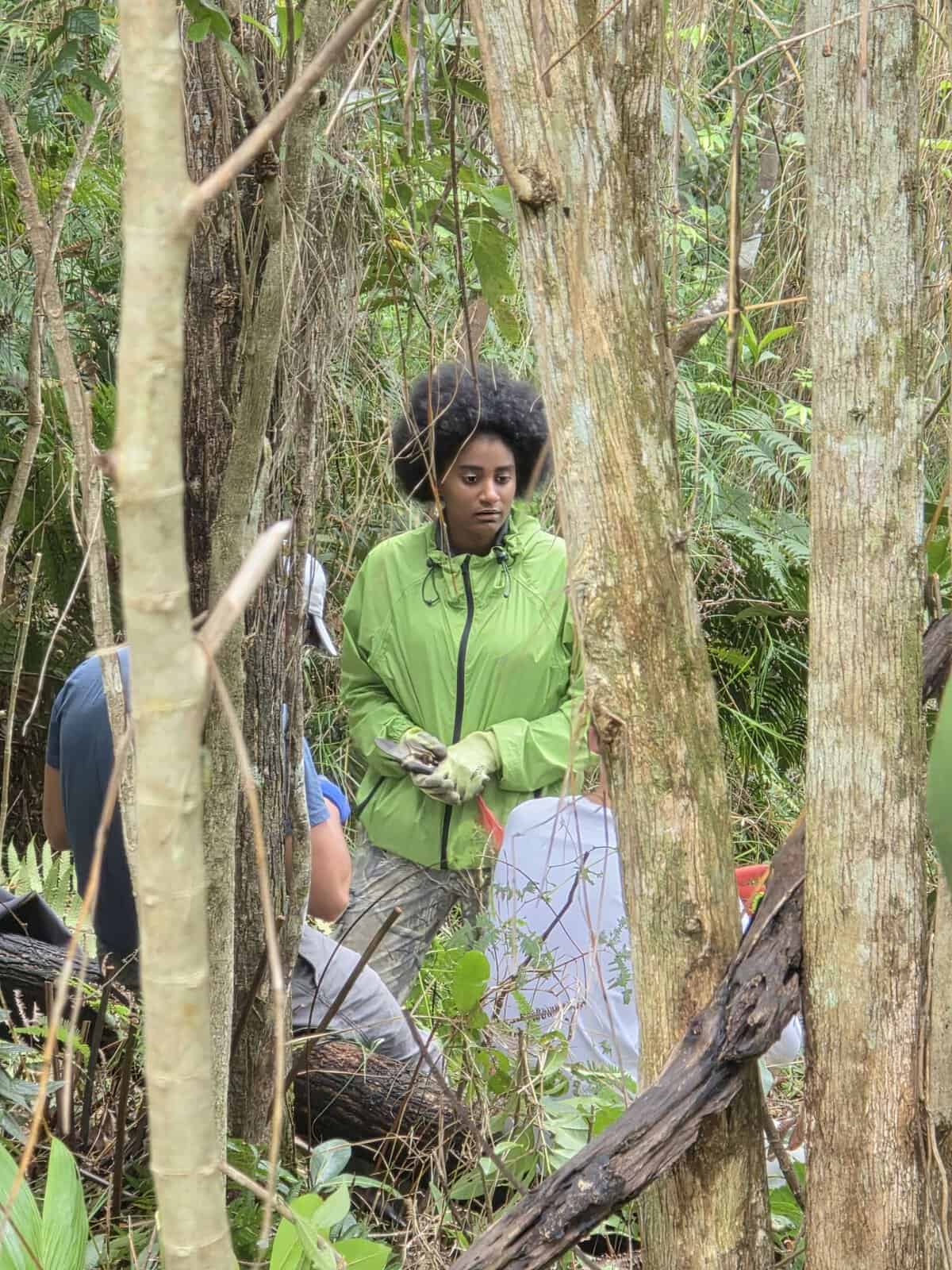
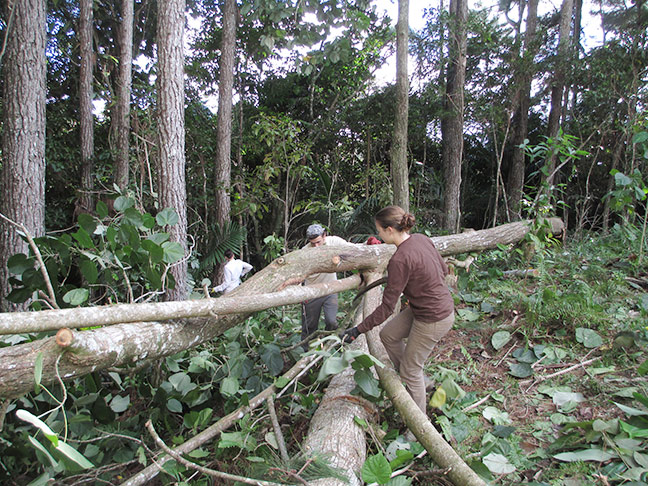
This time, we were no longer simply trying to find a way through. The goal was to begin clearing the razor grass from around the planted trees themselves, opening enough space to see the forest properly, assess the trees, and move safely through the area.The razor grass had occupied every available opening created by Hurricane Maria. Its long, sharp leaves tangled together with vines and other vigorous vegetation, concealing the ground and obscuring even substantial trees. Clearing it required patience and close teamwork. The teenagers worked steadily with gloves, loppers, and pruning shears, cutting carefully and passing the vegetation away from the trees.

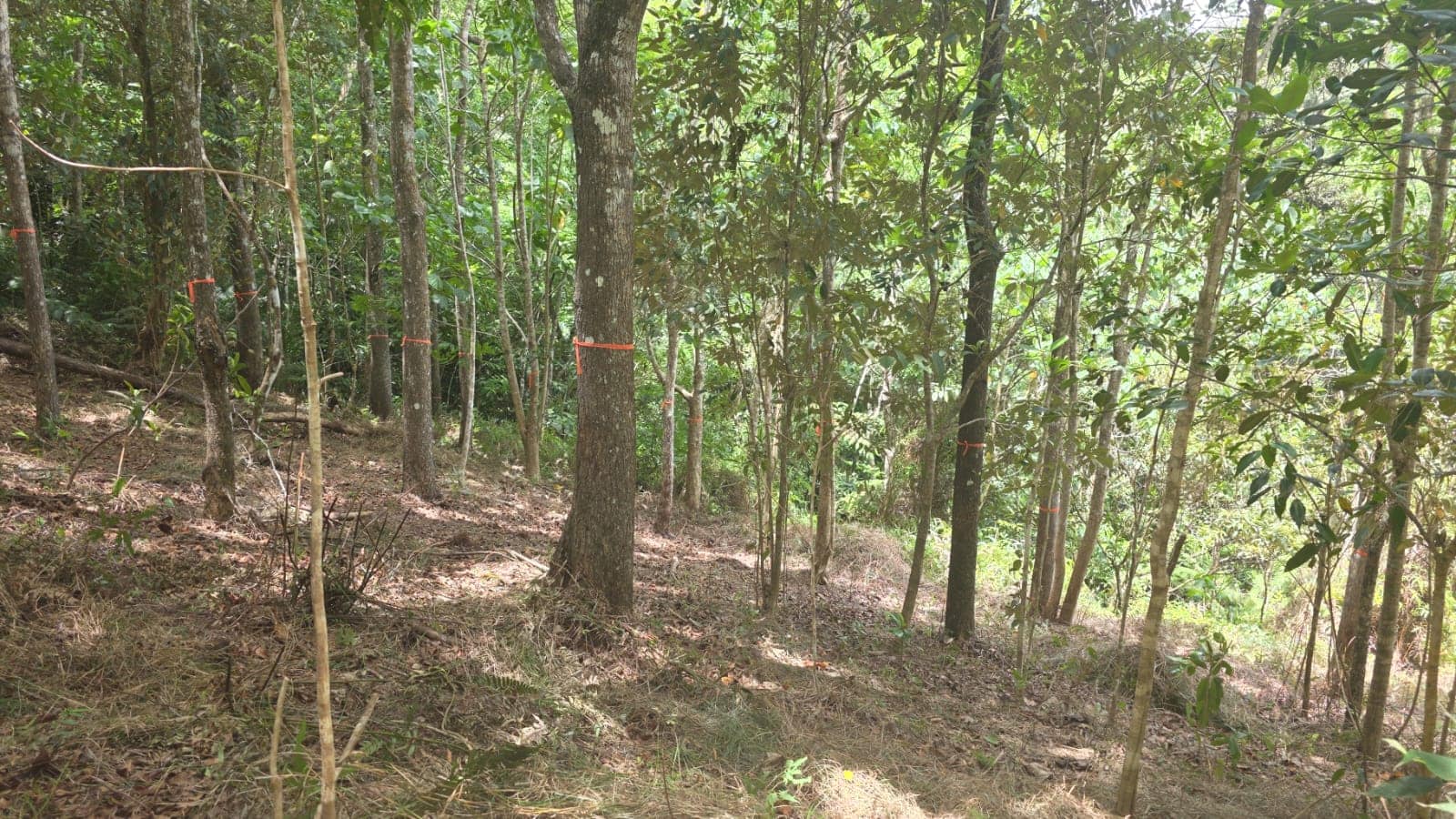
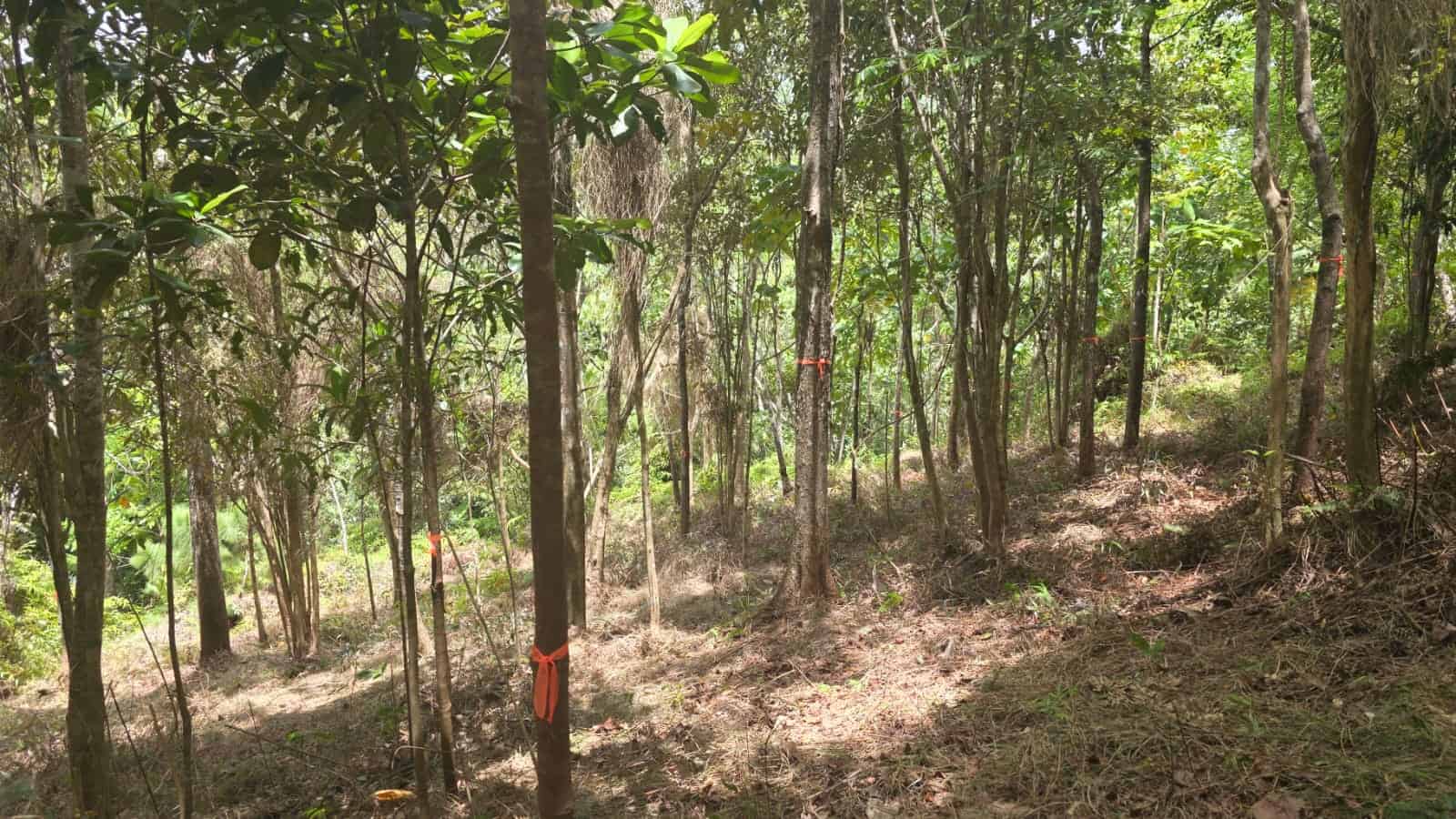
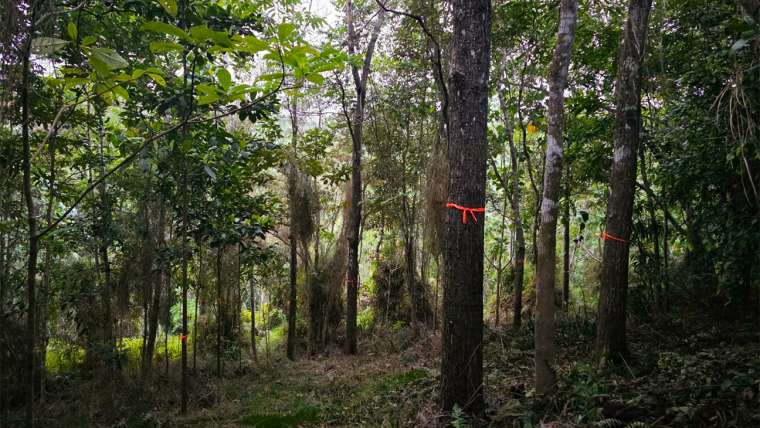
Little by little, the character of the place began to change. Individual tree trunks emerged from the tangled growth. Space opened between them. The steep contours of the hillside became visible again. We could finally look across an entire section of the planted forest rather than catching only brief glimpses through a wall of razor grass.

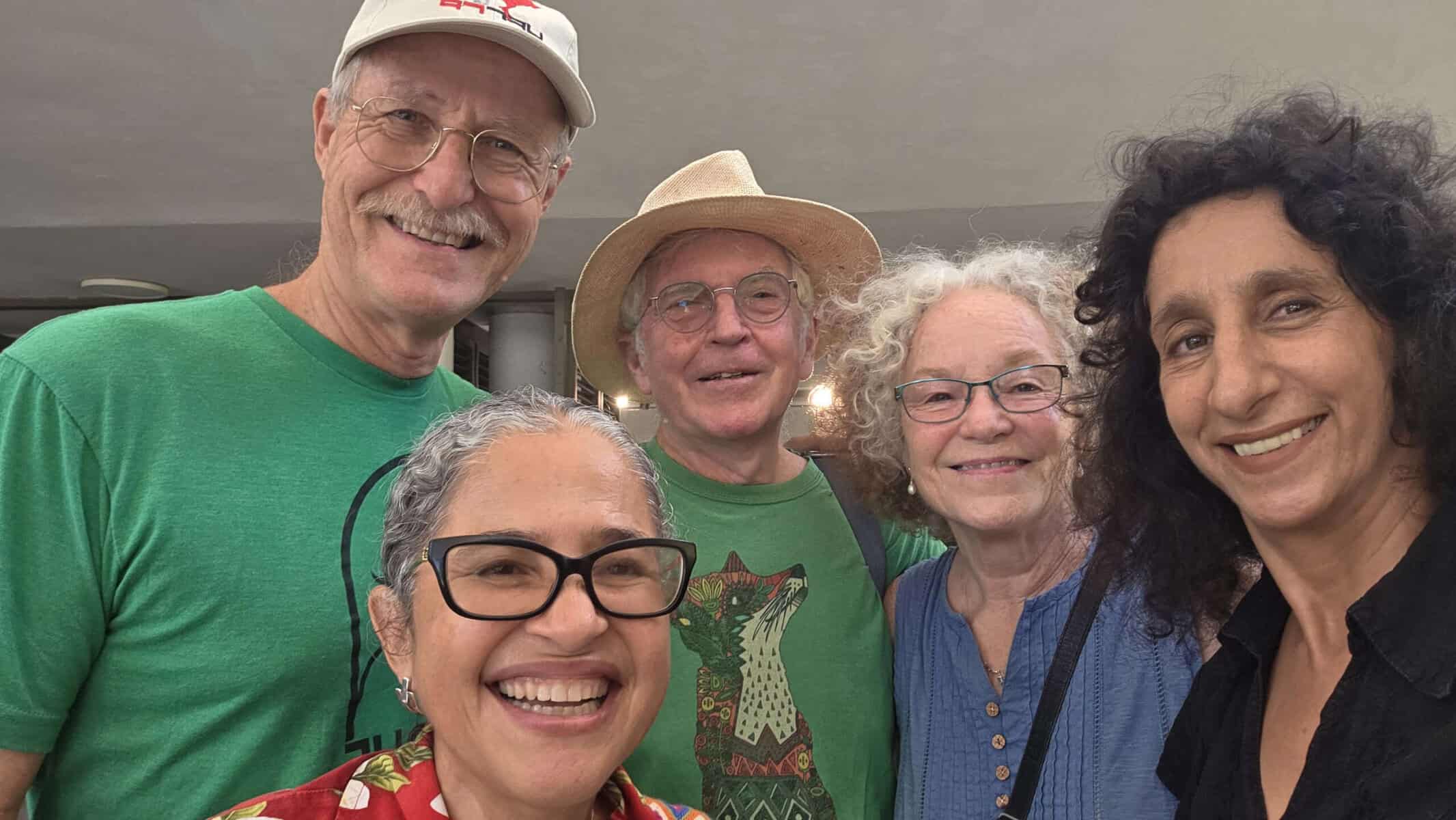
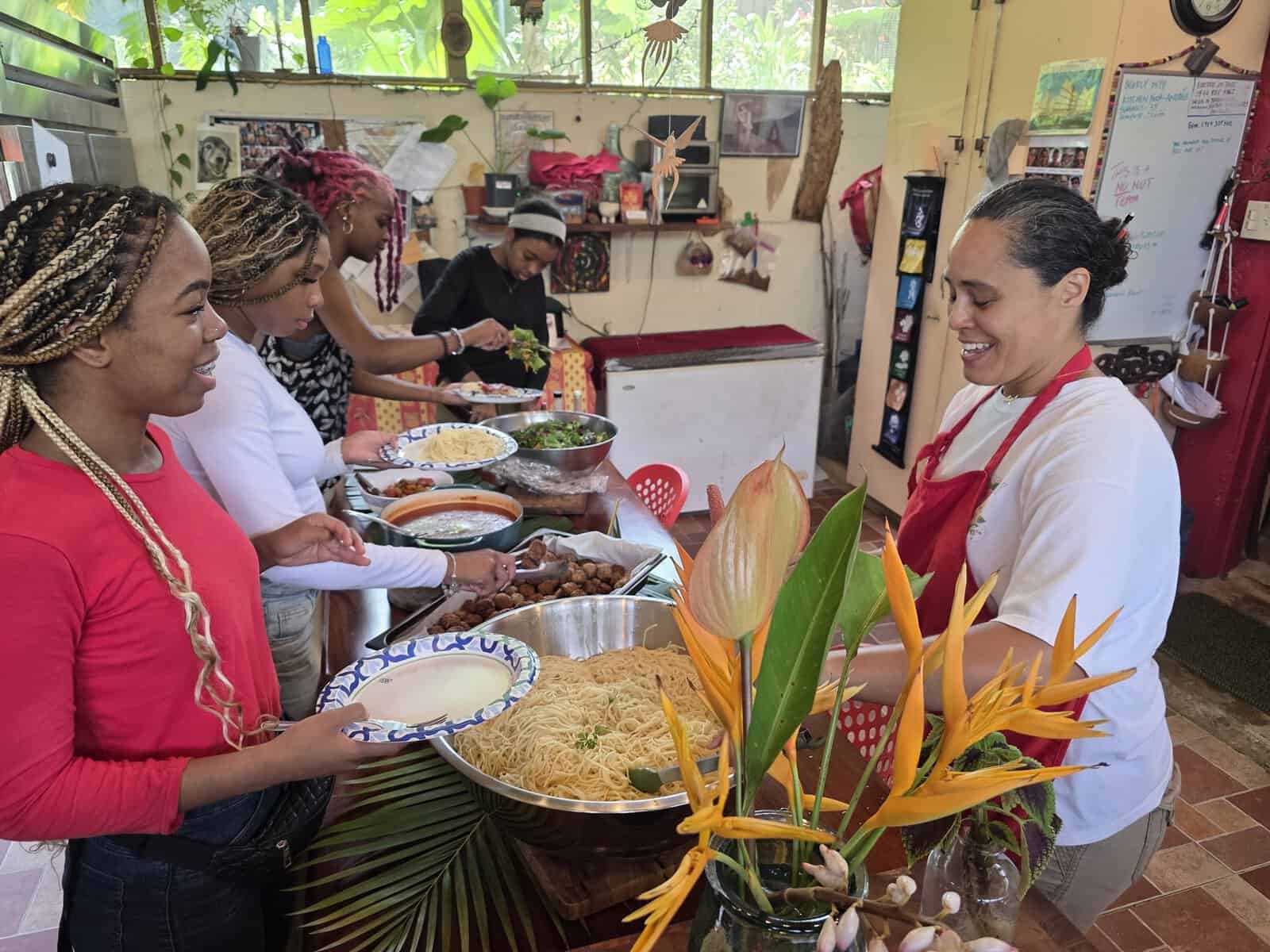
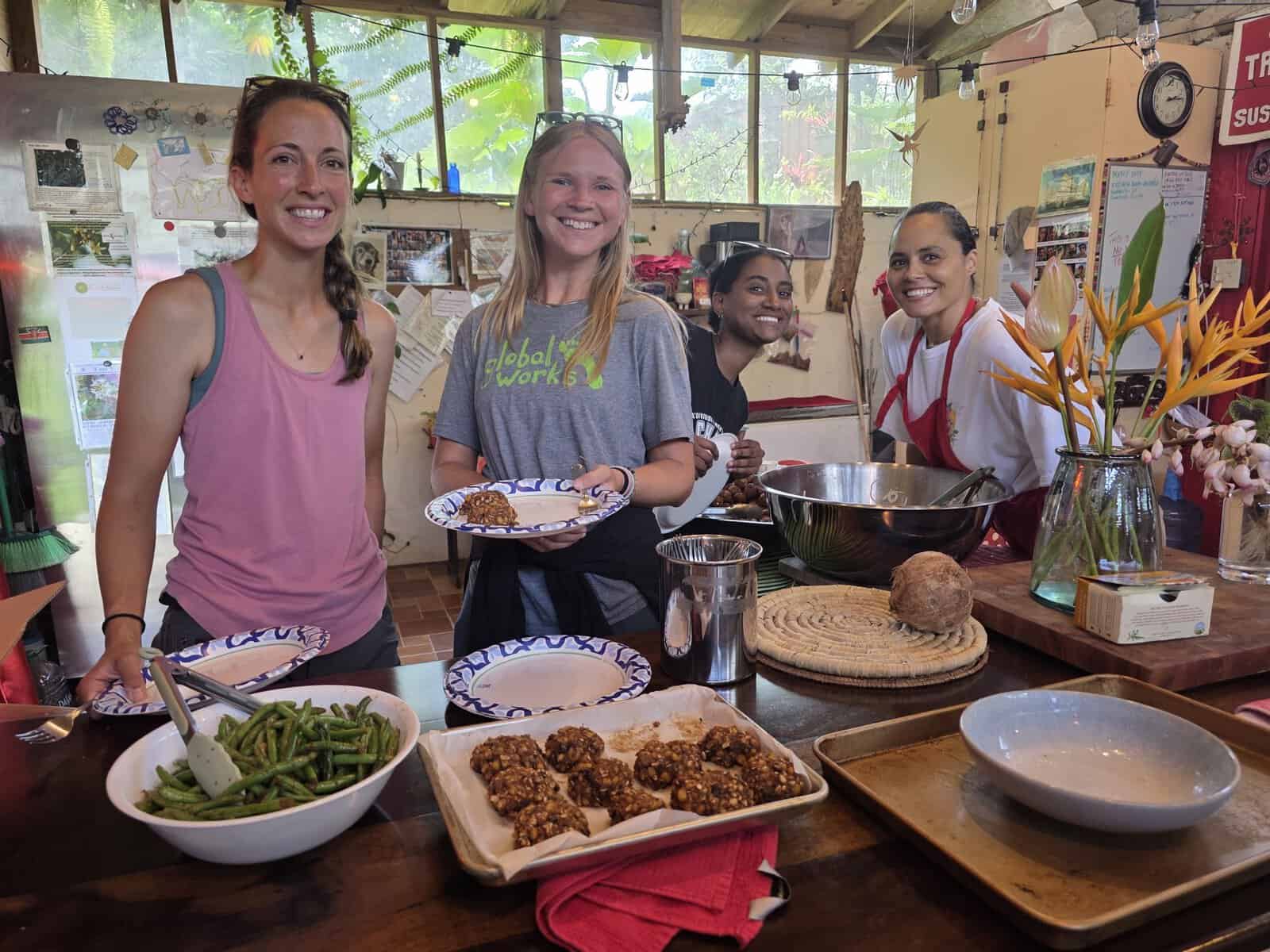
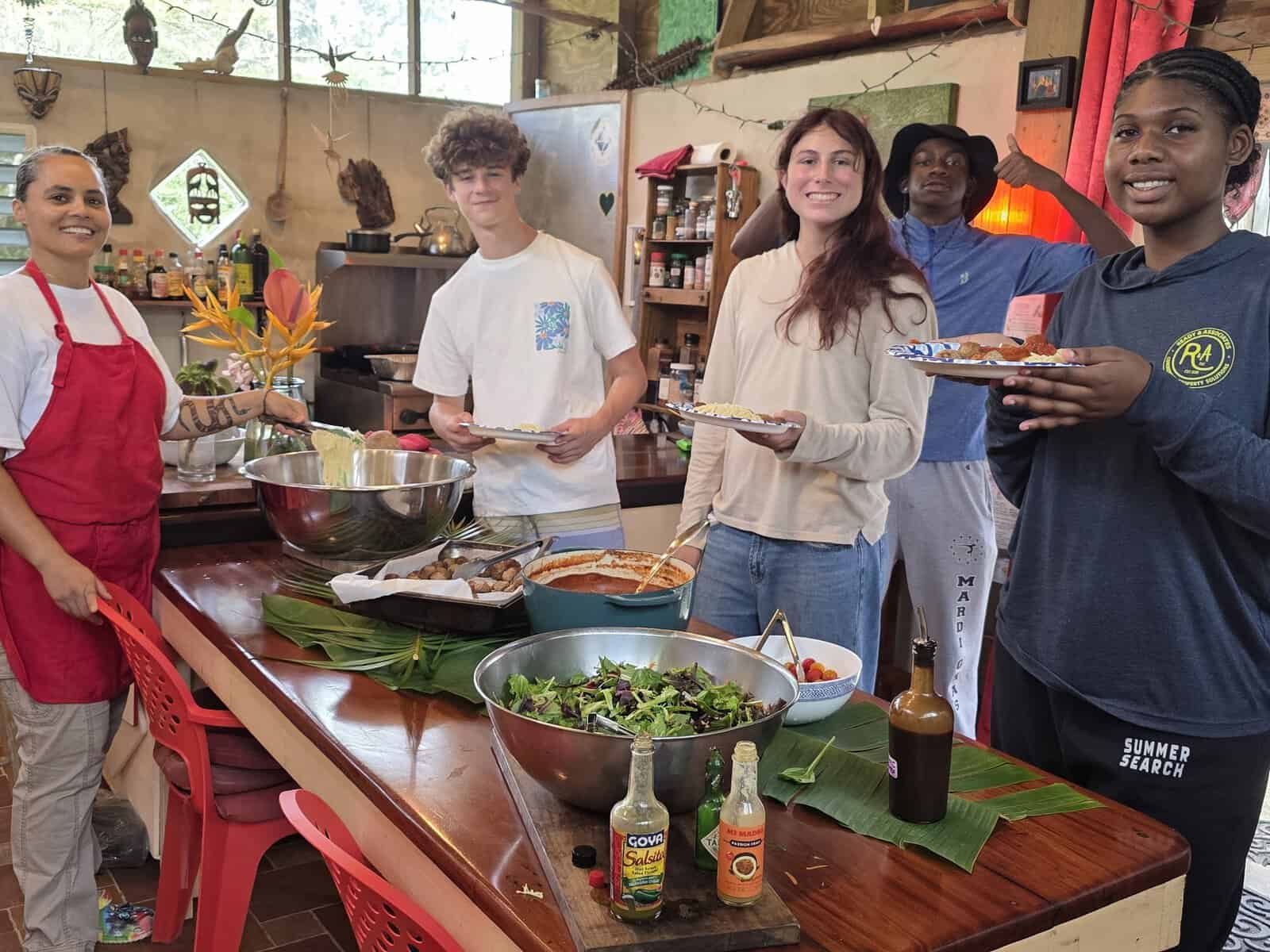
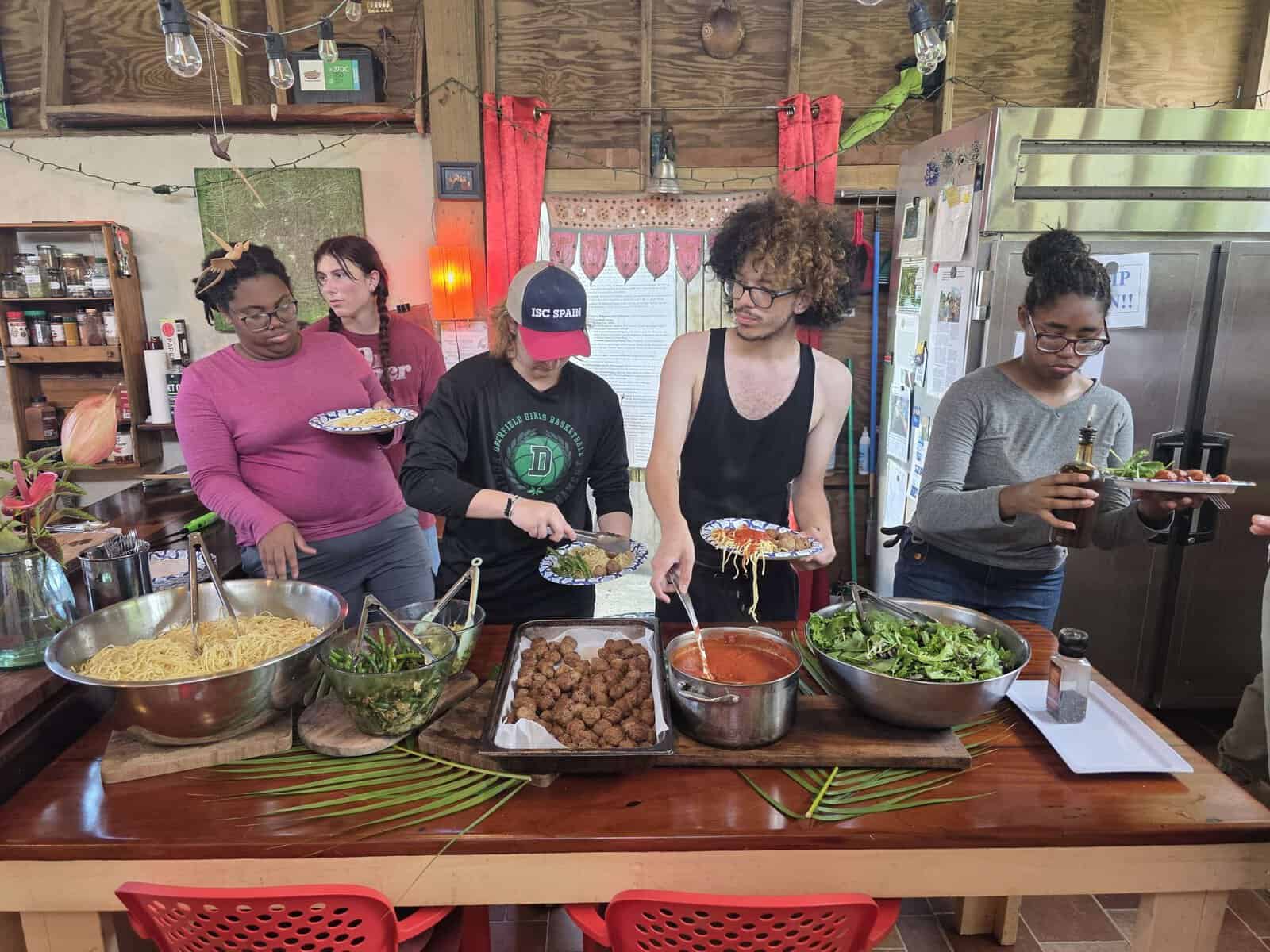
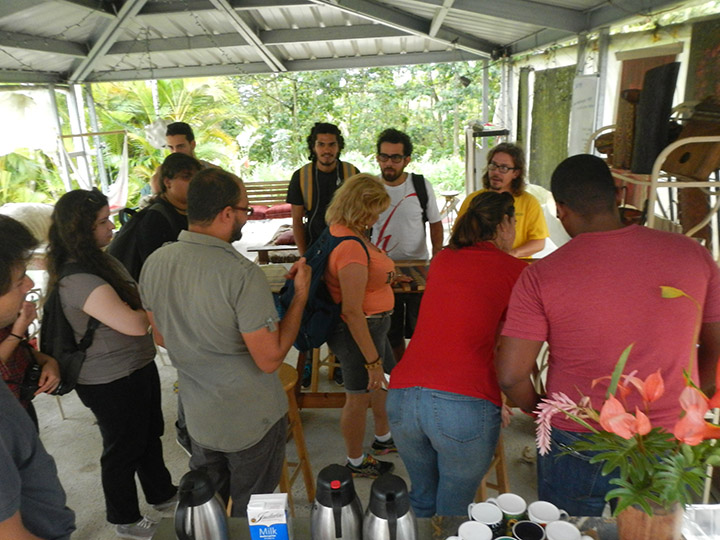
Our neighbor Mike Alvarez joined the team once again, as did local teenager Rio Collazo, who returned to lend her energy and enthusiasm to the day’s work. Monique Nieves was once again our chef, keeping the entire team well fed and restoring everyone’s energy after hours of demanding work in the forest. Her delicious food and generous care are always an essential part of these long volunteer days.

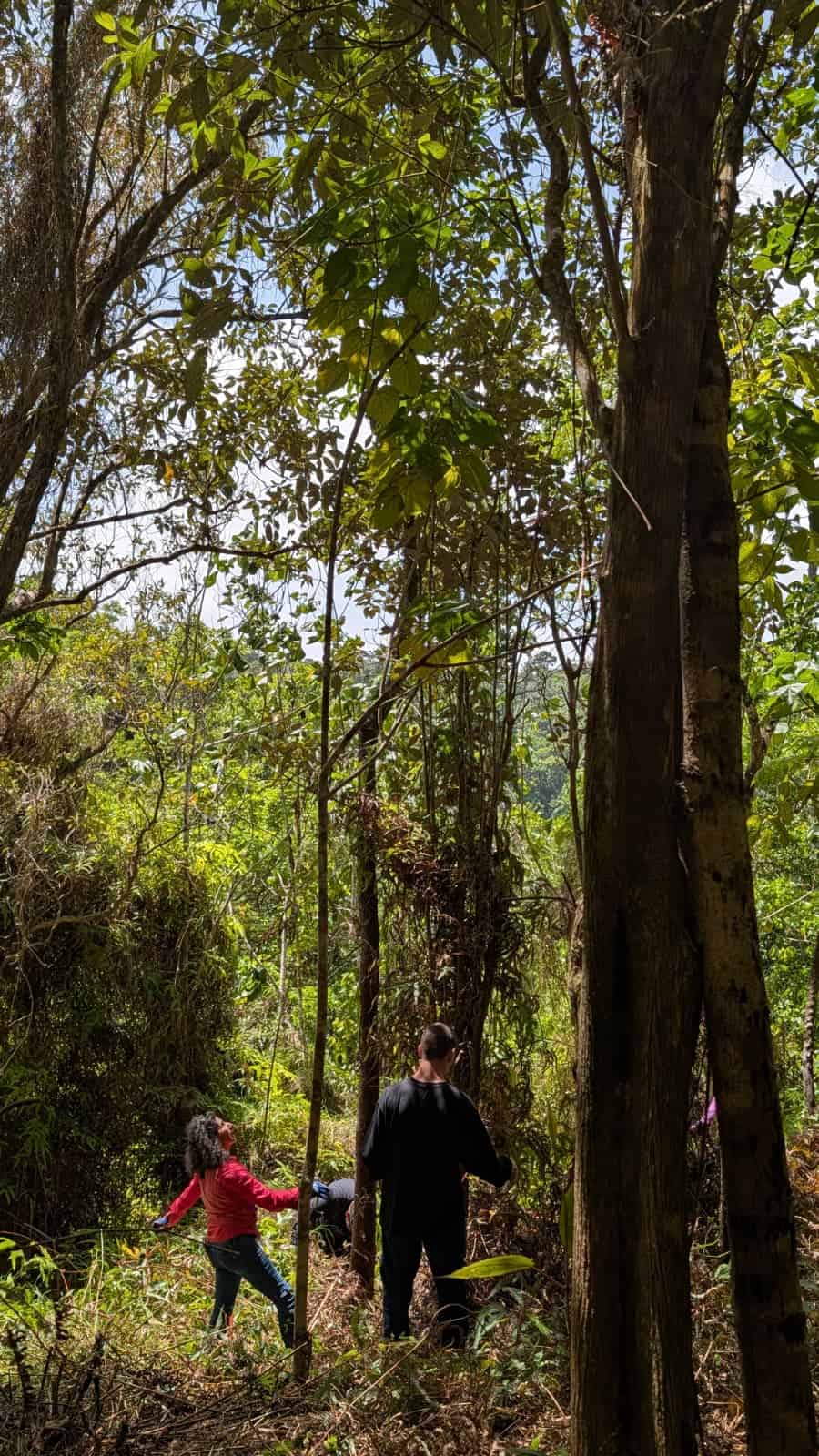
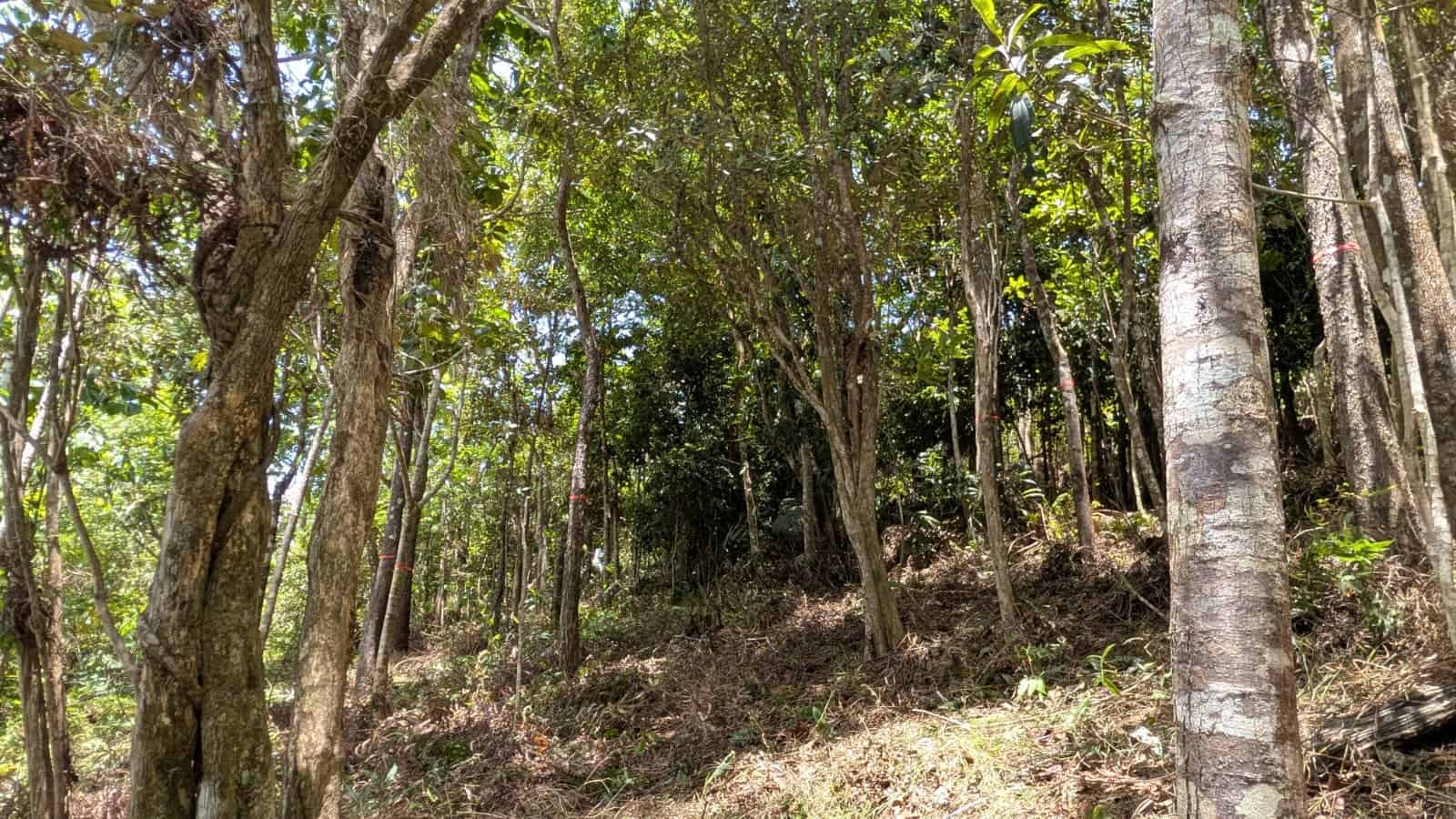
By the end of the day, a whole area was clear. For the first time in years, we could stand back and see the forest. Our planted trees now stood visibly among the naturally regenerating forest. Some had grown tall and straight; others had adapted to storms, competition, and changing light. Around them were ferns, mosses, fungi, young native trees, and the remains of fallen trunks slowly returning to the soil.The work did more than make the area look clearer.

Removing the dense grass and vines gave us access to inspect the planted trees, monitor their condition, and identify where future stewardship will be needed. It also reopened space for the forest canopy to continue closing over the site. As shade increases, the sun-loving razor grass should gradually lose some of its advantage.

There was something deeply satisfying about seeing this progression across two Global Works teams. The first group made the breakthrough and brought us back to the trees. The second carried the work forward, expanding the opening until a hidden plantation became a visible forest once again.The teenagers may have arrived seeing a hillside covered in difficult vegetation.

By the end of the day, they could see the result of their collective effort: a real and dramatic transformation.This is how long-term forest stewardship happens. One tree is planted. Years pass. Storms intervene. Trails disappear. Then many hands return—cutting, clearing, observing, and caring—and another chapter in the life of the forest begins.The razor grass had hidden this place for years. Now, at last, we can see the forest beyond it.

Photos by Mike Alvarez and 3t Vakil, 11 July 2026
Globalworks Teen Team: Beyond the razor grass! 29th June 2026
Beyond the Razor grass: a reunion in the rainforest

There are places in the forest that become almost mythical. You know they are there. You remember planting the trees, carrying saplings carefully on slopes, and imagining what the forest might look like years into the future. But then time, storms, and circumstance create barriers, and those places slip beyond reach.

One such place exists at Las Casas de la Selva. Following Hurricane Maria, the forest changed dramatically. Vast areas lost much of their canopy, and suddenly sunlight poured onto the forest floor. Nature, of course, does not leave empty spaces unoccupied for long. A profusion of sun-loving plants surged upward, among them one of our most formidable adversaries: razor grass.

Razor grass (Scleria secans), is aptly named. Its leaves are sharp enough to cut exposed skin, and it forms dense, tangled masses that can become nearly impenetrable. Along with other vigorous grasses and vines, it quickly reclaimed the disturbed areas of the forest. Trails vanished. Landmarks disappeared. Slopes we had once visited regularly became hidden behind walls of green.

One of these lost places was a hillside which had been planted with Ausubo, Mahogany and Blue Mahoe back in the late 80s and where, in my era, we had planted trees in the growing forest in 2000, 2001, 2007, 2008, and 2009. On those steep slopes, we had planted more mahoganies, more ausubos, and mahoe trees, believing that one day they would become part of the next generation of forest. And after Hurricane Maria in 2017, we simply could not get back in. Years passed.

The trees continued growing somewhere beyond the razor grass. We wondered about them often. Had they survived? Had they been overtaken by vines? Had landslides damaged the site? Were there still trees standing where we had once planted saplings no taller than us? This summer, we finally had the opportunity to find out.

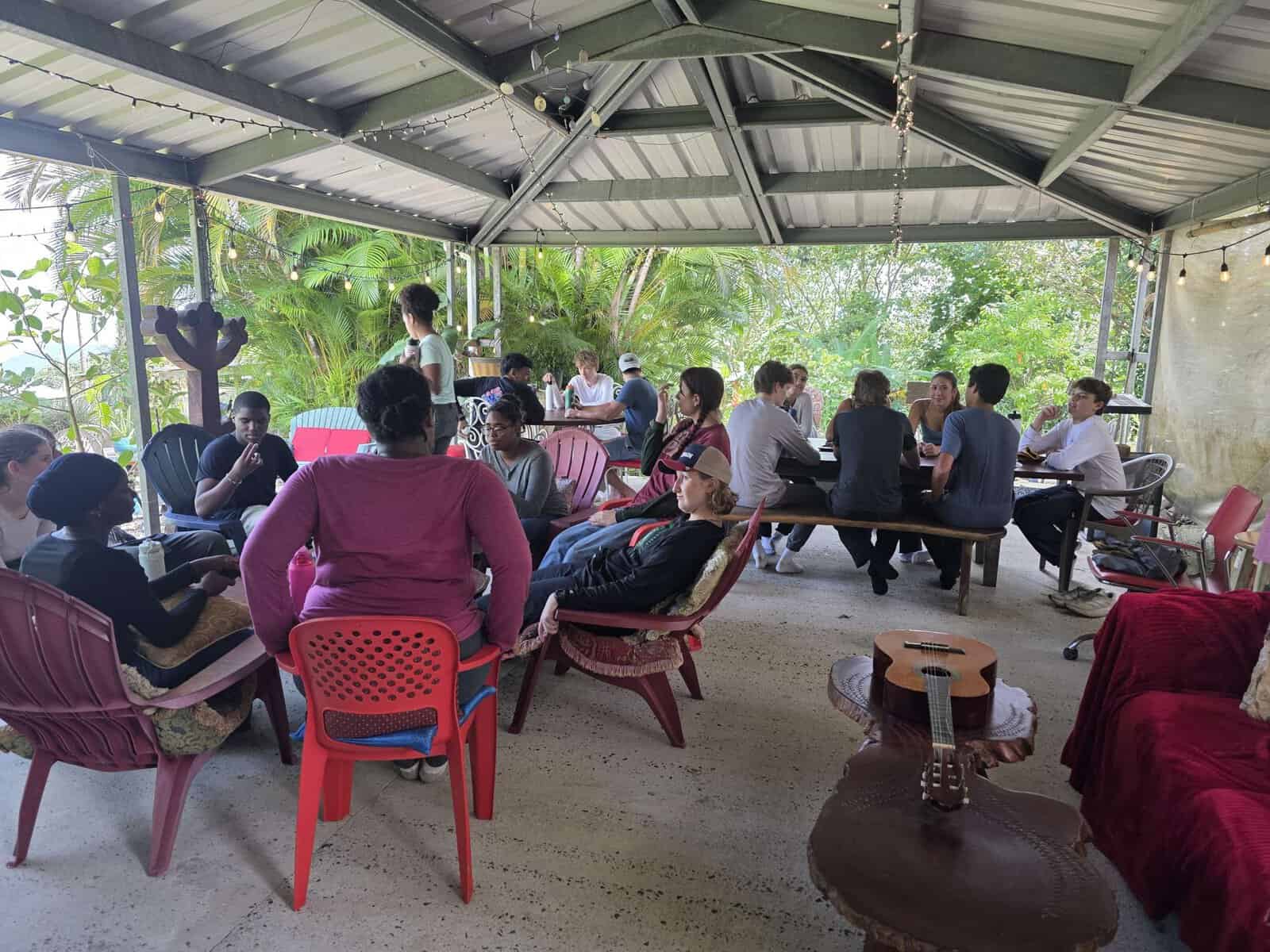
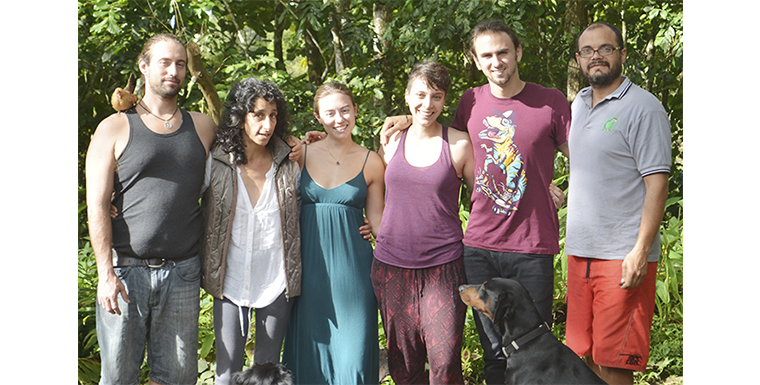
Twenty teenagers and three staff arrived at Las Casas as part of a Global Works group. From the beginning, the young people threw themselves wholeheartedly into the task. Armed with gloves, loppers, and pruning shears, as well as plenty of enthusiasm, they set about reopening the spaces between trees, access to the forgotten slope. Progress was slow. Every metre had to be earned.

Several groups before this team had also put in hard labor to enable us to get in further down slope. Razor grass resisted every advance, its long floating tendrils looking innocently like grass, dense growth grabbing at clothes like angry velcro. Yet the group remained cheerful, determined, and remarkably hard-working. Gradually, a path began to emerge. Then came one of those magical moments.

The forest opened, and suddenly, there they were. Trees. Not saplings. TREES! Mahoganies reaching skyward; Ausubos establishing themselves confidently on the slope; Blue Mahoe trees thriving in the recovering forest.

Some were far larger than any of us had imagined. They had not simply survived. They had grown. They had persisted through hurricanes, torrential rains, and years of neglect and isolation. For 3t, it was an especially emotional moment.

To stand among these planted trees was deeply moving. There was an almost childlike joy in rediscovering them.
"They made it!"

Sunlight filtered through recovering canopies. Mosses, fungi, and tall ferns carpeted fallen logs. Young trees occupied gaps left by the hurricane. Birds moved through the branches overhead. Everywhere there were signs of renewal and resilience. It was also a powerful reminder of one of the fundamental lessons of forestry and restoration work: trees operate on timescales far longer than our own immediate concerns.

When we planted these seedlings in 2000, 2001, 2007, 2008, and 2009, we were making a commitment to a future we could barely imagine. Hurricanes came and altered our plans. Trails disappeared. Life changed. Yet the trees kept growing.

Forestry teaches patience, and it rewards you with moments like this.

For the teenagers, the experience became much more than a day of clearing vegetation. They were not simply cutting a path. They were reconnecting us with a piece of our own history. They helped reveal nearly twenty years of forest growth and allowed us to witness the remarkable resilience of both planted trees and the ecosystems that surround them. The work was also a beautiful example of collaboration.

Monique Nieves kept everyone well fed with a delicious meal that restored energy after long hours in the field. 3t and Jon Warwick led the work crews with enthusiasm and determination, guiding the students through challenging terrain and sharing stories of the forest's history. Rio Collazo, age 15, volunteered with the group and helped in all areas. Mike Alvarez, a neighbor, recently back on the island after a lifetime away, joined the activity, to see what we get up to here in the mountains!

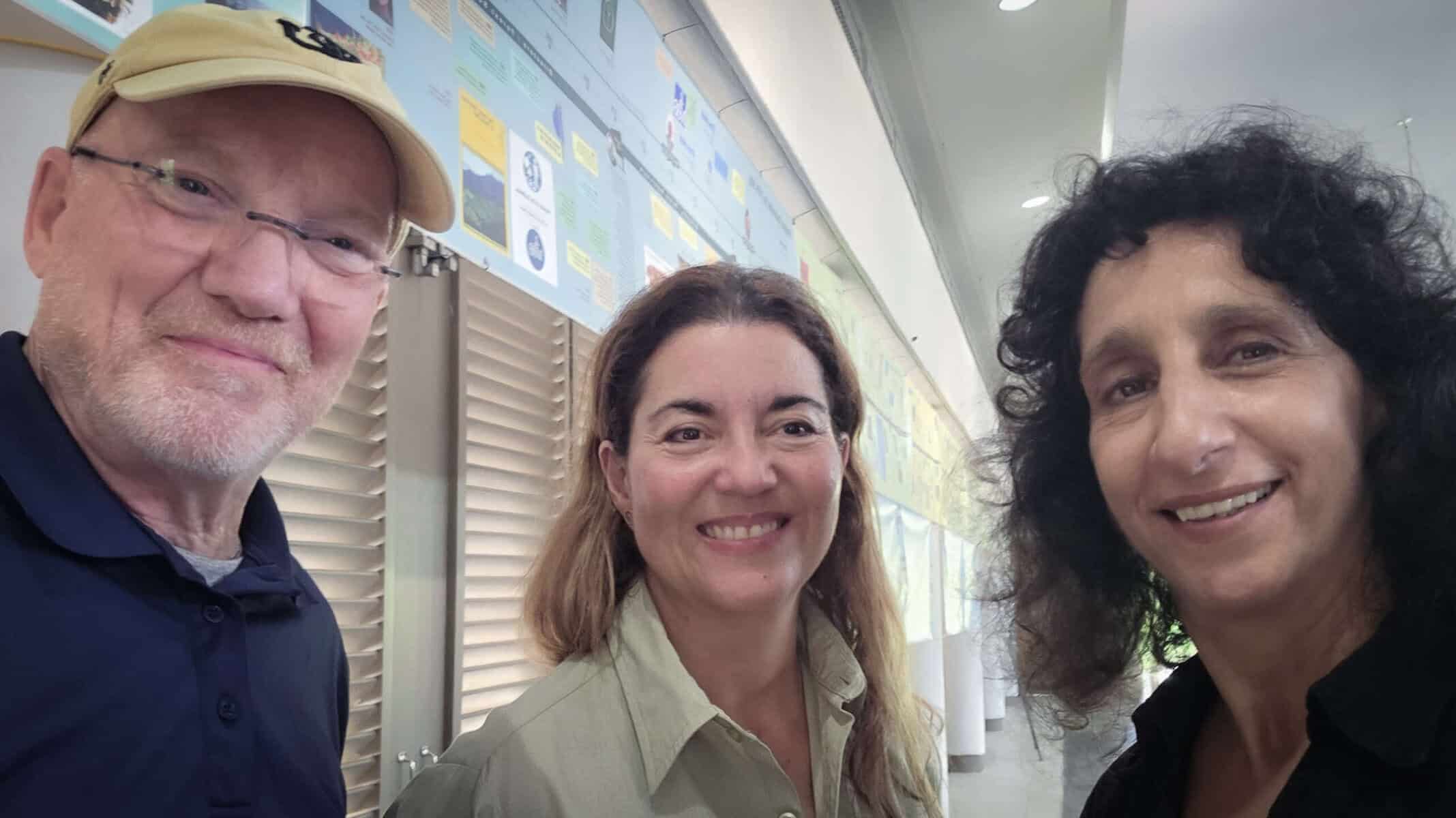
The Global Works staff, Lauren, Nahely, and Darielys, were wonderful partners, supporting the group and helping create an atmosphere of curiosity, teamwork, and adventure. By the end of the day, we had reopened access to a place we thought might remain hidden indefinitely. More importantly, we had rediscovered something precious.

Learn more about how to participate in a Teenage Globalworks adventure, see link below.

Conservation work often unfolds quietly. The victories are rarely dramatic. They come in seedlings taking root, forests slowly recovering, and young people choosing to spend their day cutting through razor grass so that others can reconnect with trees planted long ago.

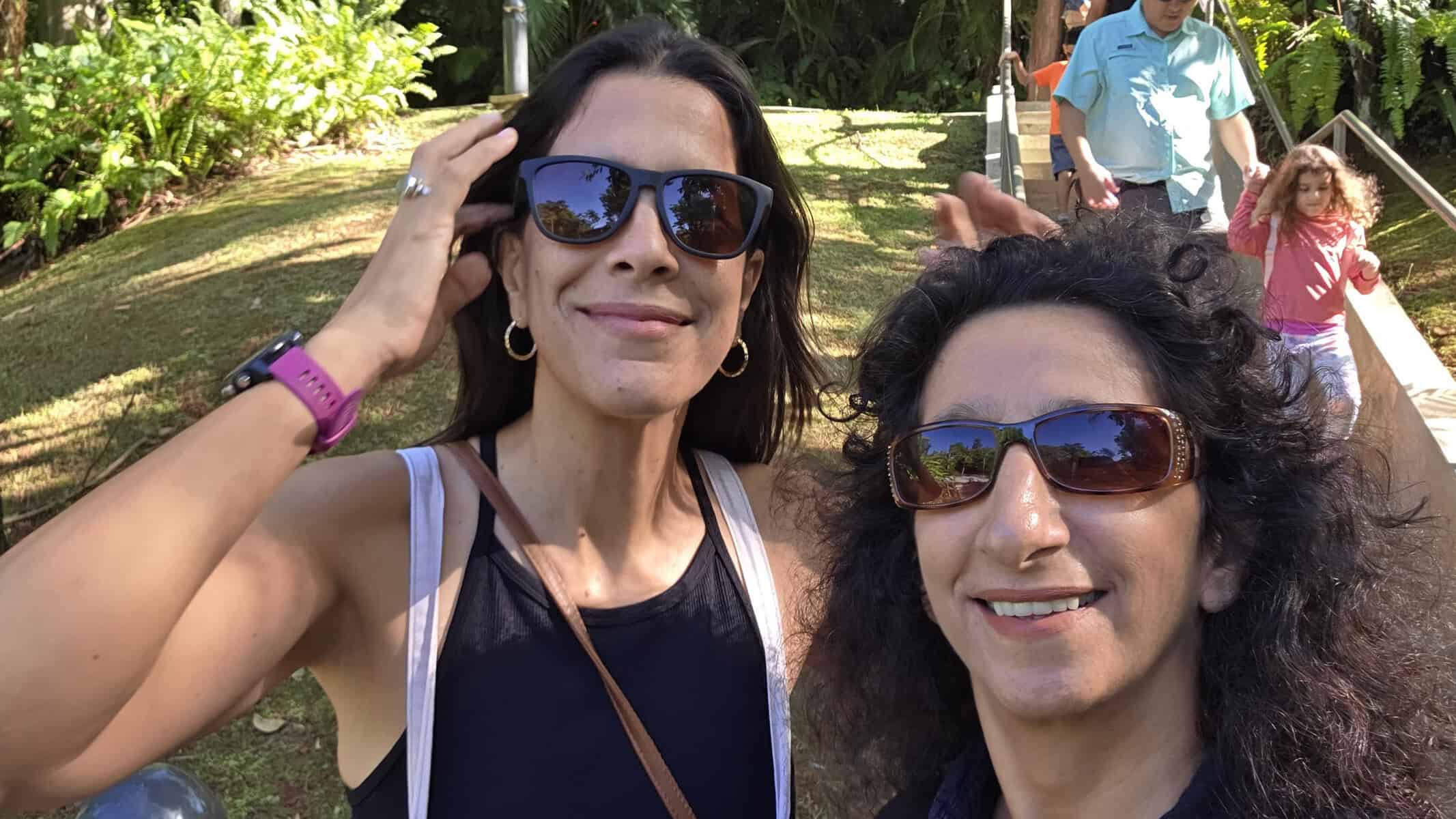
Photos by Mike Alvarez & 3t Vakil, 29 June 2026
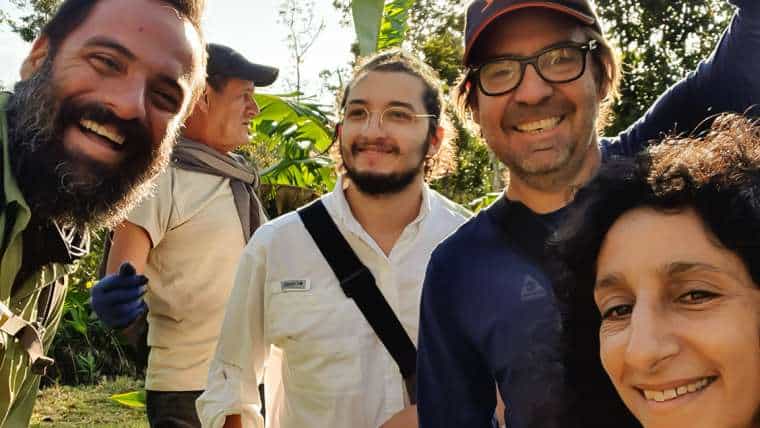
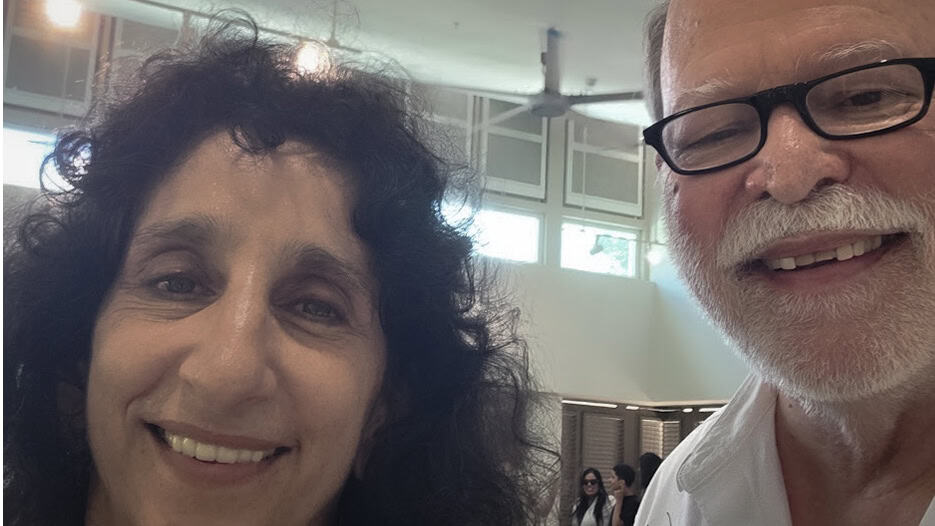
It was heartwarming to welcome back Darielys Dijol Mercedes.

In 2023, she first came to Las Casas de la Selva as a 17-year-old participant with a Global Works group, experiencing the rainforest and conservation work firsthand. 

Just three years later, she returned in a very different role, as a Global Works facilitator, helping lead and inspire a new generation of teenagers.

Watching young people grow into leaders who then guide others through these same experiences is one of the greatest rewards of educational and conservation work.

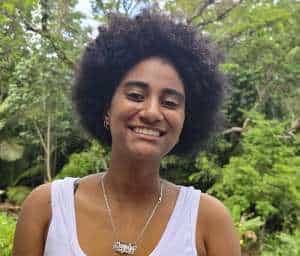
We were delighted to have local teenager Rio Collazo, age 15, join the Global Works group as a volunteer.

Rio has been eager to become involved at Las Casas de la Selva and embraced the opportunity with enthusiasm. She was helpful in every area, lending a hand wherever it was needed; sensitive to group dynamics whilst out in the field, and an invaluable member of the team.

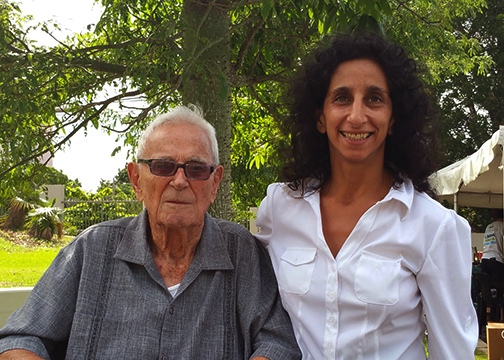
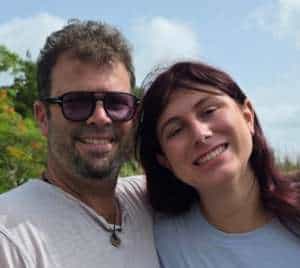
It was wonderful to see her positive energy, willingness to work with others, and genuine interest in the forest and its conservation. Photo of Rio with her father, Angel, a neighbor and very good friend of the project.

Latest Videos, Press, & Publications

For Tropic Ventures Research & Education Foundation, 2021 began with Naples Botanical Garden in Florida securing a grant from the Association of Zoological Horticulture to fund the building of a new tree nursery at our project in Patillas, Puerto Rico, after the devastation of all our tree nurseries in Hurricane Maria in 2017. Following this, the 2021 Botanical Gardens Conservation International & Global Tree Campaign agreement and grant opportunity to survey for two threatened endemic species was a huge accomplishment; a proposal for the conservation of two Puerto Rican endemic trees, Garcinia portoricensis & Ravenia urbanii. Thrity Vakil, director of TVREF, immediately set about creating a diverse team comprised of plant and tree experts, and experts in the fields of ecology, biology, taxonomy, bryology, mycology, and zoology. (TVREF is also known as Eye on the Rainforest, which is the name of its website).

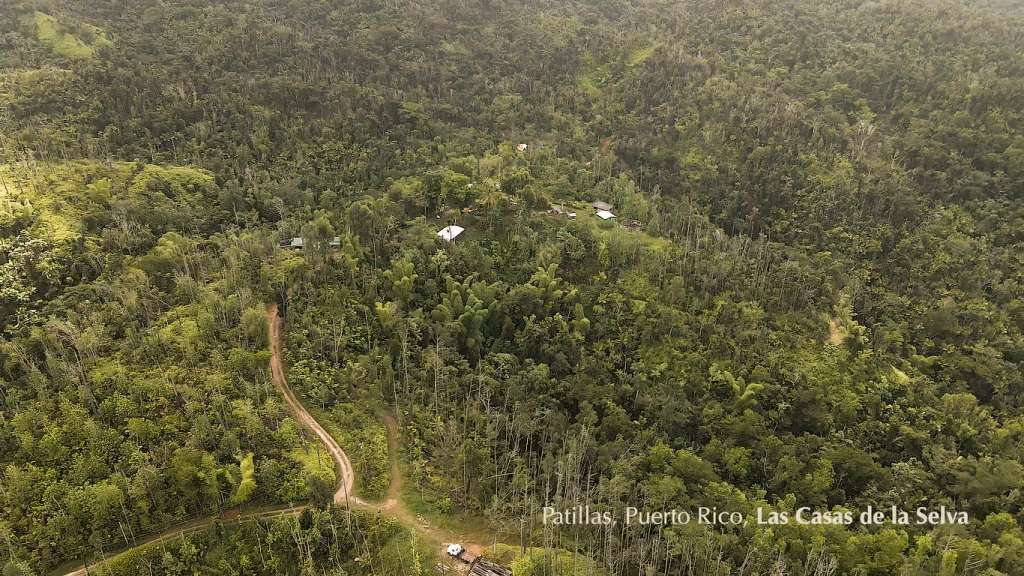
Take a short drone flight over Las Casas de la Selva, Sustainable Forestry & Rainforest Enrichment Project, established in 1983 in Patillas, Puerto Rico. August 2021.
Footage by Brent Foley, Production by Alfredo Lopez.

Earthday Botanical Survey 2021, at Las Casas de la Selva, Sustainable forestry & Rainforest Enrichment Project in Patillas, Puerto Rico. Filmwork: Raymesh Cintron, Narrator: 3t Vakil, Soundtrack: Andrés Rúa

“Re-examining Crises as Opportunities for Change: Sustainable Forestry, Log salvage, and Hardwood production after extreme social, ecological & technological disturbances in Puerto Rico.”
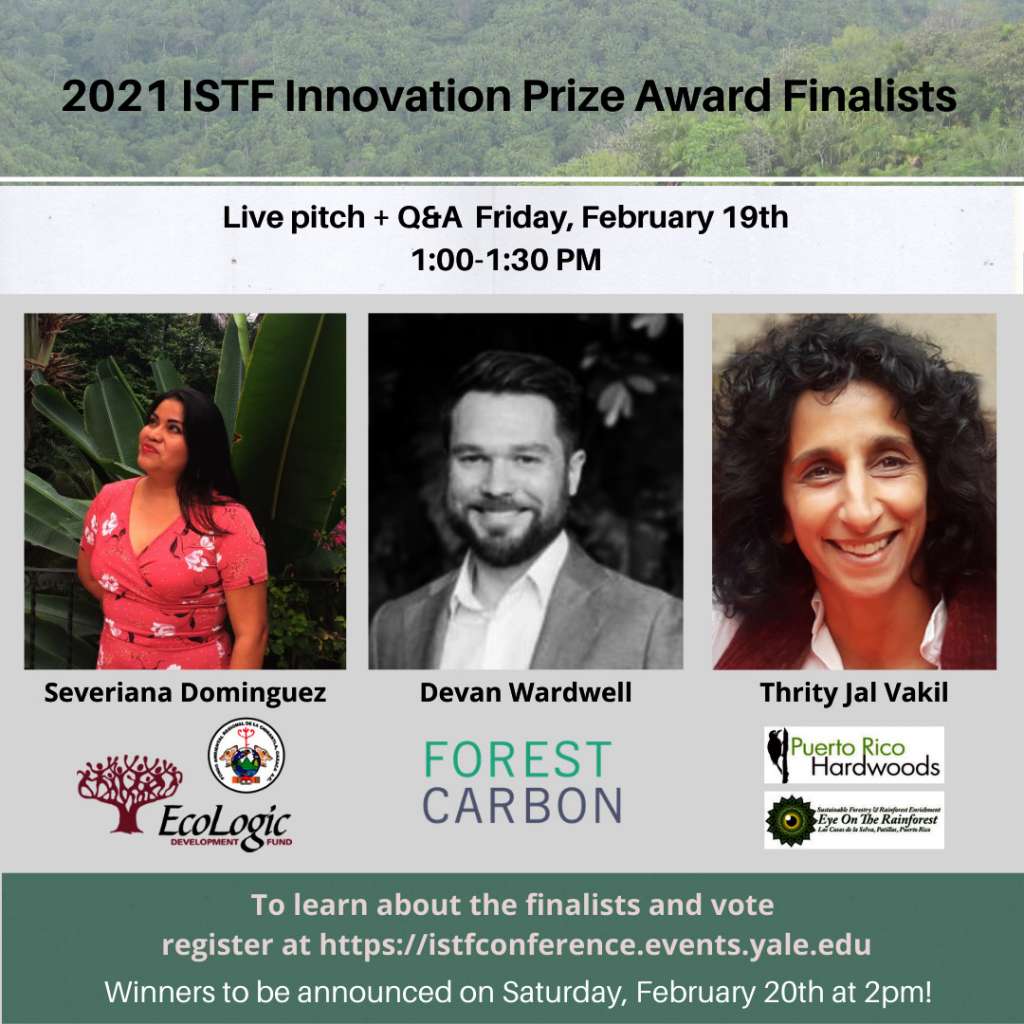
Since 2014, the Yale University Chapter of the International Society of Tropical Foresters (ISTF) has awarded an Innovation Prize at its annual conference to honor outstanding initiatives and ideas related to tropical forest use and conservation.  Thrity was selected as one of three finalists to tell the story of Las Casas de la Selva, Puerto Rico Hardwoods, and the Institute of Ecotechnics. February 2021
Images and footage: 3t Vakil, Andrés Rúa, Tom Marvel, & Greg Byers.

Hurricane Maria made landfall in Puerto Rico as a Category 4 storm on the morning of 20th September 2017. Tropic Ventures Sustainable Forestry and Rainforest Enrichment Project established 35 years ago, lay directly in her path. This is 3t’s visual story of the impact of Hurricane Maria on the rainforest project in Patillas, on the land known as Las Casas de la Selva, southeast Puerto Rico.

Film and photos by 3t Vakil, and Andrés Rúa. Edited by Corinna MacNeice. Use headphones to appreciate the soundscape.

“Seas, rain forests, and saving coral reefs” Long Lost Friends talks with 3T Vakil


“Painting and saving forests in Puerto Rico” Long Lost Friends talks with 3T Vakil


“Saving Endangered Trees” Long Lost Friends talks with 3T Vakil


PRESS & PUBLICATIONS

  1. In 2021, the Global Tree Campaign has partnered with Eye on the Rainforest, a Puerto Rican NGO, with the aims of conserving tree species most at risk of extinction by increasing the technical capacity of project partners and improving the conservation status of these tree species.  https://globaltrees.org/projects/securing-the-conservation-of-endemic-trees-in-puerto-rico/
  2. 3t made a virtual presentation to the Rotary Club of San Juan in September 2021.
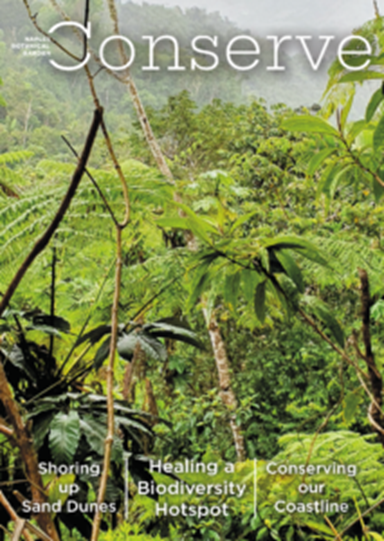
  3. Conserve Magazine: https://www.naplesgarden.org/wp-ontent/uploads/2021/08/Conserve.pdf
    See pages 16 to 20. 3t’s photo of the Las Casas forest made the front cover!



2021 Innovation Award: Yale (ISTF)

Since 2014, the Yale University Chapter of the International Society of Tropical Foresters (ISTF) has awarded an Innovation Prize at its annual conference to honor outstanding initiatives and ideas related to tropical forest use and conservation.  

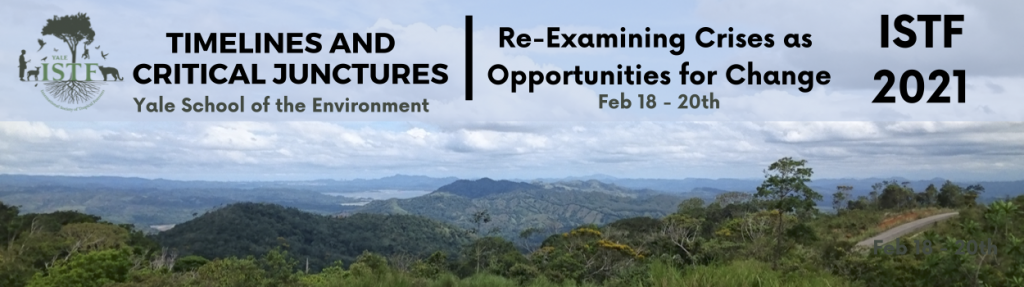
Three ISTF Innovation Award finalists were selected to present their exceptional approaches, experiences or efforts relating to the 2021 ISTF Conference theme: “Timelines and Critical Junctures: Re-examining Crises as Opportunities for Change.” The finalists participated in a live pitch event over Zoom on Friday, February 19th at 13:00, and on Saturday 20th February, votes were counted.

Thrity was selected as one of three finalists to tell the story of Las Casas de la Selva, Puerto Rico Hardwoods, and the Institute of Ecotechnics. She represented all her colleagues and friends, people that have been involved for decades with these long-term environmental projects.

Video link: https://youtu.be/hDwgZEA_zkg

3t’s presentation: “Re-examining Crises as Opportunities for Change: Sustainable Forestry, Log salvage, & Hardwood production  after extreme social, ecological & technological disturbances in Puerto Rico” won second prize.

Established in 1983, Las Casas de la Selva (LCS) Sustainable Forestry Project planted 40,000 hardwood trees on 300 acres to explore viable alternatives to clear-cutting and short-term exploitation of tropical rainforest. We are demonstrating planting valuable hardwoods within secondary forests can reduce pressures on primary forests. Silvicultural techniques developed and applied at LCS over the last three decades show that enrichment planting of secondary forests maintains ecological diversity and health, while providing economic returns from sustainable timber production.

The Homestead, Las Casas de la Selva, sustainable forestry in Patillas, PR
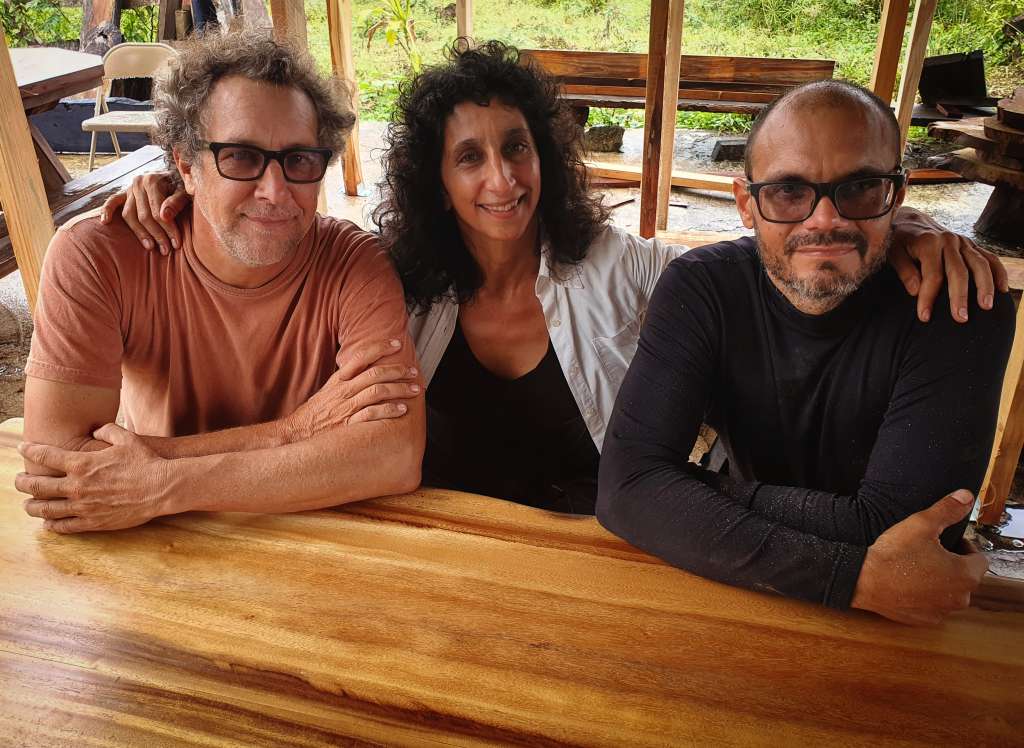
The PRH Team: Tom Marvel, 3t Vakil, Andres Rua

Puerto Rico, currently facing incredible economic distress, is awakening to the potential of sustainable use of its forest resources. Forest cover, just 6% in the 1900s, has grown to 60+% through tree planting and natural regeneration of abandoned short-term farmland.

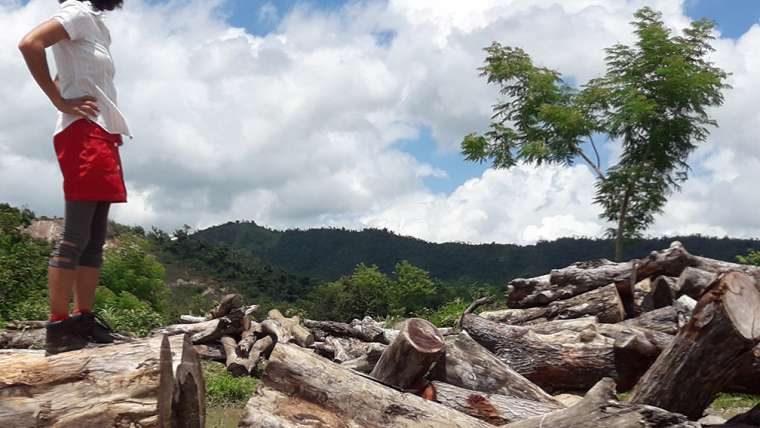
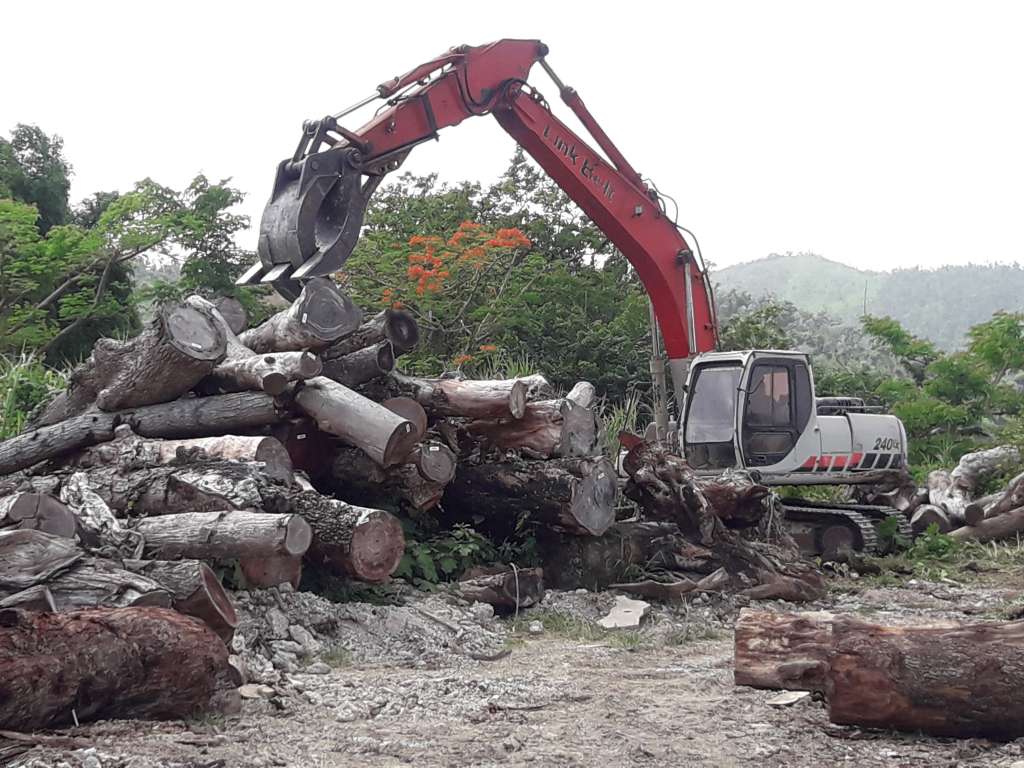
 Since 2015, Puerto Rico Hardwoods had been salvaging tropical hardwood trees destined for chipping/dumping at huge cost to Puerto Rican municipalities. Thousands of valuable mature trees fell during Hurricane Maria.  The PRH team quickly started reclaiming logs, reducing the amount of waste going into overburdened landfills, transformed salvaged timber into value-added products, creating jobs, stimulating the economy, and demonstrating the value of wood!  


Hurricane Maria was a devastating social, ecological, and technological crisis, providing a moment of huge learning. Novel approaches are necessary to build resilience and adaptability to large-scale disturbances. We have an opportunity to create new potentialities for PR’s mass debris removal after extreme events potentially powering the rebirth of the island’s lost wood industry. This is crucial since extreme weather catastrophes will be more frequent and of greater intensity in these unstable Anthropocene conditions.

Dig deeper:

Enriched secondary subtropical forest through line-planting for sustainable timber production in Puerto Rico, paper in Bois et Forets des Tropiques. Dr. Mark Nelson, Sally Silverstone, Dr. Kelly Chinners Reiss, Thrity Vakil, & Molly Robertson http://bft.cirad.fr/cd/BFT_309_51-61.pdf

Journal of Sustainable Forestry, Volume 29, 2010 – Issue 5.
Dr. Mark Nelson, Sally Silverstone, Dr. Kelly C. Reiss, Dr. Patricia Burrowes, Dr. Rafael Joglar, Molly Robertson & Thrity Vakil https://www.tandfonline.com/doi/abs/10.1080/10549810903479045

Institute of Ecotechnics IE: www.ecotechnics.edu

Puerto Rico Hardwoods Instagram: https://instagram.com/prhardwoods?igshid=gm00lyfqyzzi 

Photos by: Thrity Vakil, Andres Rua, Raymesh Cintron (Drone Image), Ariza Torres.

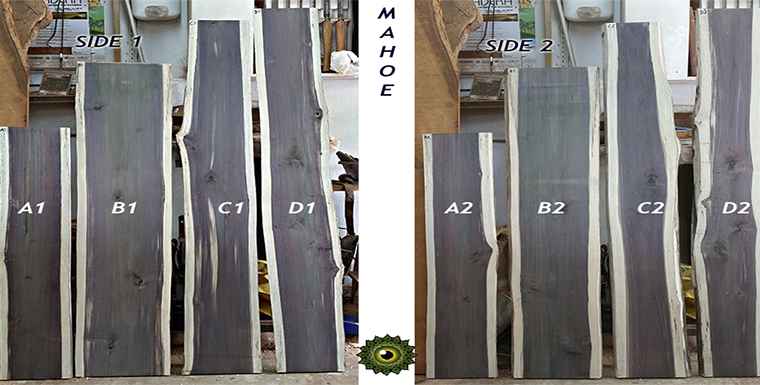
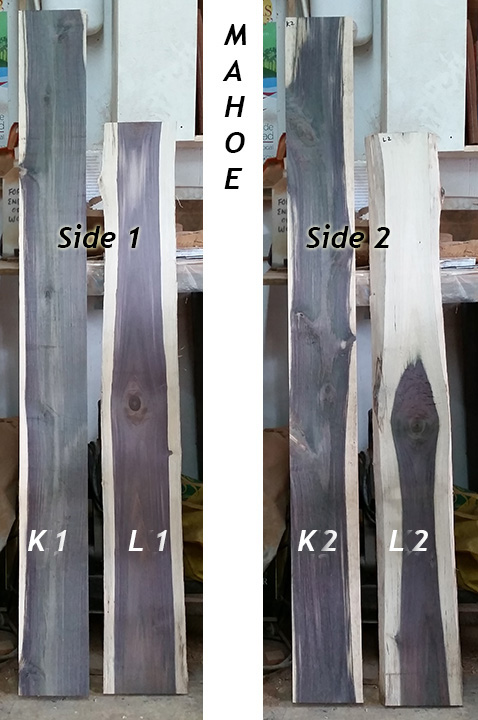
April 2016 Mahoe (Hibiscus elatus) available

SUSTAINABLY GROWN AND HARVESTED HARDWOOD.

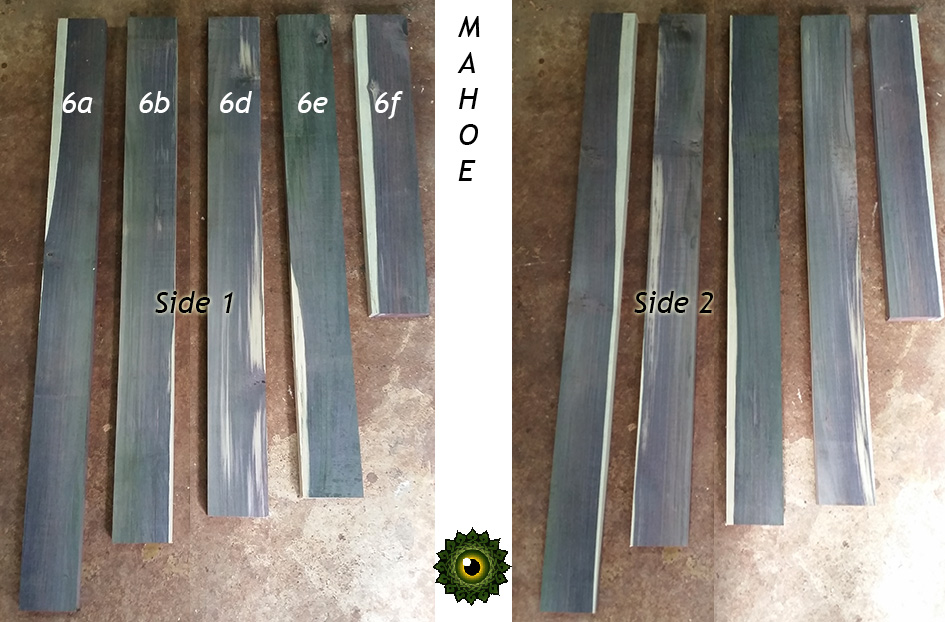
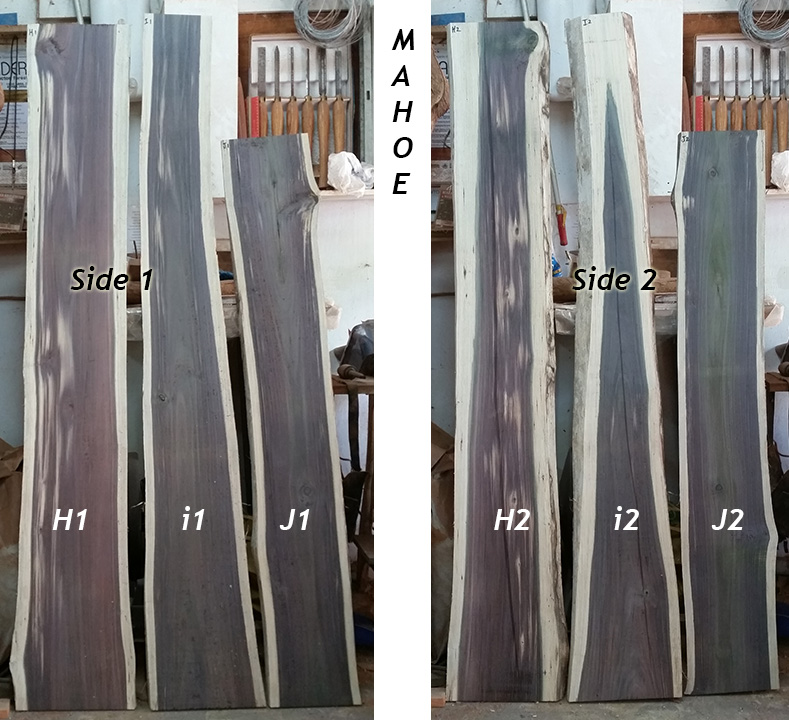
#LENGTHWIDTHTHICKNESSBOARD FEET$ $20 per bftNOTES
A44.571.252.70$54.00SOLD
B57101.254.94$98.80SOLD
C6571.253.94$78.80SOLD
D6771.254.07$81.40SOLD
E64.5101.255.59$111.80SOLD
F65.58.51.254.83$96.60SOLD One side (F2)few pin holes
G63.5813.52$70.40SOLD
H73914.56$91.20SOLD
I7471.254.49$89.80SOLD
J6081.254.20$84.00SOLD
K676.52.256.80$136.00SOLD
L5661.252.91$58.20SOLD
6a433.751.251.39$27.80SOLD
6b39.5411.09$21.80SOLD
6d3841.251.31$26.20SOLD
6e36.541.251.26$25.20SOLD
6f24410.66$13.20SOLD

All dimensions are in inches and all slabs are slightly larger than stated. All pieces have been planed on both sides.
Shipping is not included. We accept secure payments through Paypal.

Please include in your email to 3t@eyeontherainforest. org
1) Your shipping address.
2) Your shipping preference for a quote: Priority (8-12 days) or Standard Mail (14-18 days) .

Mahoe is the timber tree currently being harvested from 26 – 30yr old plantations at Las Casas de la Selva. Mahoe or Hibiscus elatus, (also known as “Blue Mahoe” for the characteristic coloration of its wood after milling), is a tree native to Jamaica and Cuba. A volunteer species, characteristic of open disturbed habitats and also found, due to its shade tolerance, as an understory tree in secondary forests, mahoe grows to 25 m tall and upwards of 100 cm DBH (KIMBER, 1970). It was recognized as a potentially important species for plantation and forest enrichment after a survey by Jamaican foresters (LONG, 1963 cited in KIMBER, 1970). It is an excellent wood with a rich variety of colors and attractive grain, but surprisingly, very little mahoe is currently being produced anywhere else. The first plantings in Puerto Rico were in the 1940s and it has been also been introduced to other Caribbean islands and Hawaii for evaluation. It has become naturalized in Mexico, Peru, Brazil, southern Florida and the West Indies (CHUDNOFF, 1982 cited in WEAVER, FRANCIS, n.d.)

BUY OUR MAHOE WOOD

Mahoe lumber (wood from the mill that requires no further processing) is $20.00 per board foot. Mahoe turning and carving blanks are $26.00 per board foot. Wood for sale may include some sapwood, and all ends are anchor-sealed. Mahoe can vary greatly in color from tree to tree, the blue tone does not tend to endure for many years. The wood transforms over time to shades of browns, purples, greys, and bluey-greens.

SEE MORE MAHOE FOR SALE: SERIES 7 SERIES 8 SERIES 9 MAHOE SLABS MNOPQRS

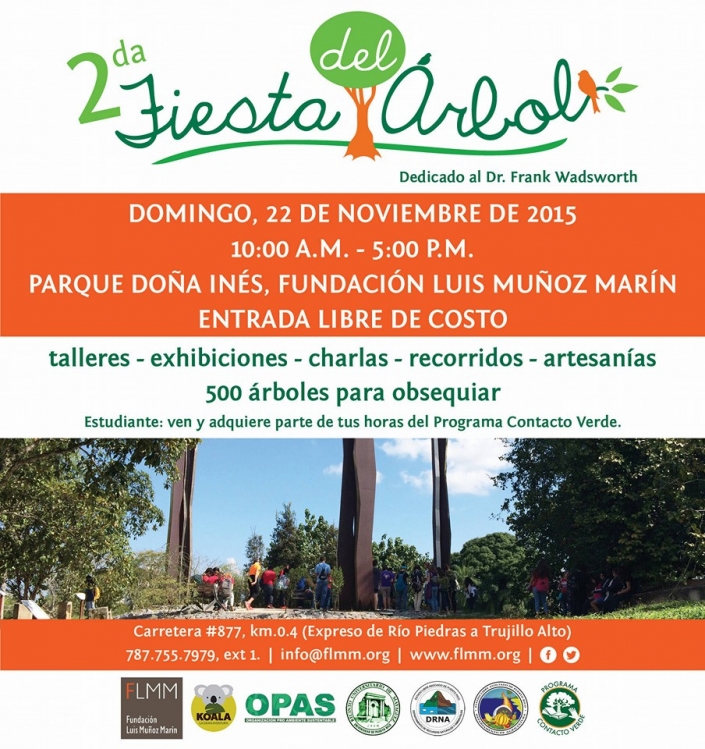
Fiesta del Arbol November 2015

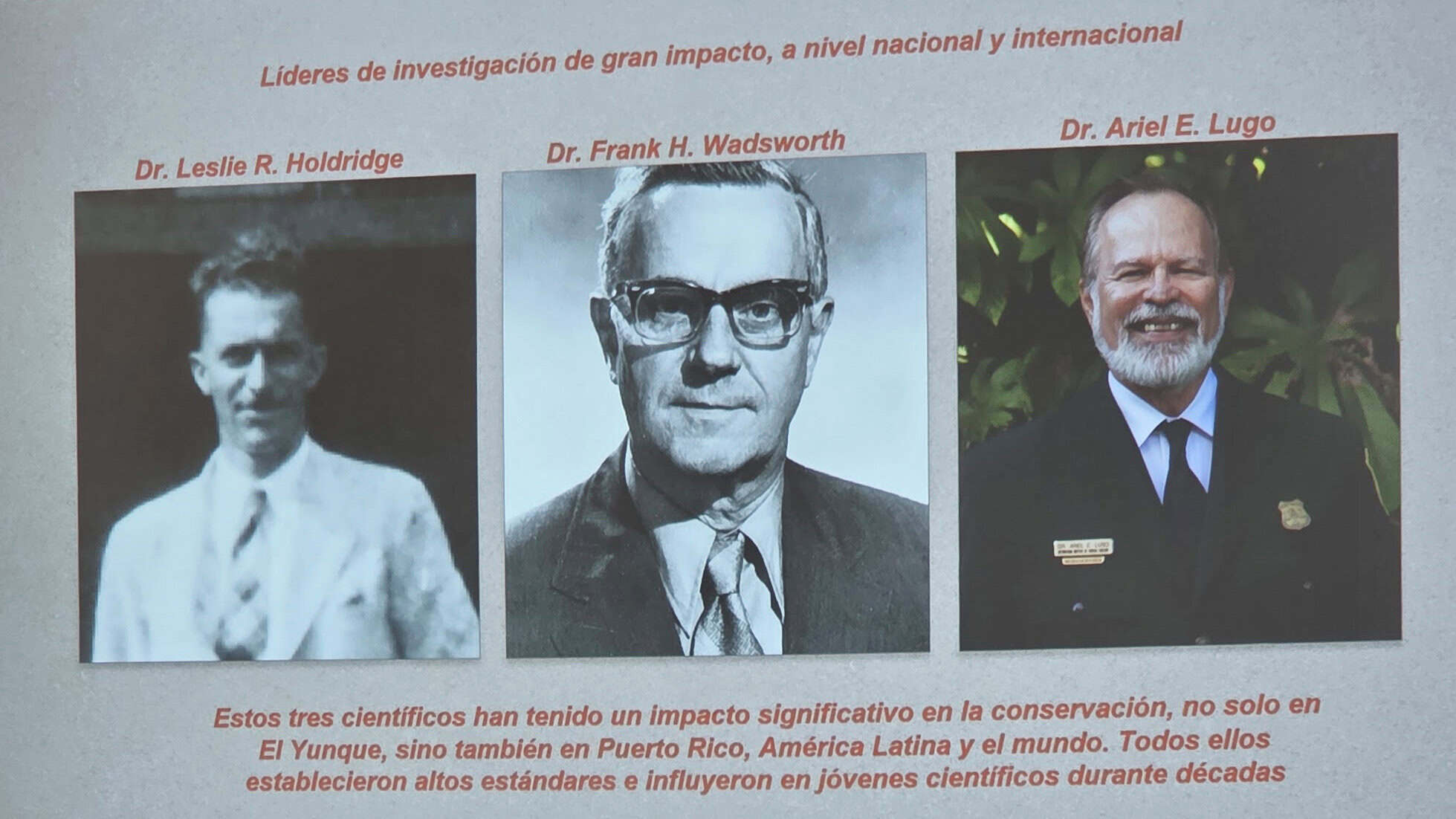
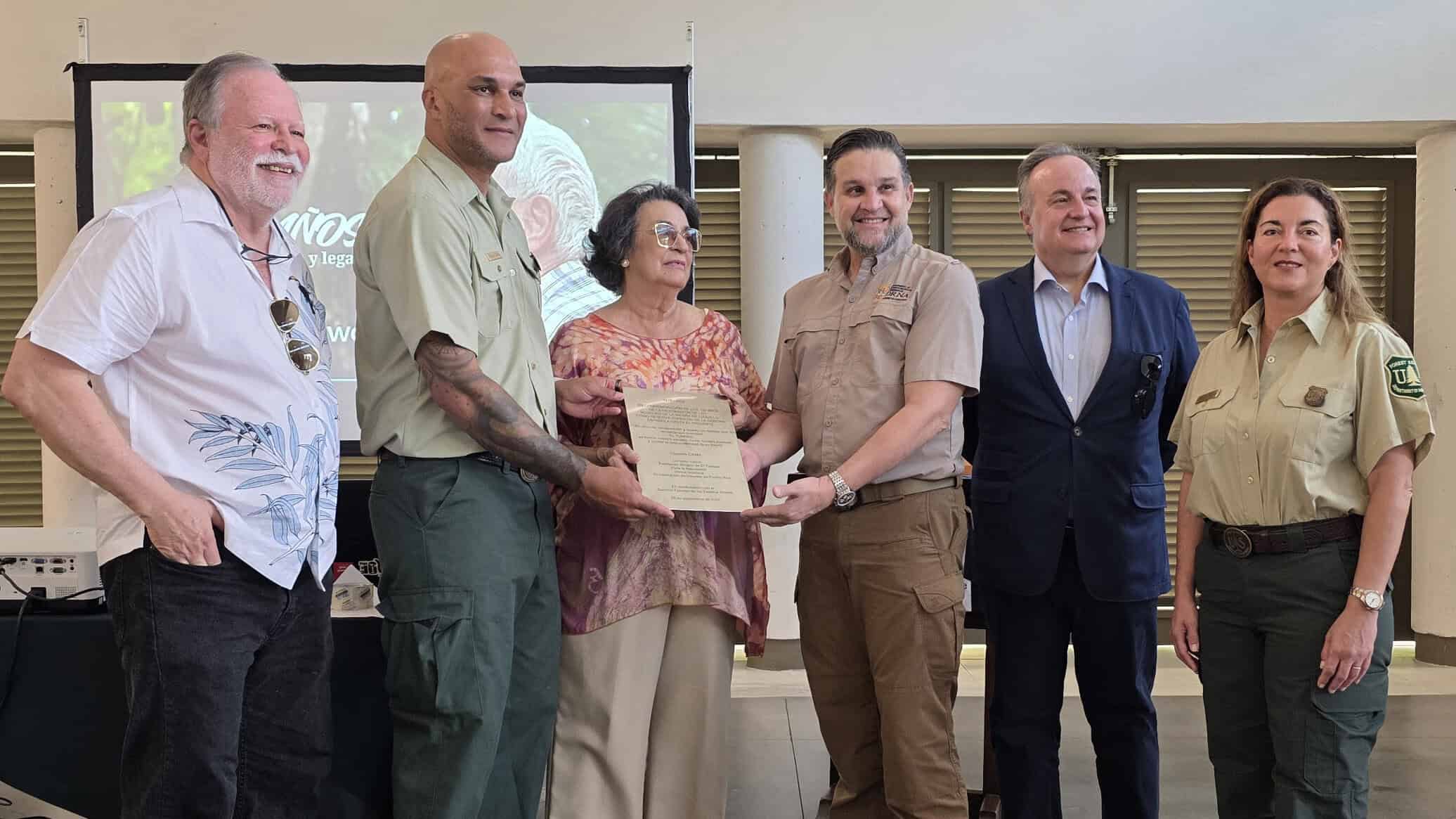
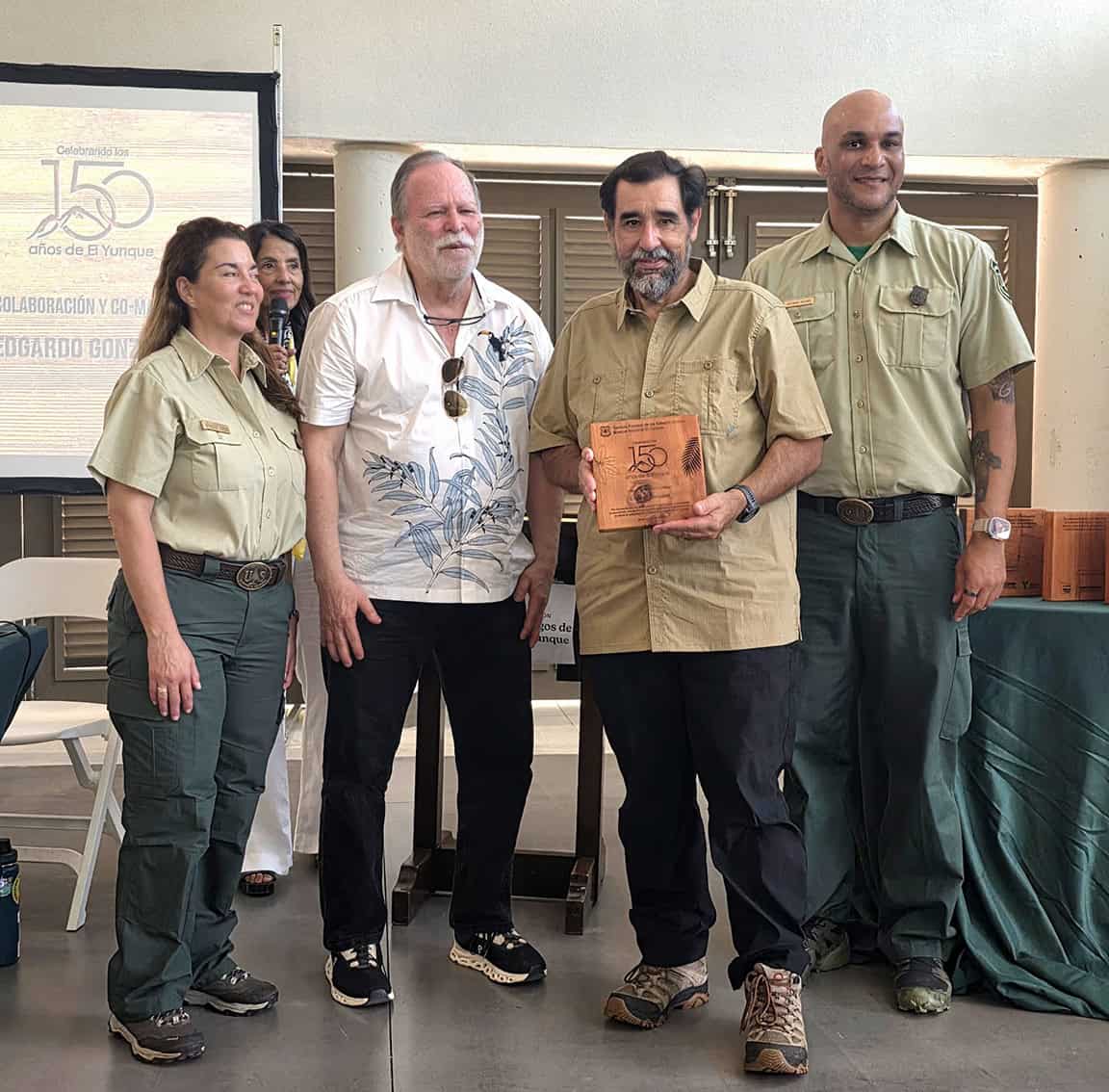
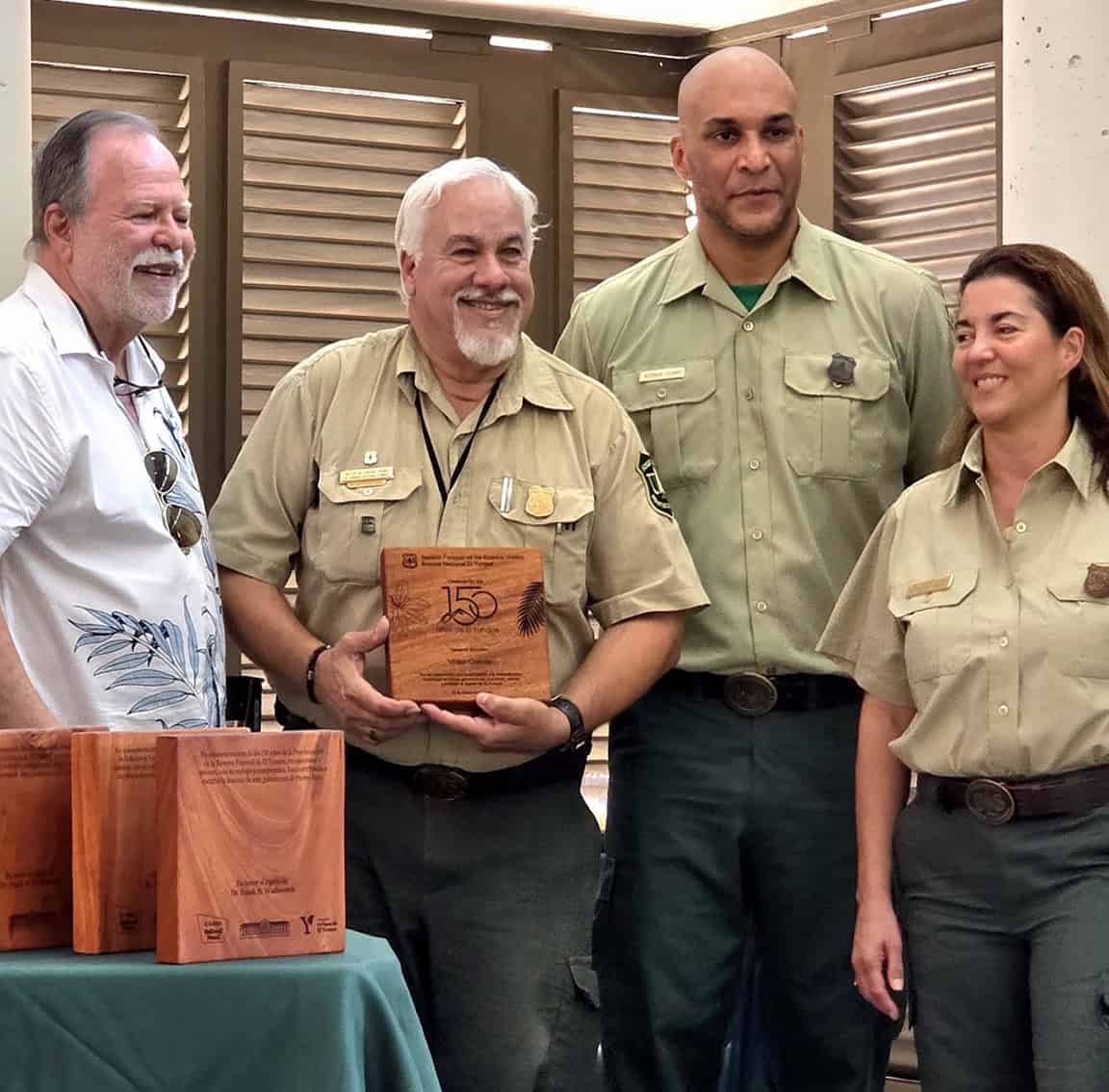
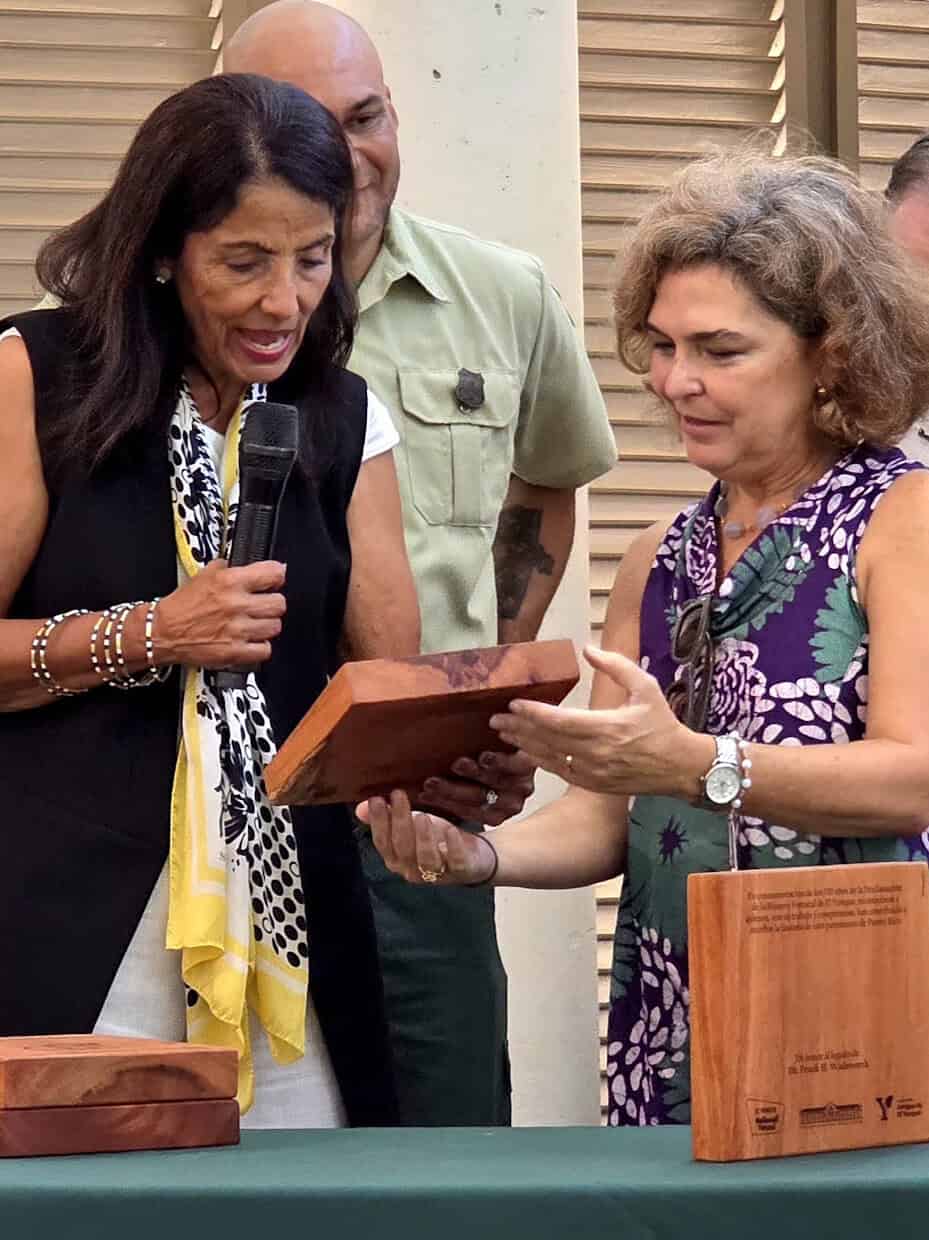
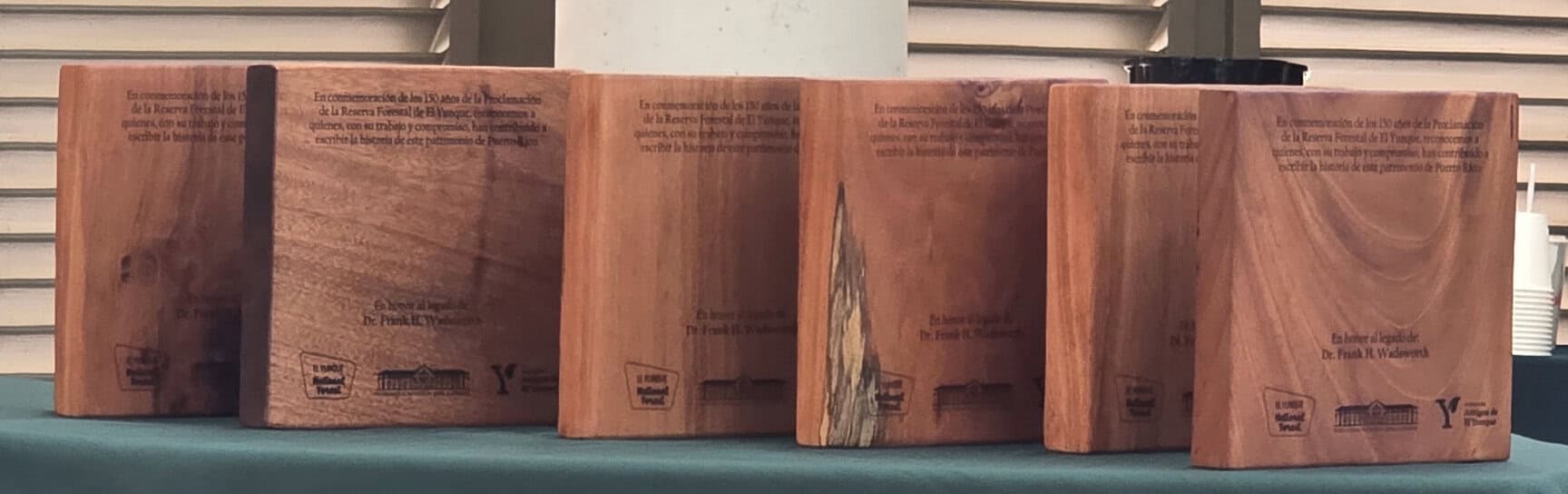
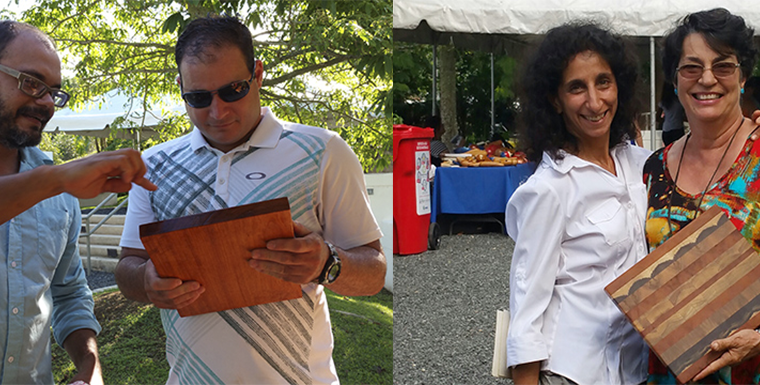
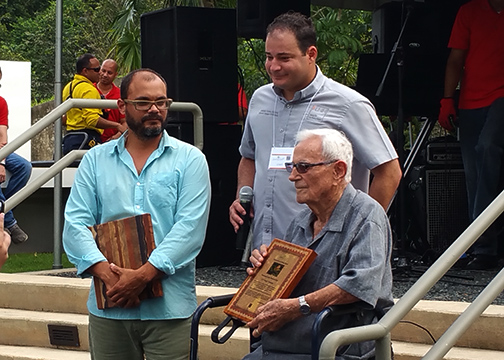
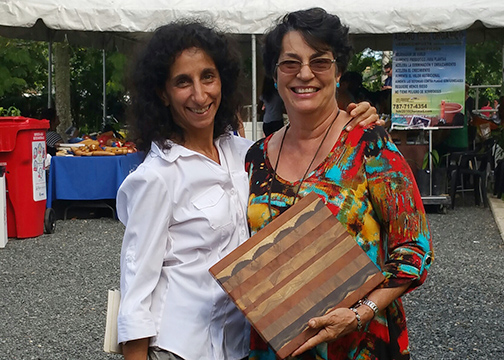
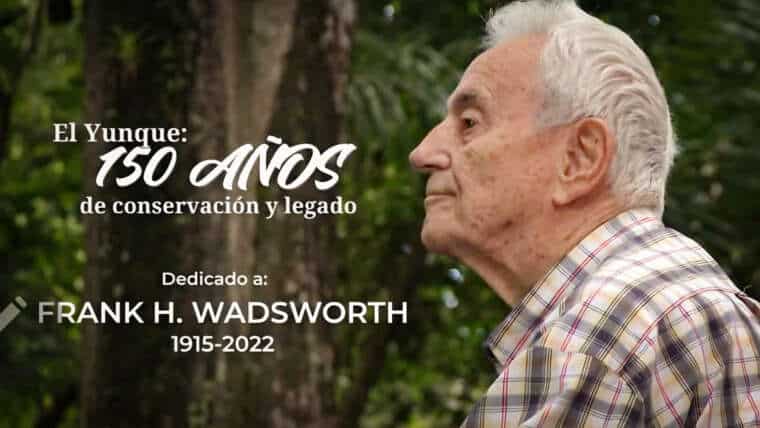
This event was dedicated to forester Dr. Frank Wadsworth, and Andrés presented a plaque to celebrate his 100th birthday.

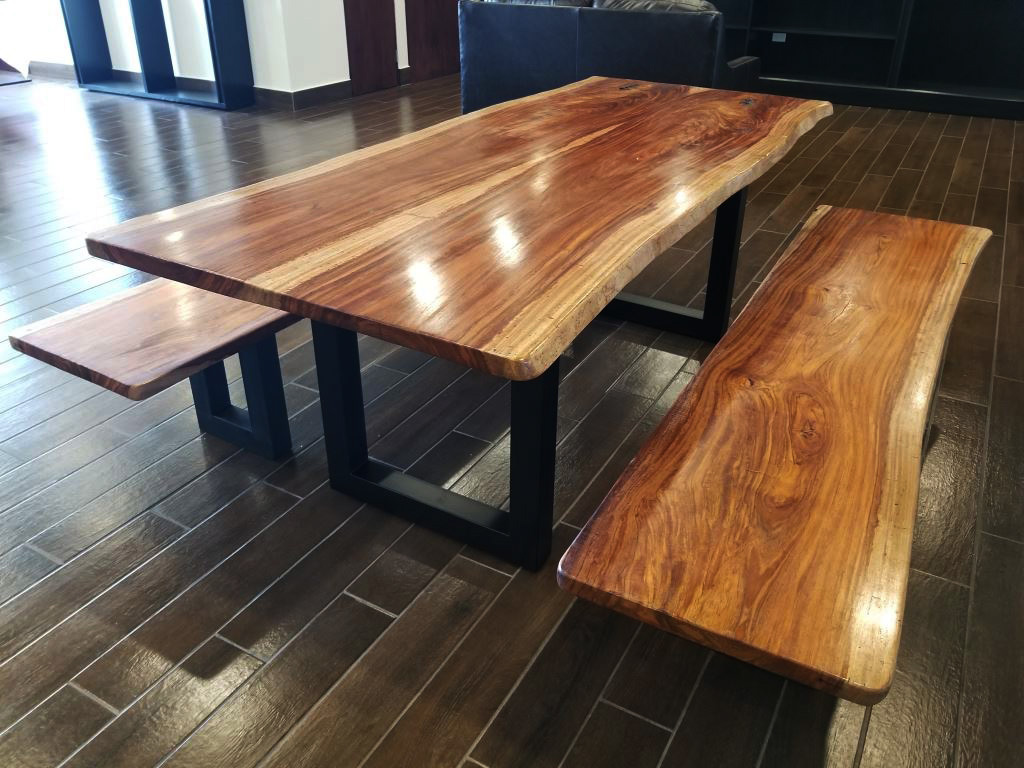
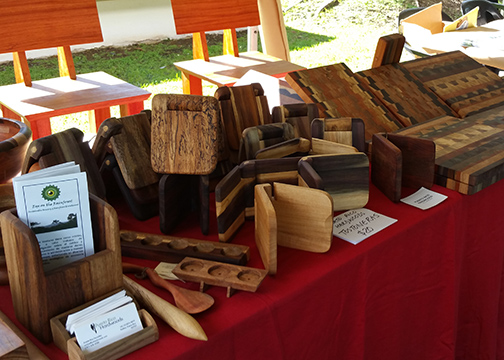
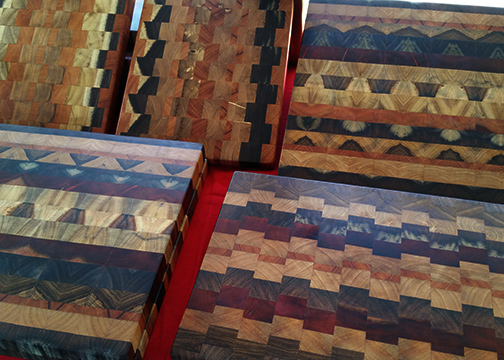
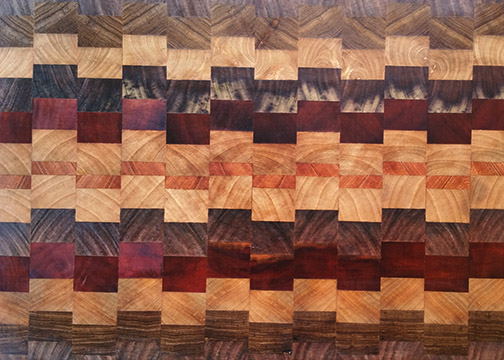
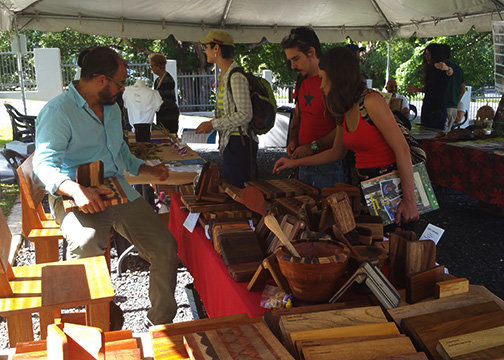
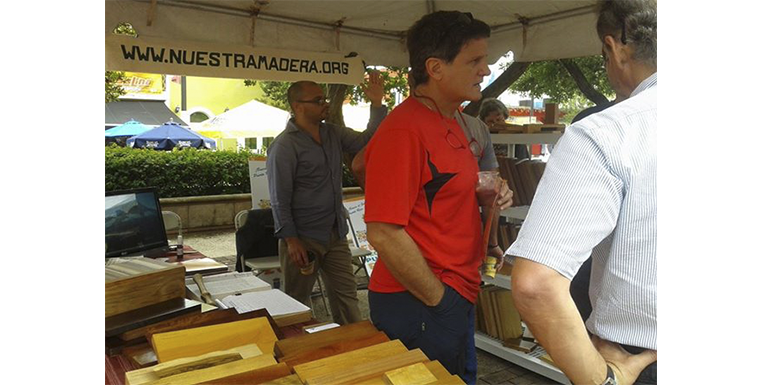
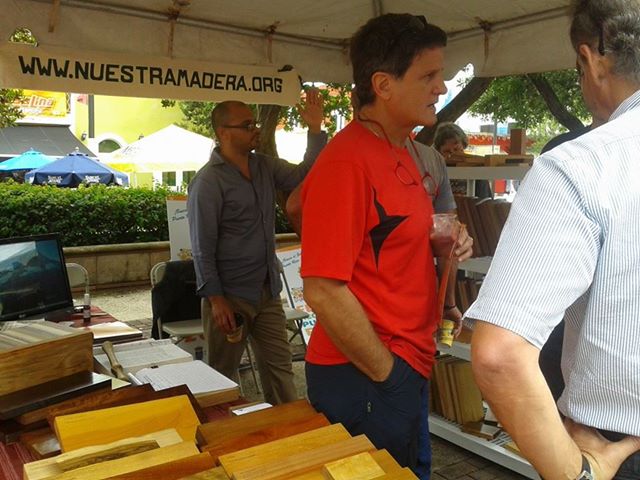
We had a table to show off some of our latest products, cheese boards, chopping boards, tostoneras, and samples of Puertorican hardwoods.

Students from University of PR – Department of Fine Art

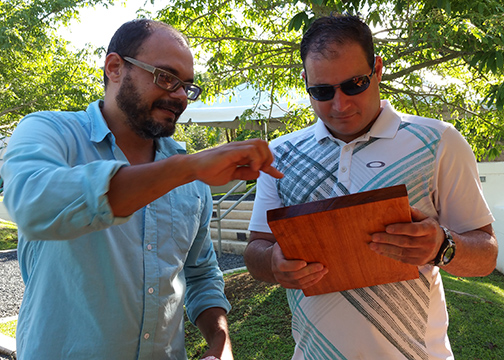
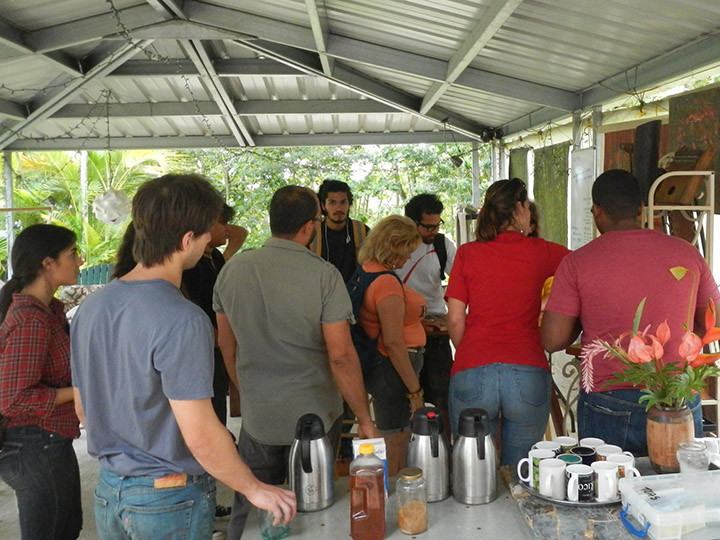
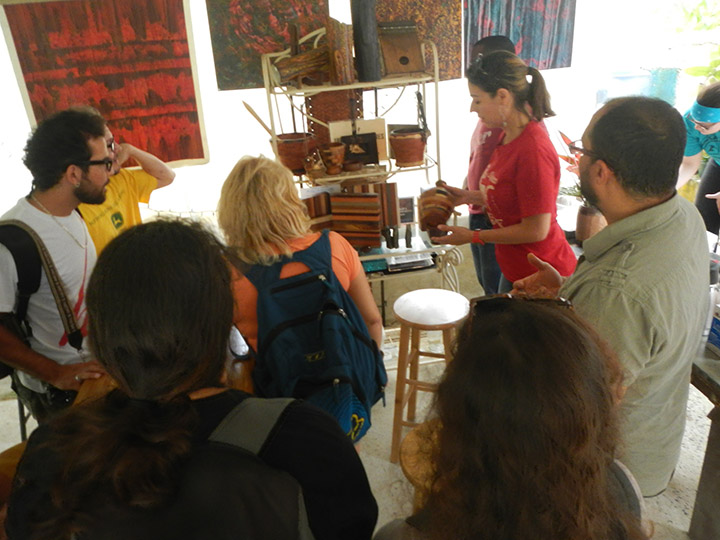
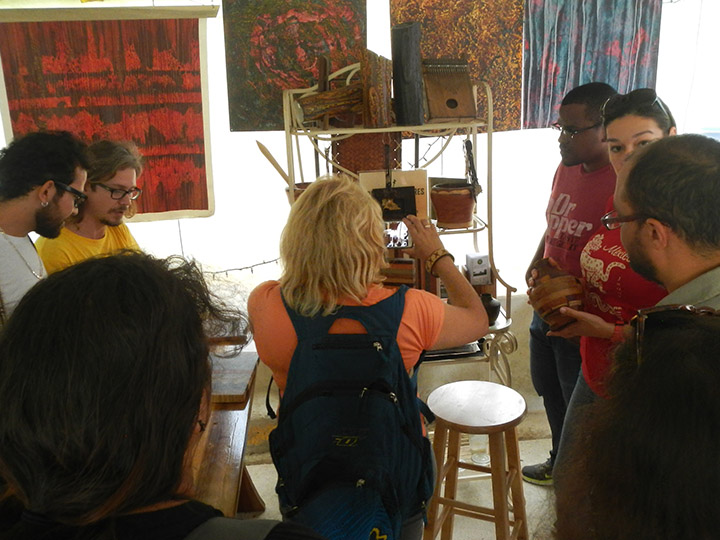
In April this ebullient group of students from the Department of Fine Arts, University of Puerto Rico, arrived on a day trip to find out more about the forest plantations at Las Casas de la Selva, and to see the timber operation; the sawmill, drying shed, and workshop. Everyone was wowed by our wood collection, that we inherited from Jose Mari Mutt, and have been adding to. Eyes opened wide at the beauty of these different and relatively unknown hardwoods that Puerto Rico has. Many discussions ensued about sustainable use of forest resources, especially wood, and later all left smiling, having bought some of our wood to create their latest projects. We look forward to seeing the results soon.

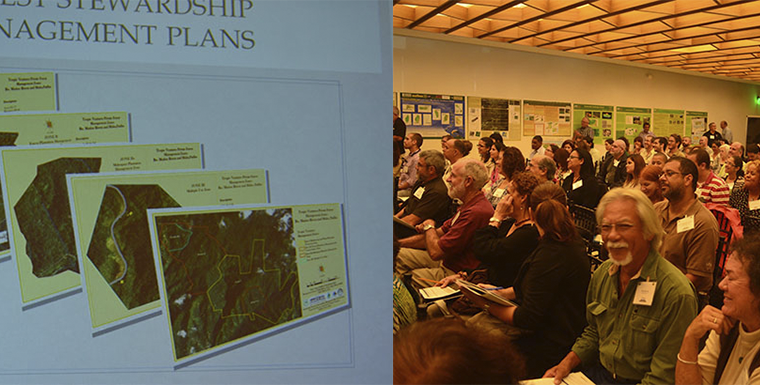
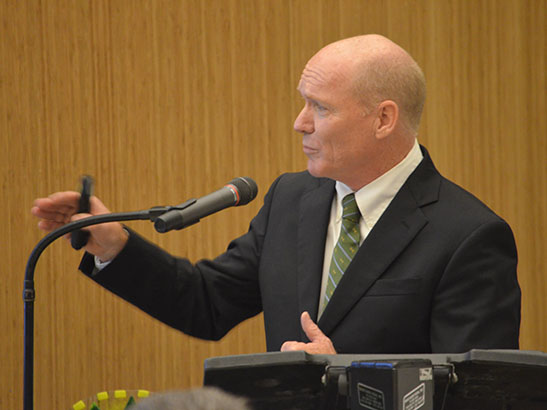
Symposium and Exhibition of Forest Products at IITF, 6th December 2014

SEE MORE IMAGES HERE:
https://plus.google.com/photos/114745085458651133282/albums/6089798854434161681?authkey=CLytzaWvsMmIfg

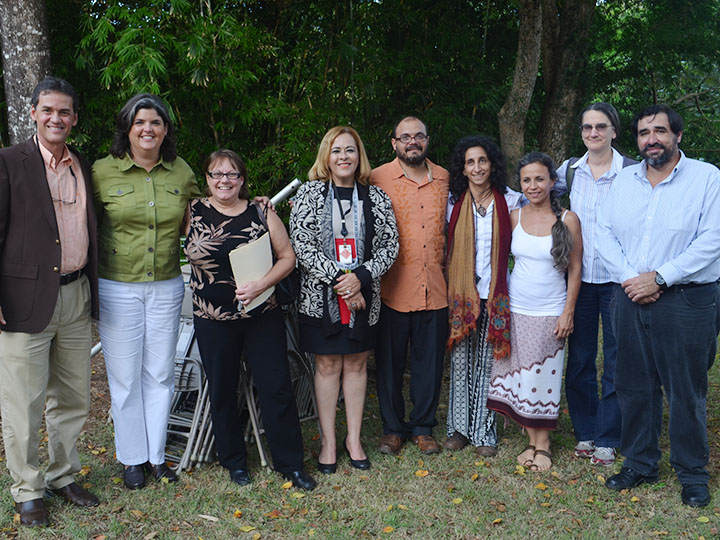
L-R: Luis Soto, (Land Authority Director) Carmen Guerrero, (Secretary of DNR), Connie Carpenter, Magaly Figueroa, (USDA State & Private Forestry), Andrés Rúa, 3t Vakil, (Tropic Ventures and Nuestra Madera), Magha Garcia, (Director Pachamama Organic Farm), Sheila Ward, (Mahogany for the Future), Edgardo Gonzalez (Landscape Conservation Center).

75 years of Forestry!

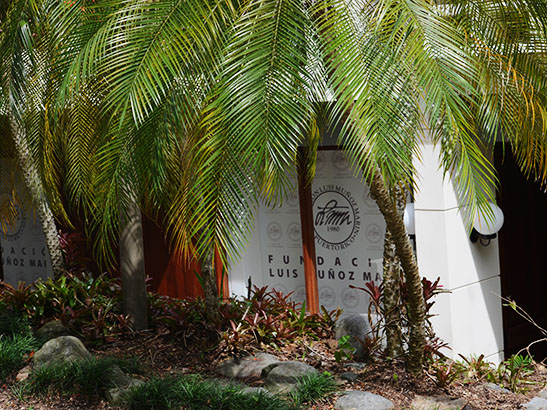
International Institute of Tropical Forestry celebrated its 75th year anniversary and a wonderful event at the Fundacion Luis Munoz Marin (FLMM) gave everyone a chance to meet up and connect over the whole days symposium, followed by a wonderful and lively reception in the evening. 21st May 2014
See more great images of this event here. Pix by 3t and Andrés

Tropic Ventures was honored to be mentioned in the recently published 2102 IITF Accomplishments. See PDF here.

Gracious thanks to FLMM, and IITF.

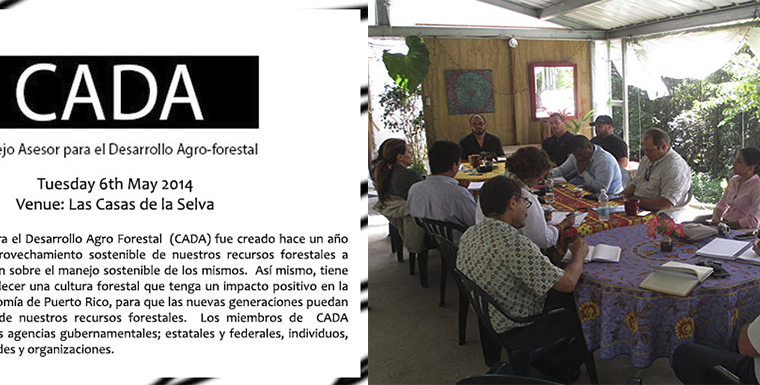
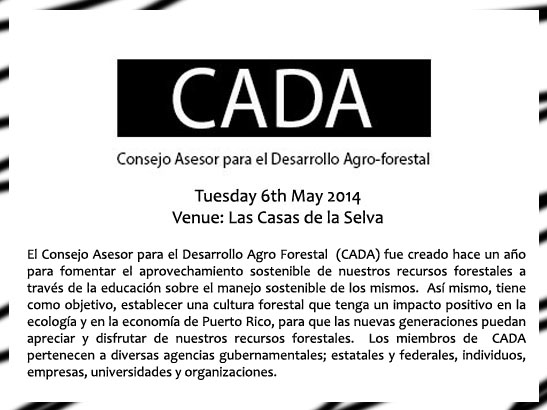
Consejo Asesor para el Desarrollo Agro-forestal, May 6th, 2014

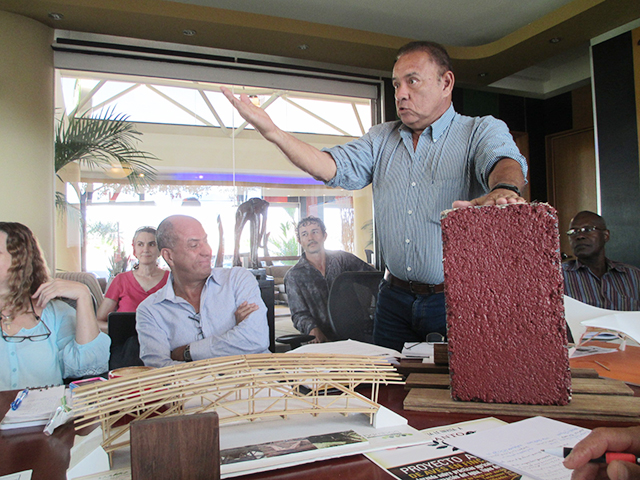
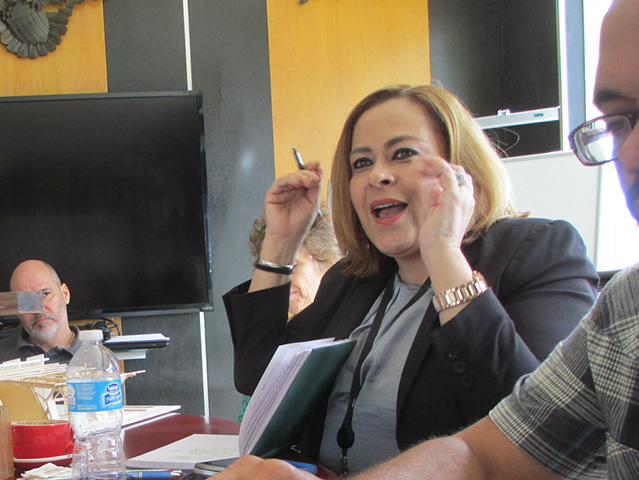
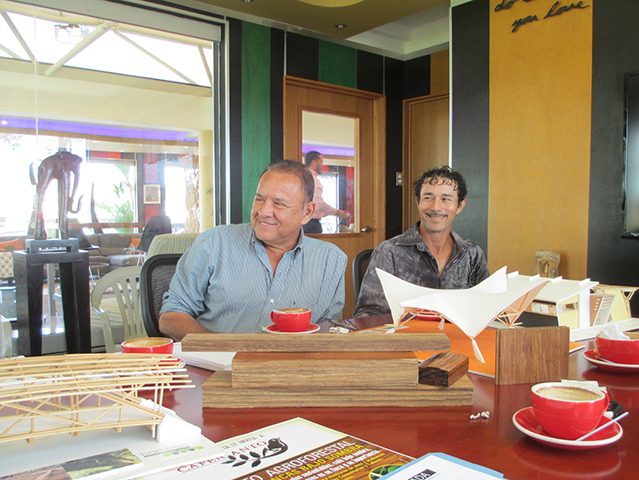
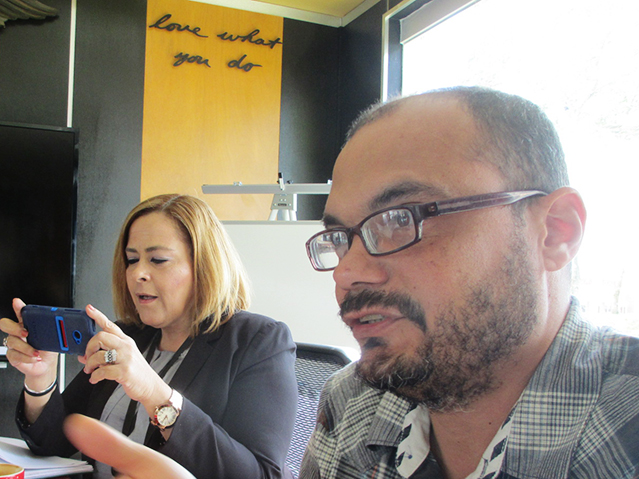
Another historic meeting for CADA, this time at Las Casas de la Selva, sustainable forestry project in the steep mountains of Patillas.

CADA, comprises of individuals brought together by a strong commitment to stimulate and create the sustainable management of all forest resources on the island of Puerto Rico. Founded in 2013 by Andrés and 3t.

SEE MORE IMAGES FROM THIS MEETING HERE:

Participants NameAgency or group
Andrés Rúa GonzálezTropic Ventures Sustainable Forestry
Thrity VakilTropic Ventures Sustainable Forestry
Magaly Figueroa (Vía teléfono)USDA US Forest Service
Arnaldo AstacioDepartamento de Agricultura de Puerto Rico
Alexis Laurent Dragoni CebolleroConsultor Fundación Aireko
Christina CabreraDepartamento de Recursos Naturales y Ambientales de PR
Enrique SantiagoDepartamento de Recursos Naturales y Ambientales de PR
Jess ZimmermanUPR Rio Piedras
Franklin RománServicio de Extensión Agrícola
Jimena ForeroUPR Rio Piedras
Rosamaría QuilesDepartamento de Recursos Naturales y Ambientales de PR
Tomas TorresFundación Aireko
Orlando GómezPaddle Sur
Francisco AliceaMunicipio de Arroyo
Elizabeth RodriguezVoluntaria
Milagros Solís OcasioPridco
Hector RodriguezPridco
Evelyn MeloPridco
Omar GarciaPaddle Sur
Enrique C. Colon BurgosAutoridad de Energía Eléctrica

SEE MORE IMAGES FROM THIS CADA MEETING AT LAS CASAS DE LA SELVA, 6TH MAY 2014

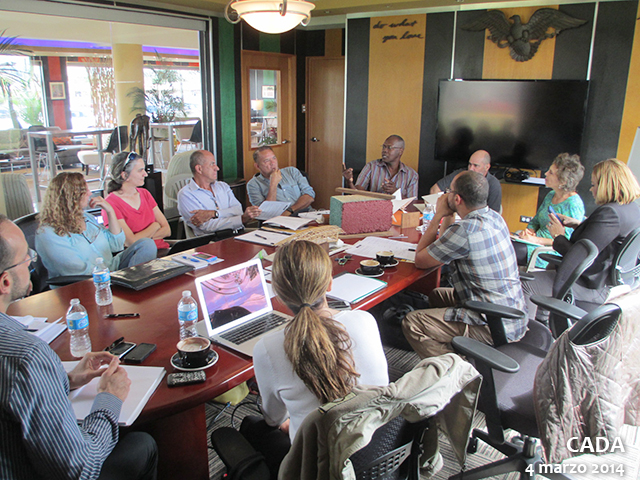
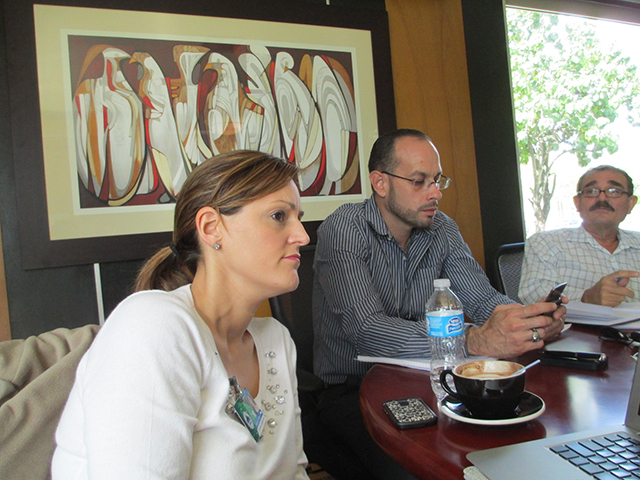
See images from the CADA meeting at Cyber Café, Caguas, 4th March 2014
See images from the CADA meeting at the International Institute of Tropical Forestry, 30th August 2013.
See images from the meeting of The Forest Products Assessment group, at Cayey University, the day the group formally became CADA, 6th May 2013
See images from the meeting of The Forest Products Assessment group at International Institute of Tropical Forestry, March 18th 2013.
See images from the FPA Field meeting at Las Casas de a Selva, 8th August, 2012
See images from the FPA Symposium at the Department of Natural Resources, Rio Piedras, 11th April, 2012

Consejo Asesor para el Desarrollo Agro-forestal 4th March 2014

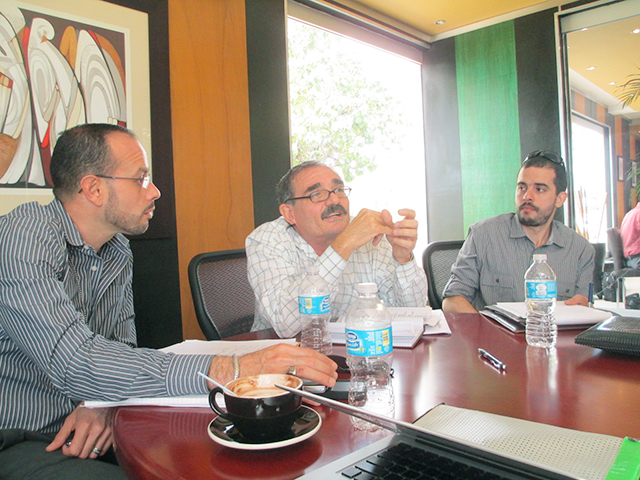
Meeting at Cyber Café, Caguas, 4th March 2014

NombreAgencia o grupo
Andrés Rúa GonzálezTropic Ventures Sustainable Forestry
Thrity VakilTropic Ventures Sustainable Forestry
Magaly FigueroaUSDA US Forest Service
Arnaldo AstacioDepartamento de Agricultura de Puerto Rico
Fernando ArroyoUSDA Natural Resources Conservation Service
Christina CabreraDepartamento de Recursos Naturales y Ambientales de PR
Enrique SantiagoDepartamento de Recursos Naturales y Ambientales de PR
Lisette FasCafiesencia
Franklin RománServicio de Extensión Agrícola
Mariano RobledoBamboo Puerto Rico
Maria BenedettiBotanicultura
Daniel CabanBamboo Puerto Rico
Sheila WardMahogany for the future
Félix Aponte GonzálezDepartamento de Recursos Naturales y Ambientales de PR
Enrique C. Colon BurgosAutoridad de Energía Eléctrica

Images by 3t Vakil, 2014

Ready, willing, and able.

Erin Dahl, (who first came here two years ago with a team from University of Miami), Christopher Sanchez, and Danielle Ungermann all participated in the January harvest of mahoe trees from around the homestead. Andres, chainsawyer, and 3t, felling buddy, were happy to have the help of these three ready, willing, and able apprentices, and together, everyone trained and learned something in the essential art of directional felling, using cuts, wedges, ropes, and a come-along (a small portable winch usually consisting of a cable attached to a hand-operated ratchet).Gentle gasps of astonishment were heard as 65 feet tall trees fell, and fortunately, they all fell exactly where Andres designated. The team have been busy clearing the slash (the small twigs and branches), and depositing it back into the forest for nutrients and erosion control. Thank you Erin, Chris, and Danielle, we have really appreciated your stay with us.

Collecting Ausubo seedlings

Collecting Ausubo seedlings sounds like an easy task, but carrying full tree bags up and down forest slopes back to the homestead is demanding physical labor.
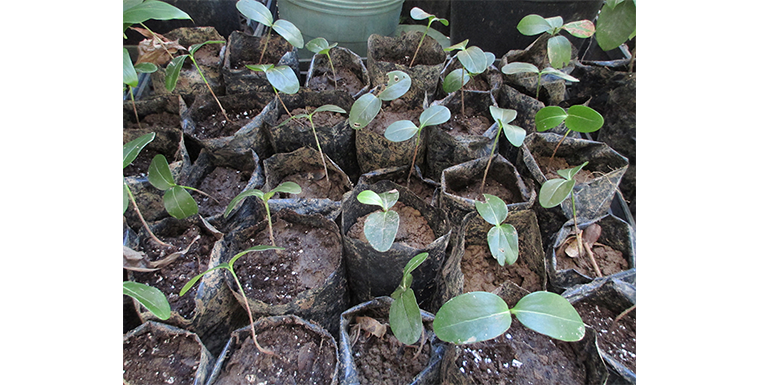
Our current Earthwatch Team assisted with this task on New Years Eve, and in one morning we collected 110 Ausubo (Manilkara bidentata) seedlings.

Ausubo (Manilkara bidentata), also known a balata, is a large evergreen forest tree that was probably the most important timber tree of Puerto Rico. It grows best in Puerto Rico on alluvial plain where it may reach the age of 400 years. Ausubo is extremely tolerant of shade. The strong and attractive wood makes it highly valued commercially an it is widely used in the tropics for many woo products. The tree is often tapped for its milky latex the source of balata gum. Although growth is slow, ausubo is planted for shade and timber.

Ausubo is one of the strongest and most attractive commercial woods in Puerto Rico. It is widely used in the tropics for railway sleepers, bridging, heavy construction, furniture, turnery, flooring, violin bows, and billiard cues. Its strength, high wear resistance, and durability qualify the timber for use in textile and pulpmill equipment. Its excellent steam-bending properties make it suitable for boat frames and other bent work.

The heartwood is light red when cut and turns to dark reddish brown when dry. The sapwood is whitish to pale brown. The wood is very hard, strong, fine textured, and heavy, with a specific gravity of 0.85. The wood rates excellent for boring, fair for planing, and poor for turning. It is difficult to air season and shows severe checking and warp if dried too fast. The wood finishes very well and resembles mahogany.

This info is by Peter Weaver, one of our favorite foresters, and good friend. For more detailed info on this tree and its properties see: https://www.na.fs.fed.us/pubs/silvics_manual/volume_2/manikara/bidentata.htm

Pines and orchids -14th September 2013

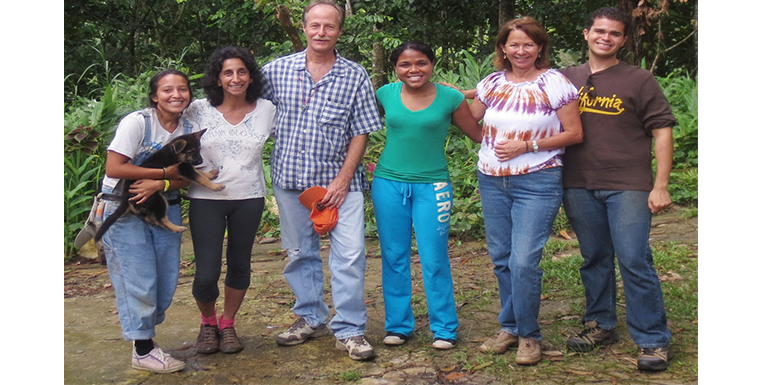
L-R: Tania Hernandez Caraballo,  3t,  Jim Ackerman, Escarlin Reyes Genao, Carmen-Iris Rodriguez, and Joel Salcedo Mejias (Pic by Andrés R♪a)

Prof. Jim Ackerman brought his students to Las Casas de la Selva to make observations on exotic orchids and pines. Our friend Carmen Iris, (second from right), studied with Jim 26 years ago. Always a pleasure to spend time with Jim and get the downloads on his current studies and forest insights.
Oh, and the puppy is the new addition to Carmen Iris and Alberto Rodriguez’ household.  An adorable pedigree German Shepherd, 2 months old, called Ninja,

Talking about wood

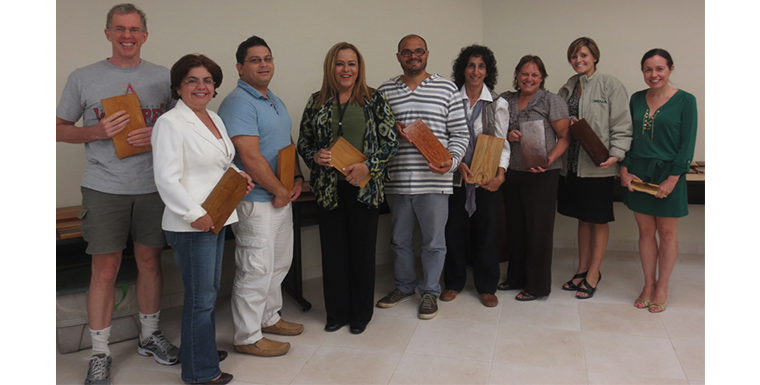
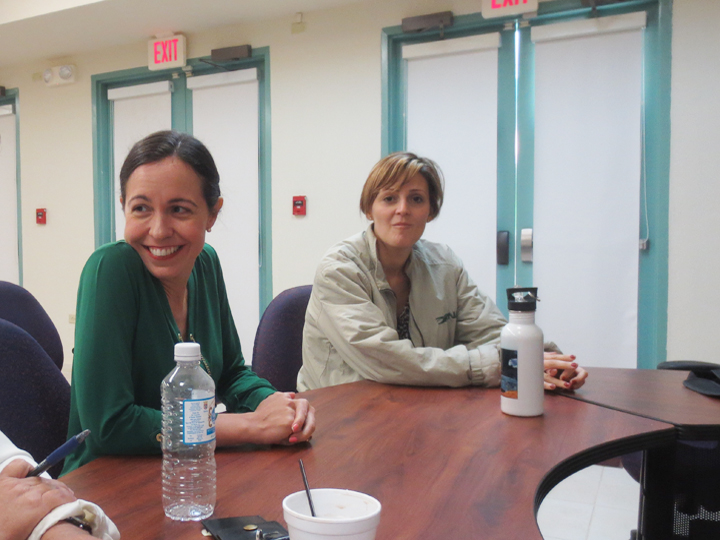
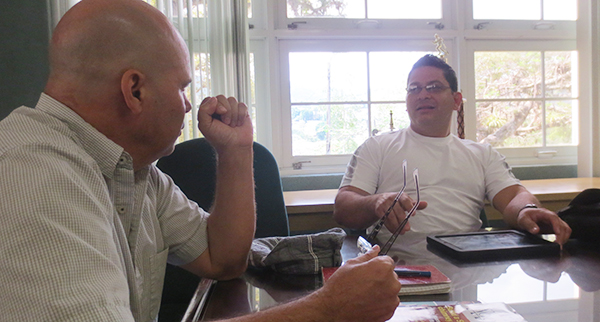
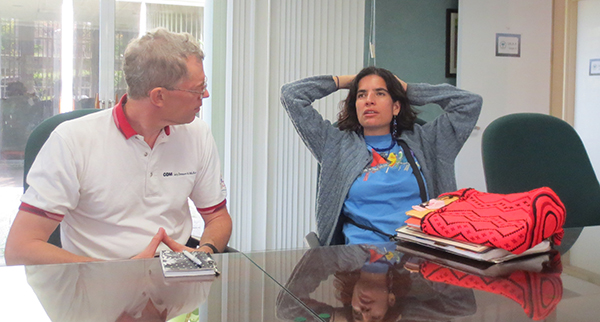
L-R: Mark Schofield (Ex-Editor of Fine Woodworking Magazine); Yolanda Flores (Department of Agriculture); Augusto Carvajal (Biologist); Magaly Figueroa (USDA Forest Service, IITF); Andrés Rúa (Tropic Ventures Research & Education Foundation); 3t Vakil (Tropic Ventures Sustainable Forestry Project); Connie Carpenter (US State & private Forestry, IITF); Christina Cabrera (Departmento de Recursos Naturales y Ambientales, Ayudante Especial, Oficina del Secretario); Aileen Amador (Departamento de Transportación y Obras Públicas).

CADA meeting at the International Institute of Tropical Forestry, 30th August 2013.
Consejo Asesor para el Desarrollo Agroforestal de Puerto Rico

“Working towards the development of Sustainable Forestry in Puerto Rico, and the research and creation of a forest products industry and relevant markets.”

See www.nuestramadera.org for more info on this new council and its mission, founded in May 2013 by Andrés Rúa and 3t Vakil.

All images by 3t Vakil

May 6th 2013, meeting at Cayey University.

The Forest Products Assessment group formally became C.A.D.A. (Consejo Asesor para el Desarrolo Agro-forestal de Puerto Rico).

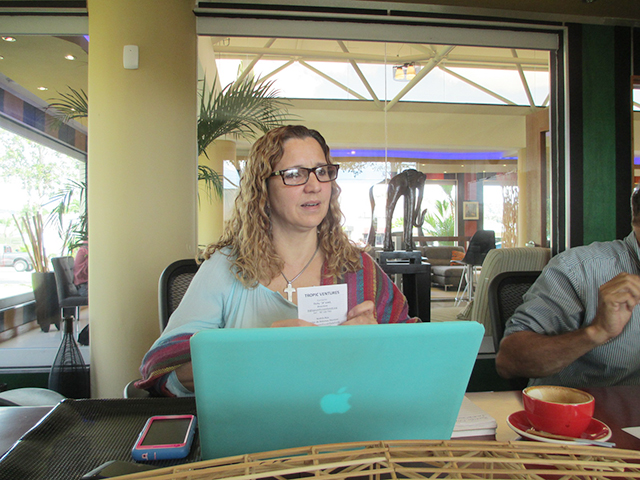
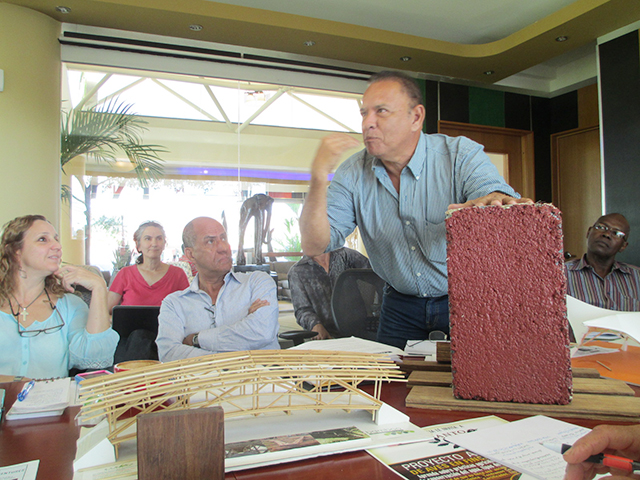
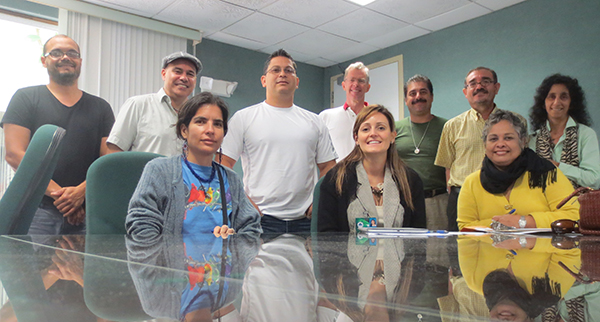
Back row: Andrés Rua (TVREF), Enrique Santiago Irrizary (DRNA), Augusto Carvajal (UPR Cayey), Mark Schofield (former editor of Fine Woodworking Magazine), Gerardo Hernandez (Management Official for Toro Negro State Forest), Franklin Roman (UPR Agriculture Extension Officer and Agronomist), 3t Vakil (TVREF)
Front: Jimena Forero Montanez (UPR Phd student), Christina Cabrera (Special Assistant to the Secretary, DRNA), Rosamaria Quiles (DRNA)

Translate »