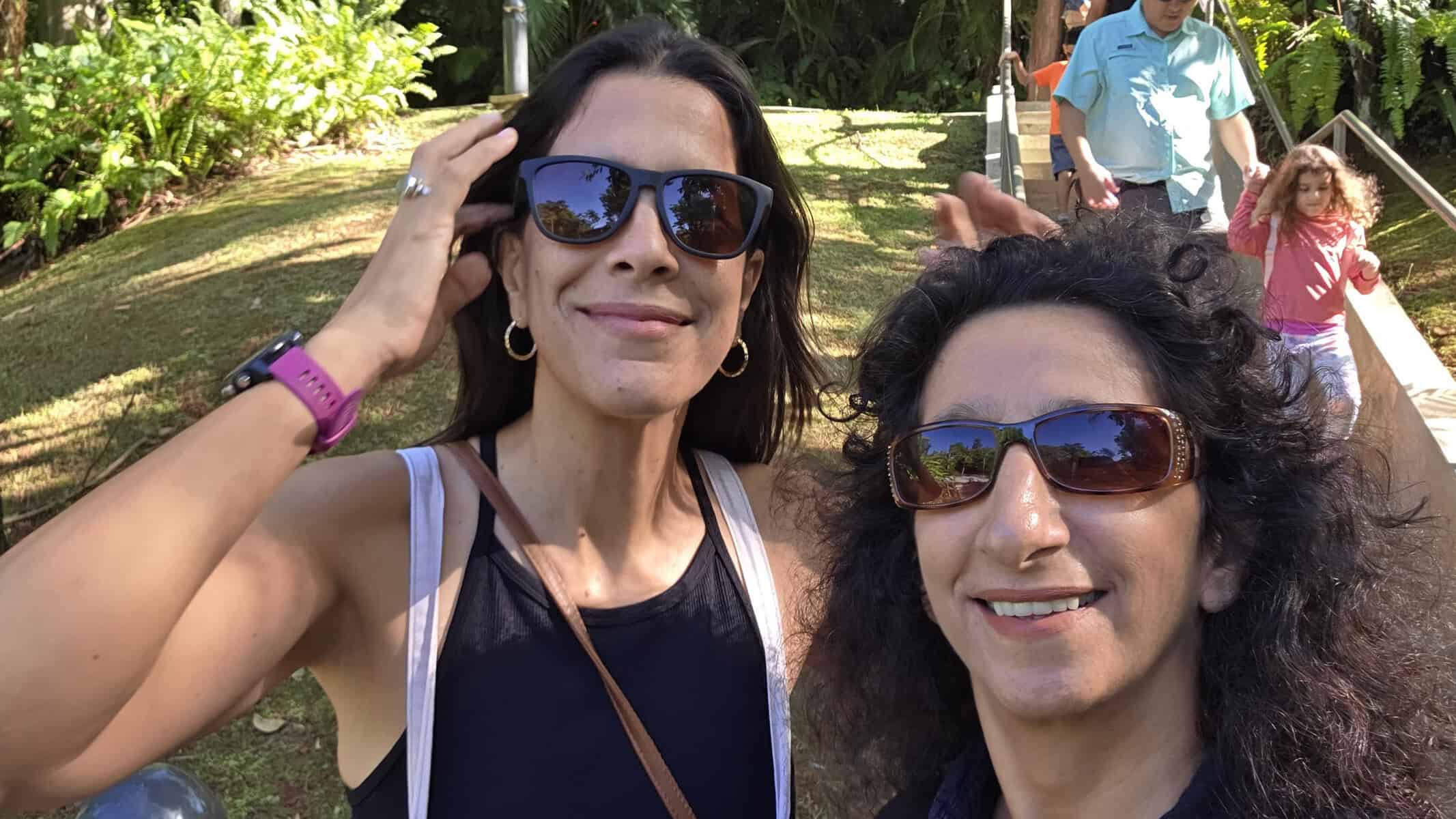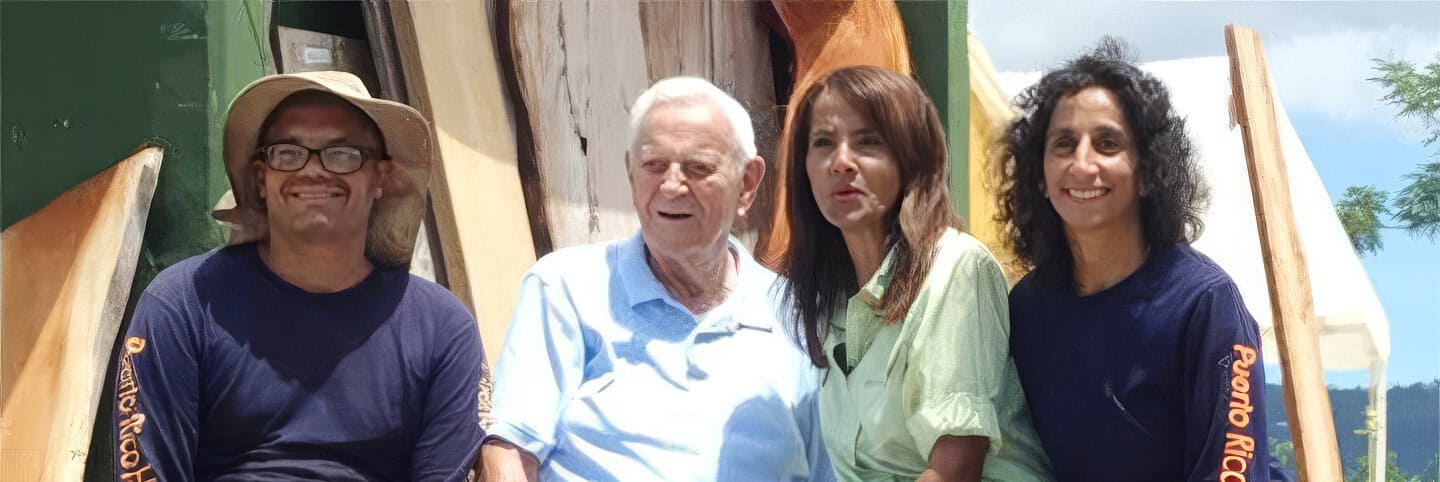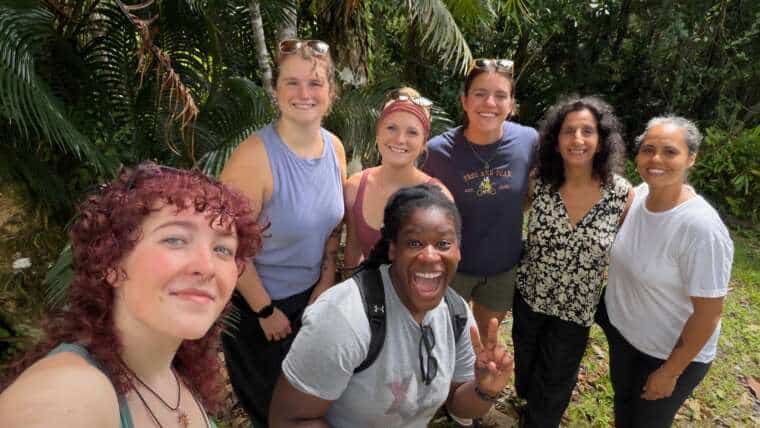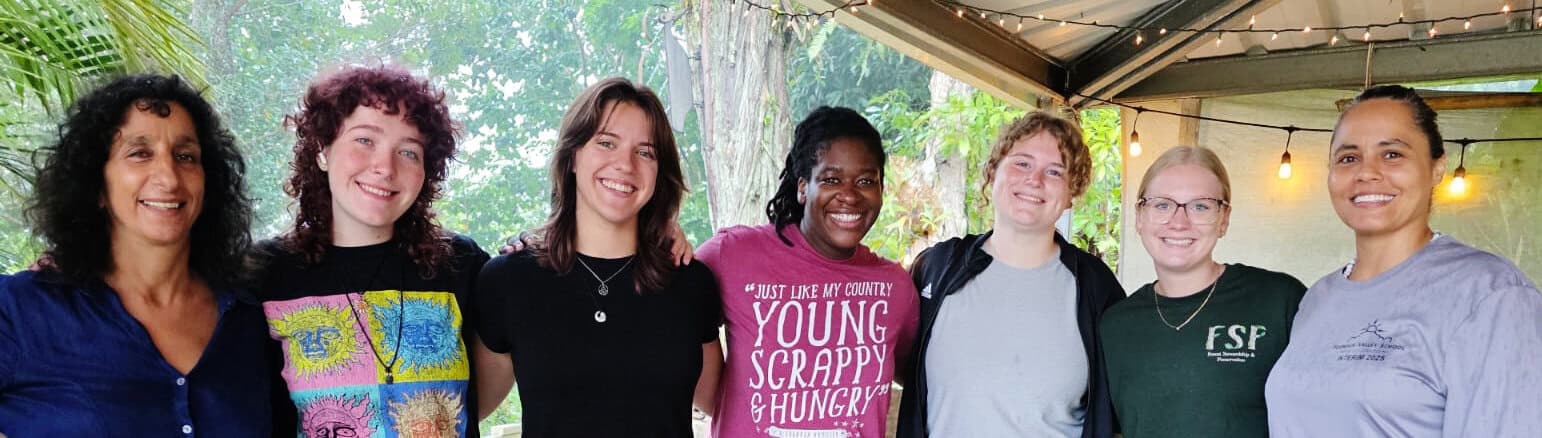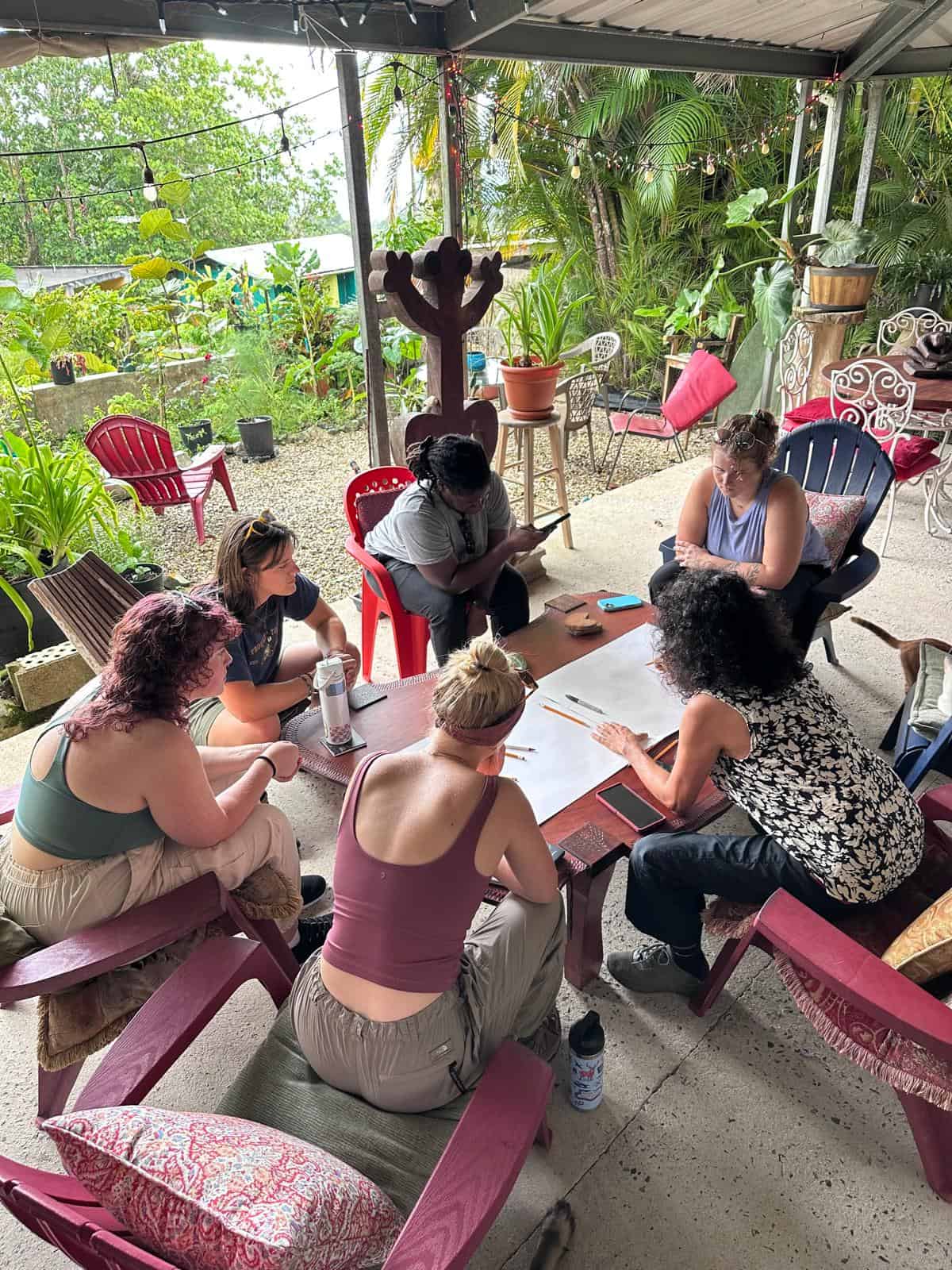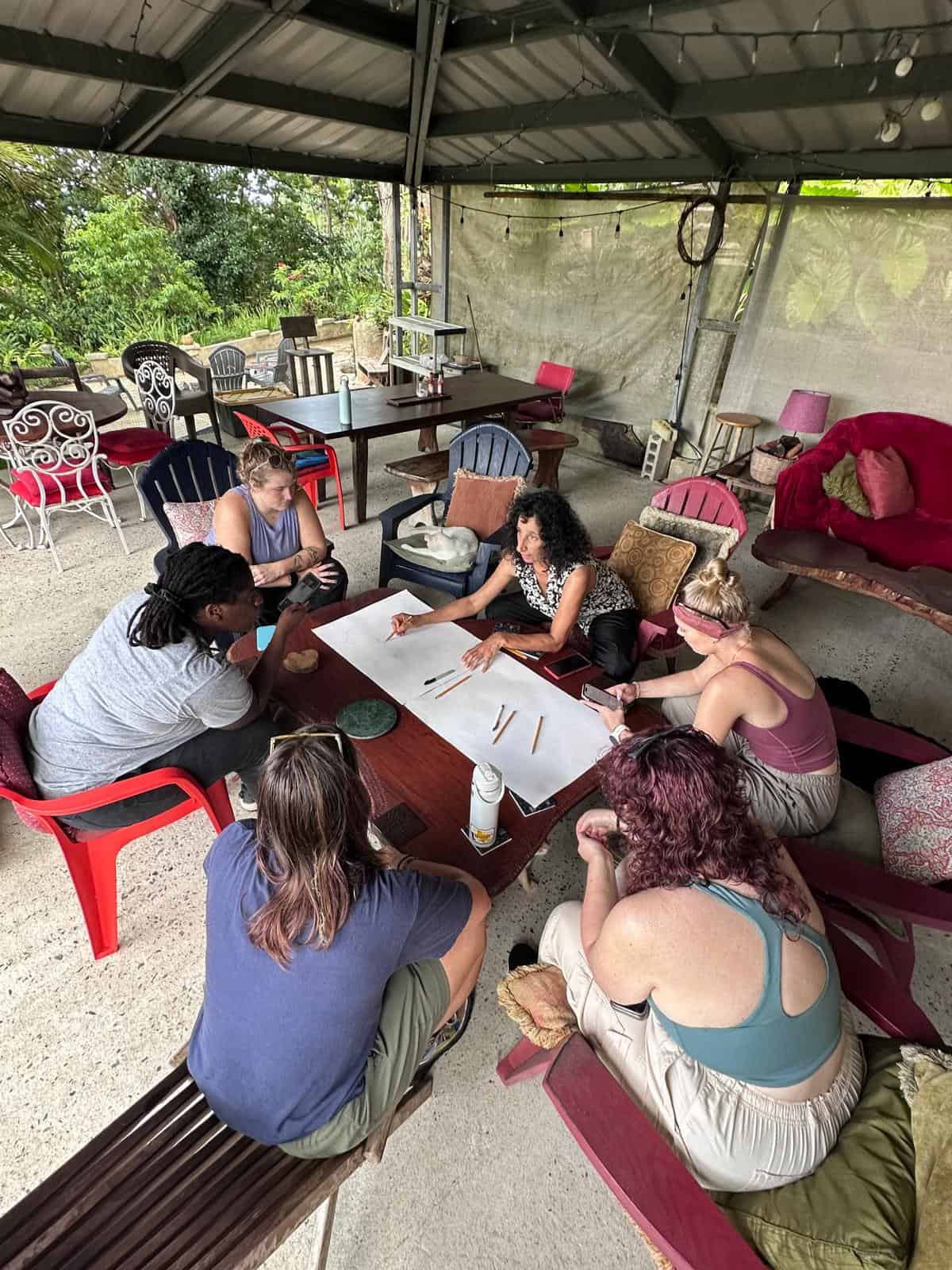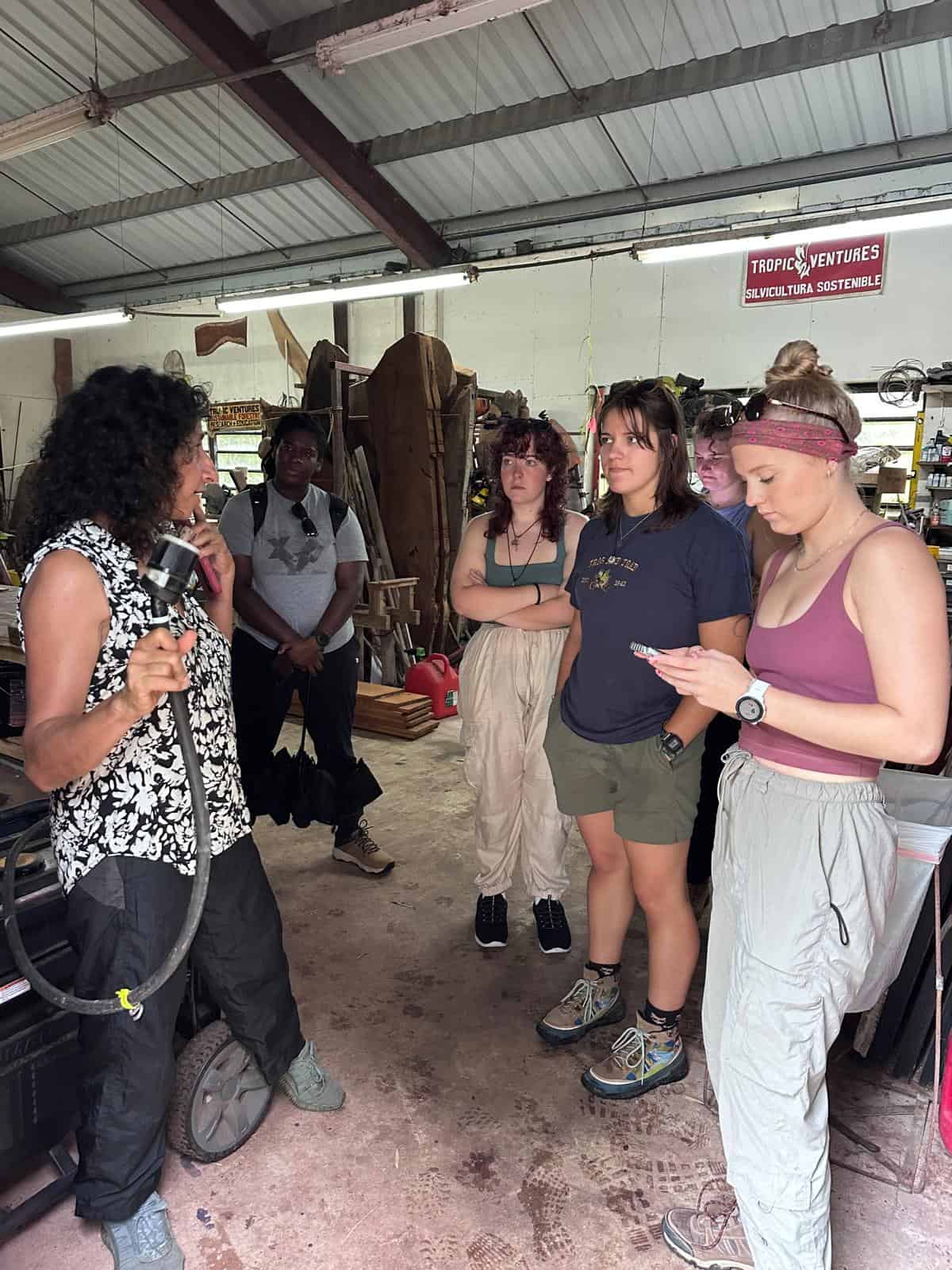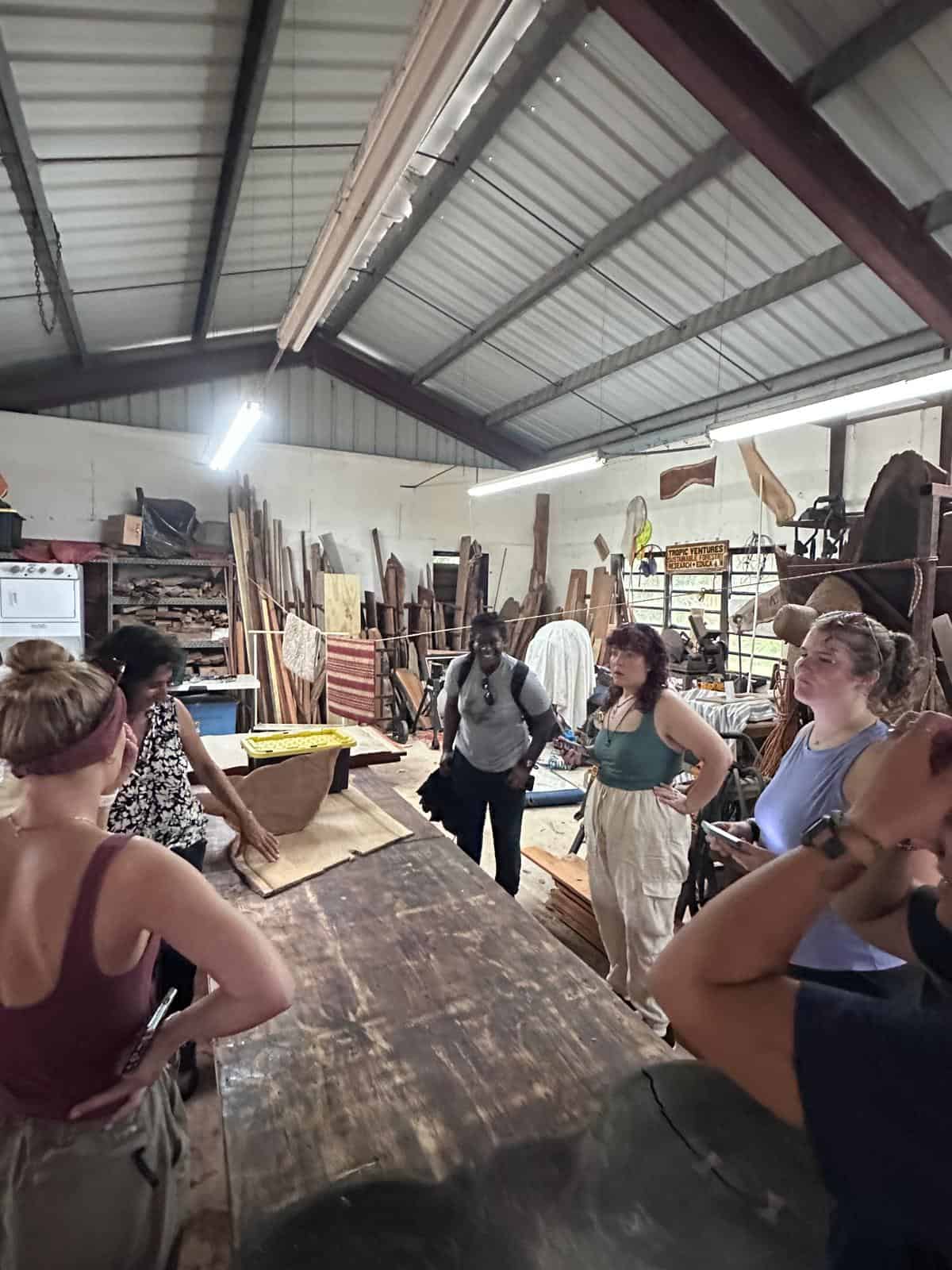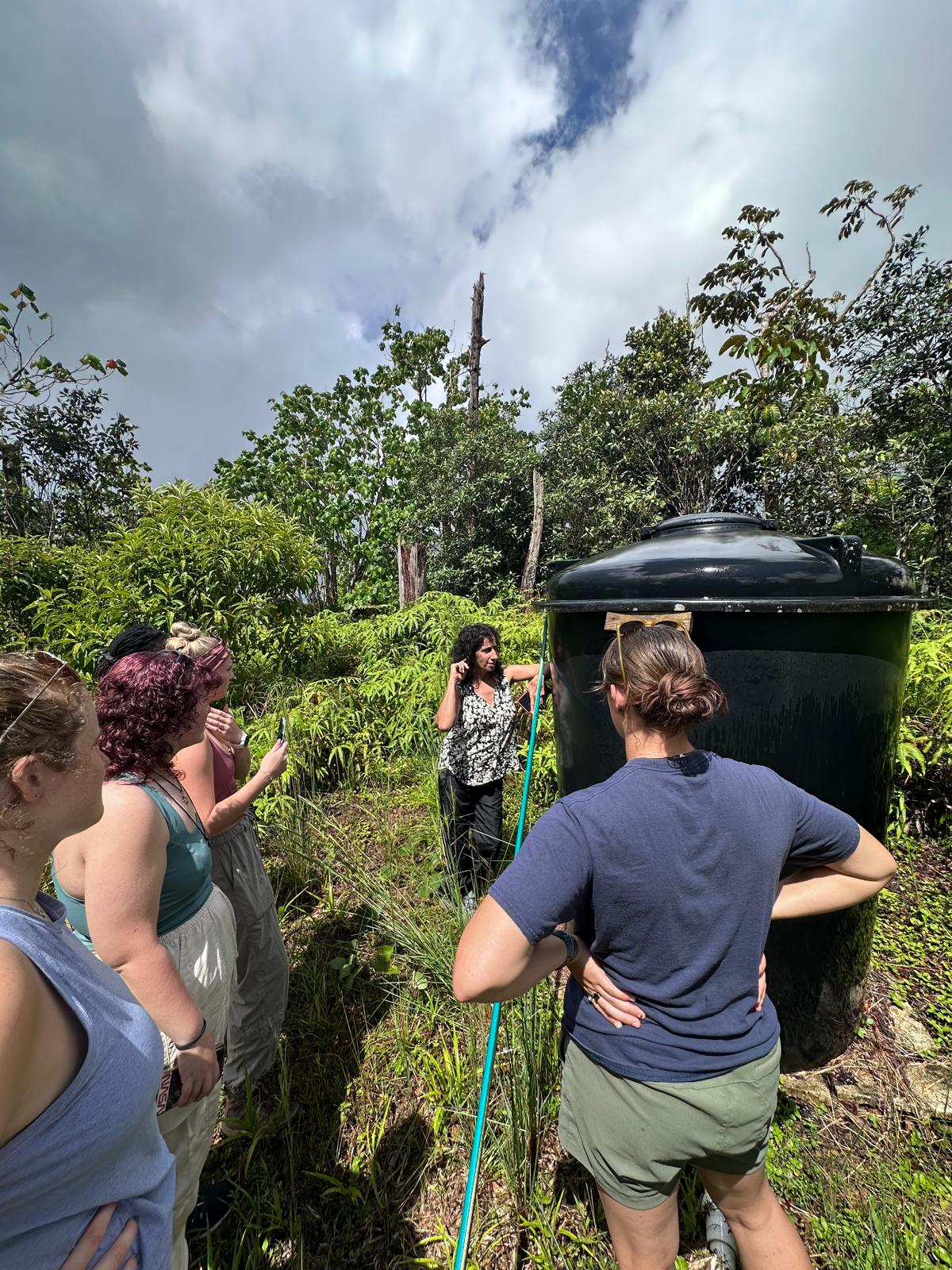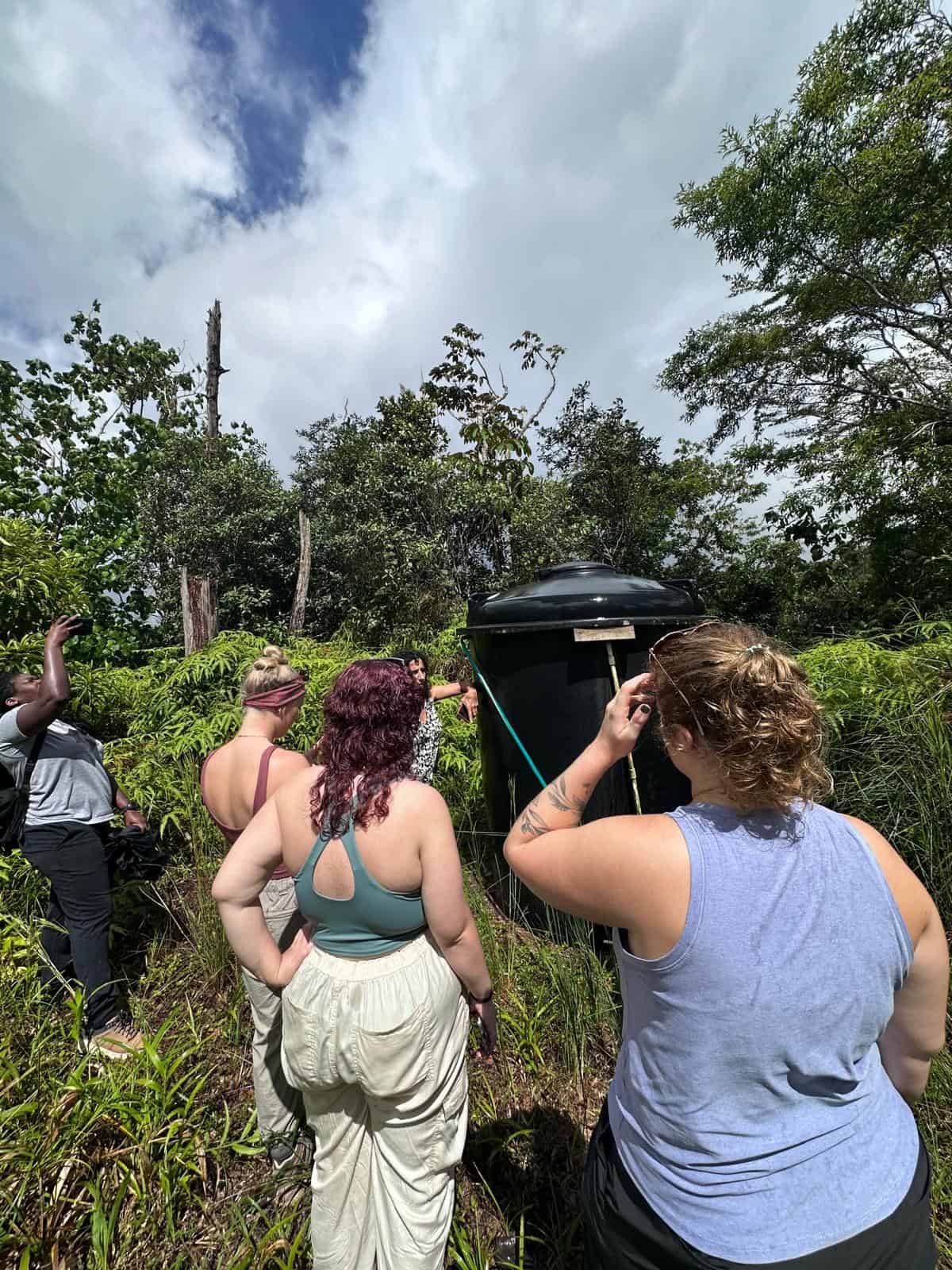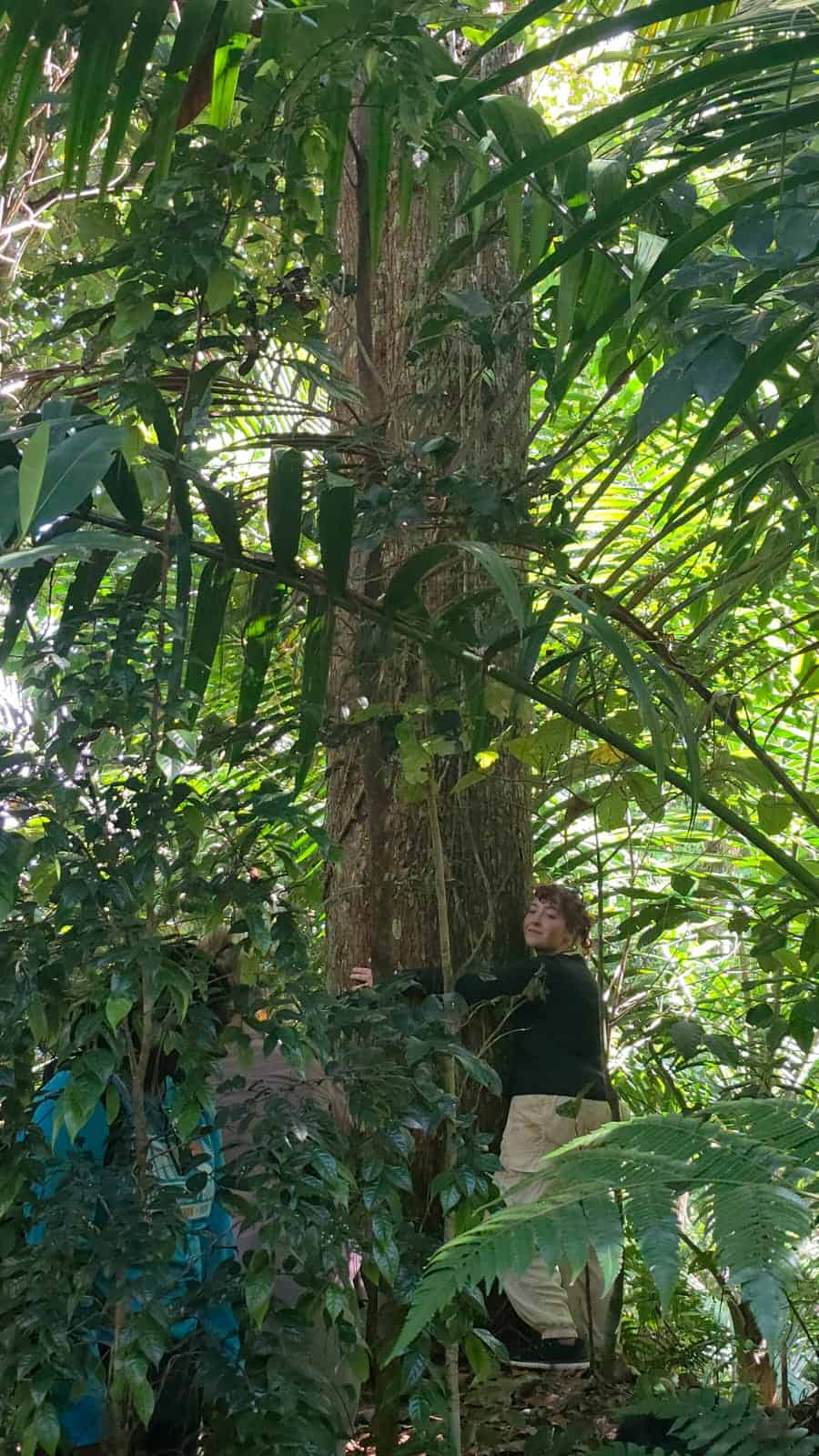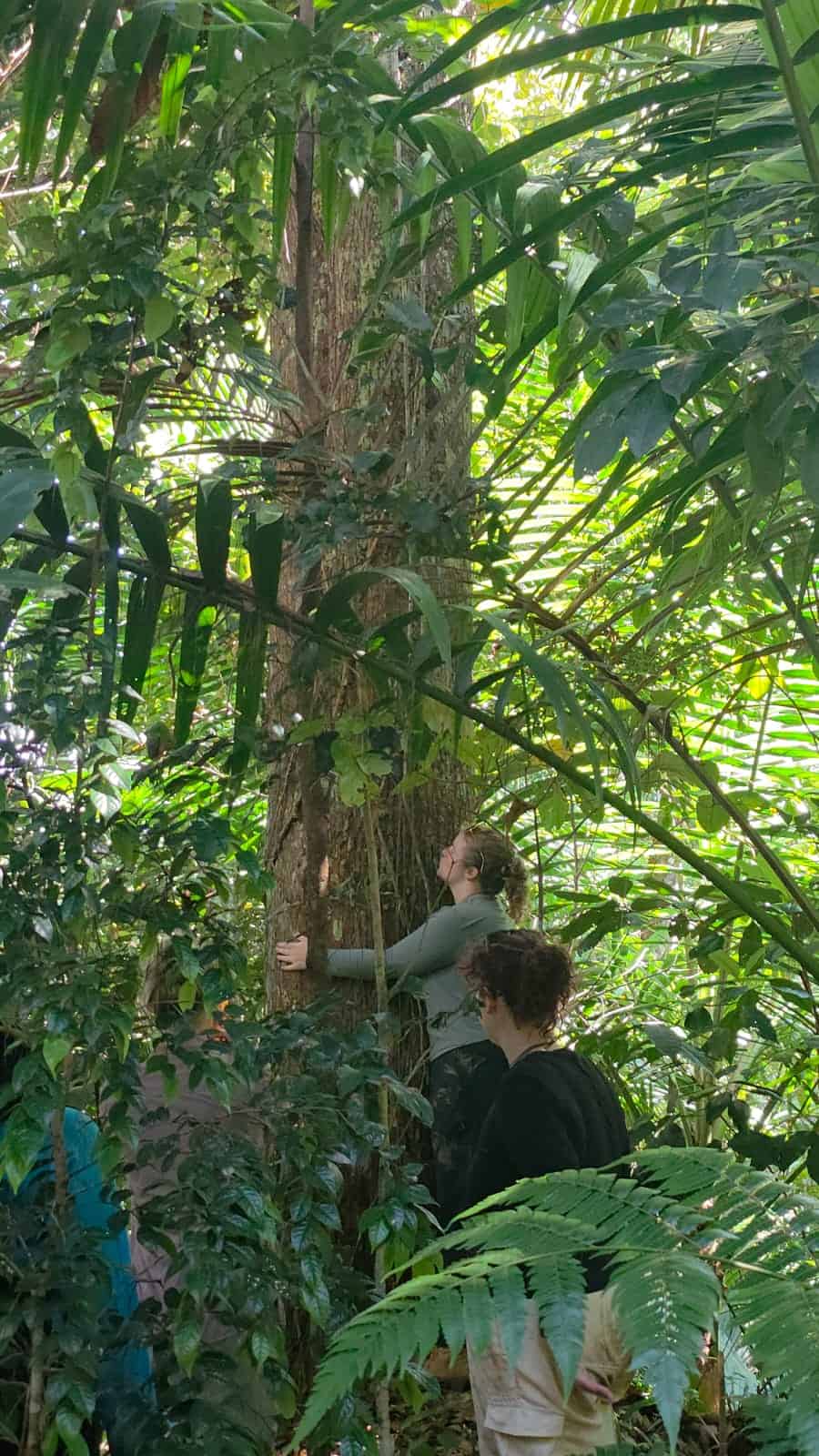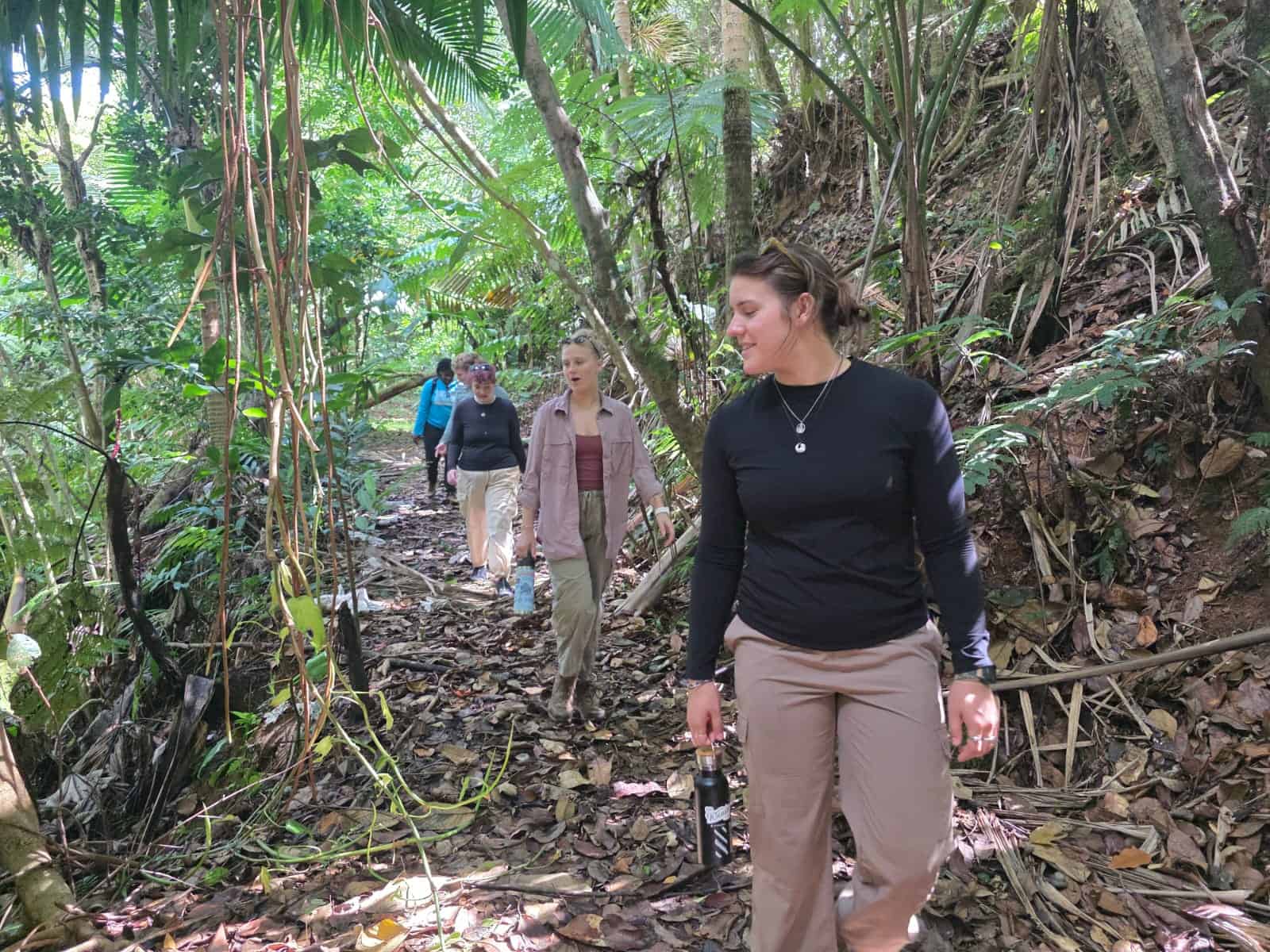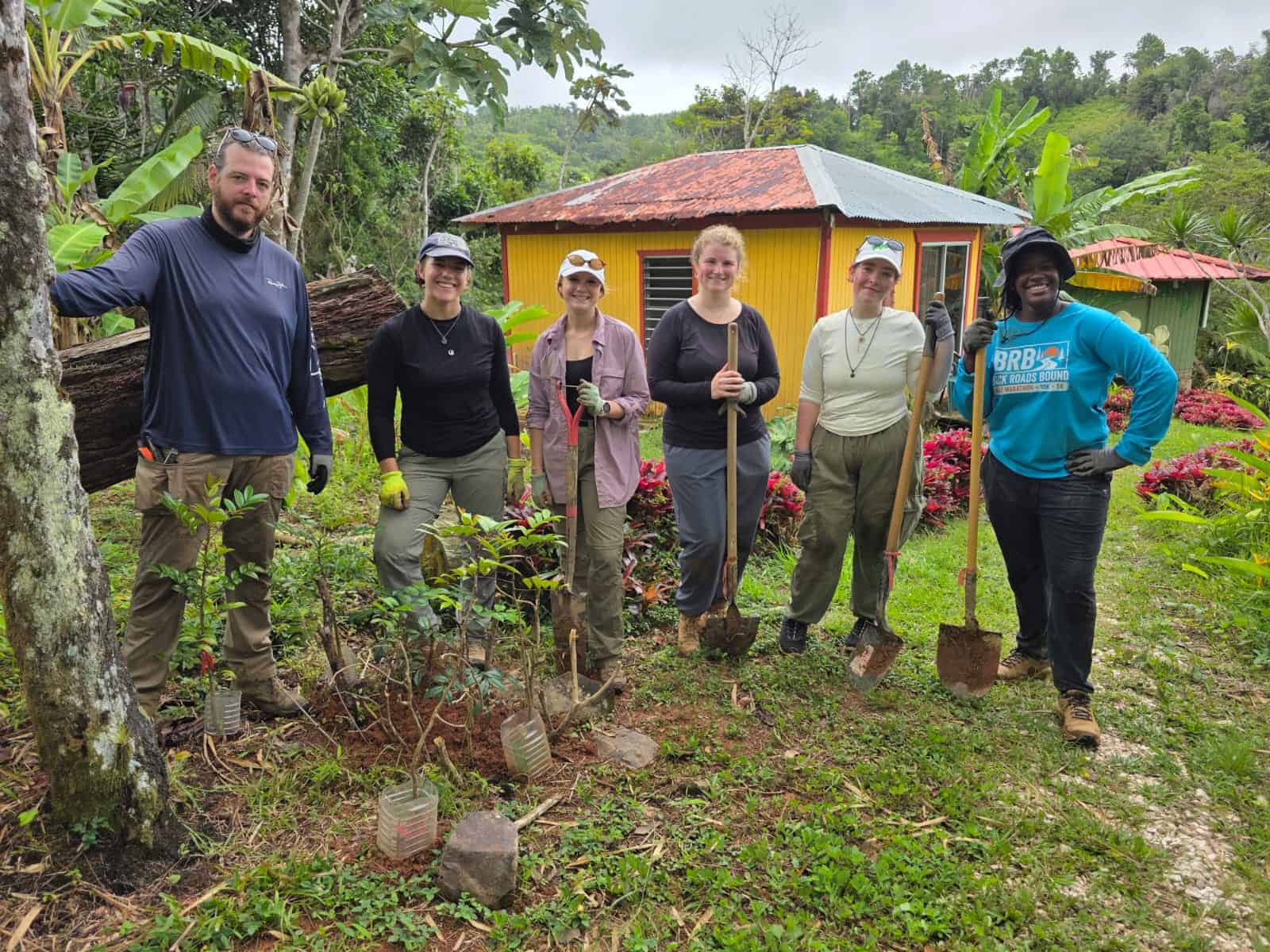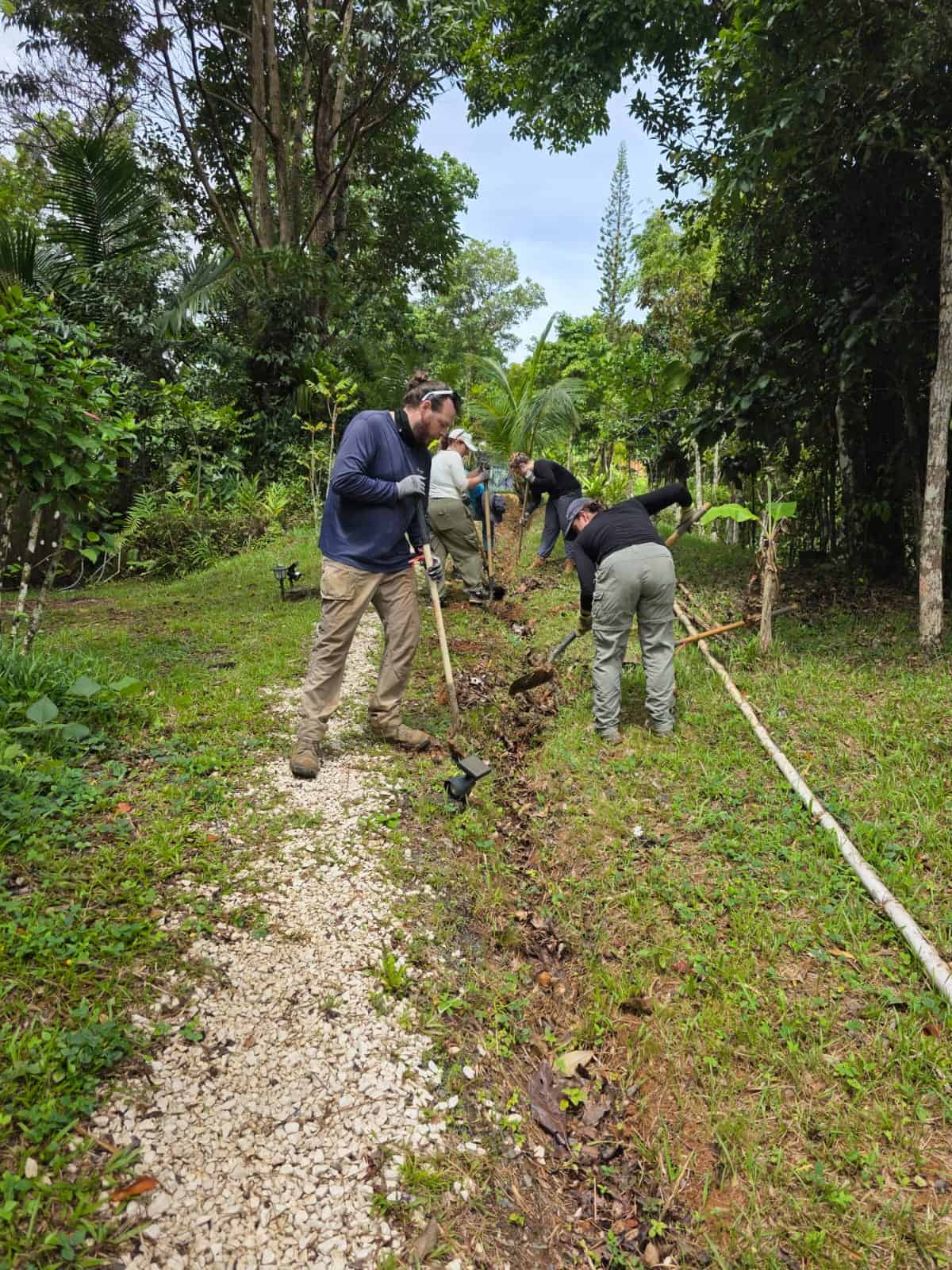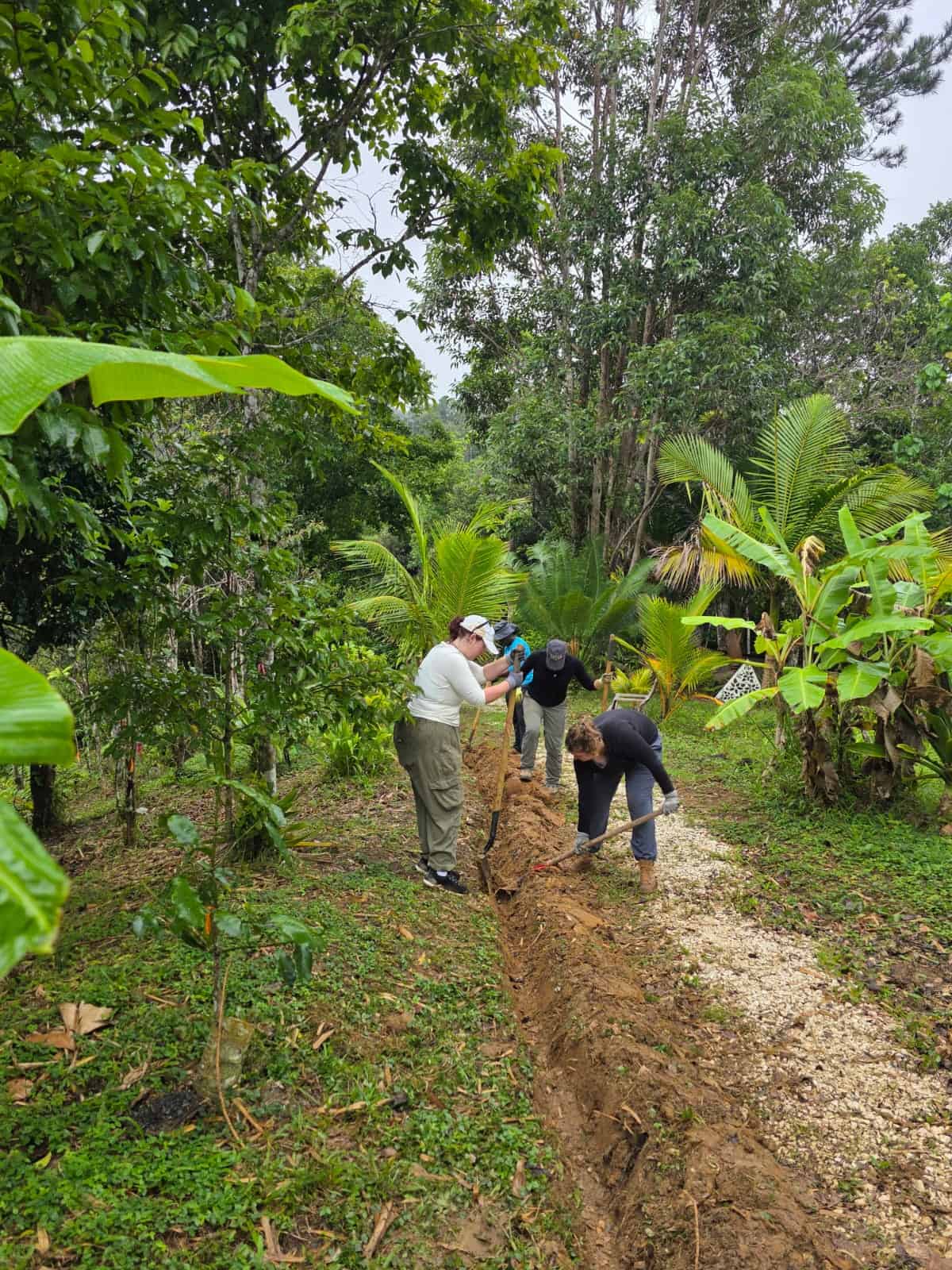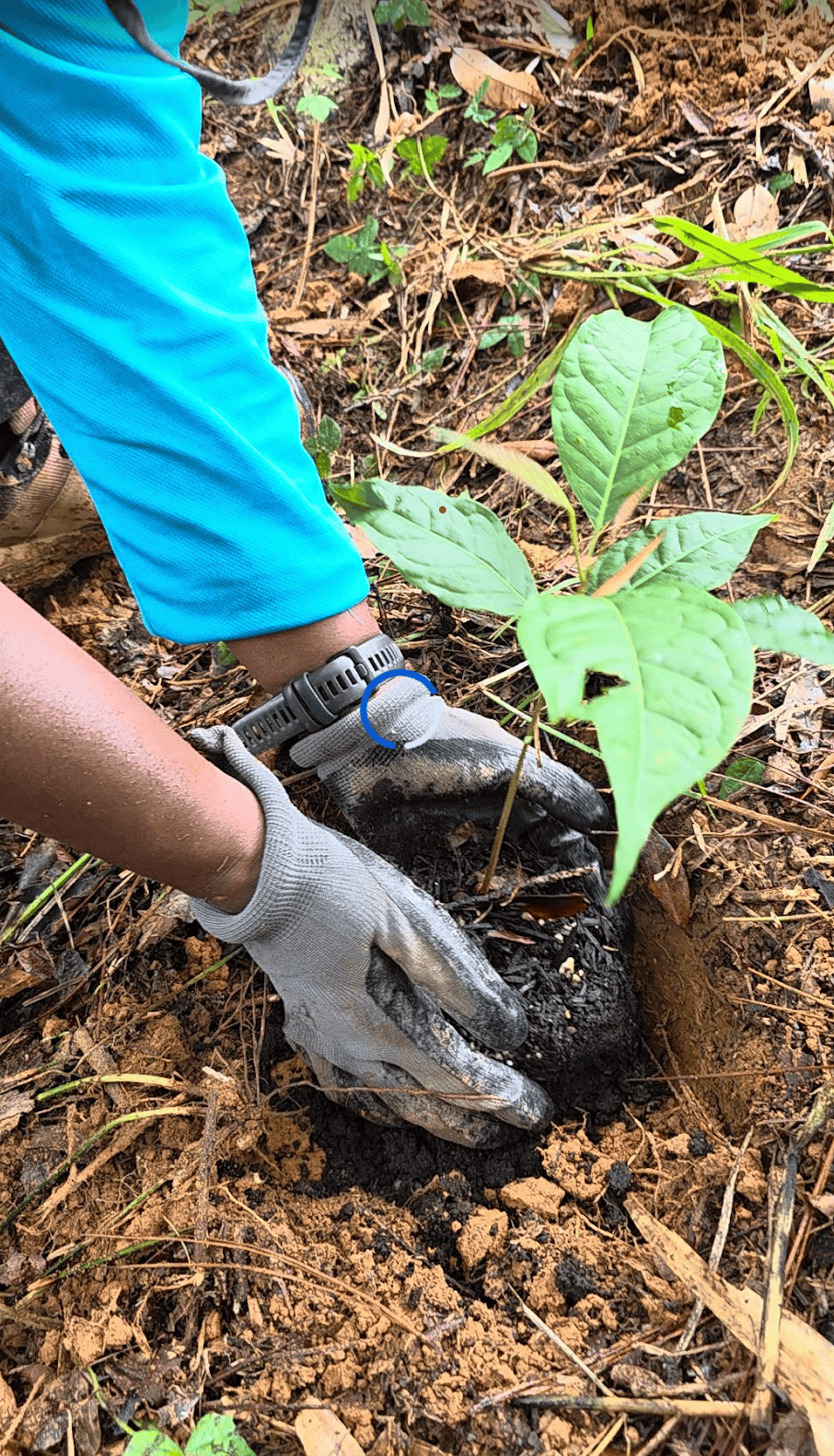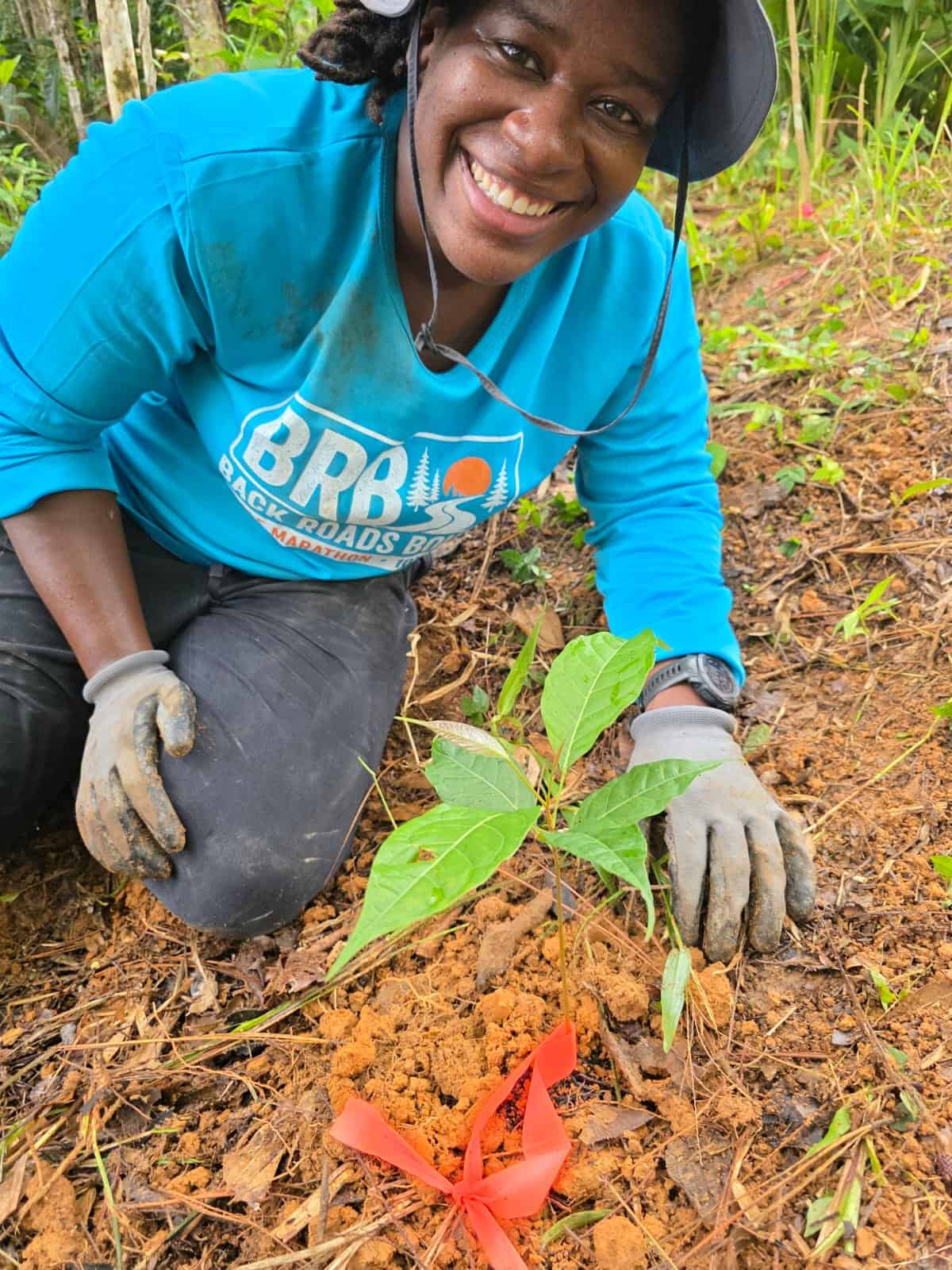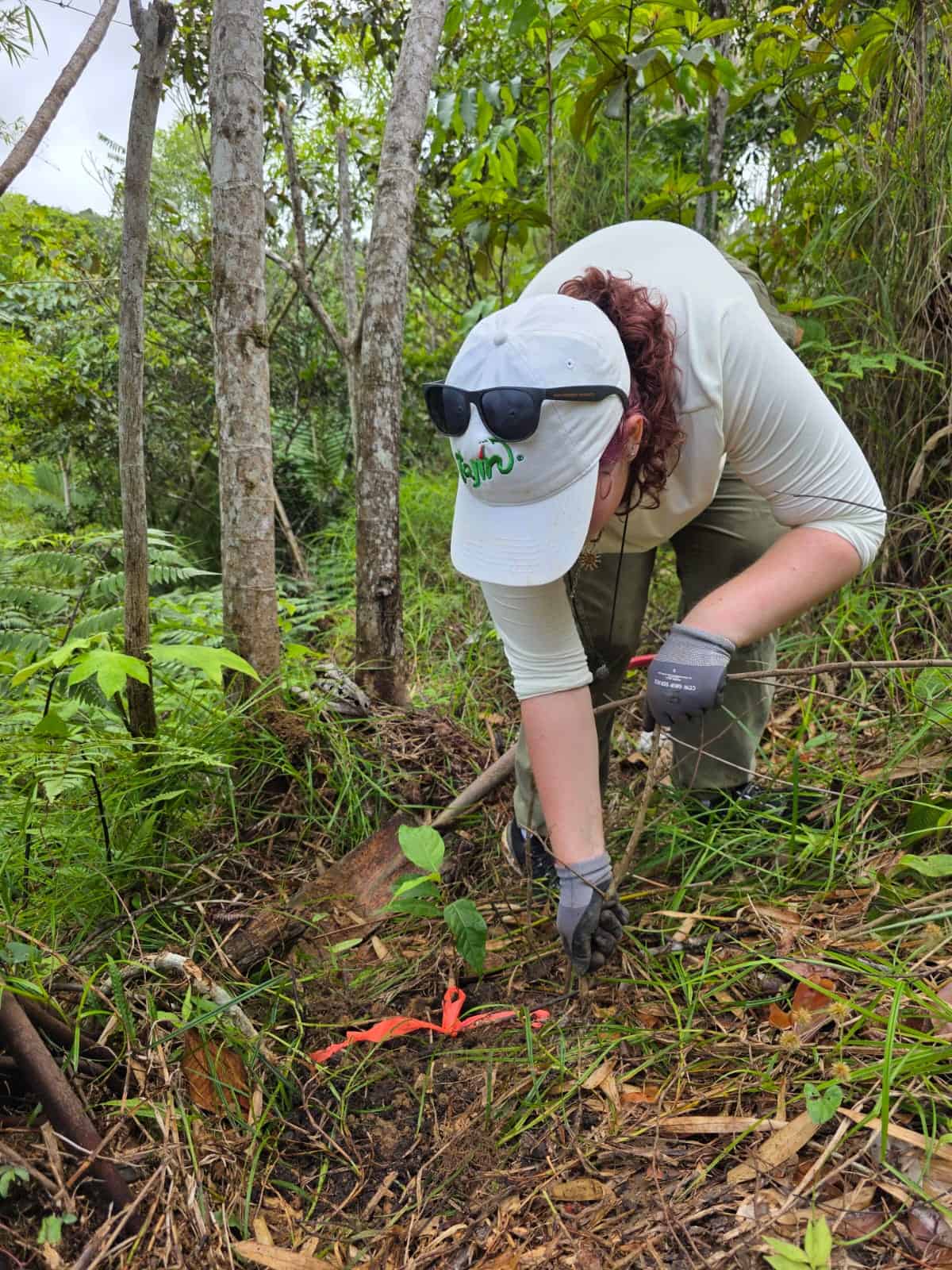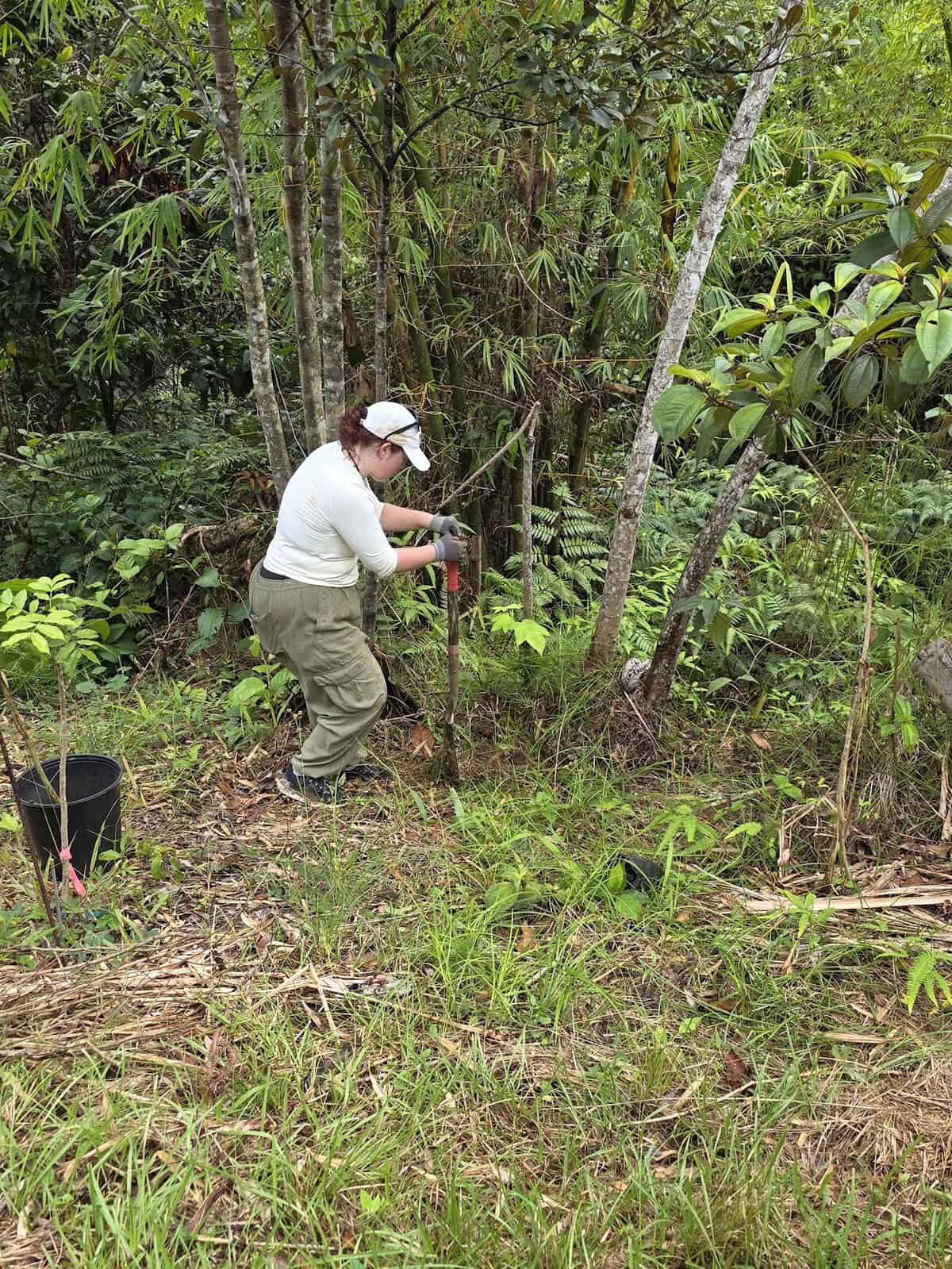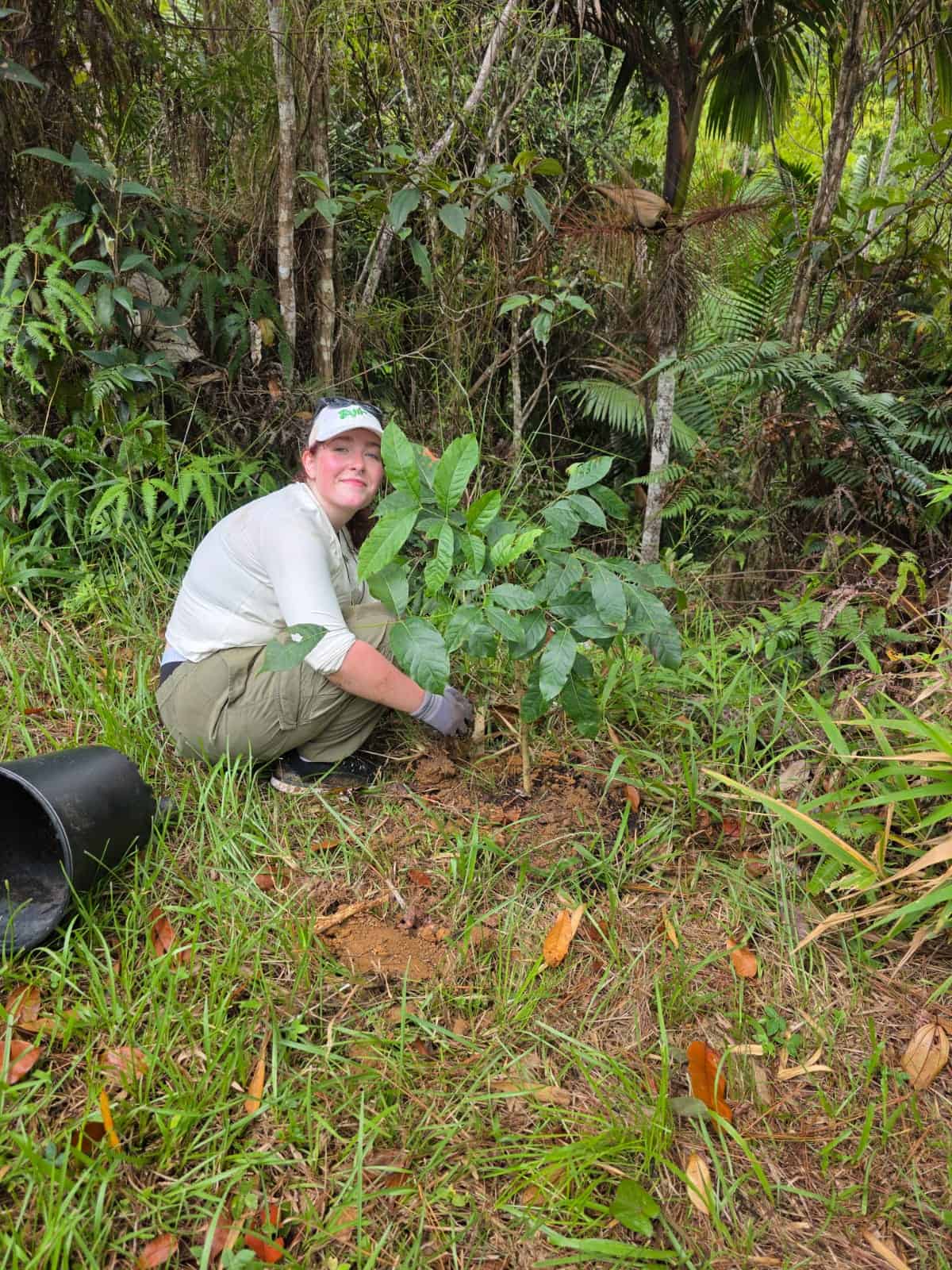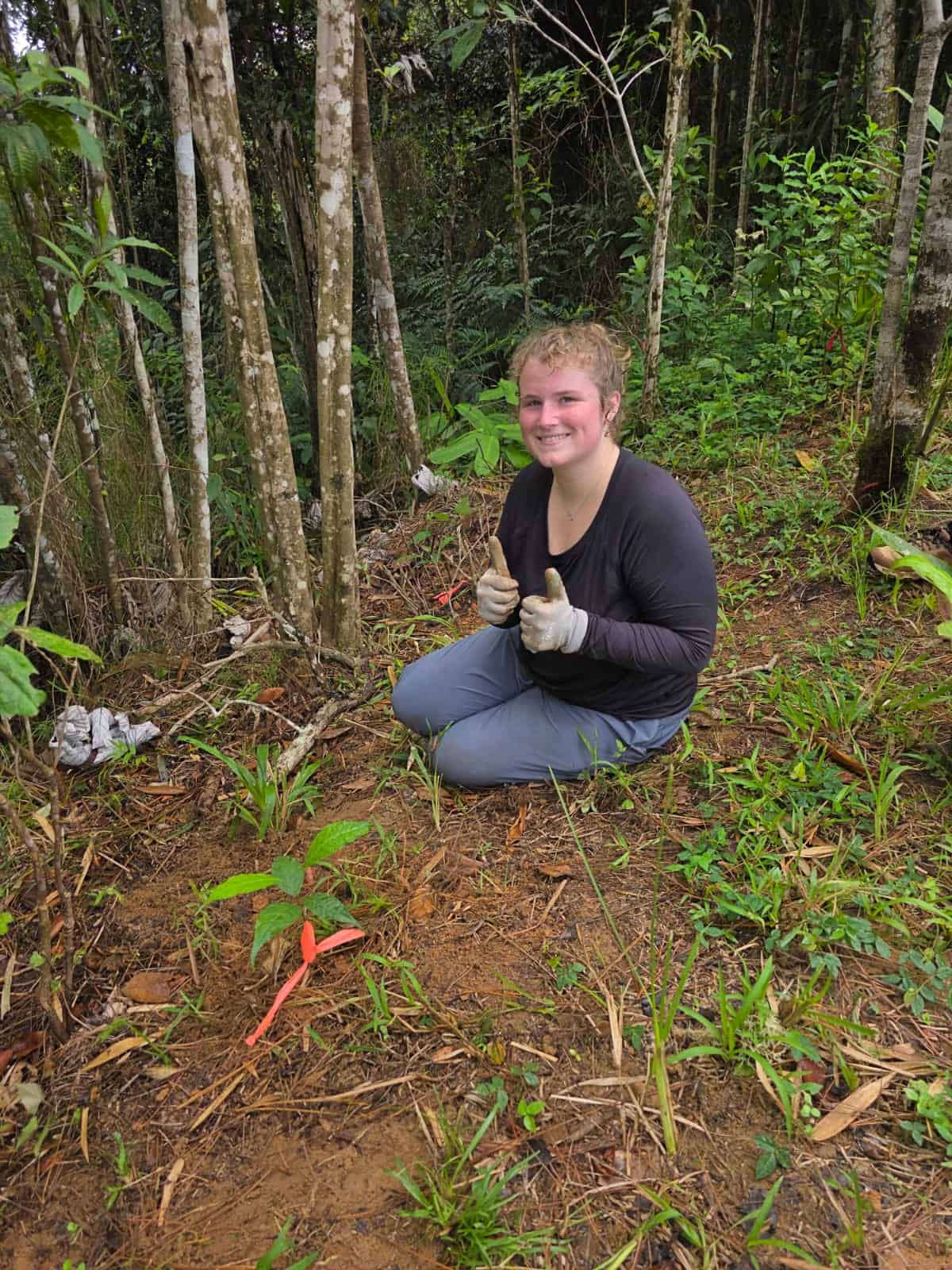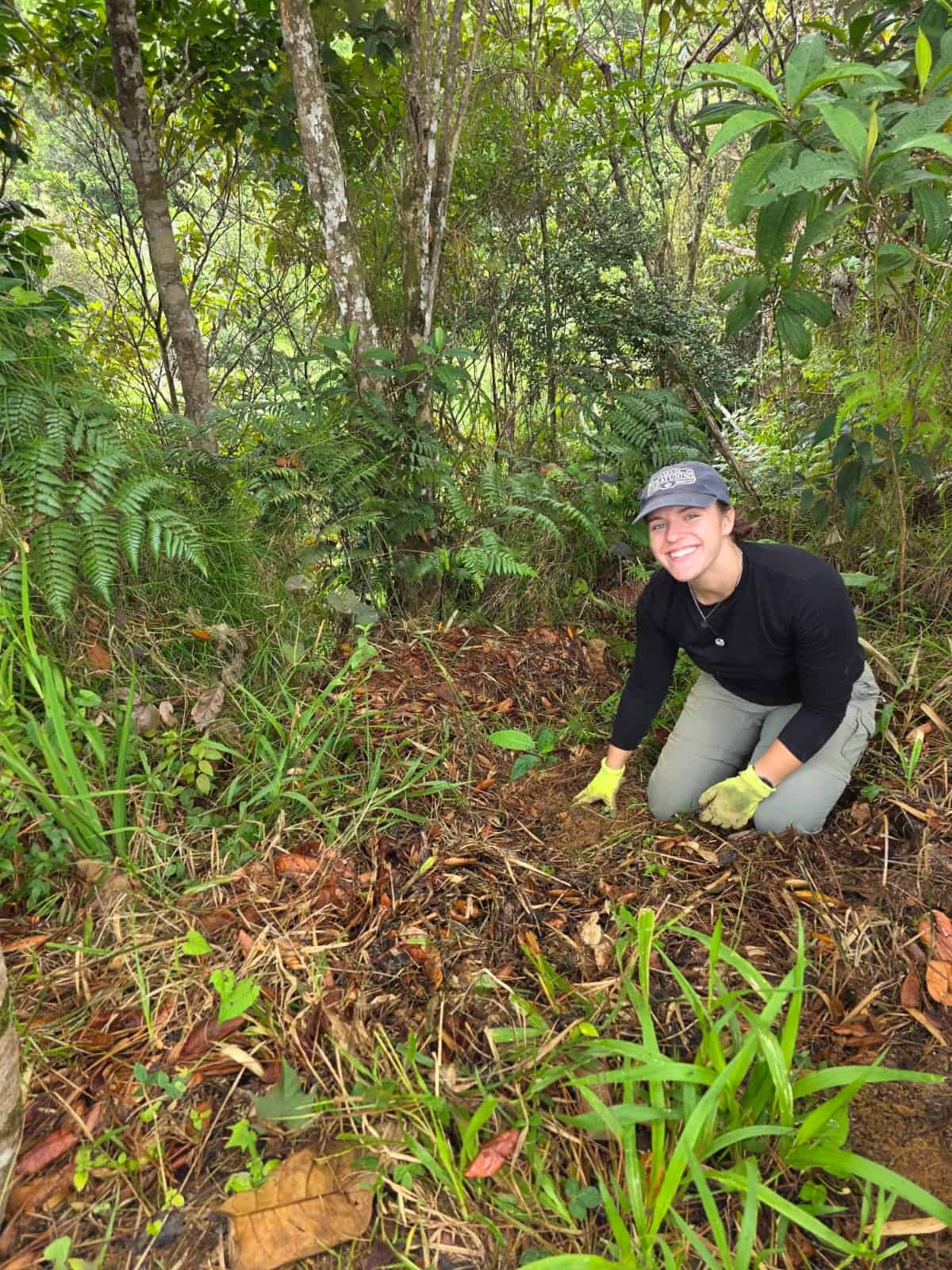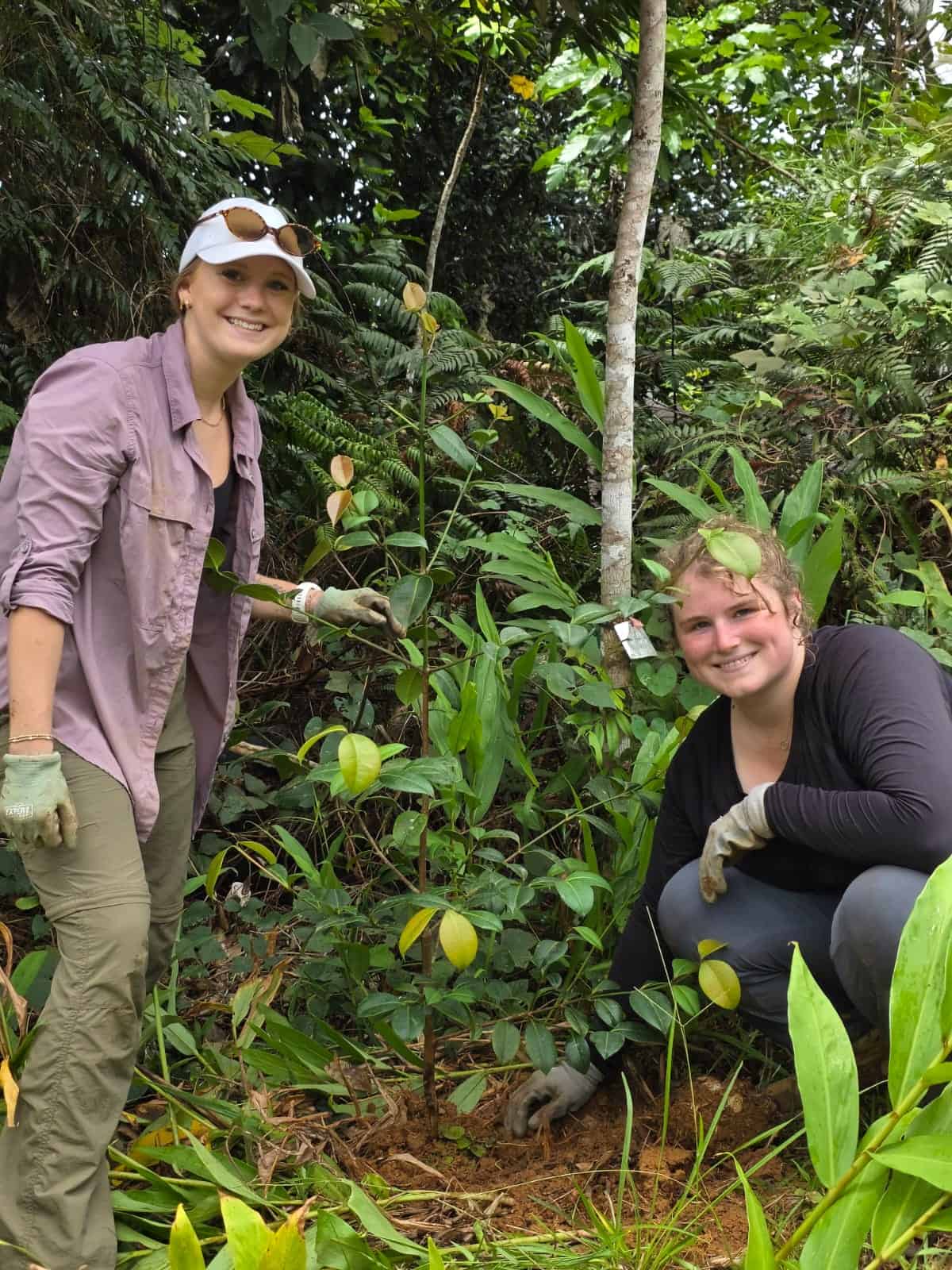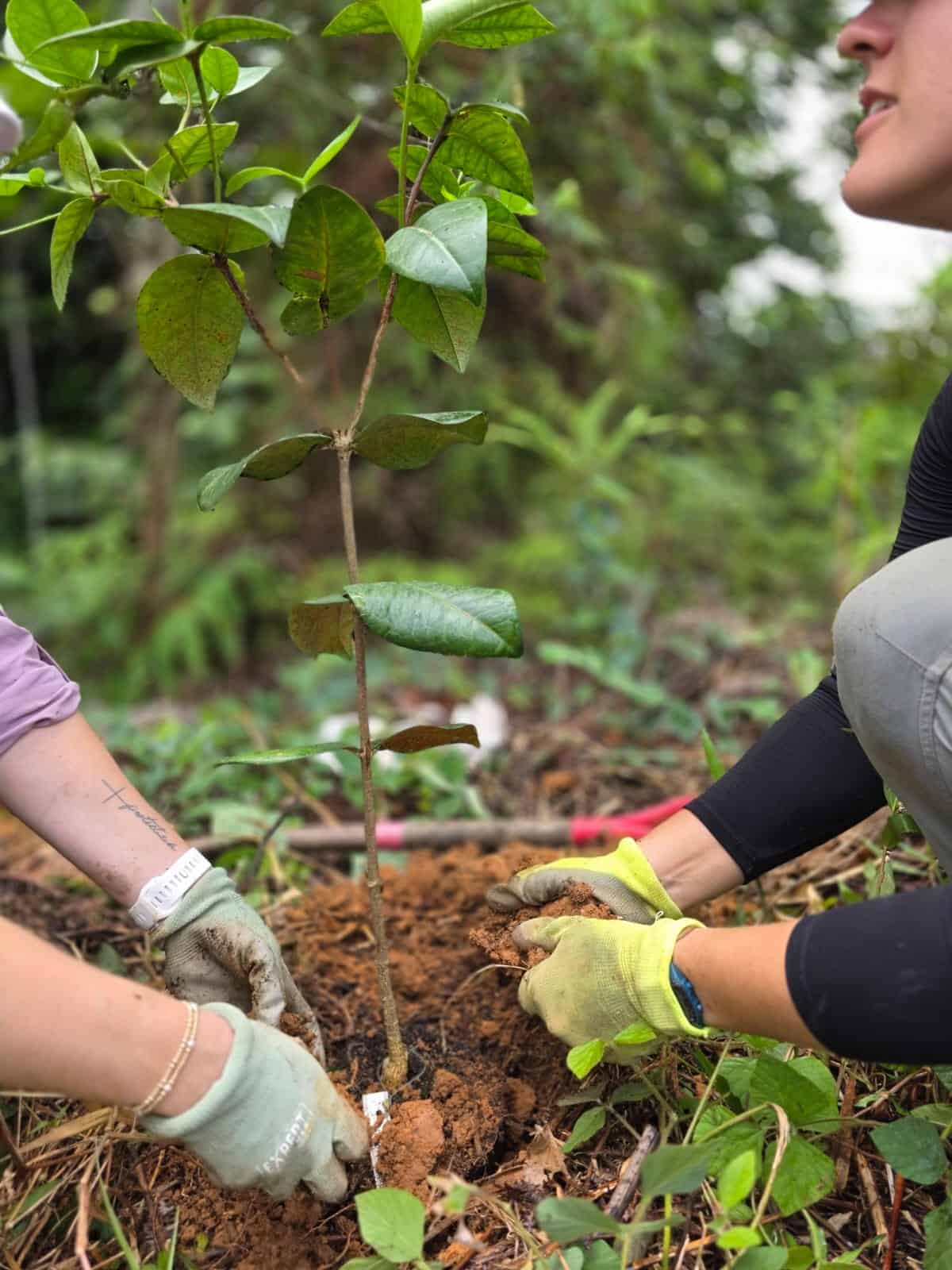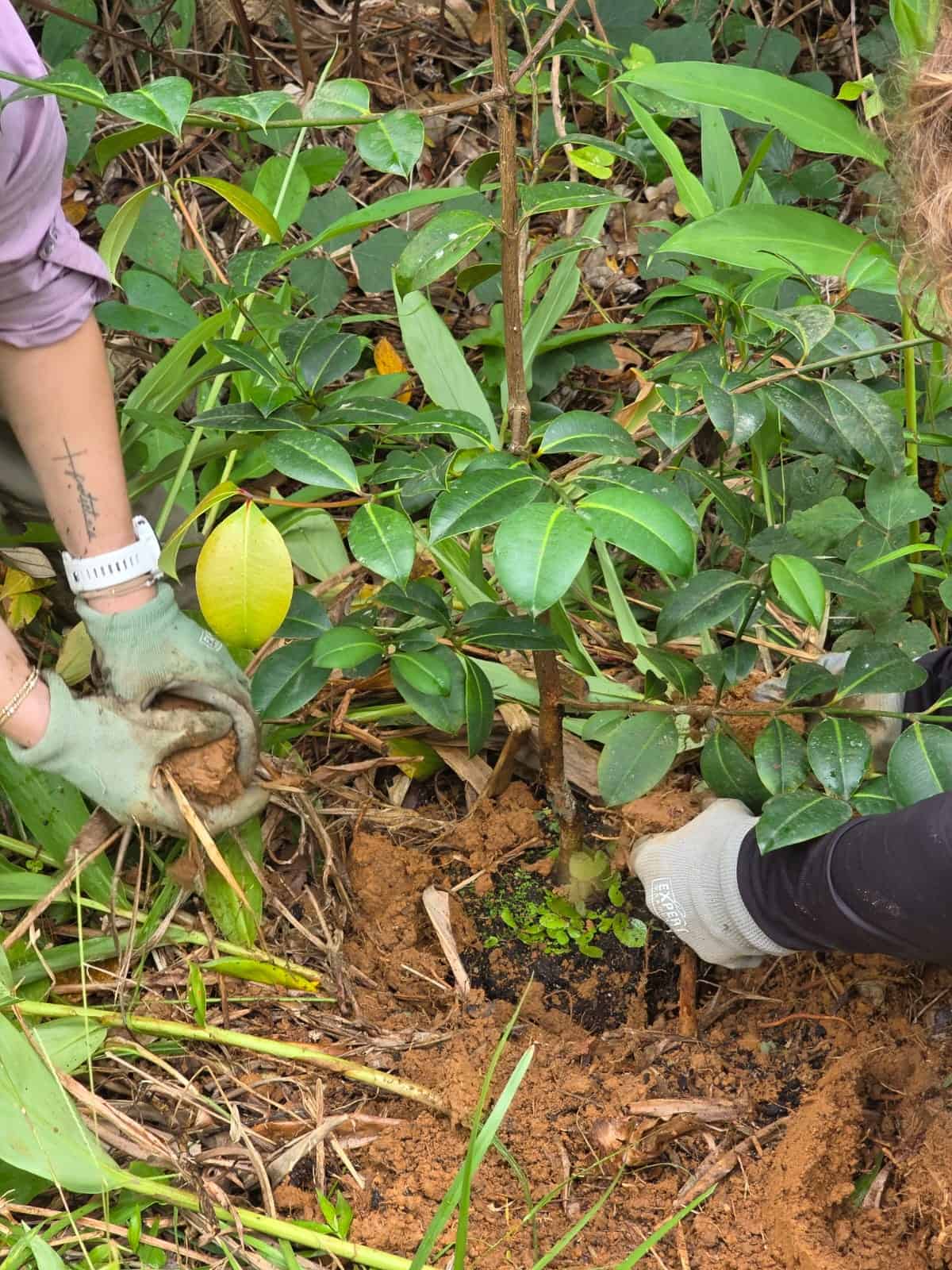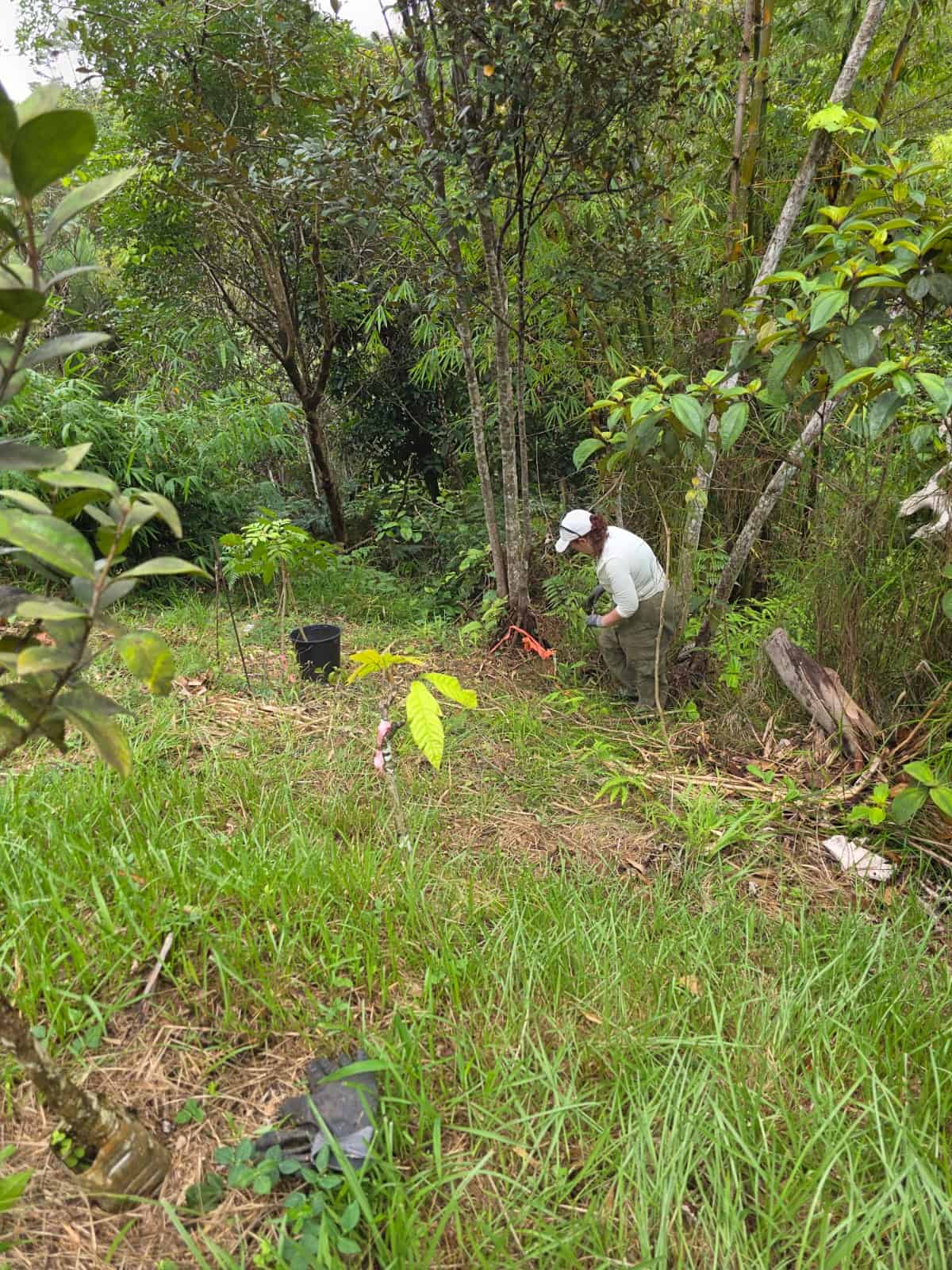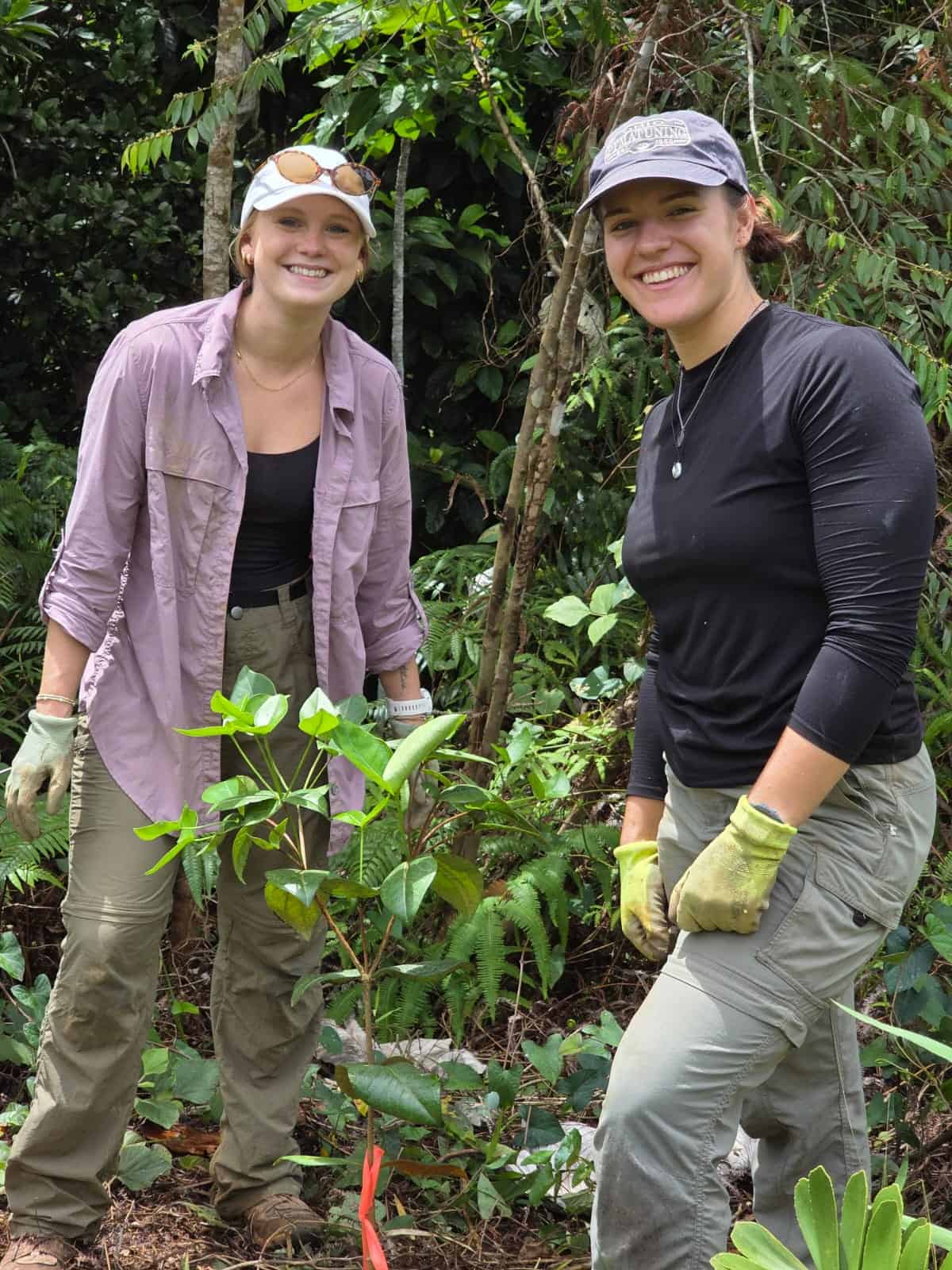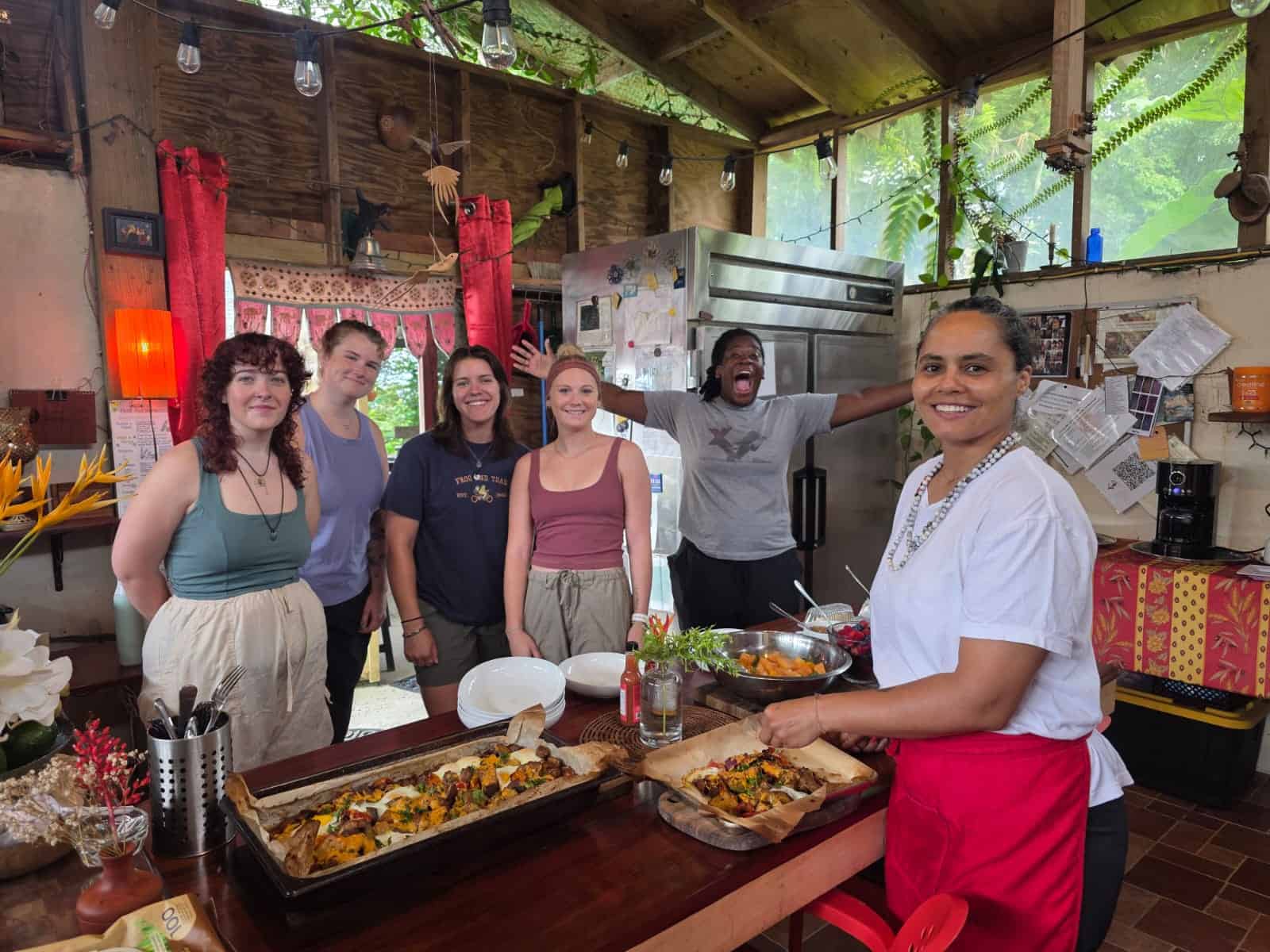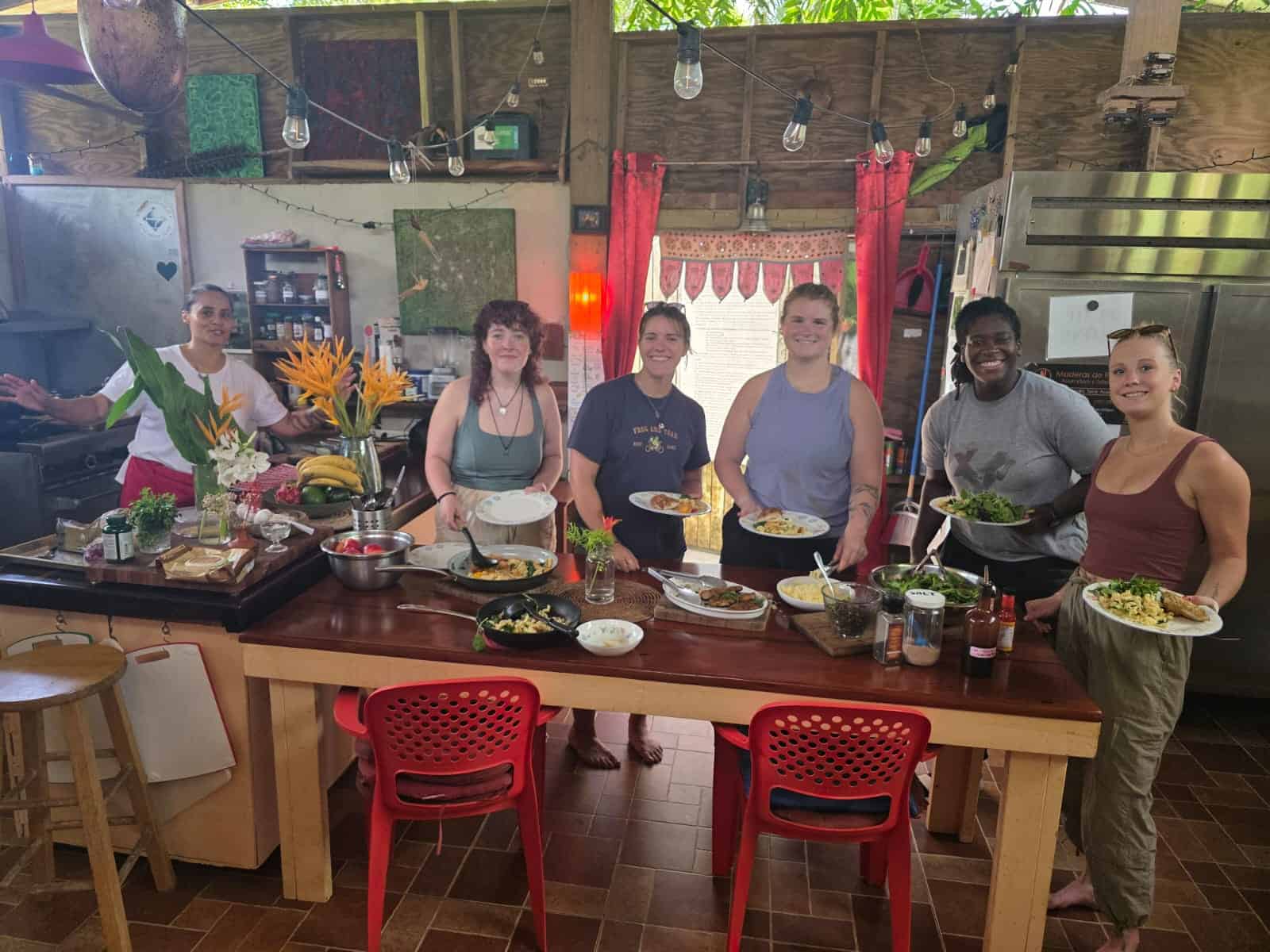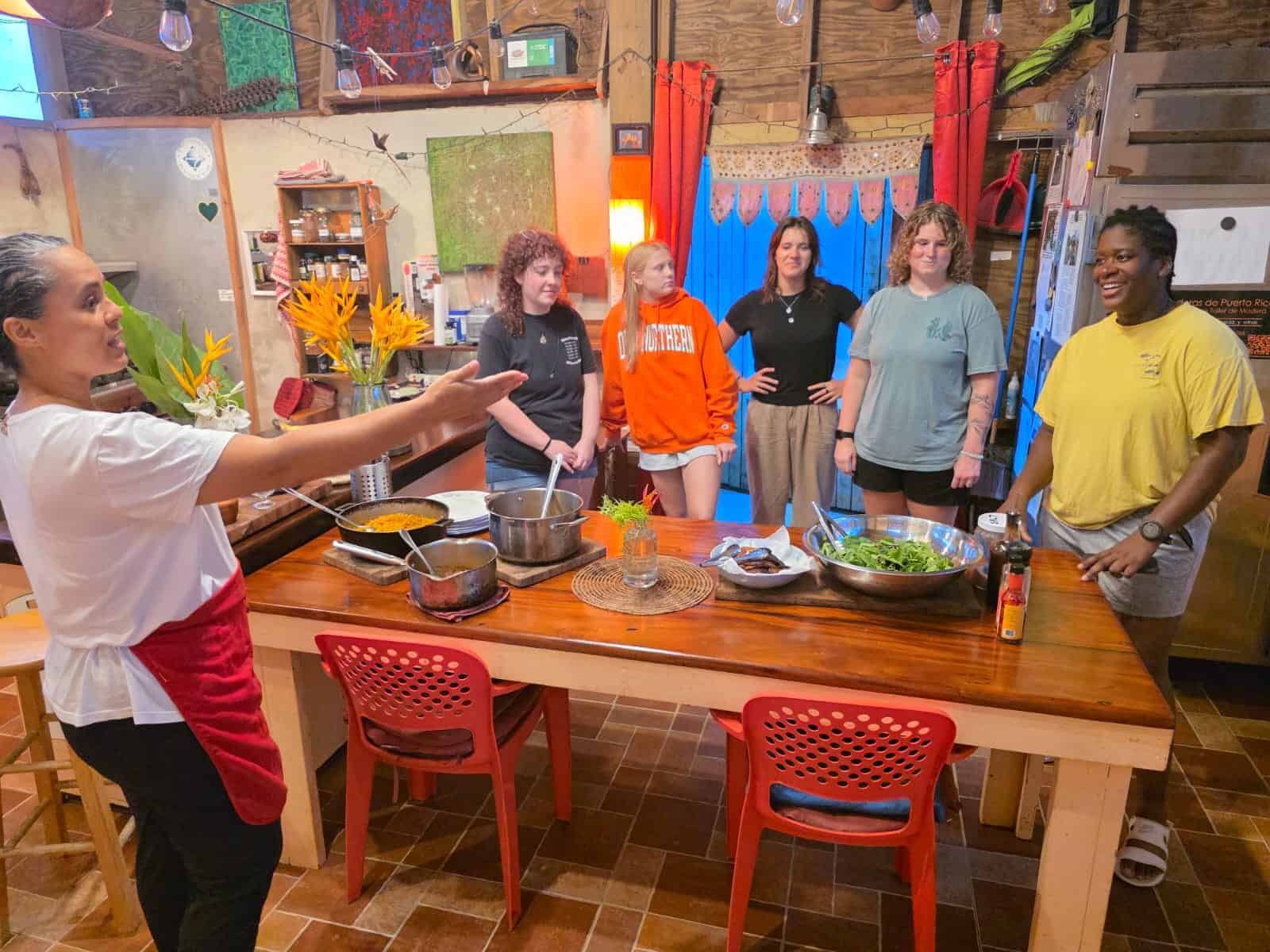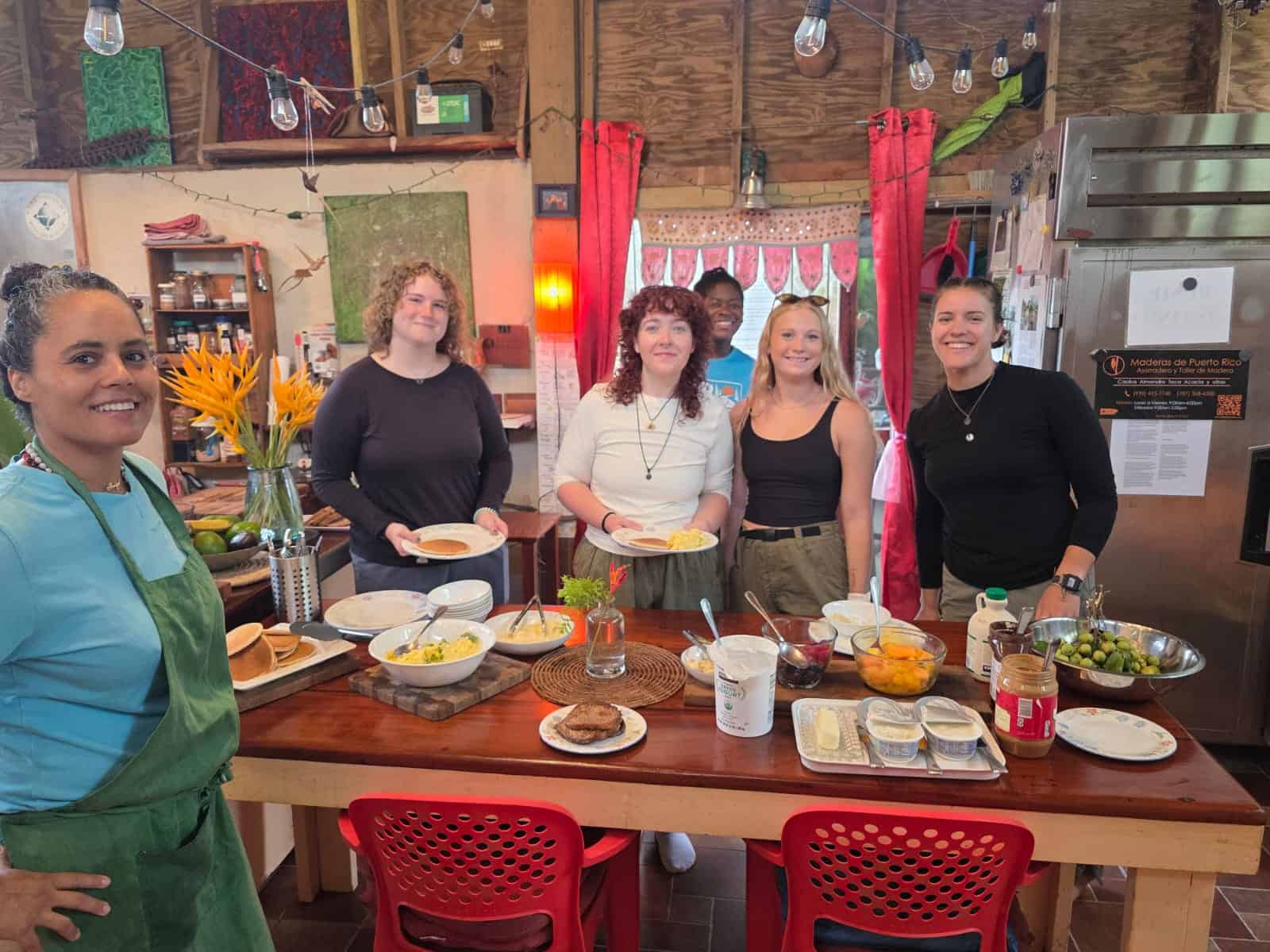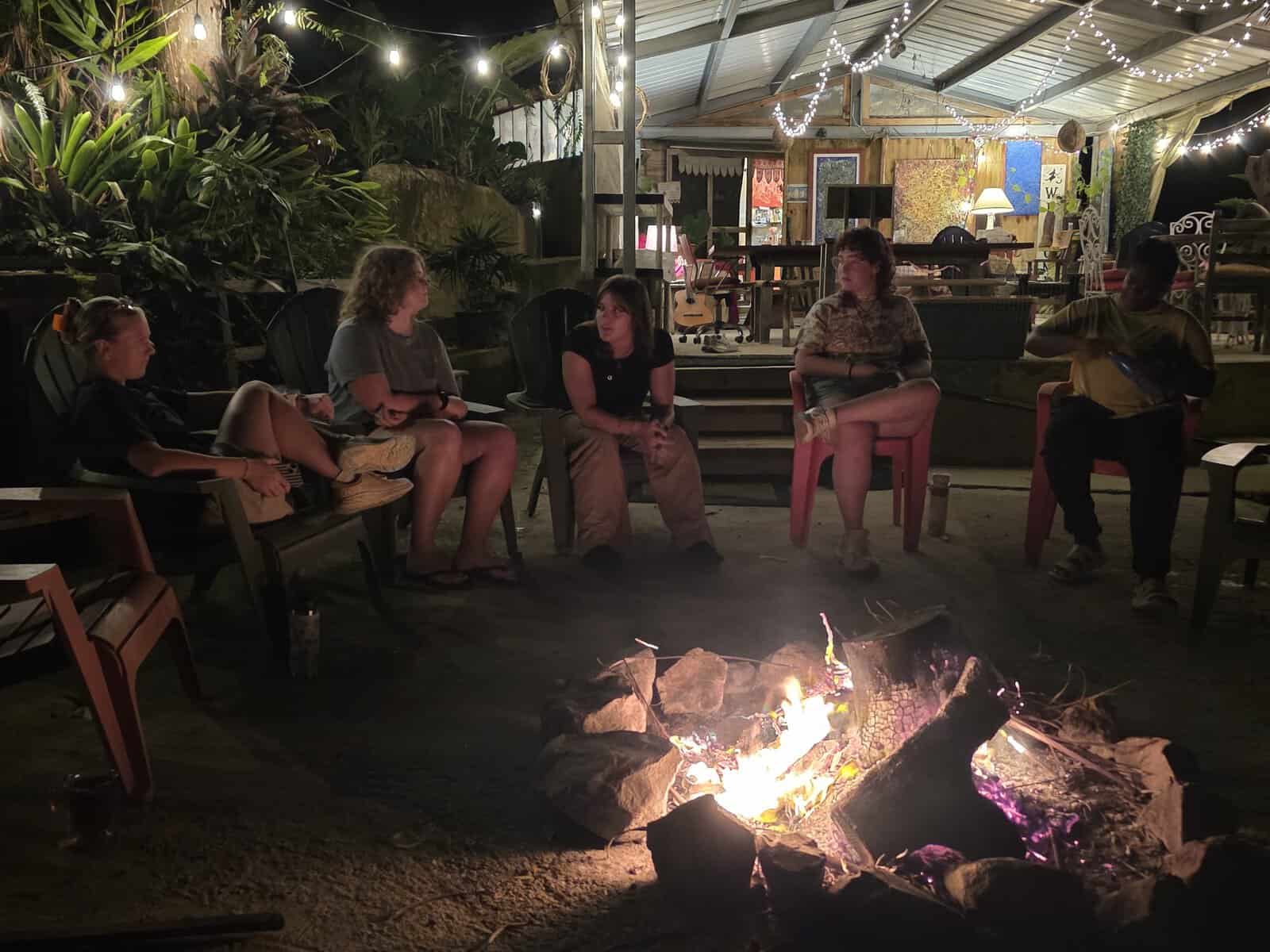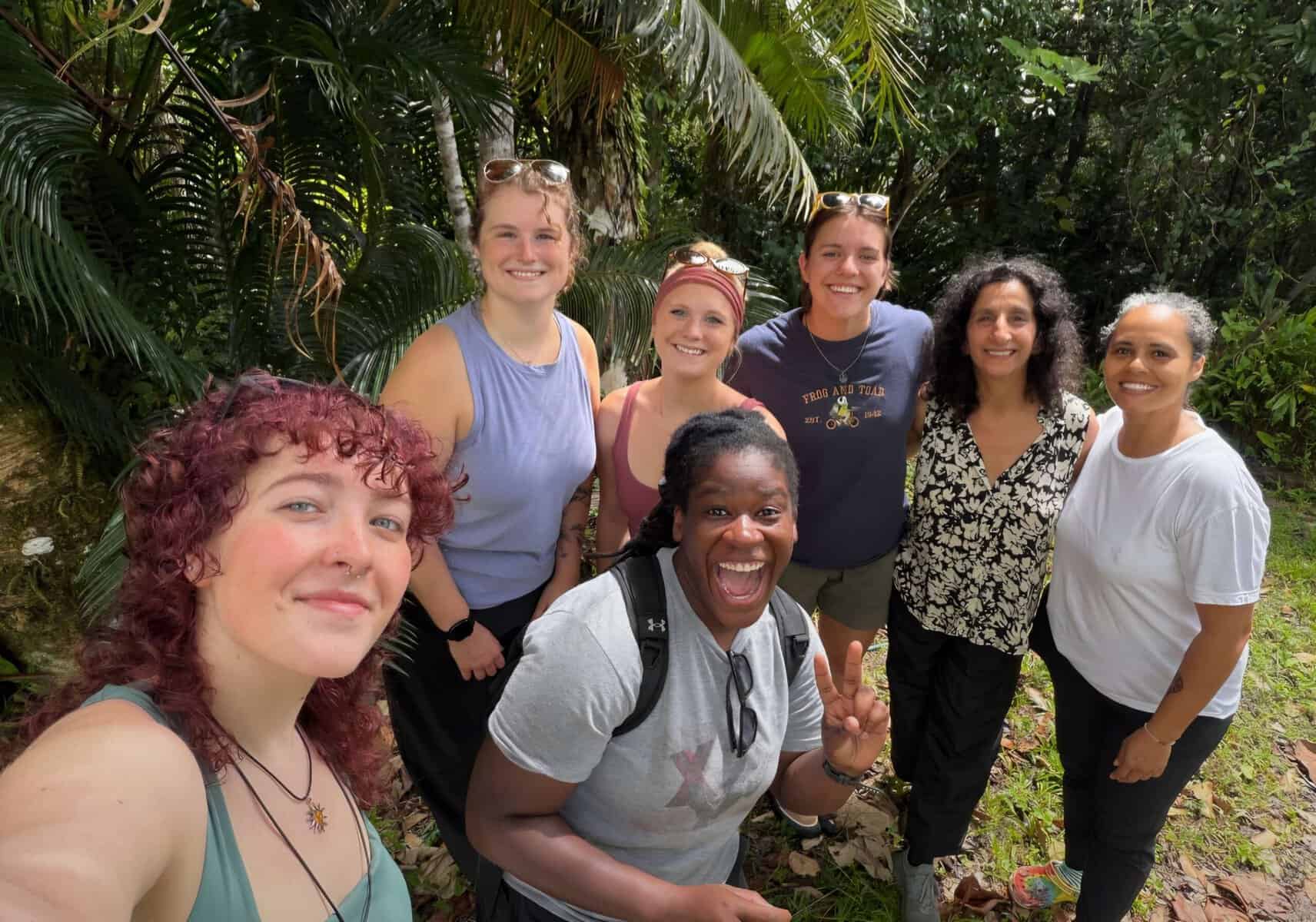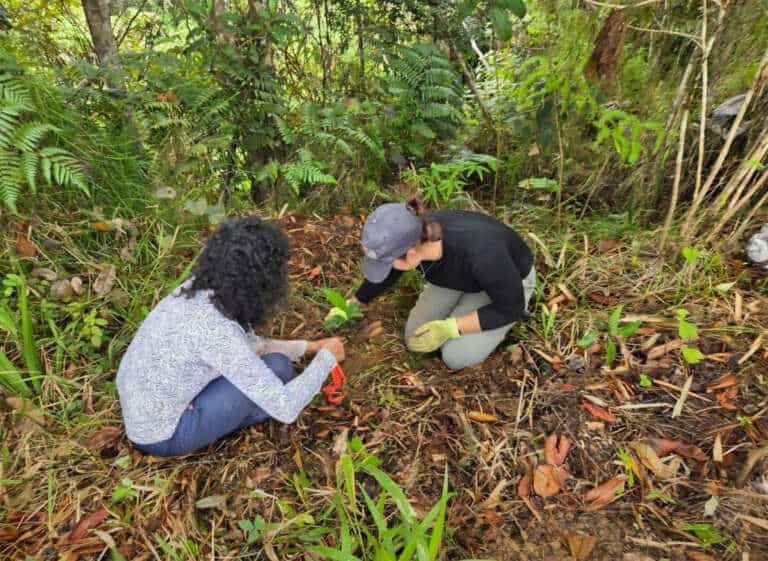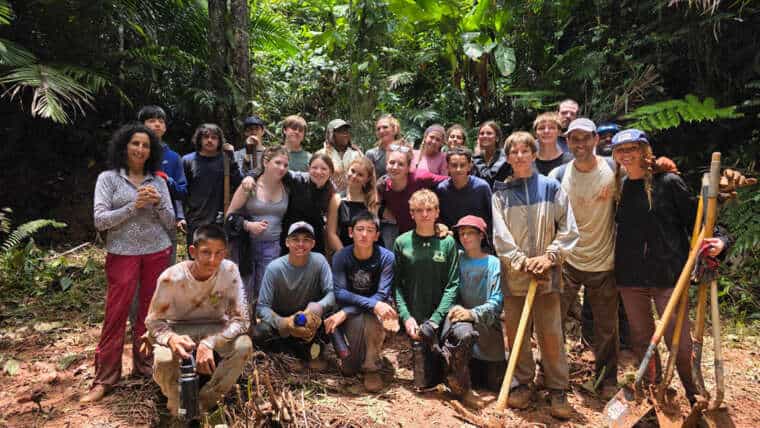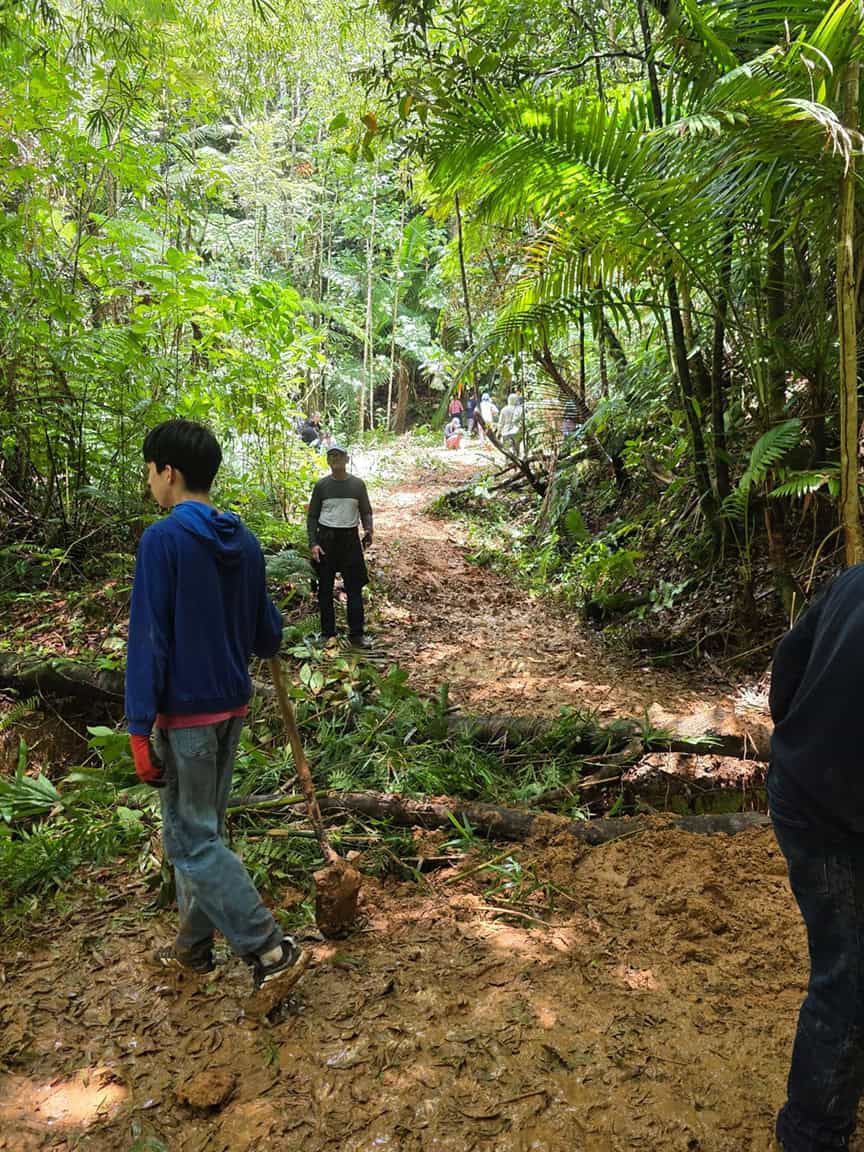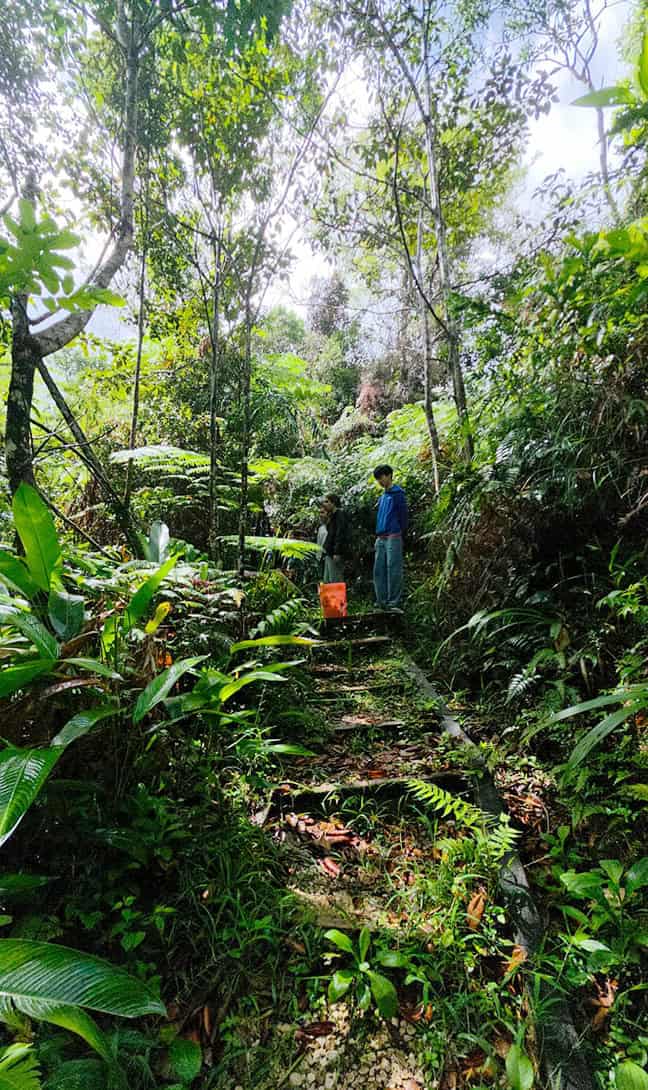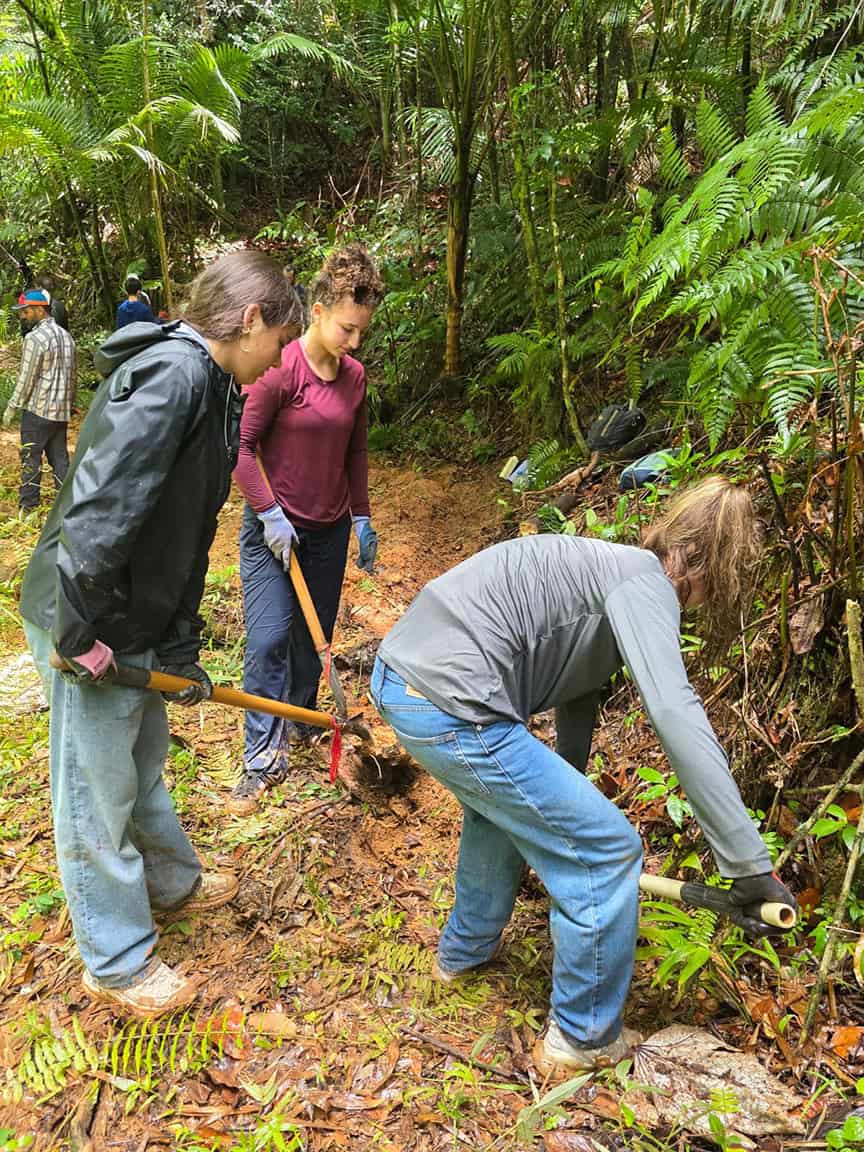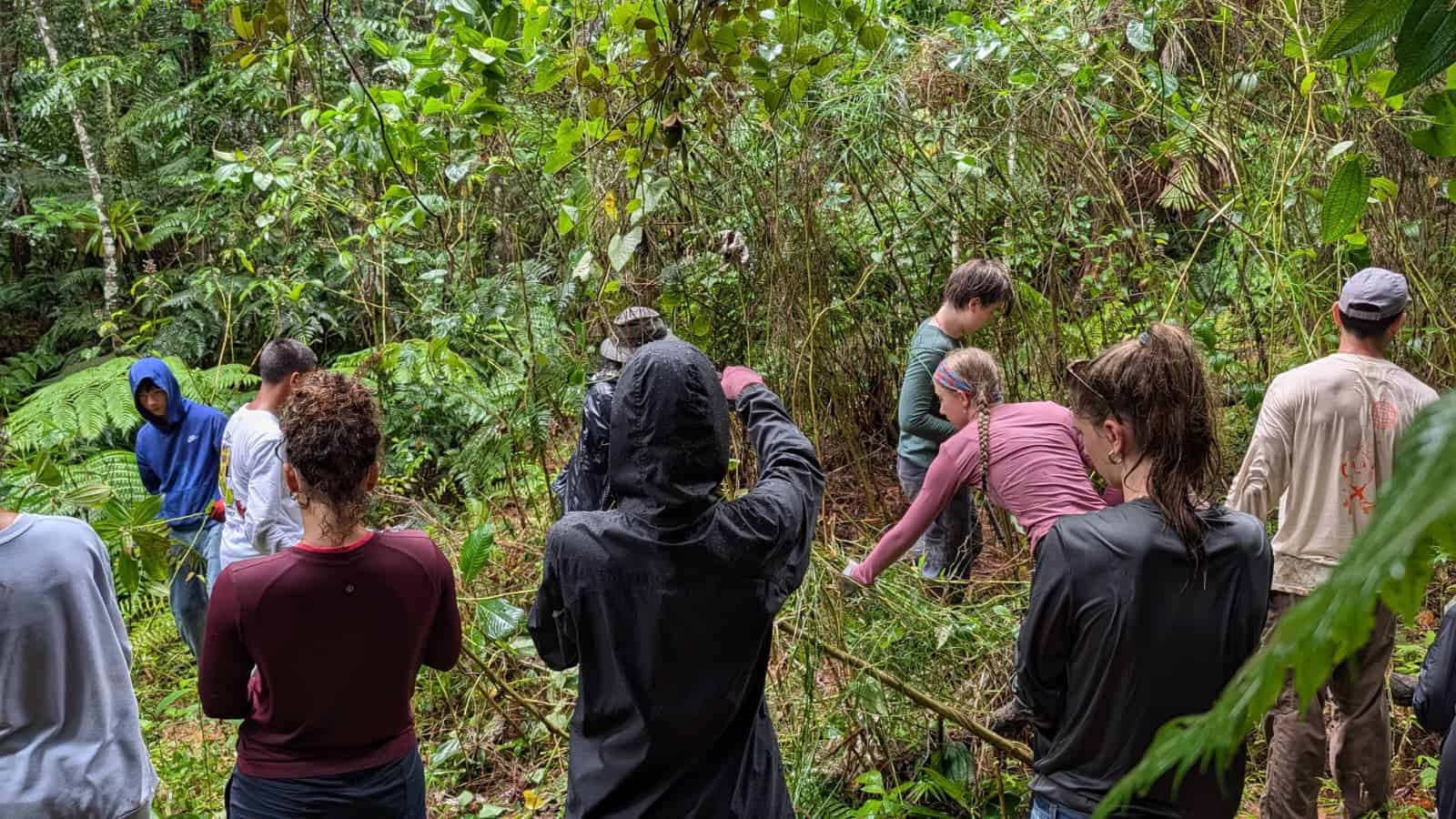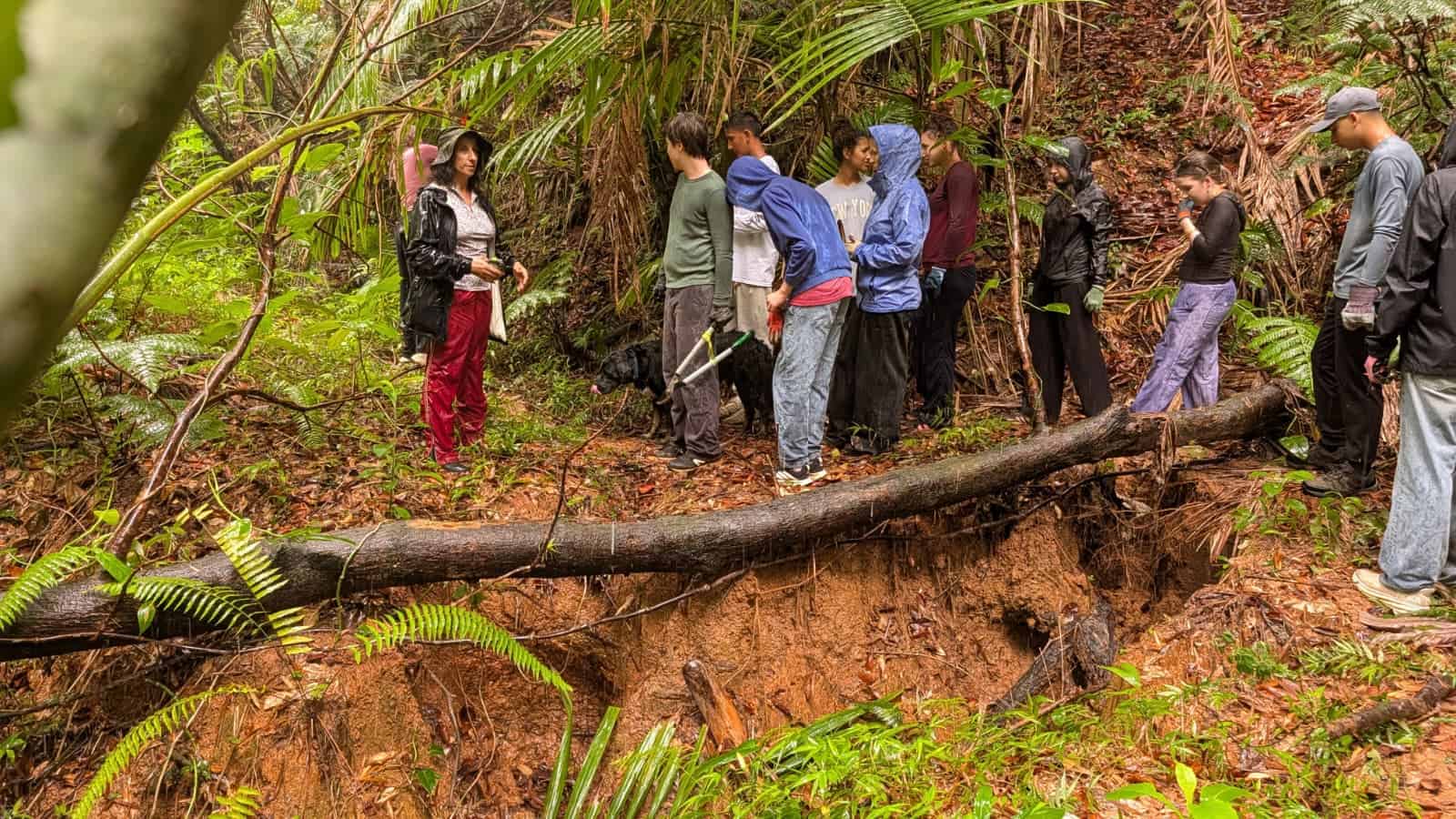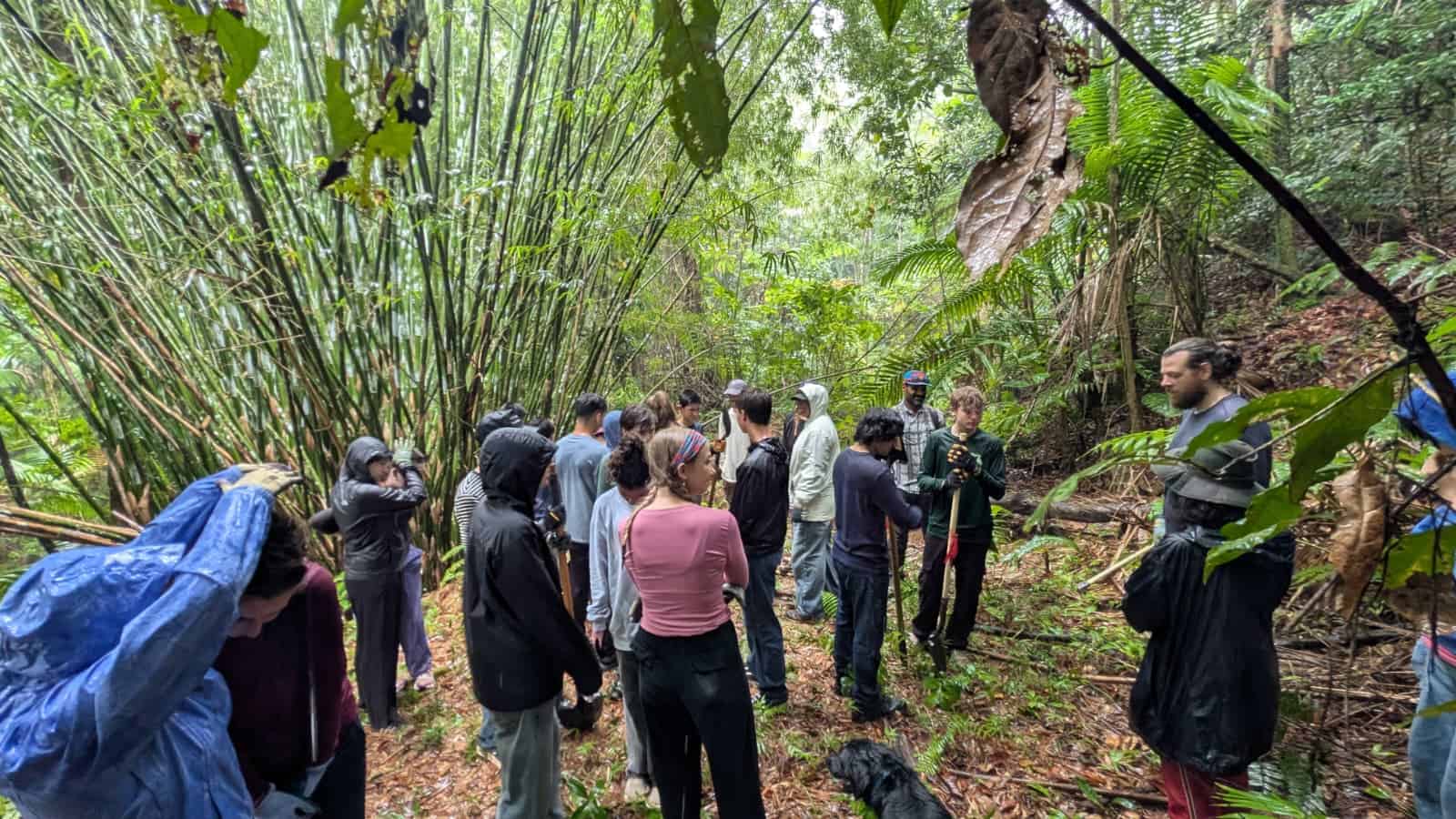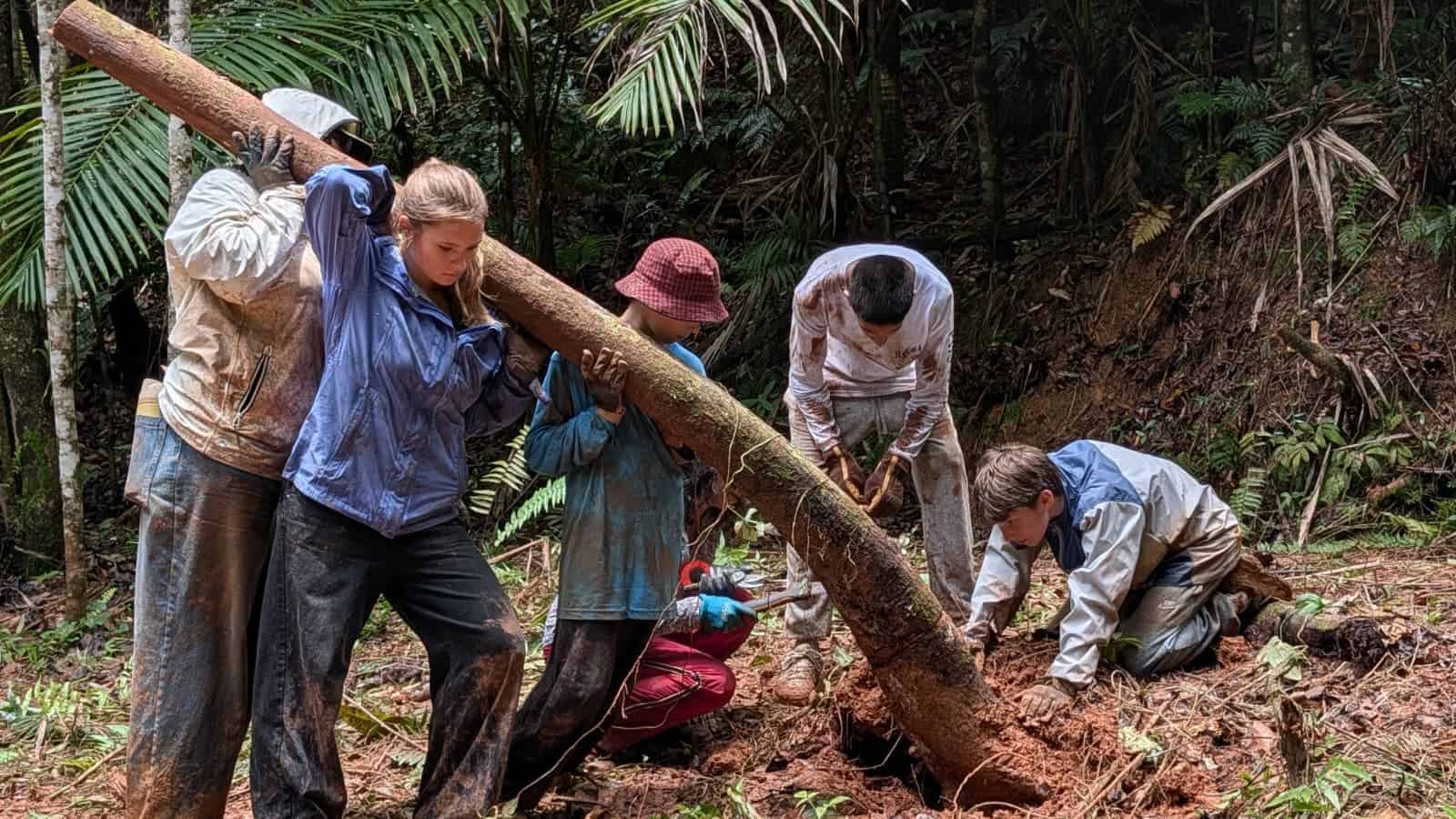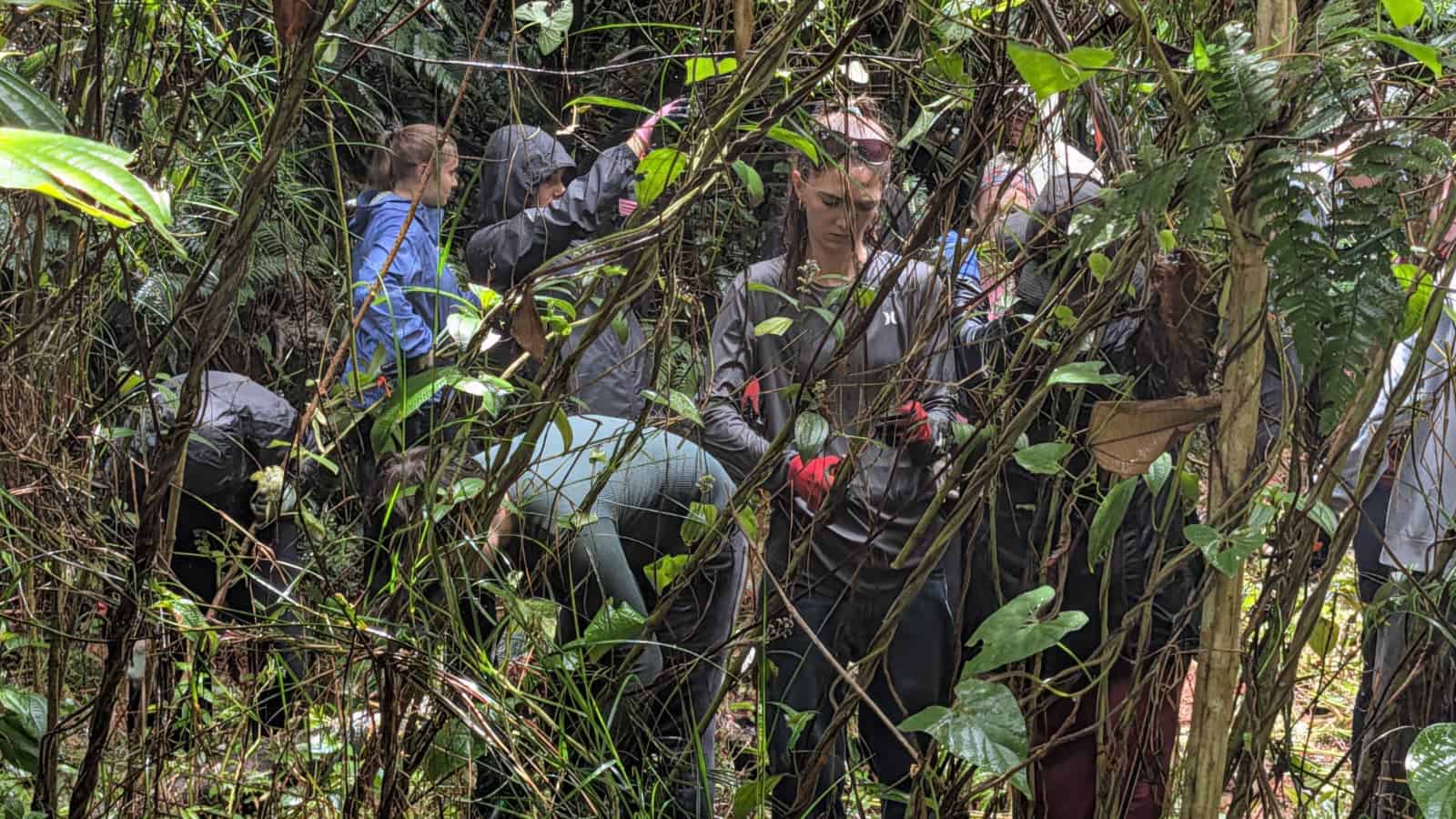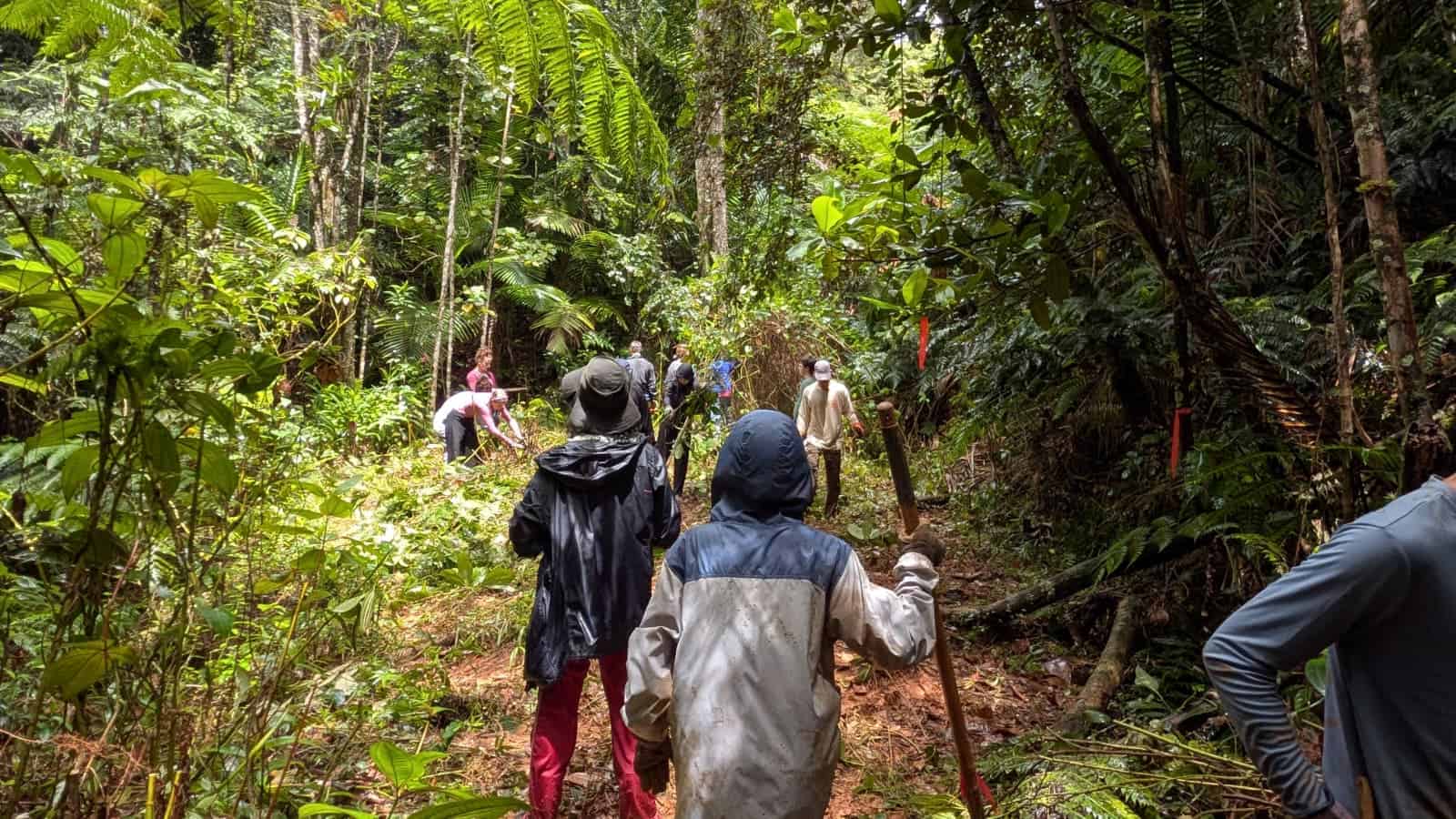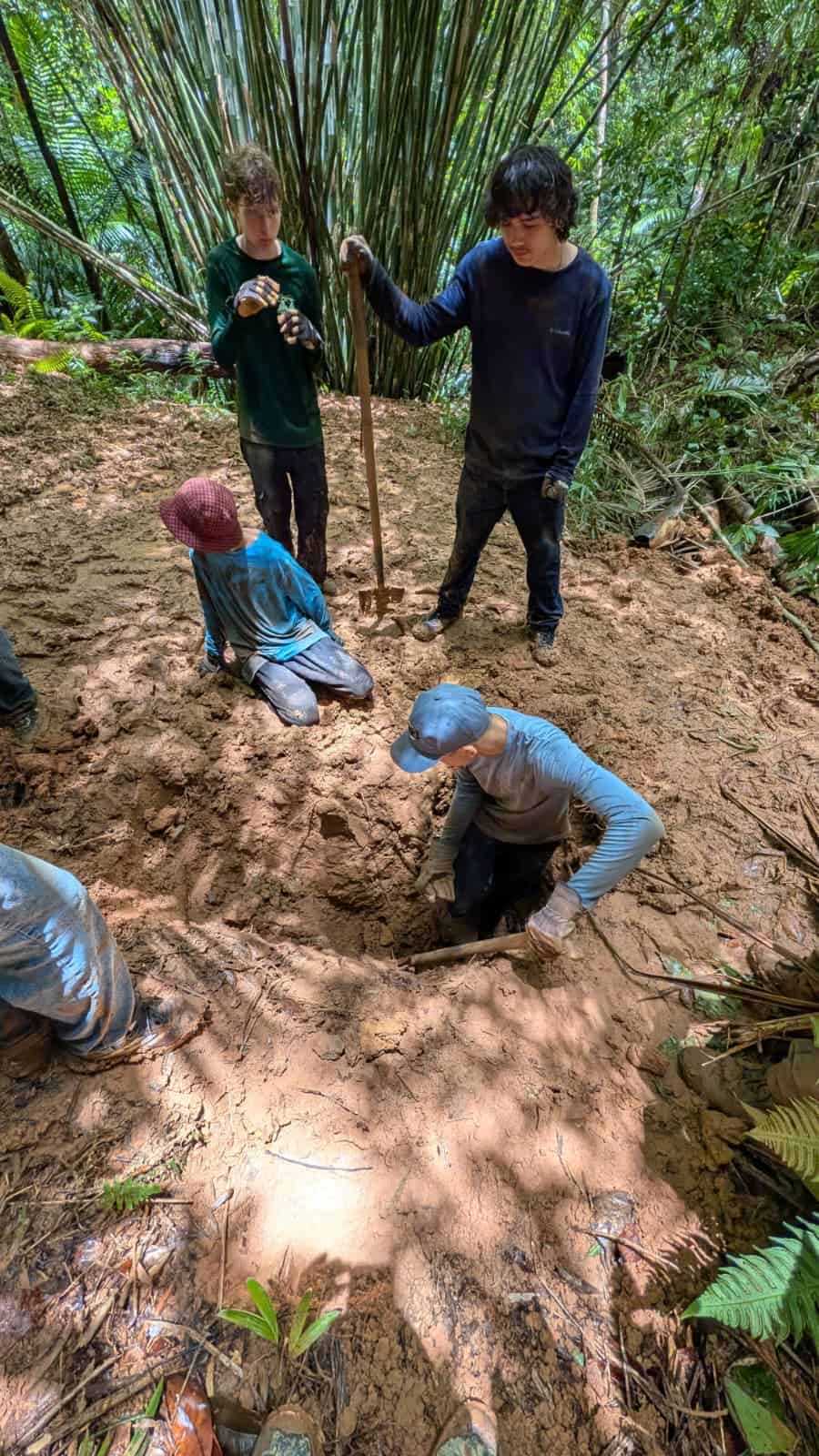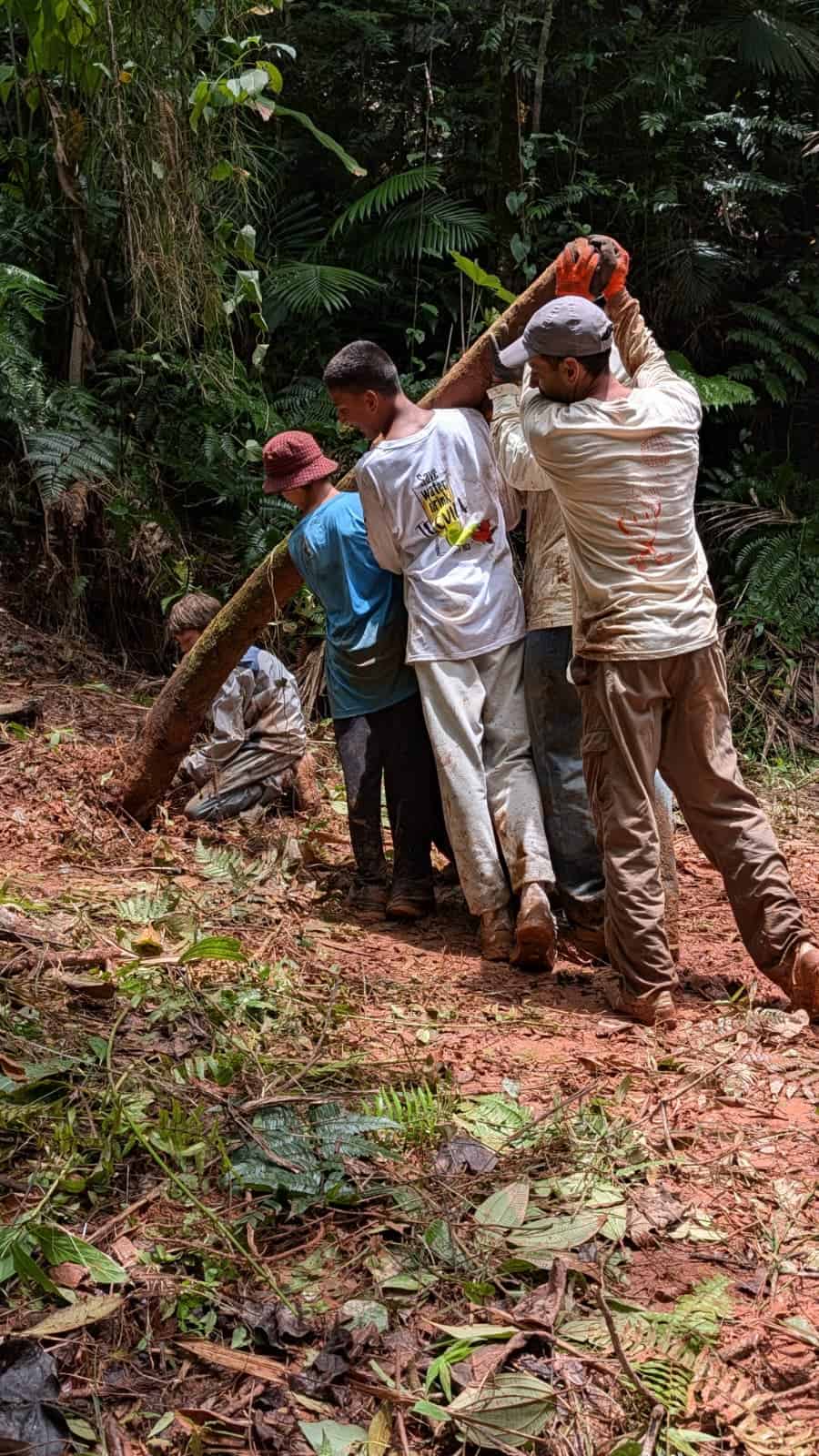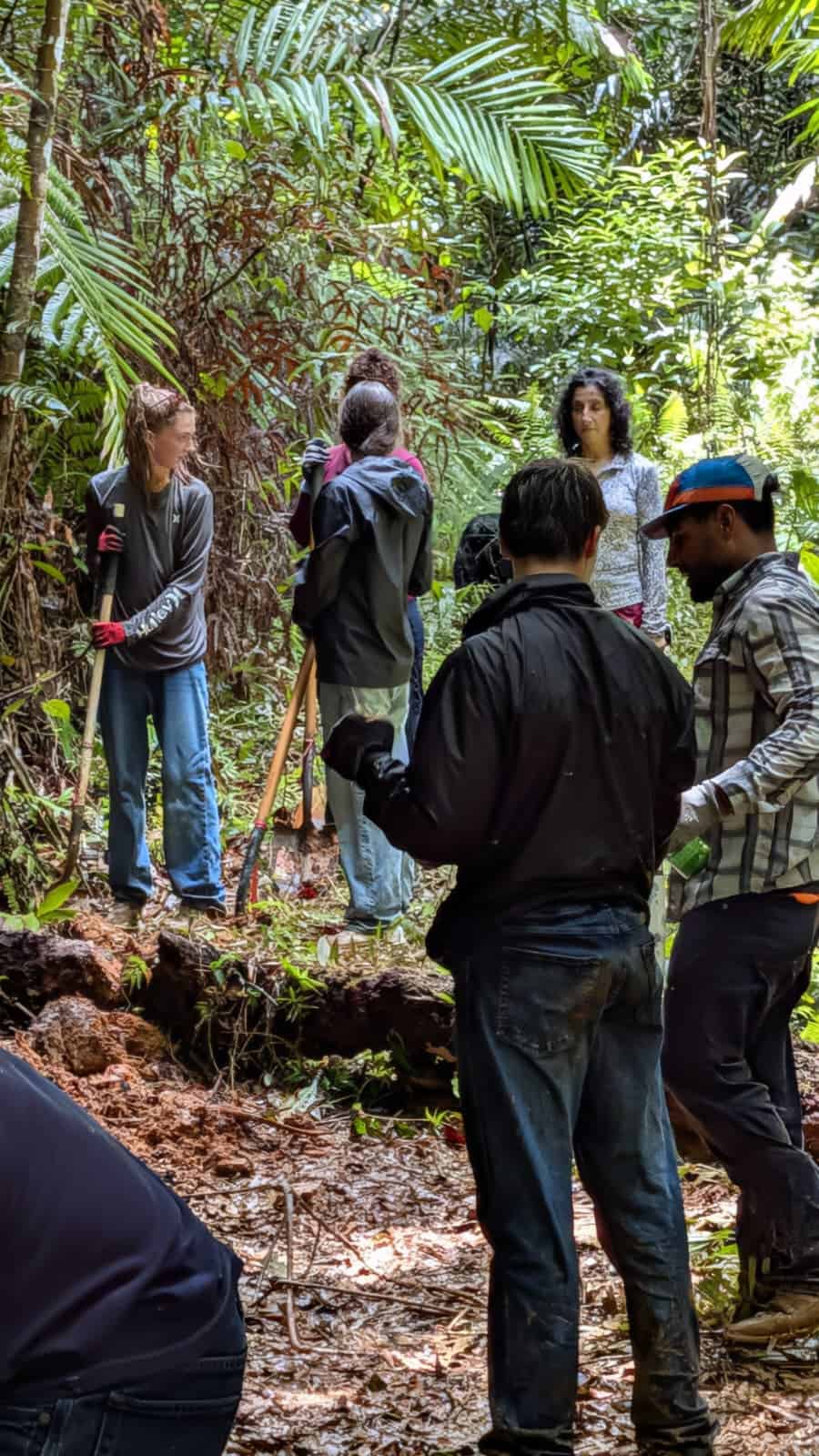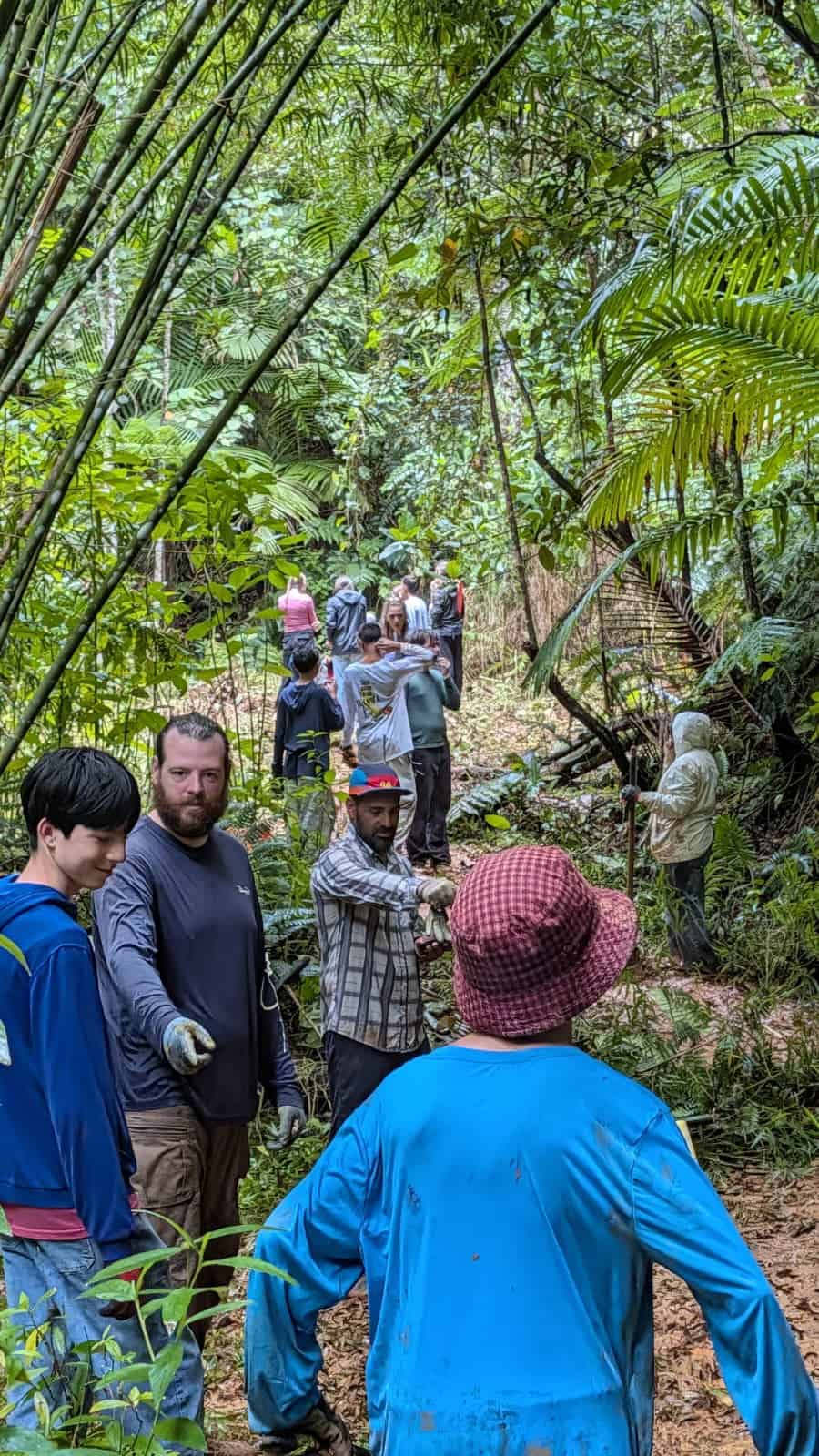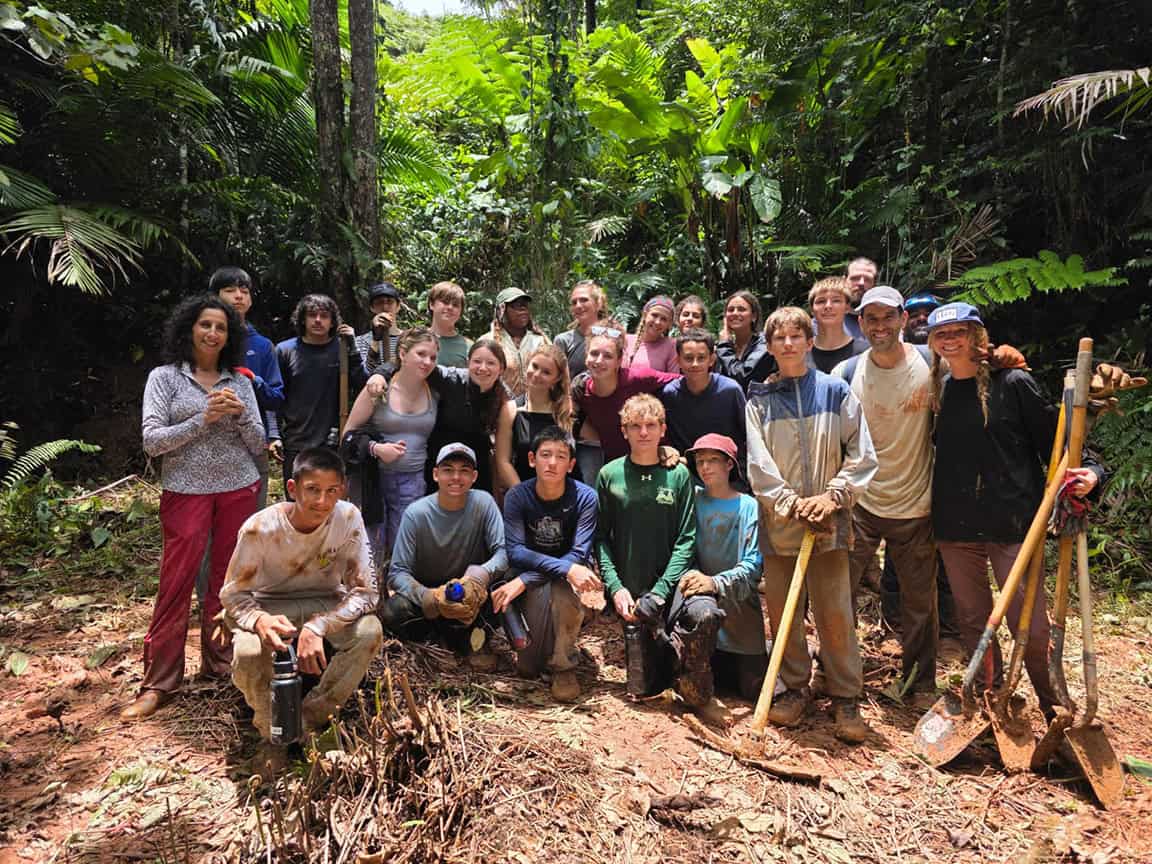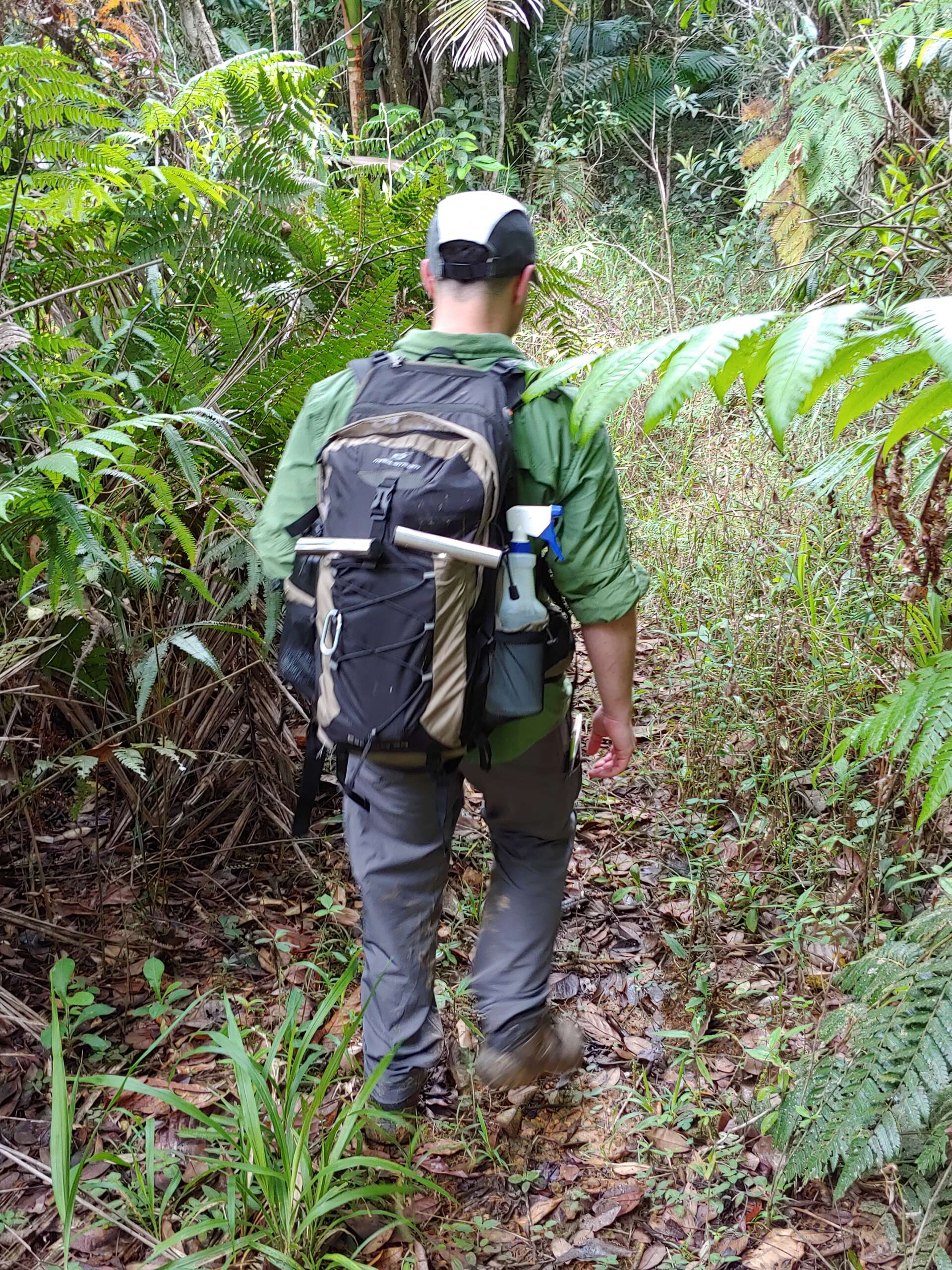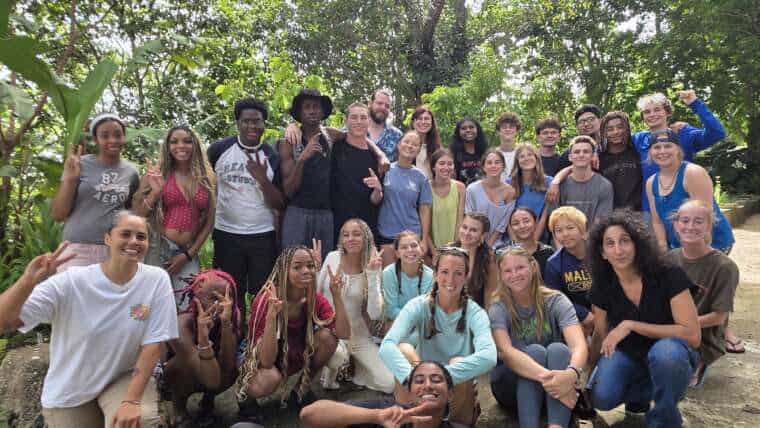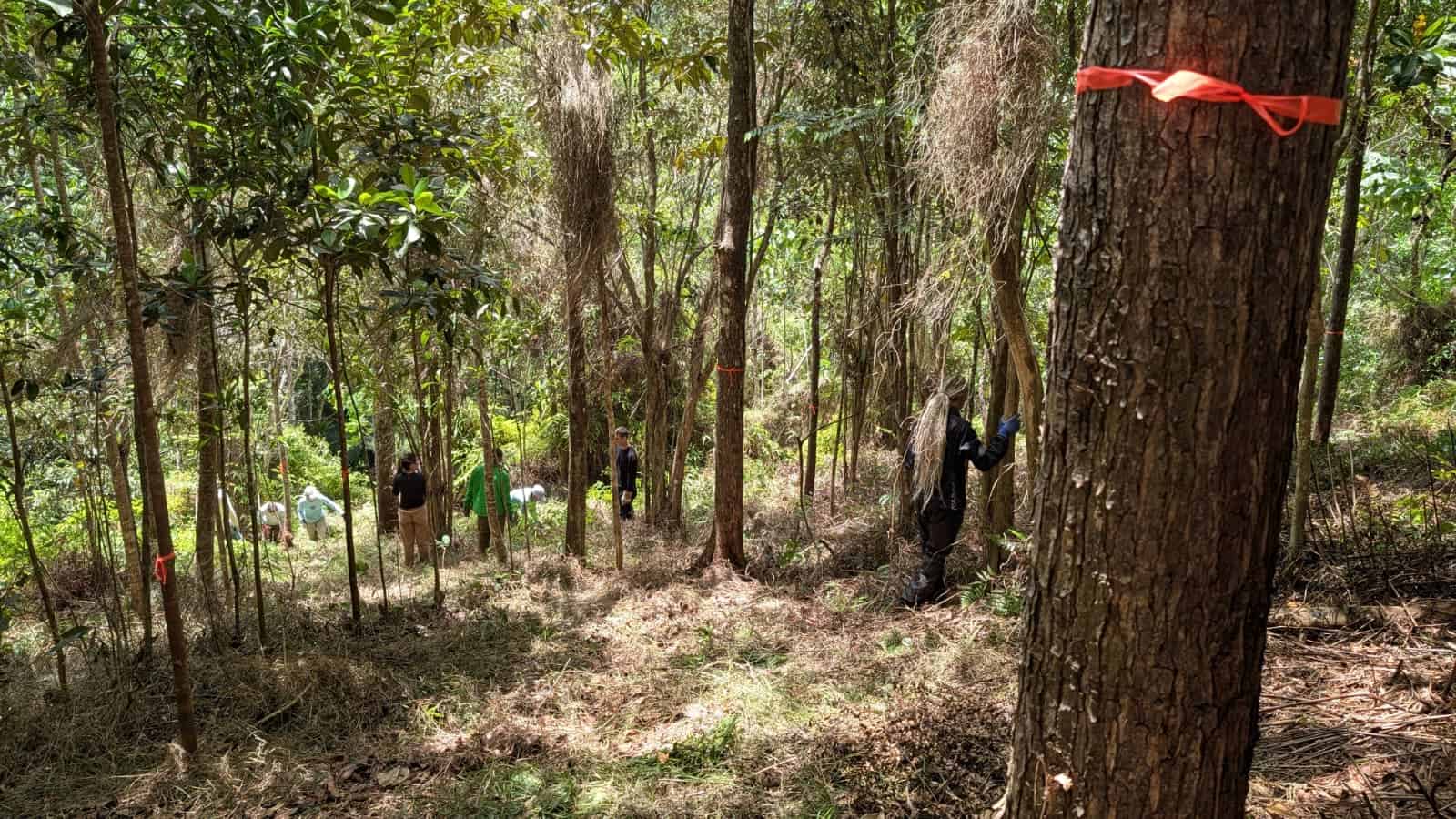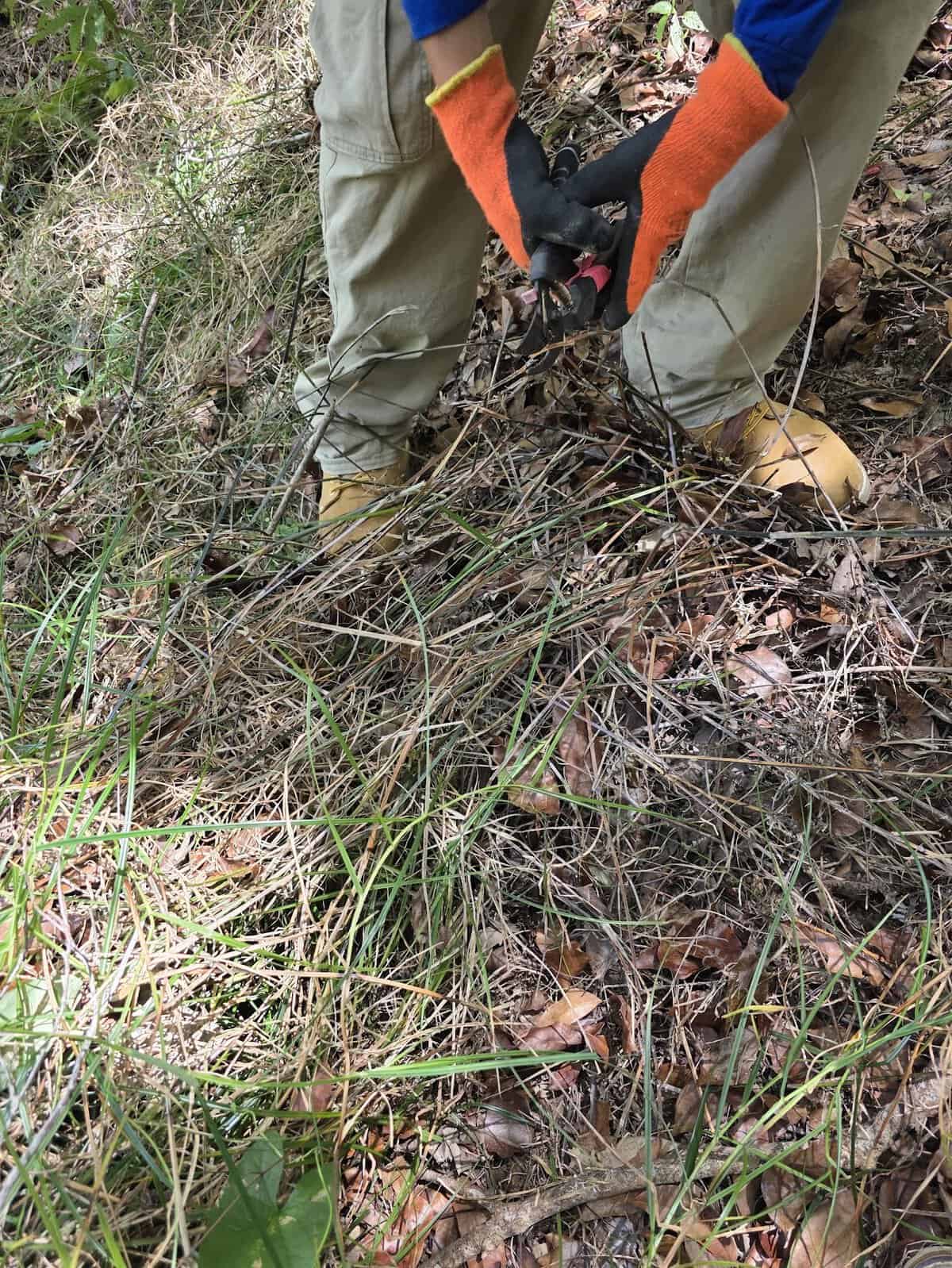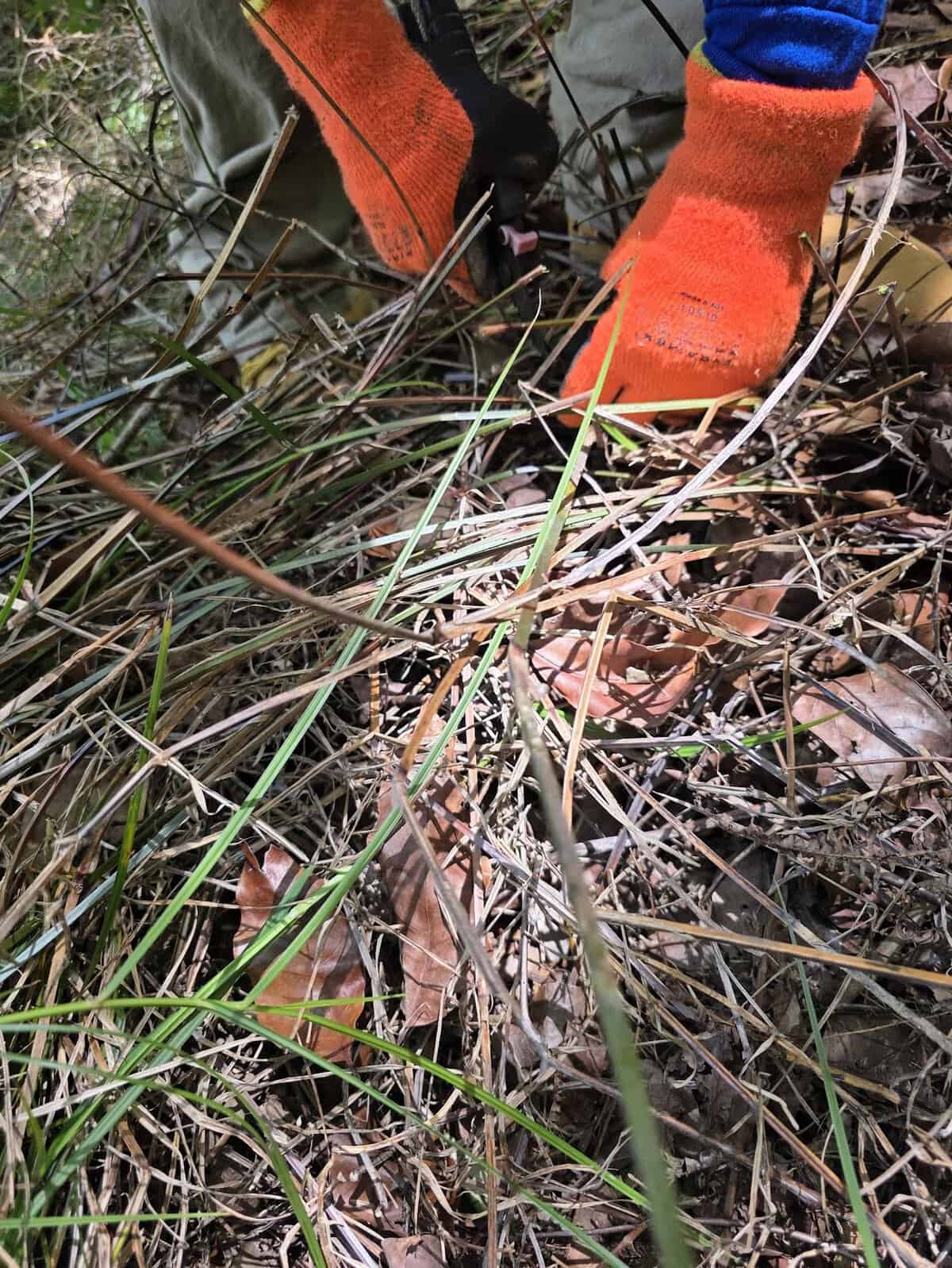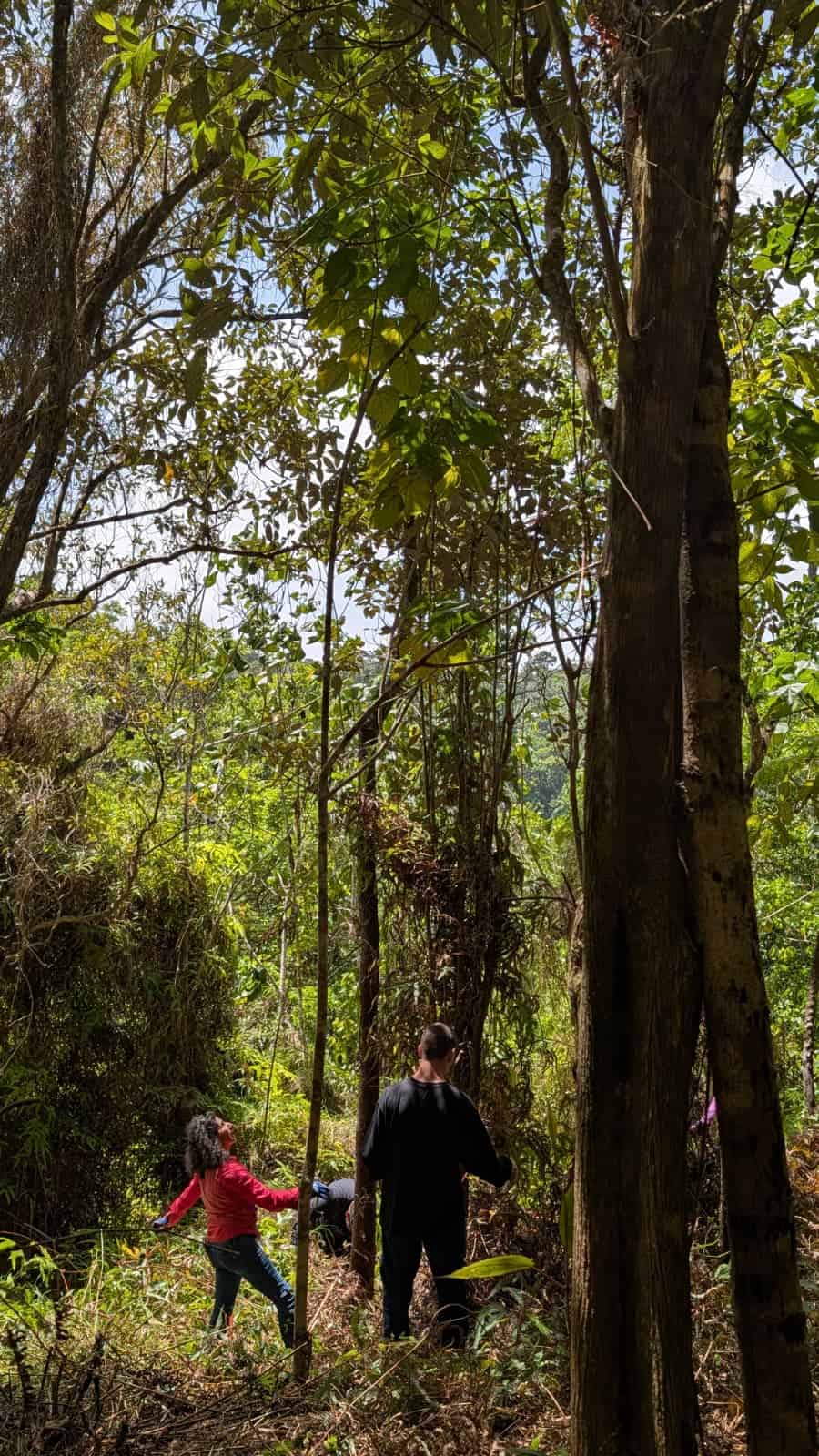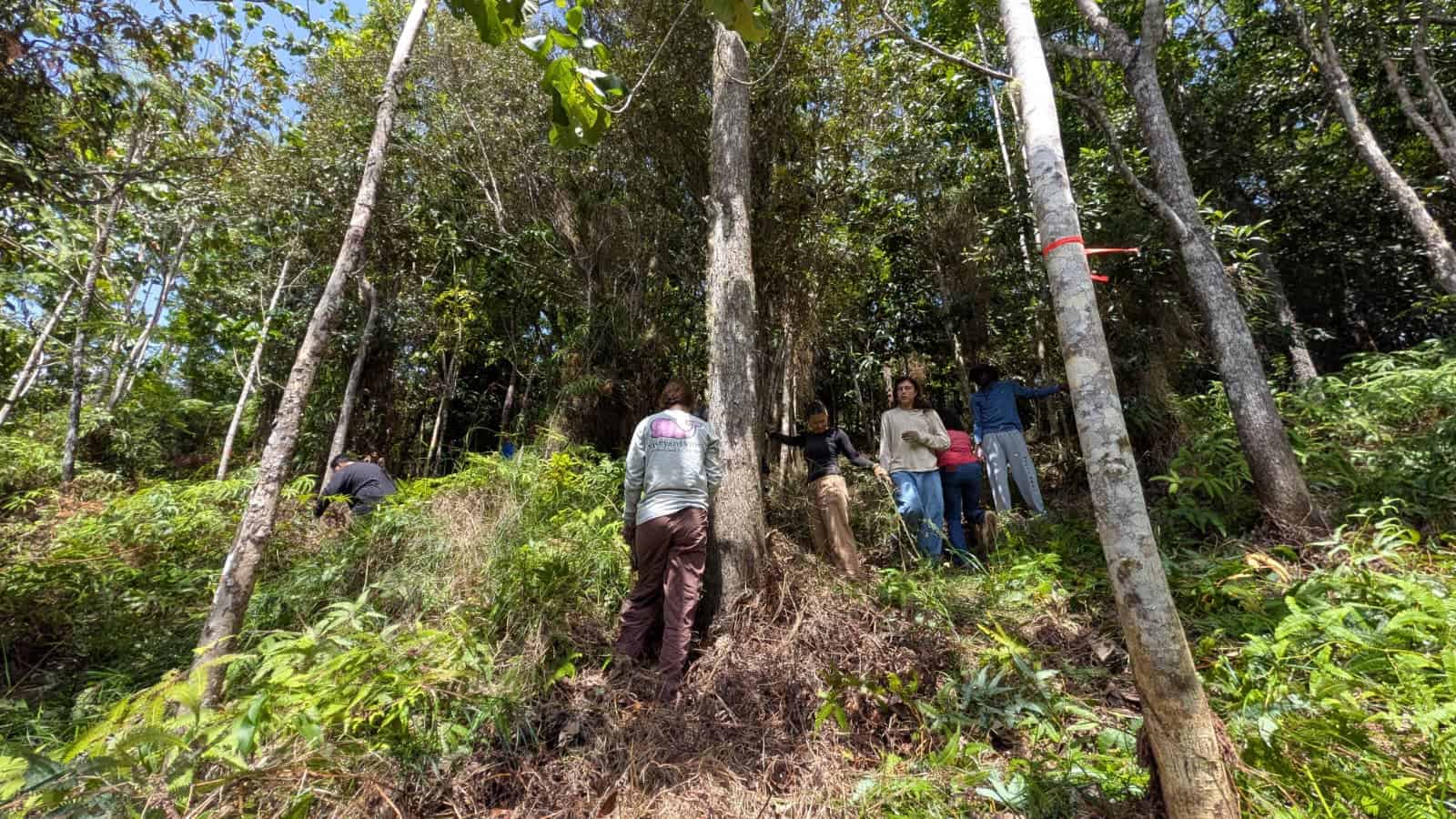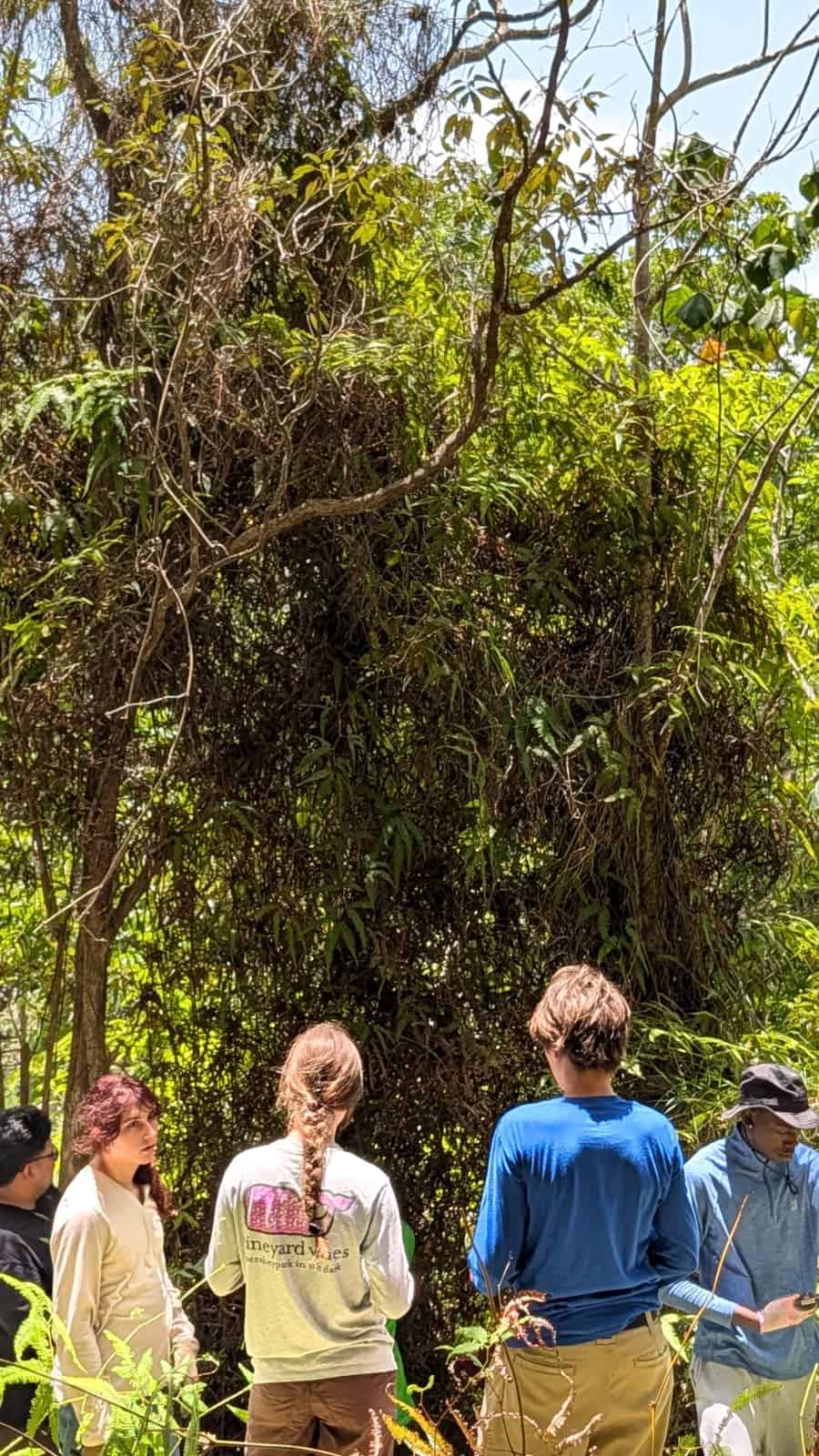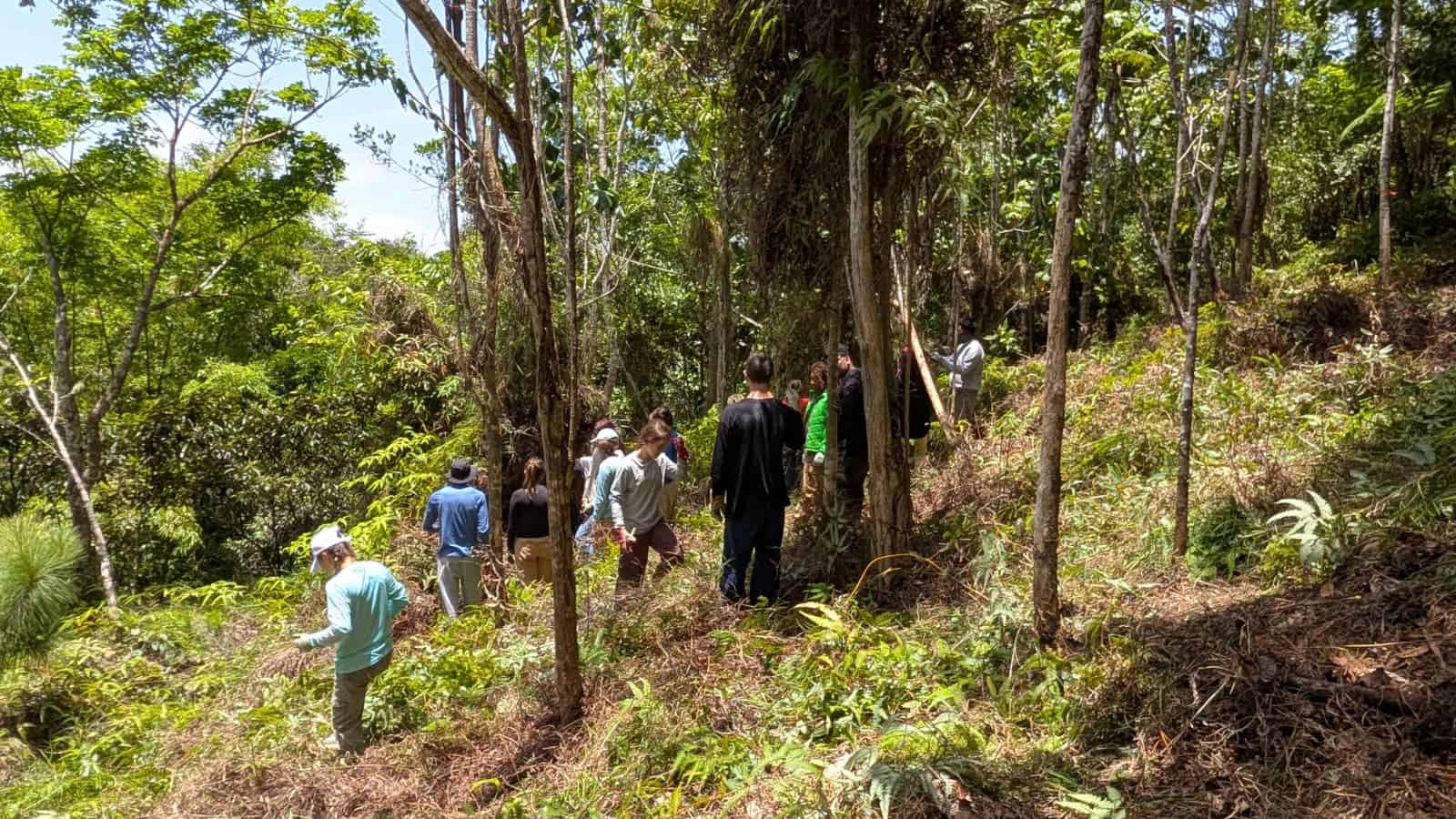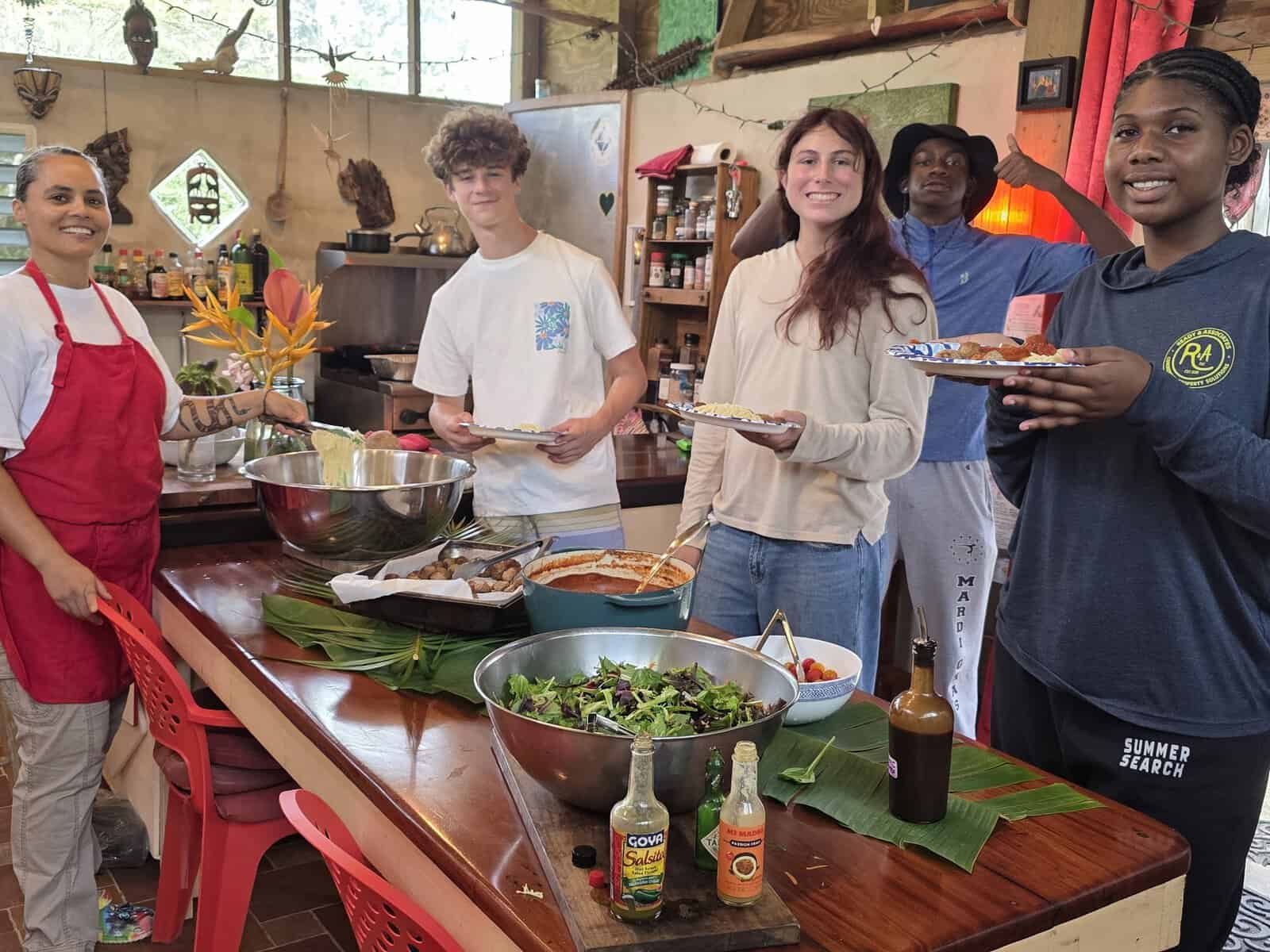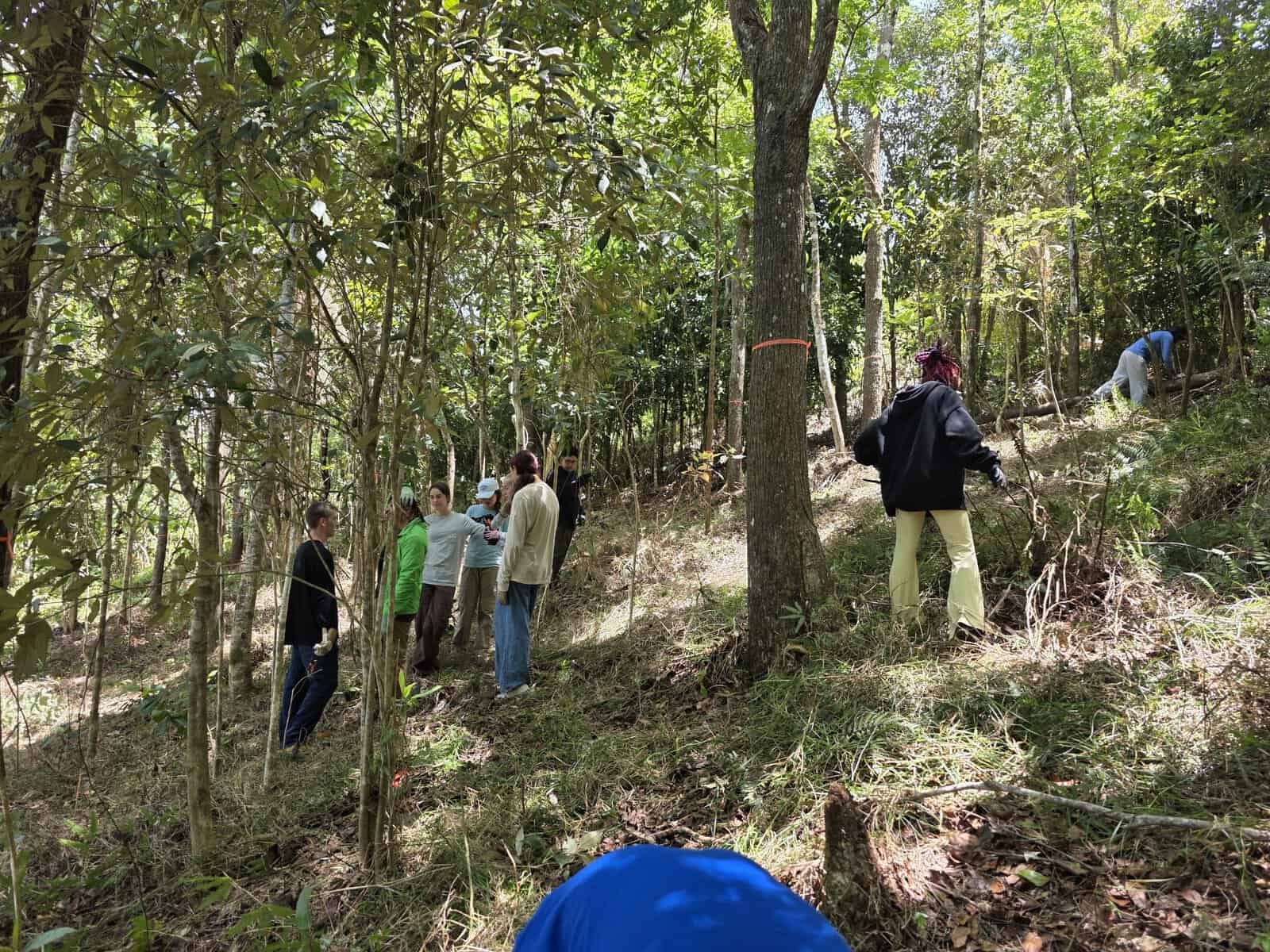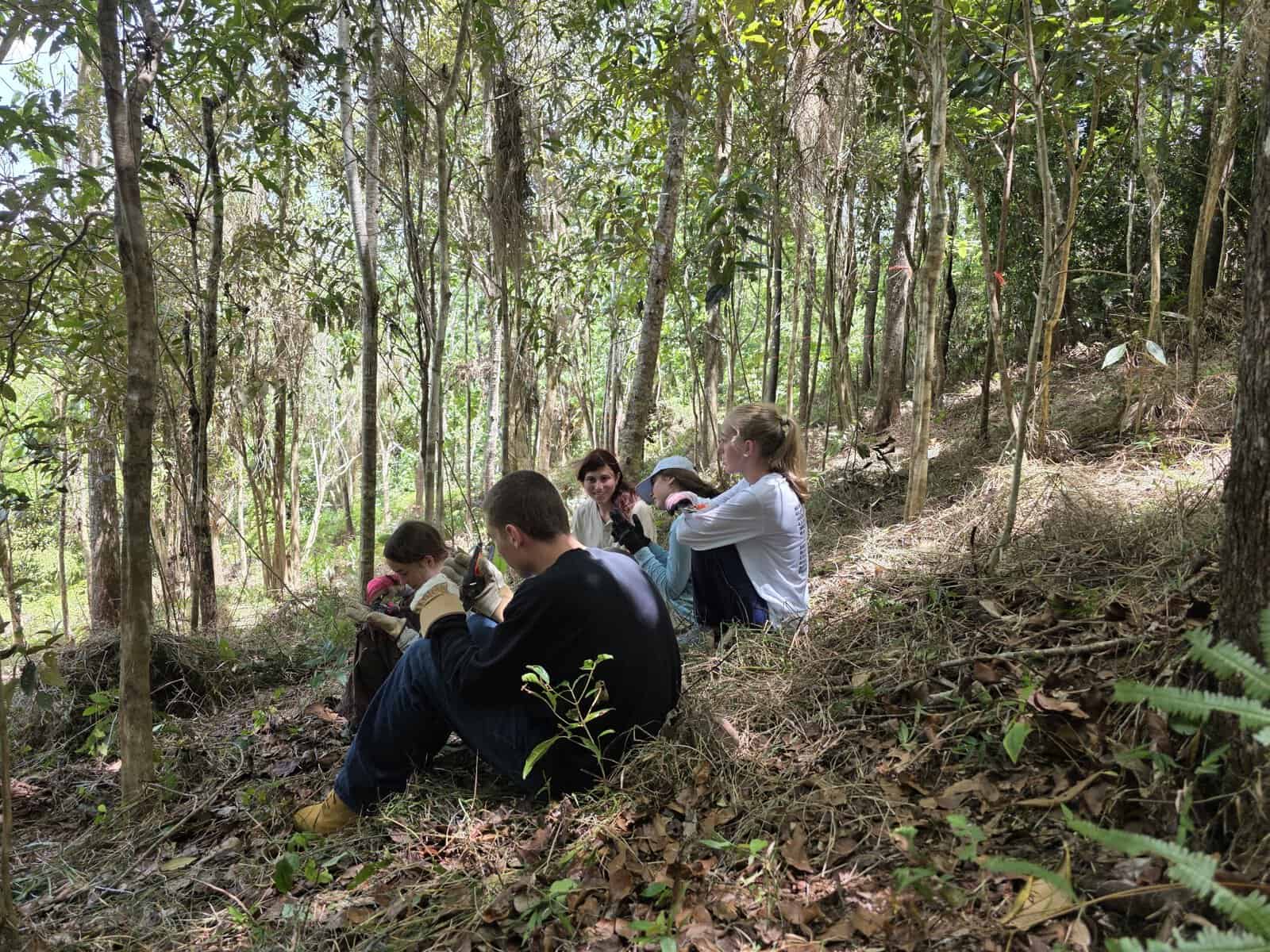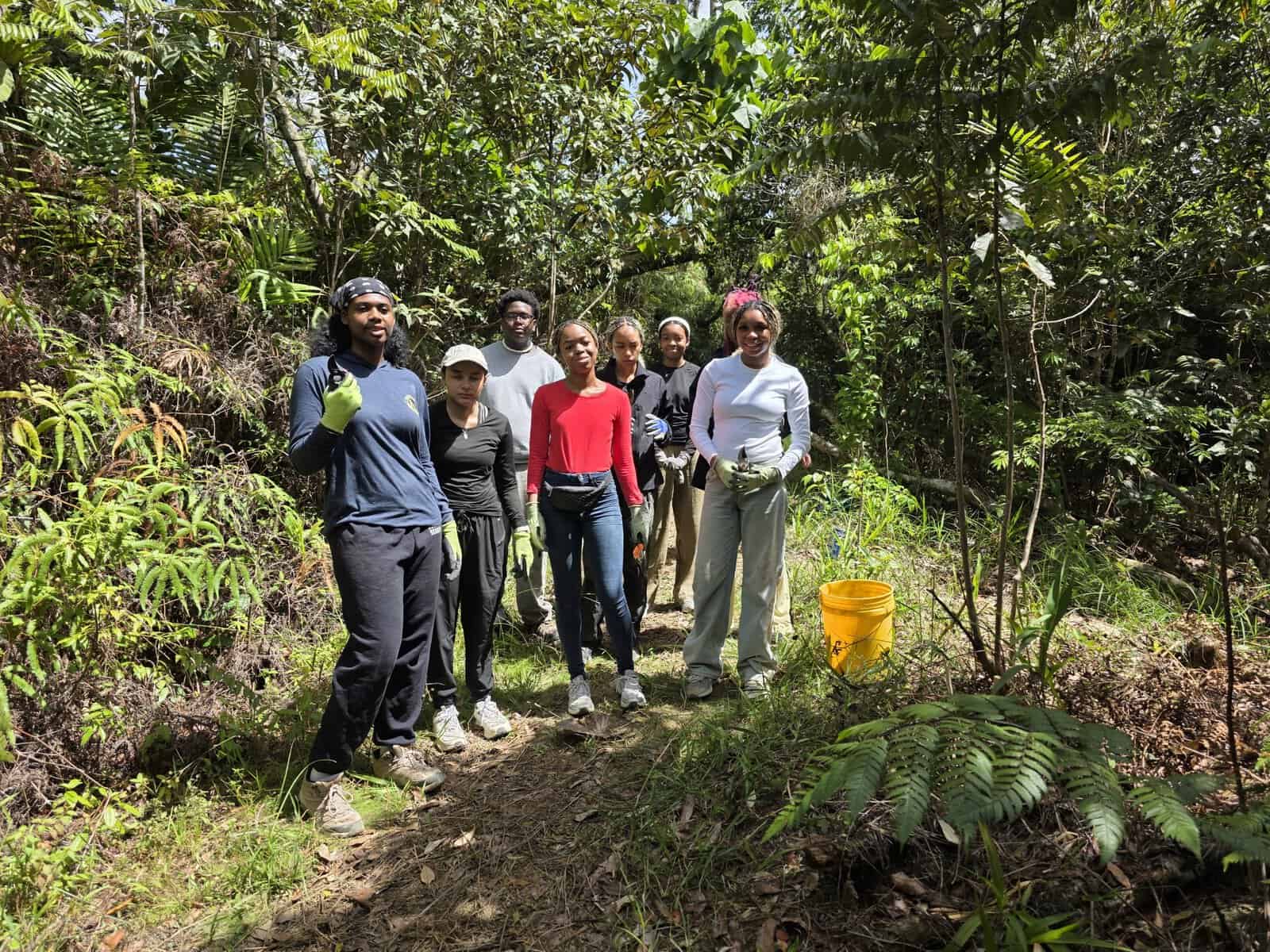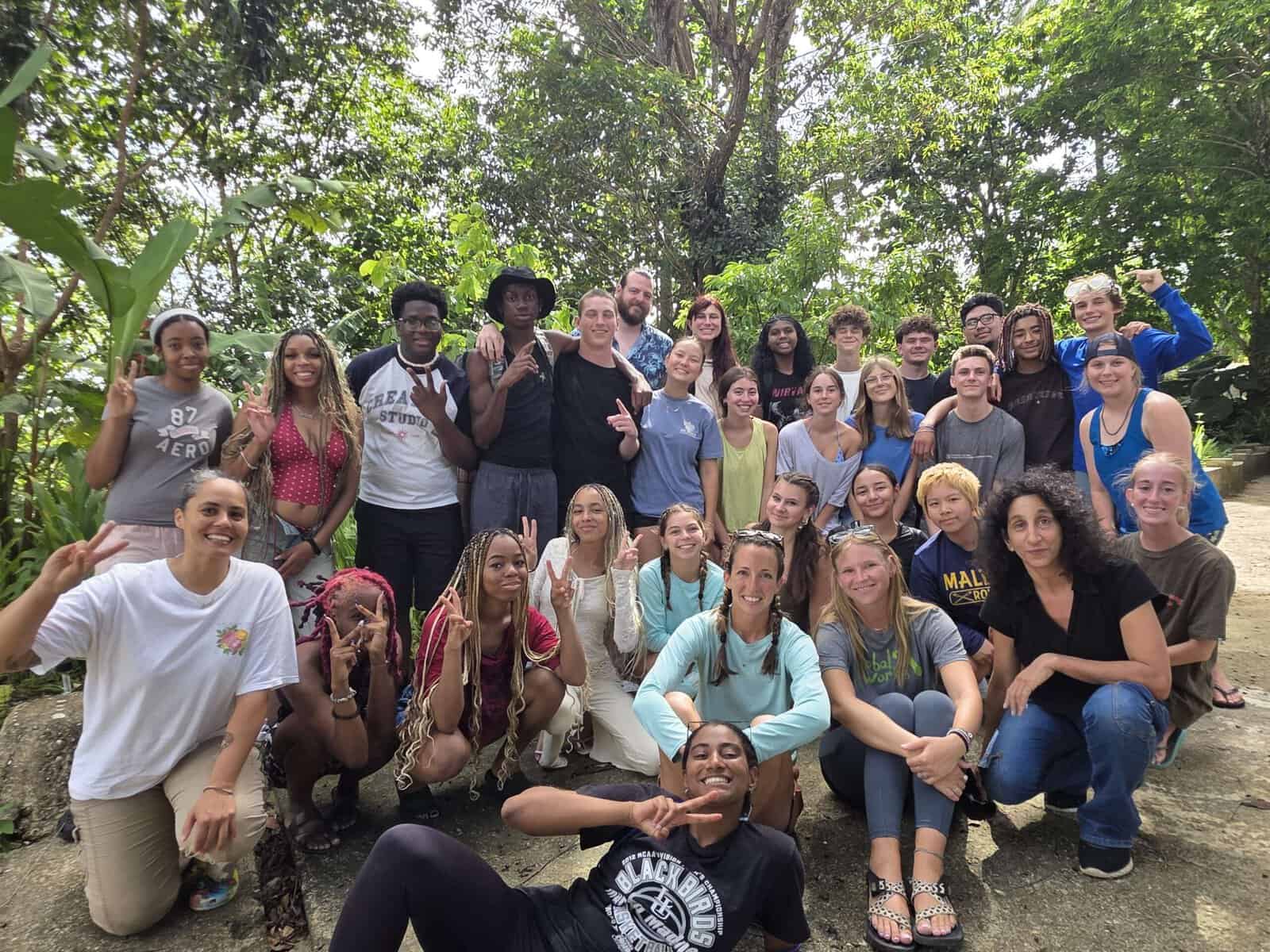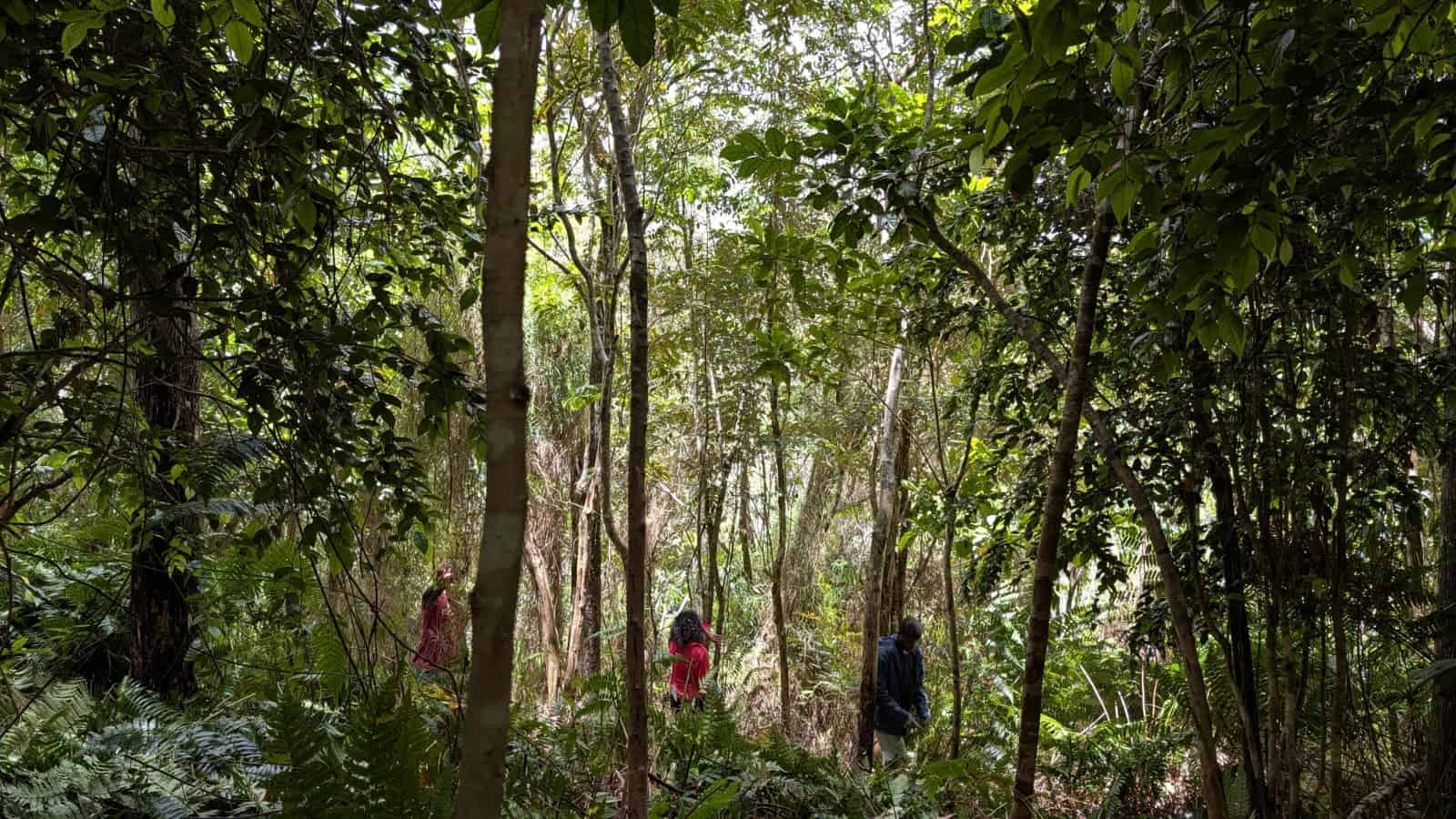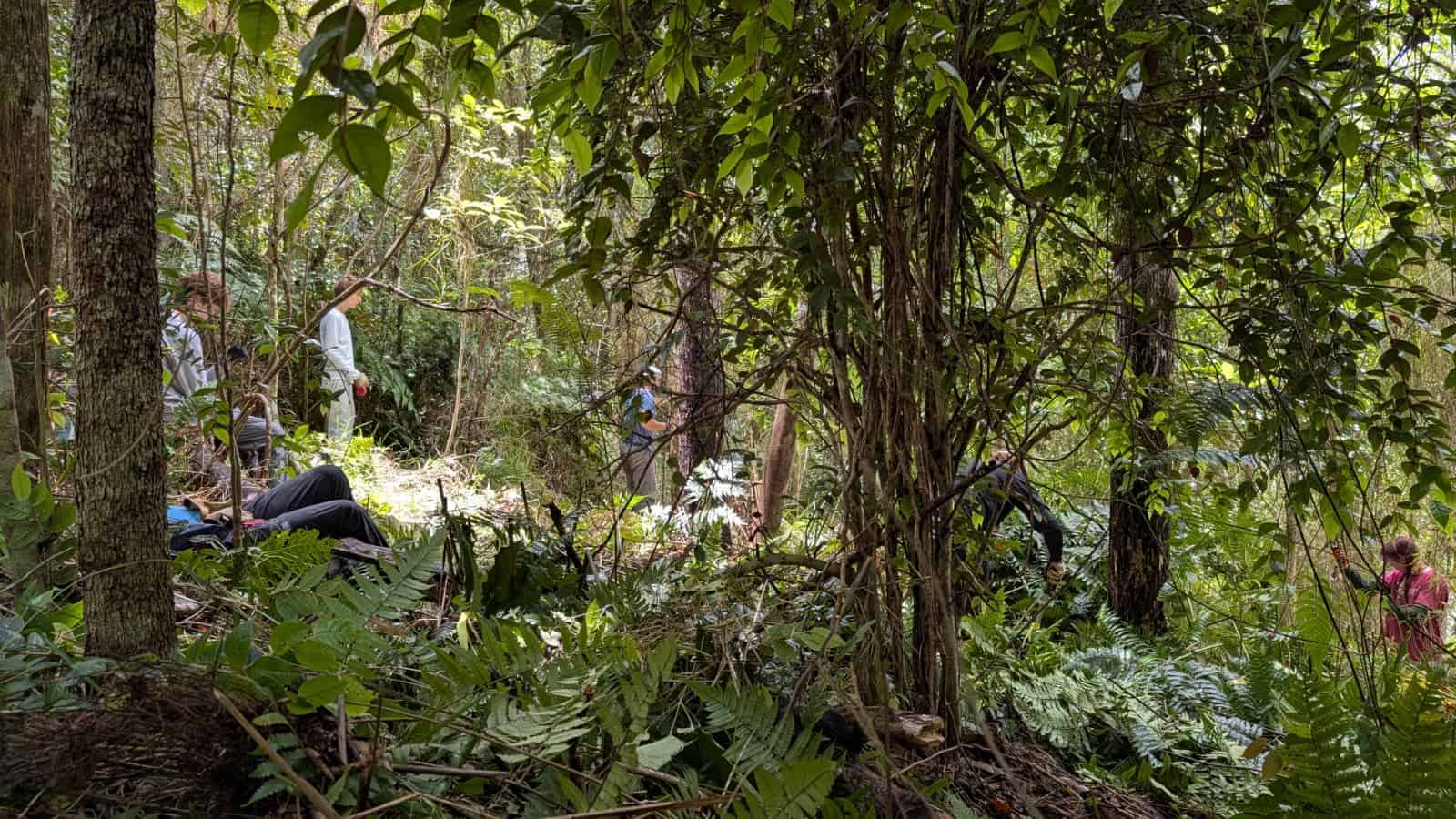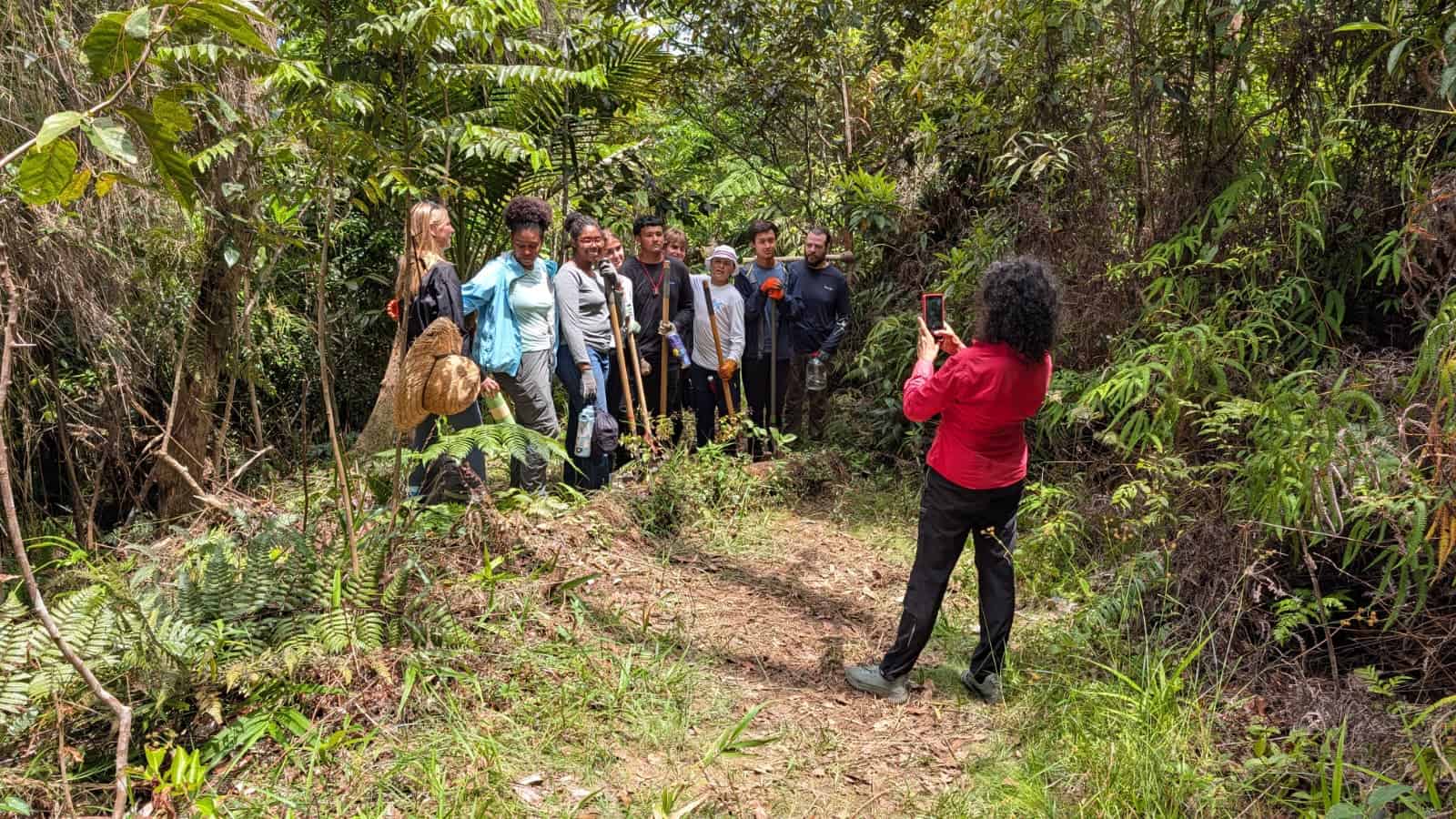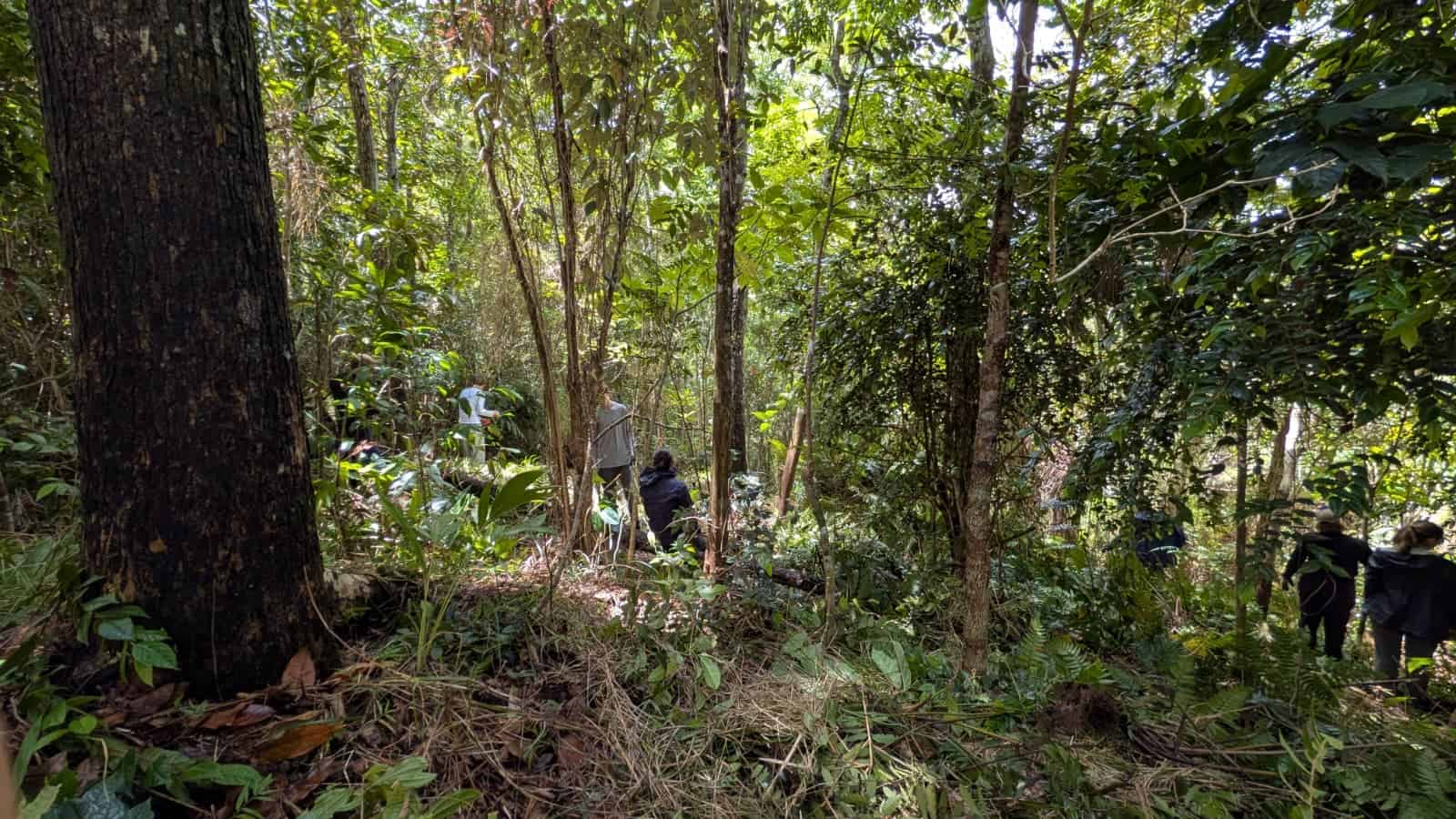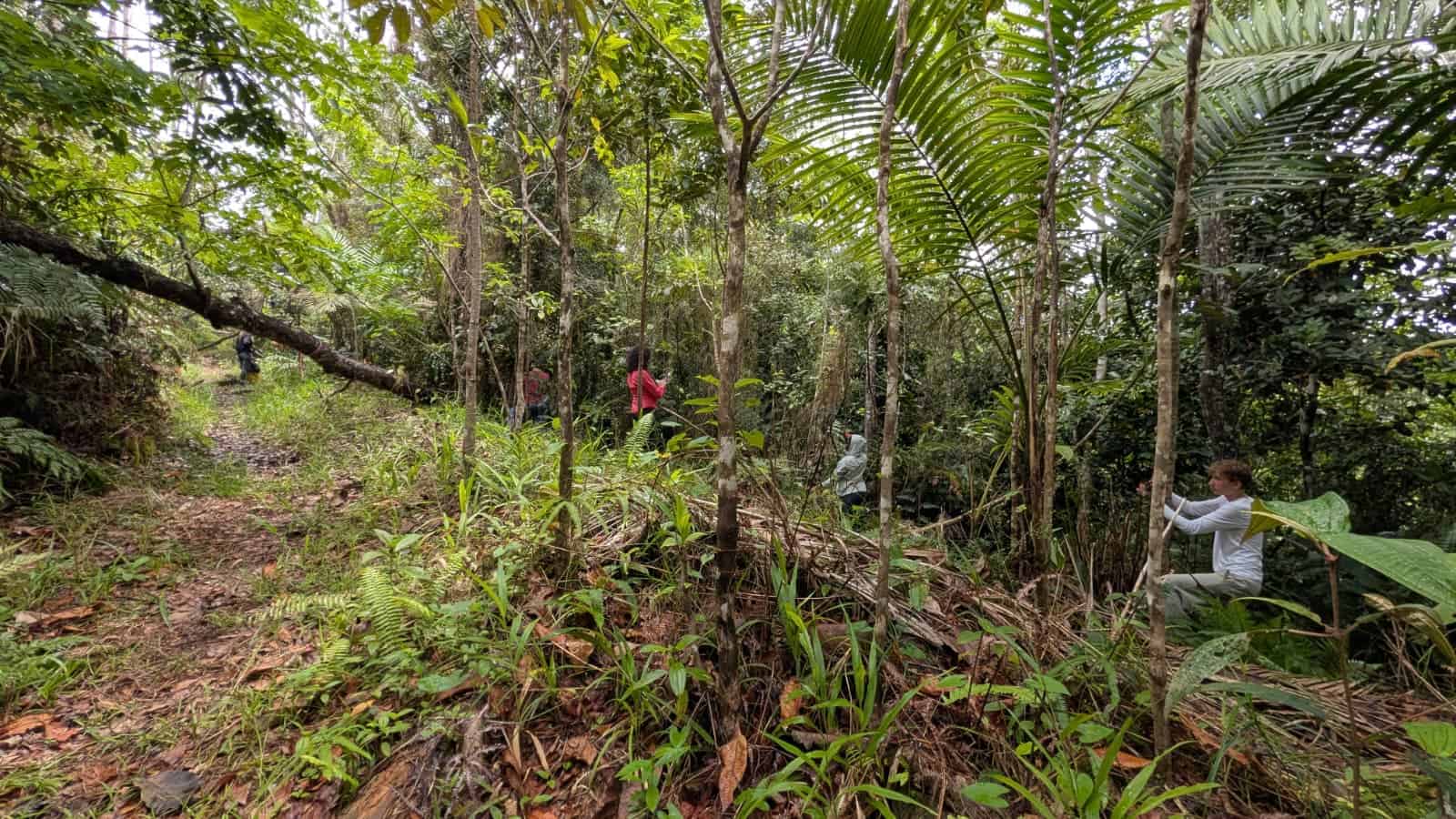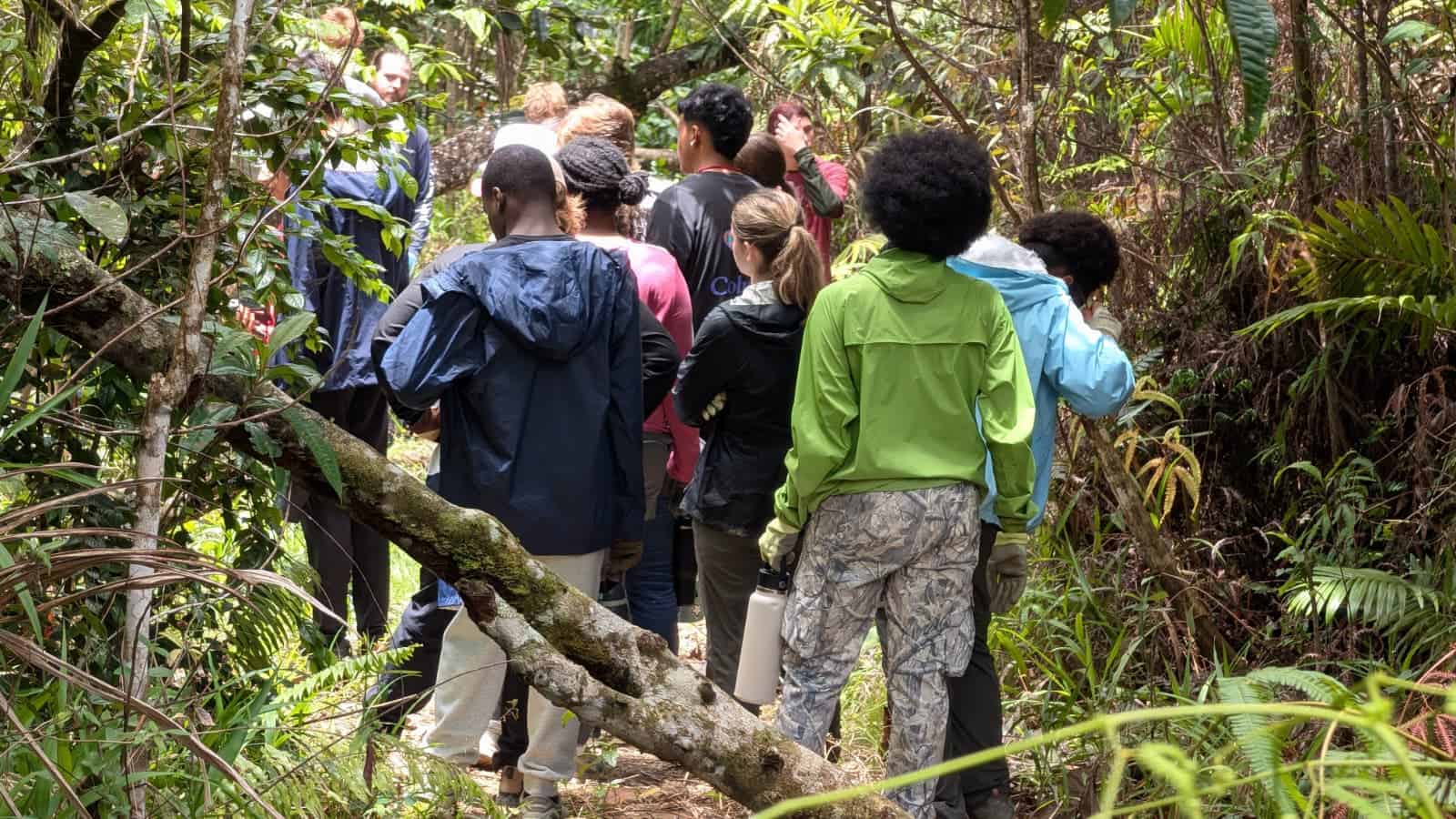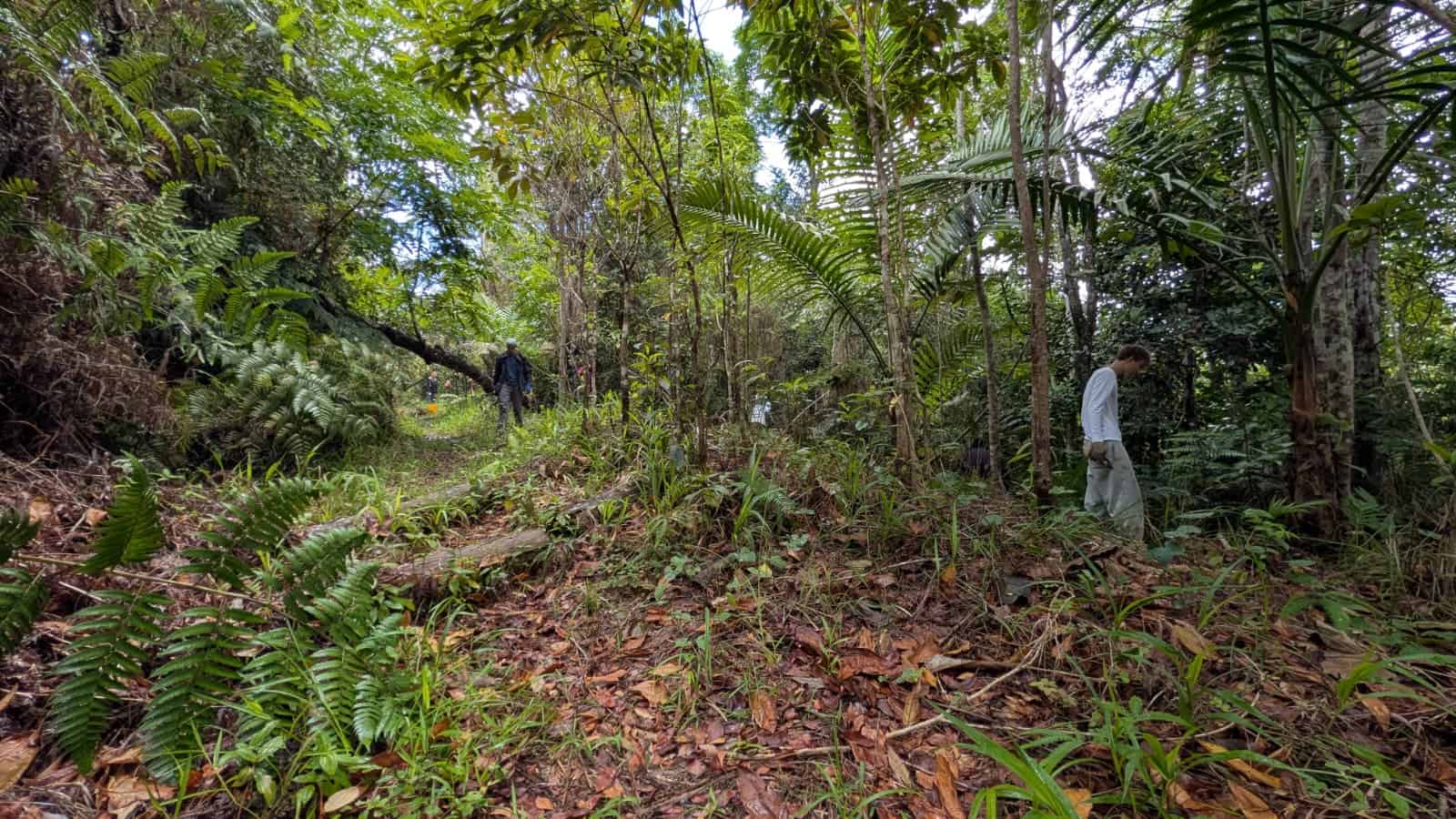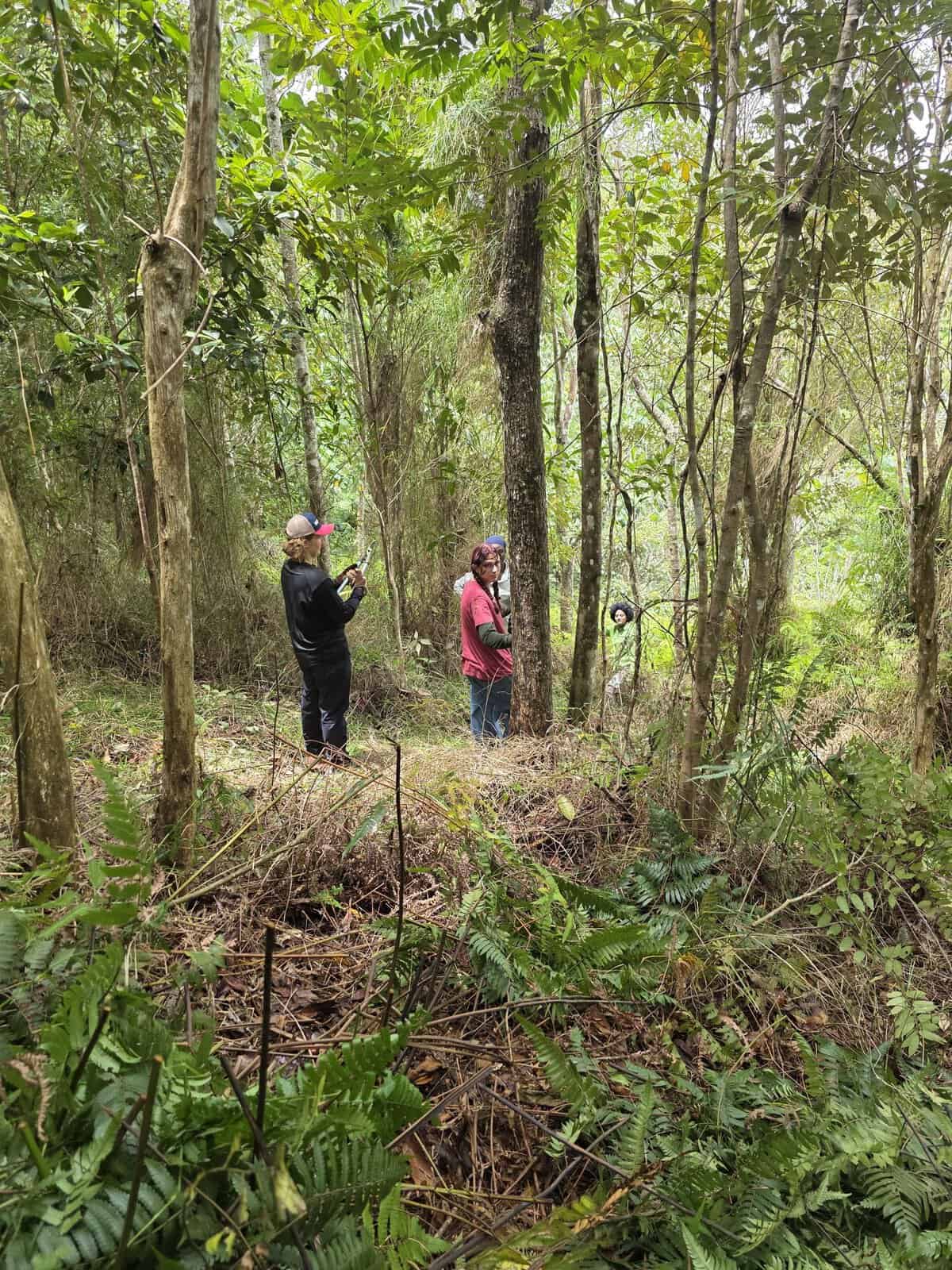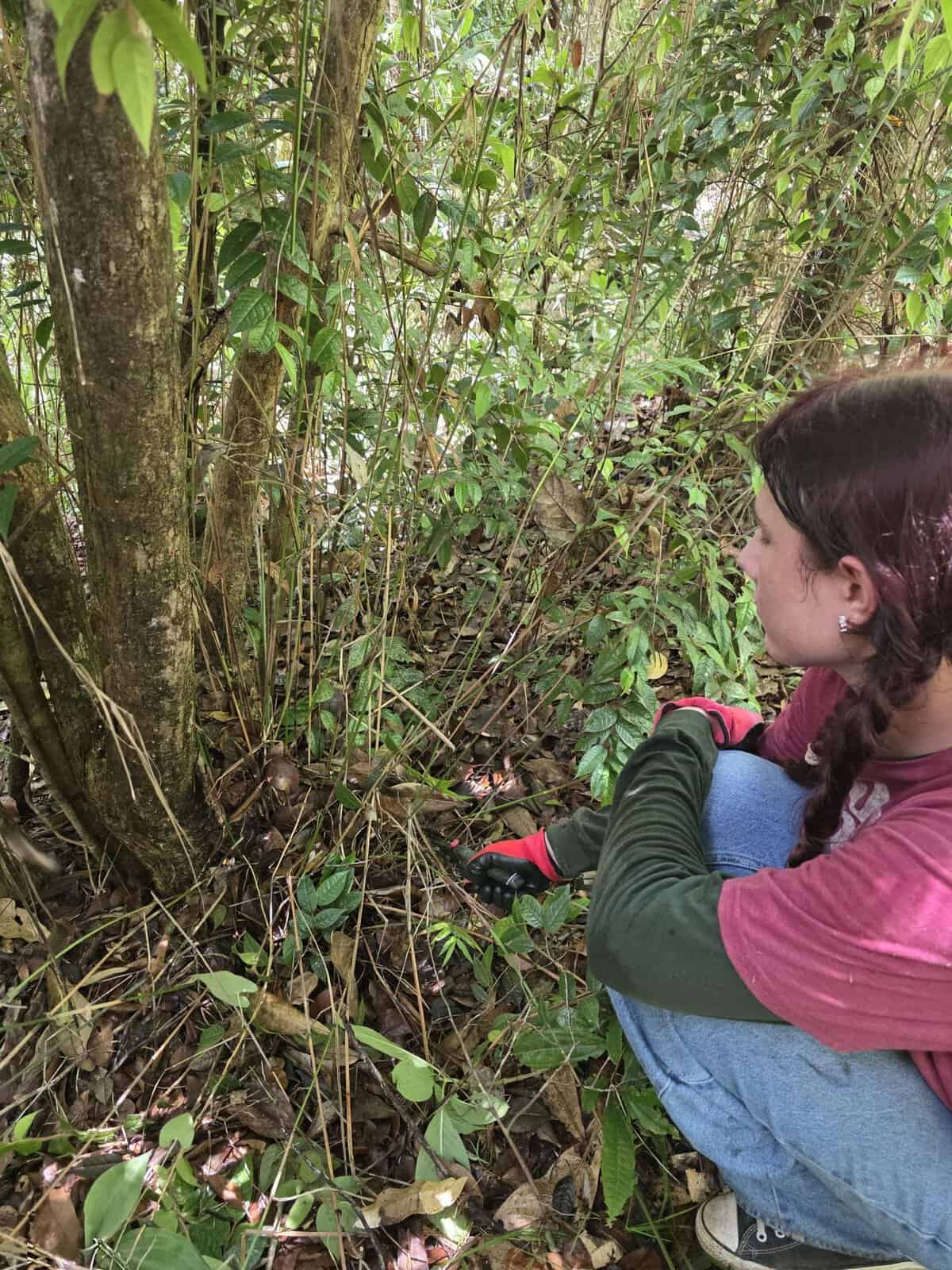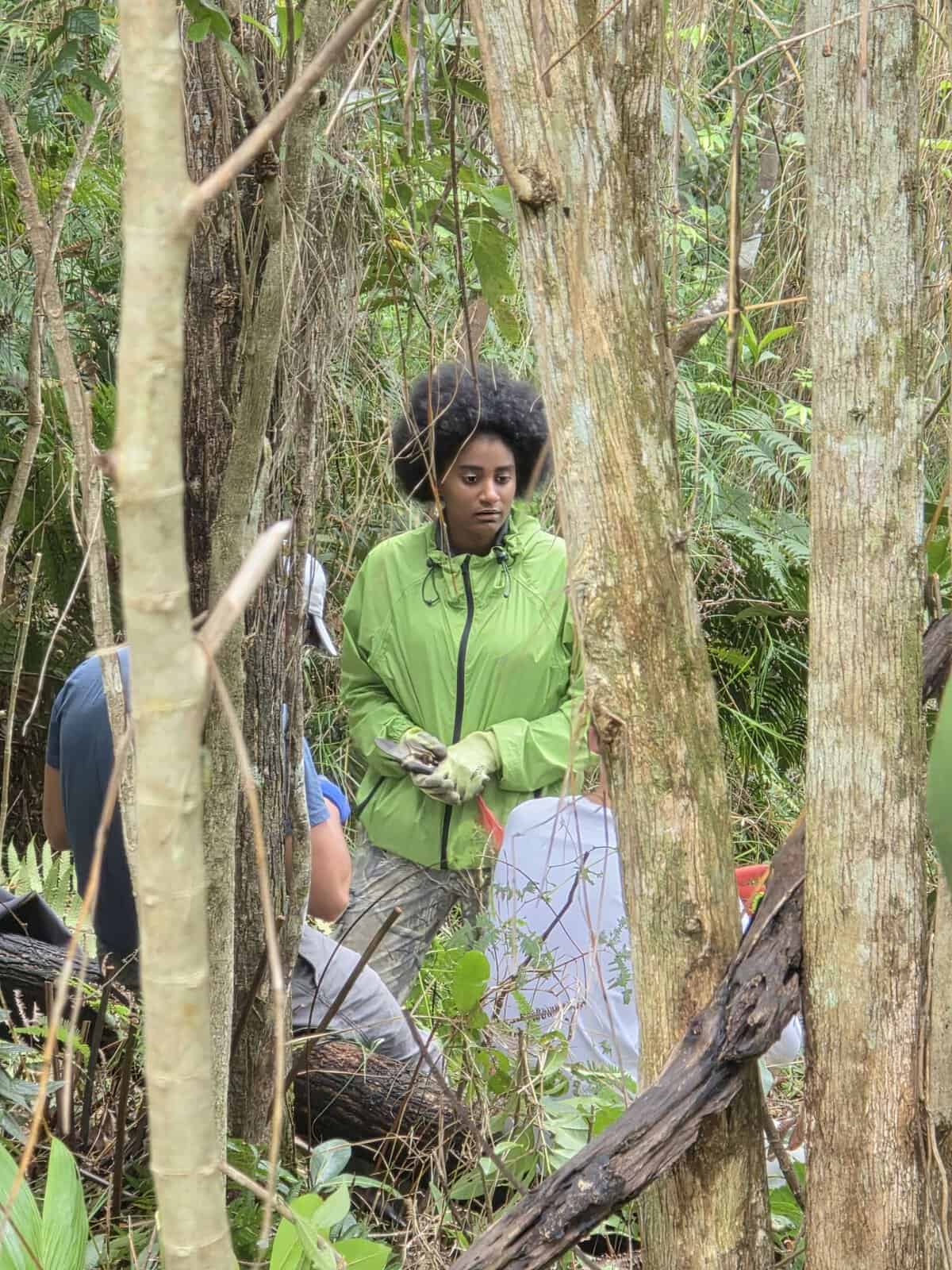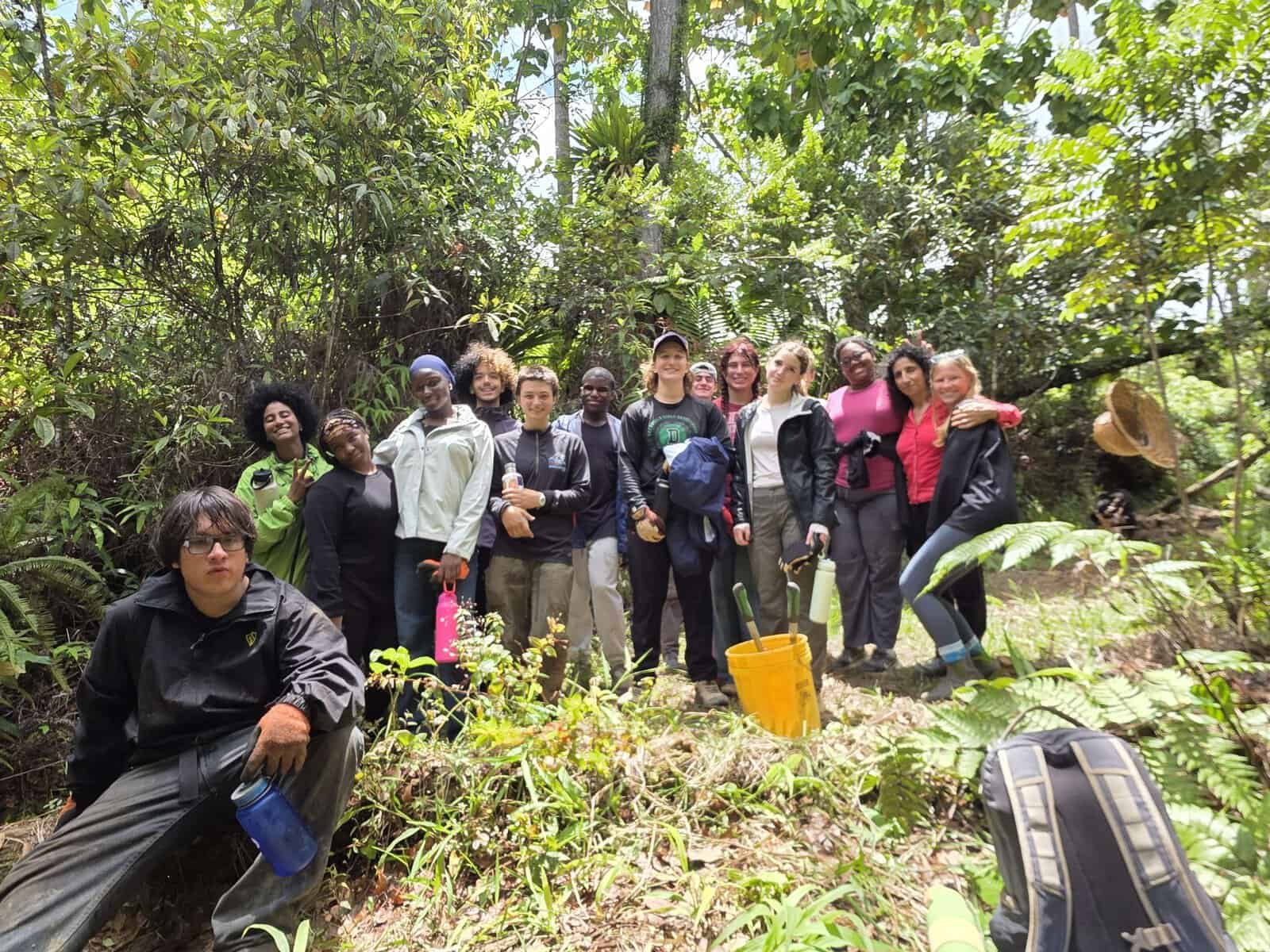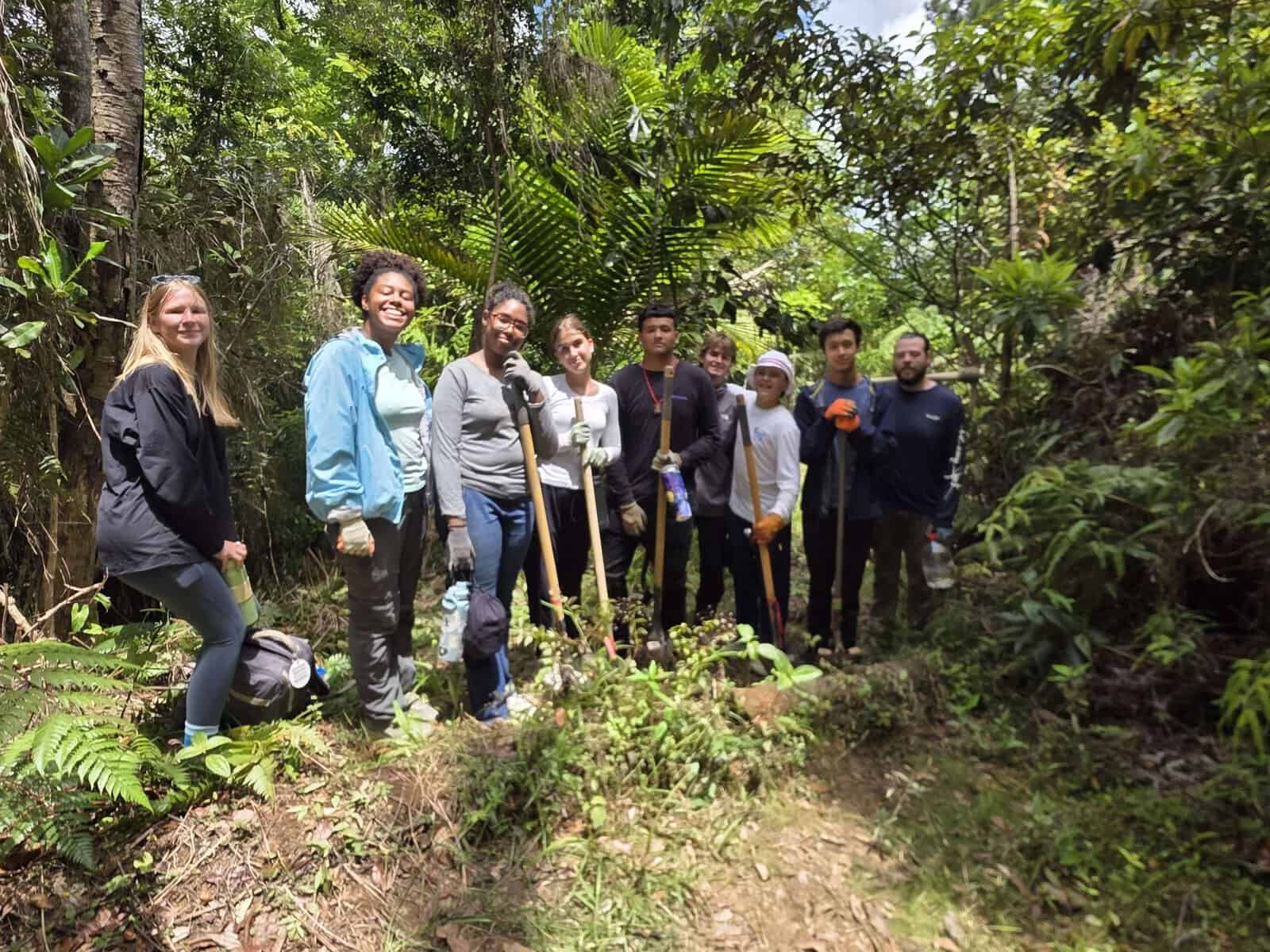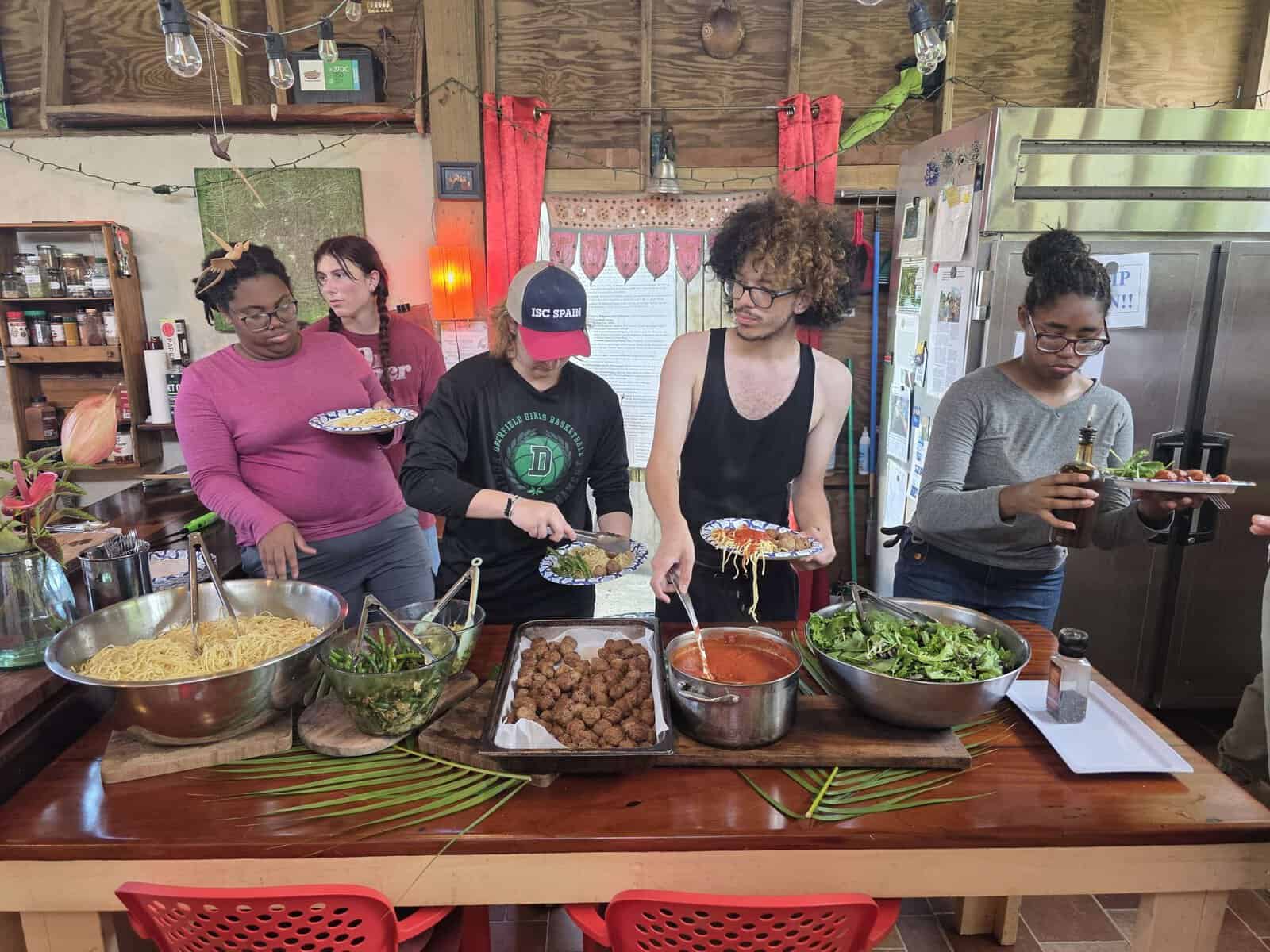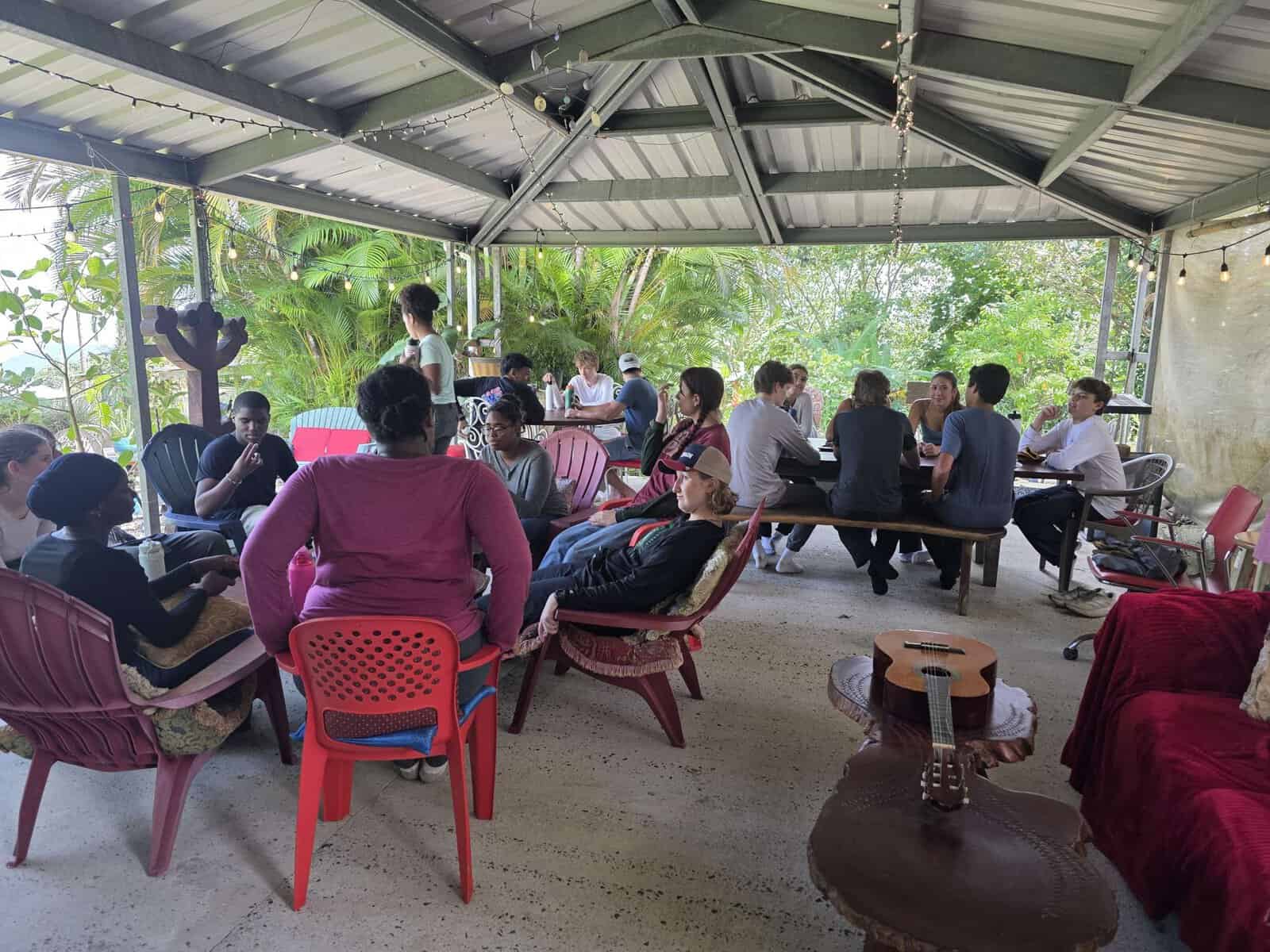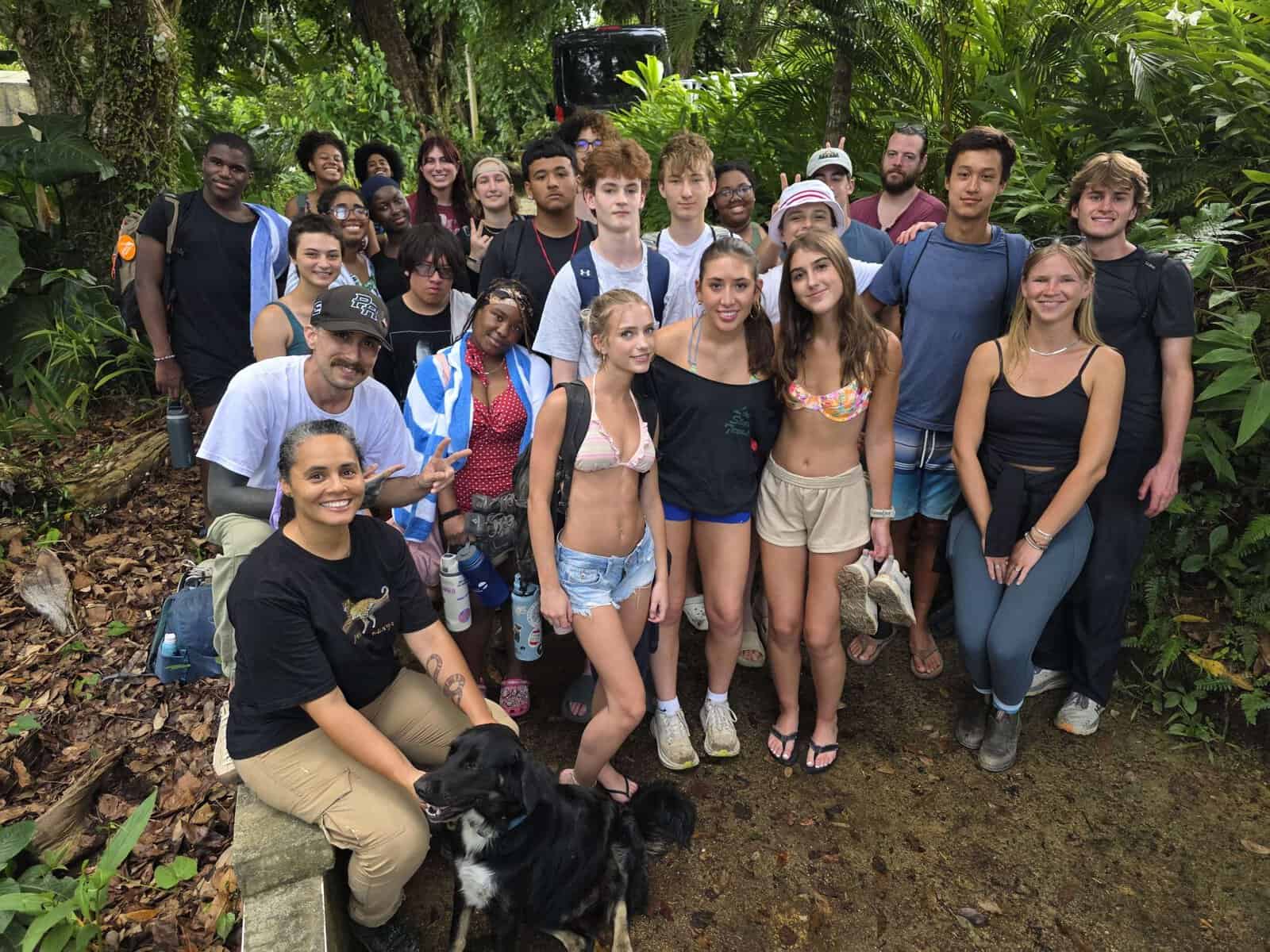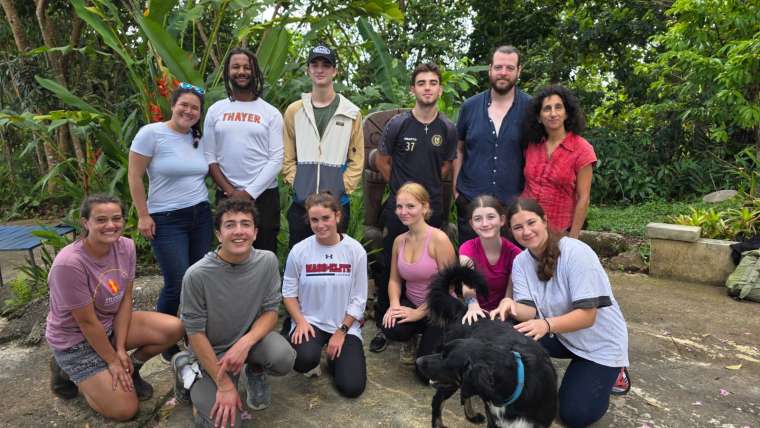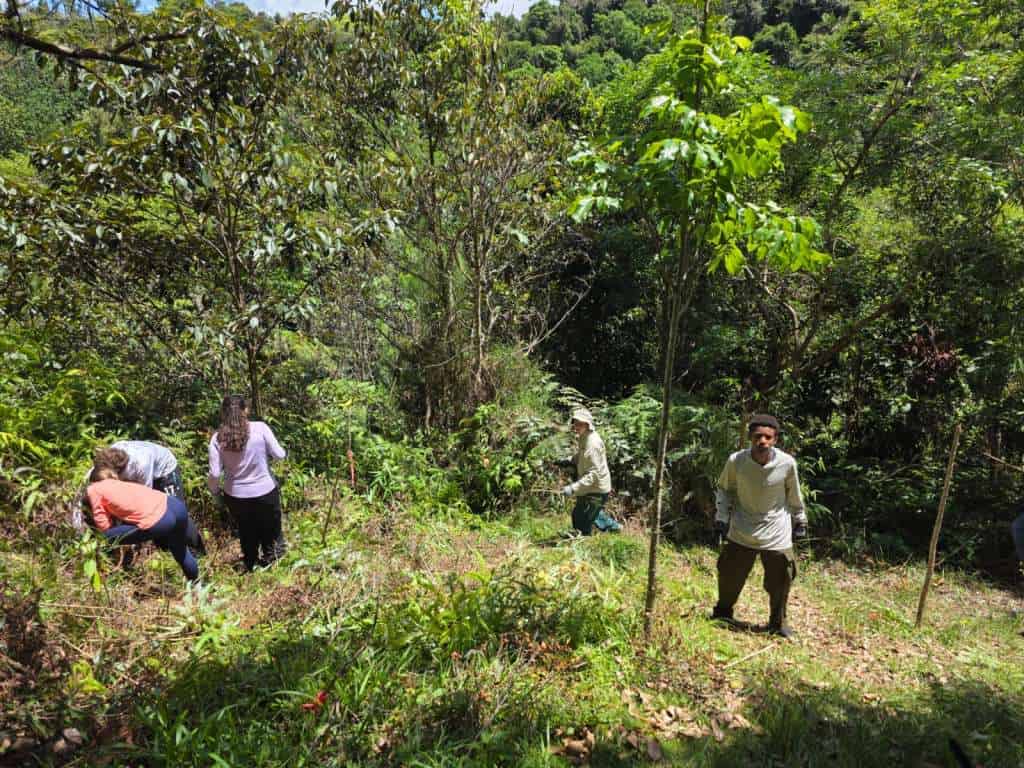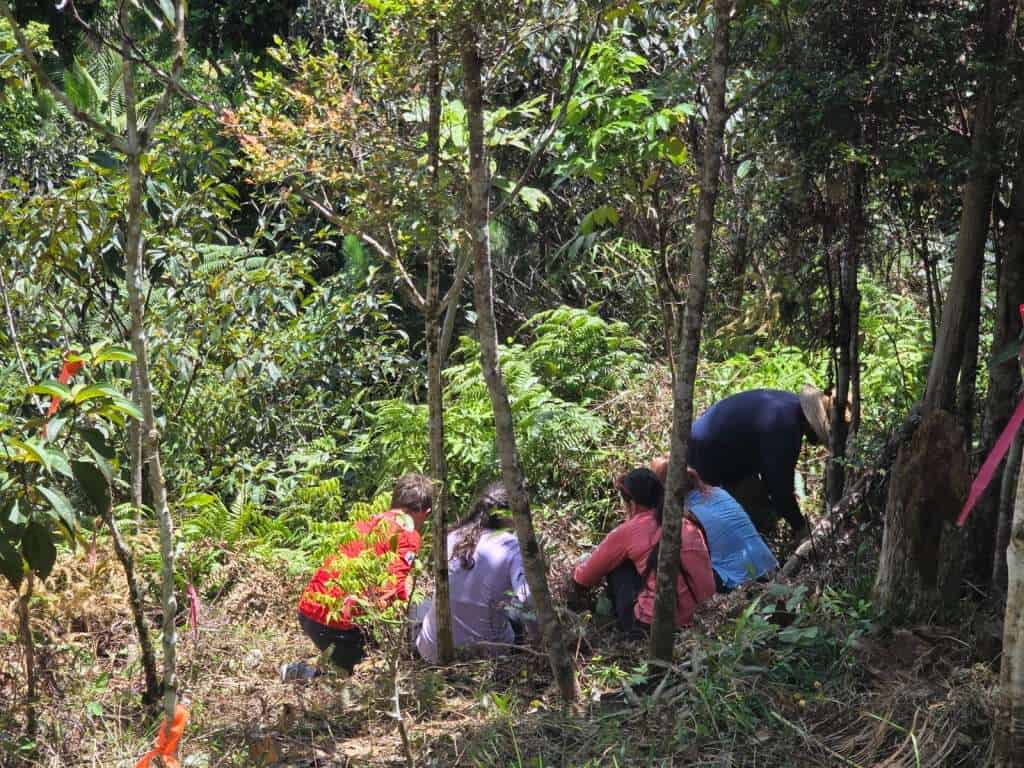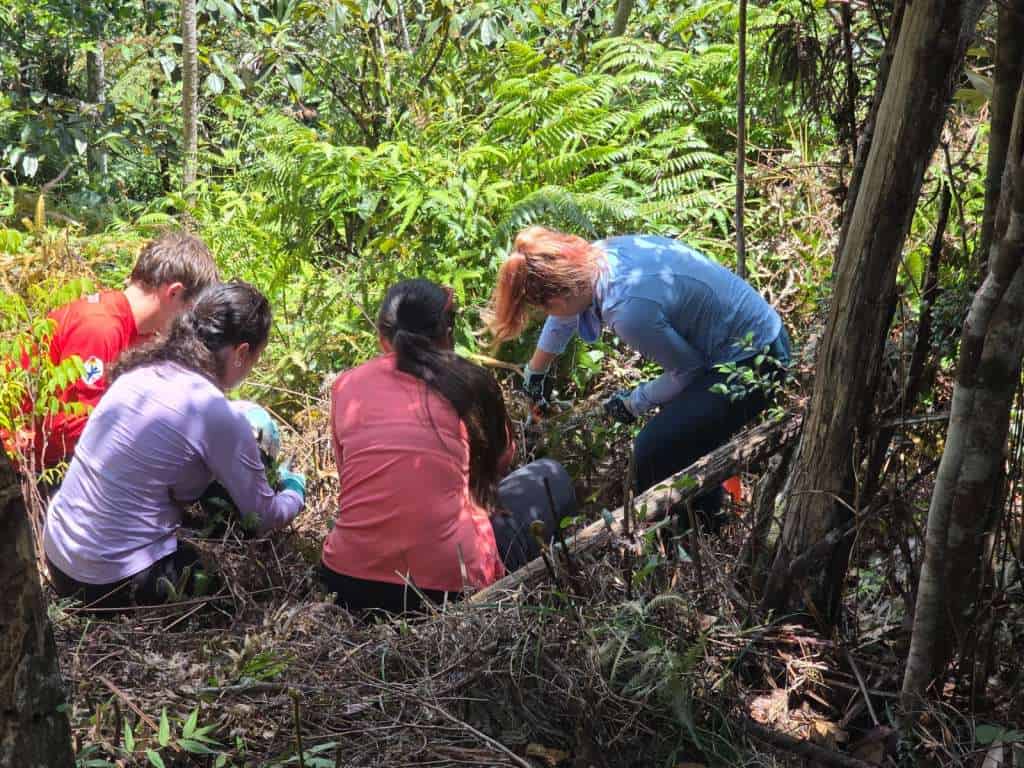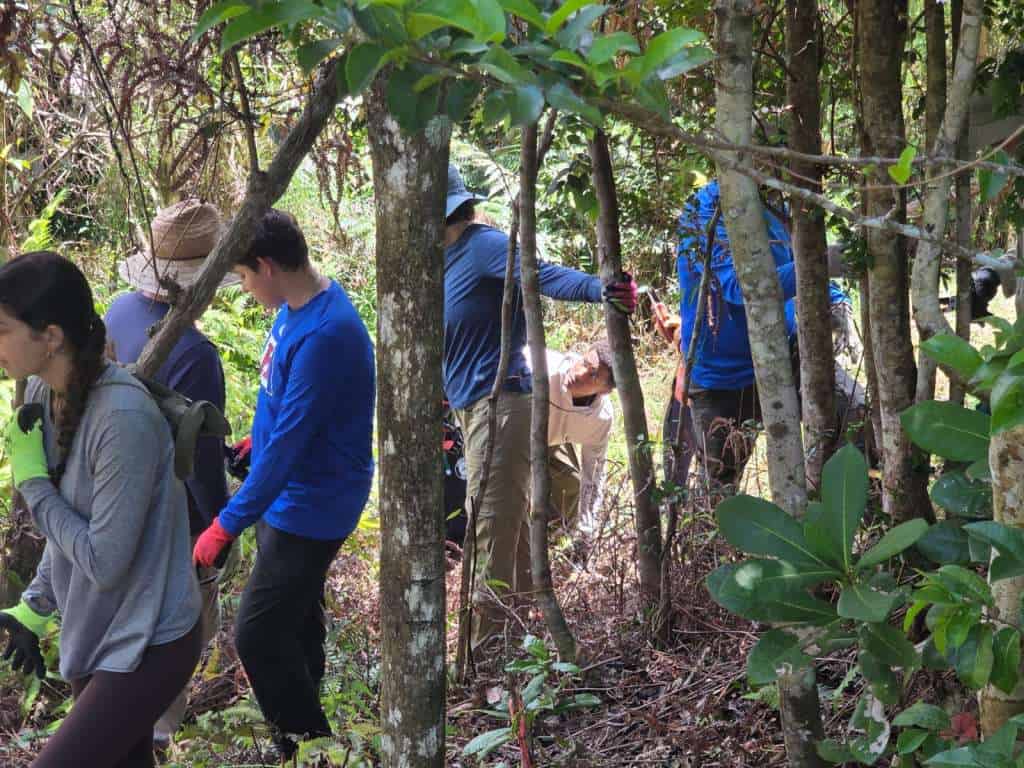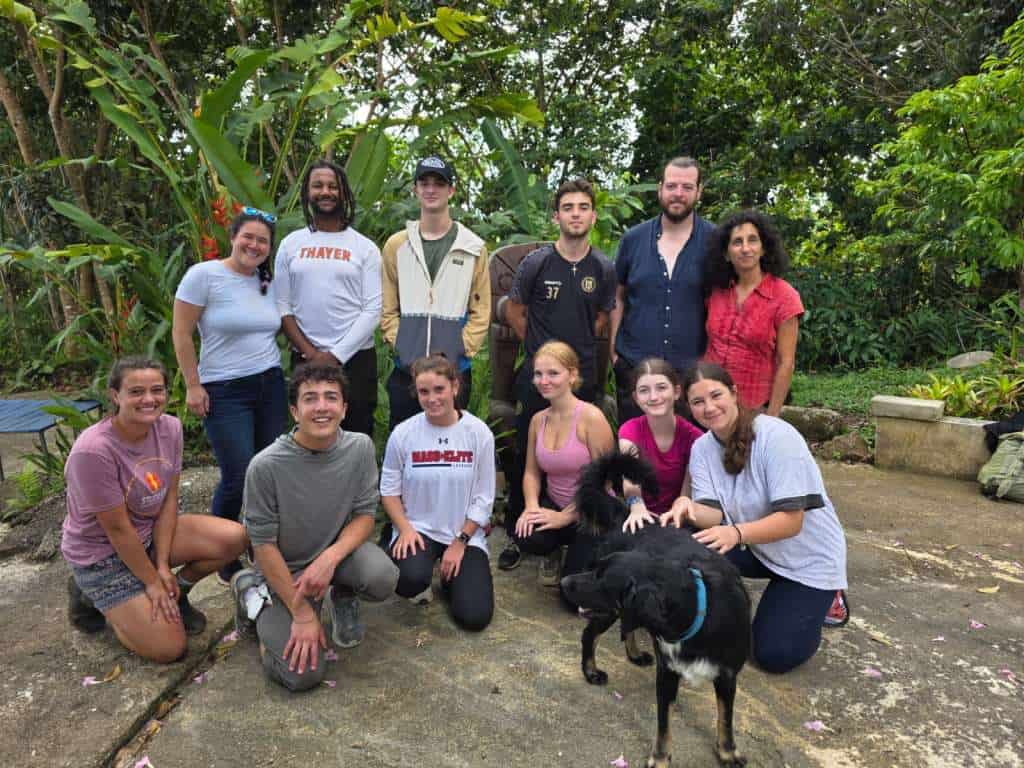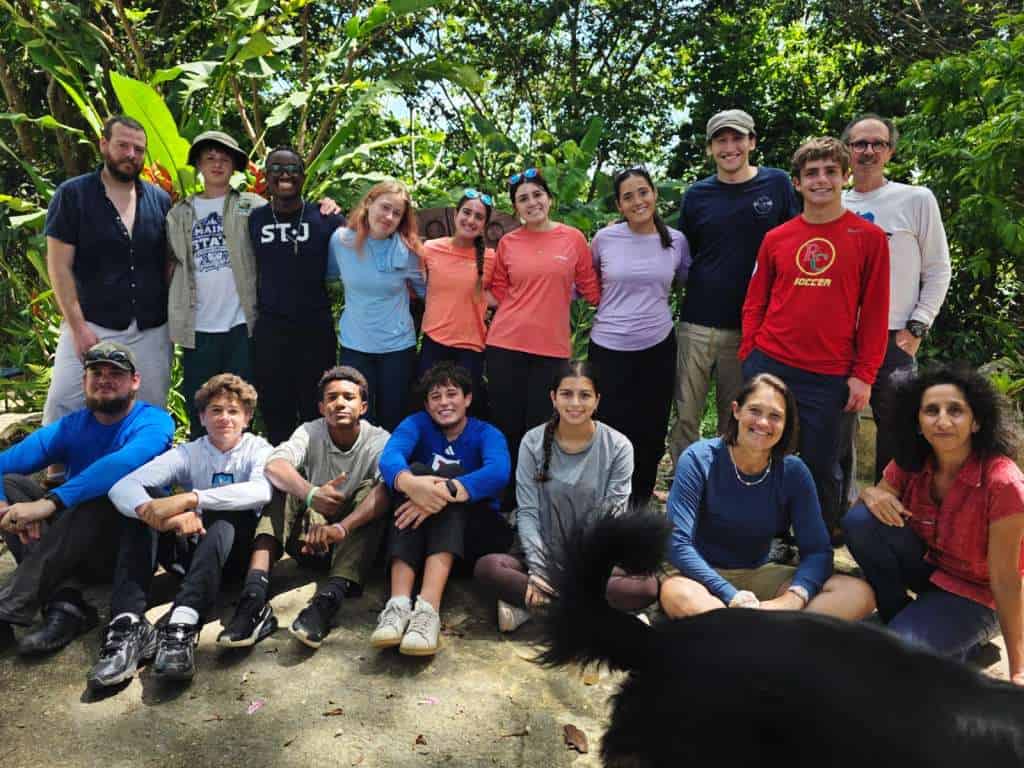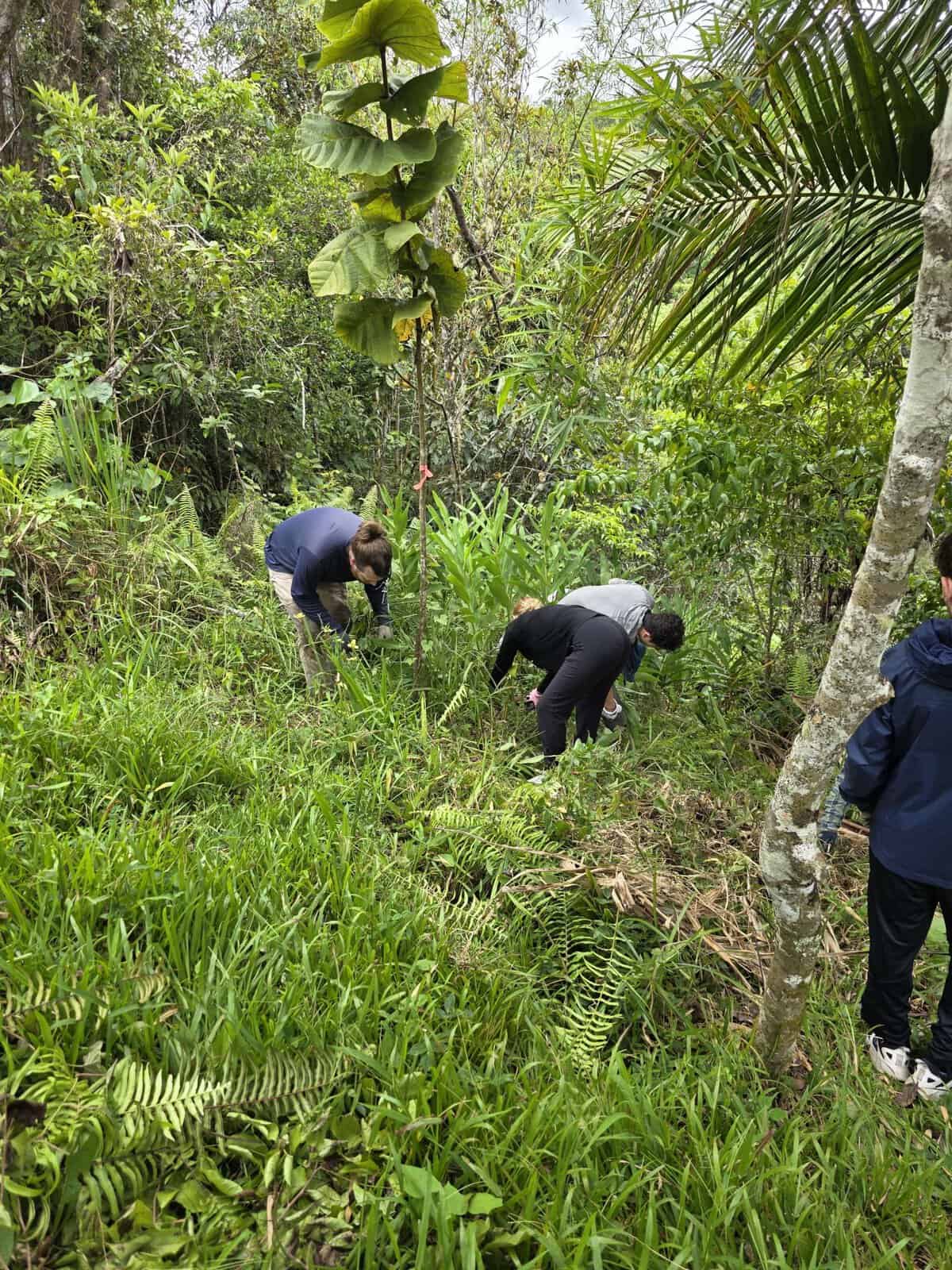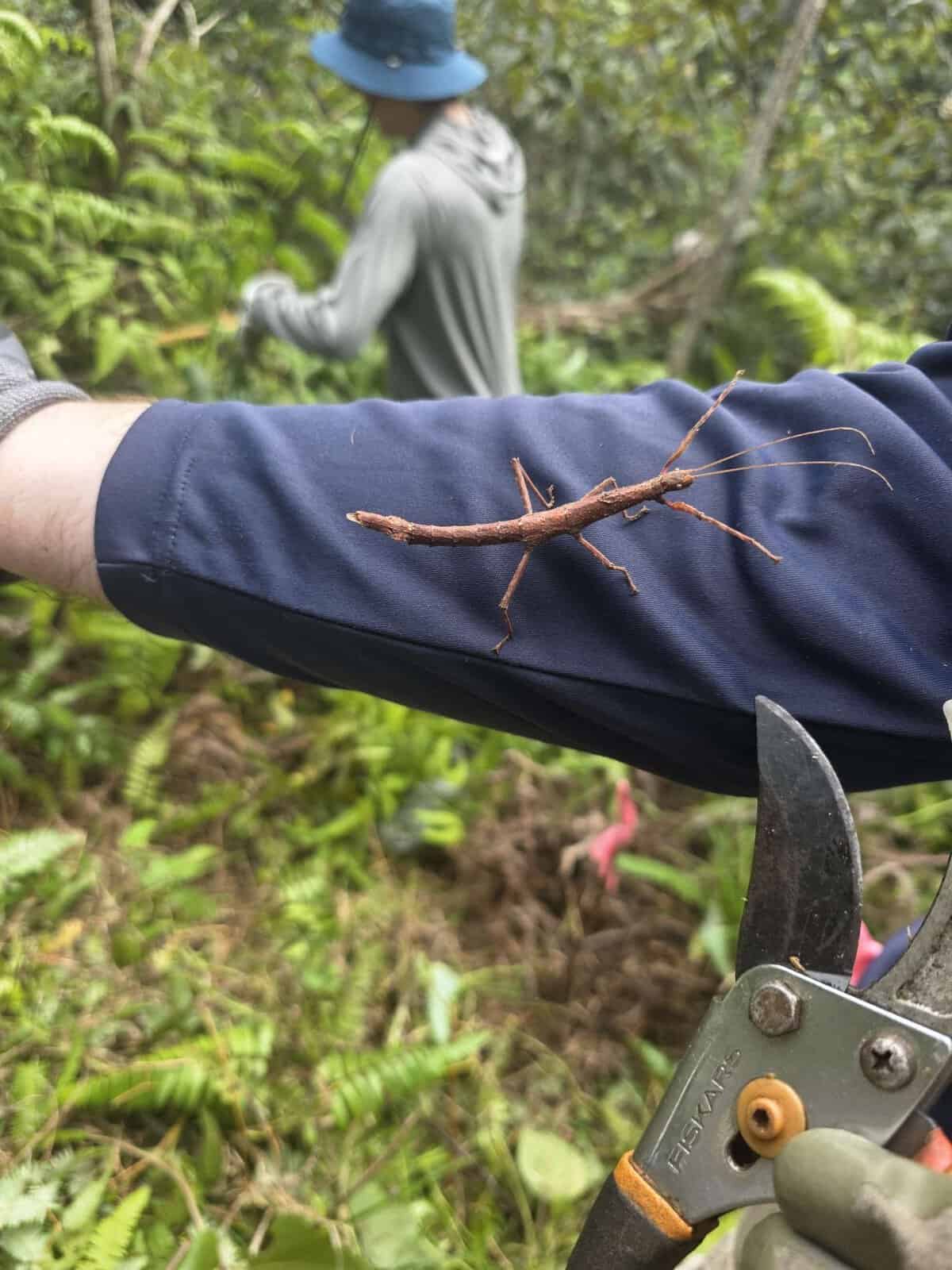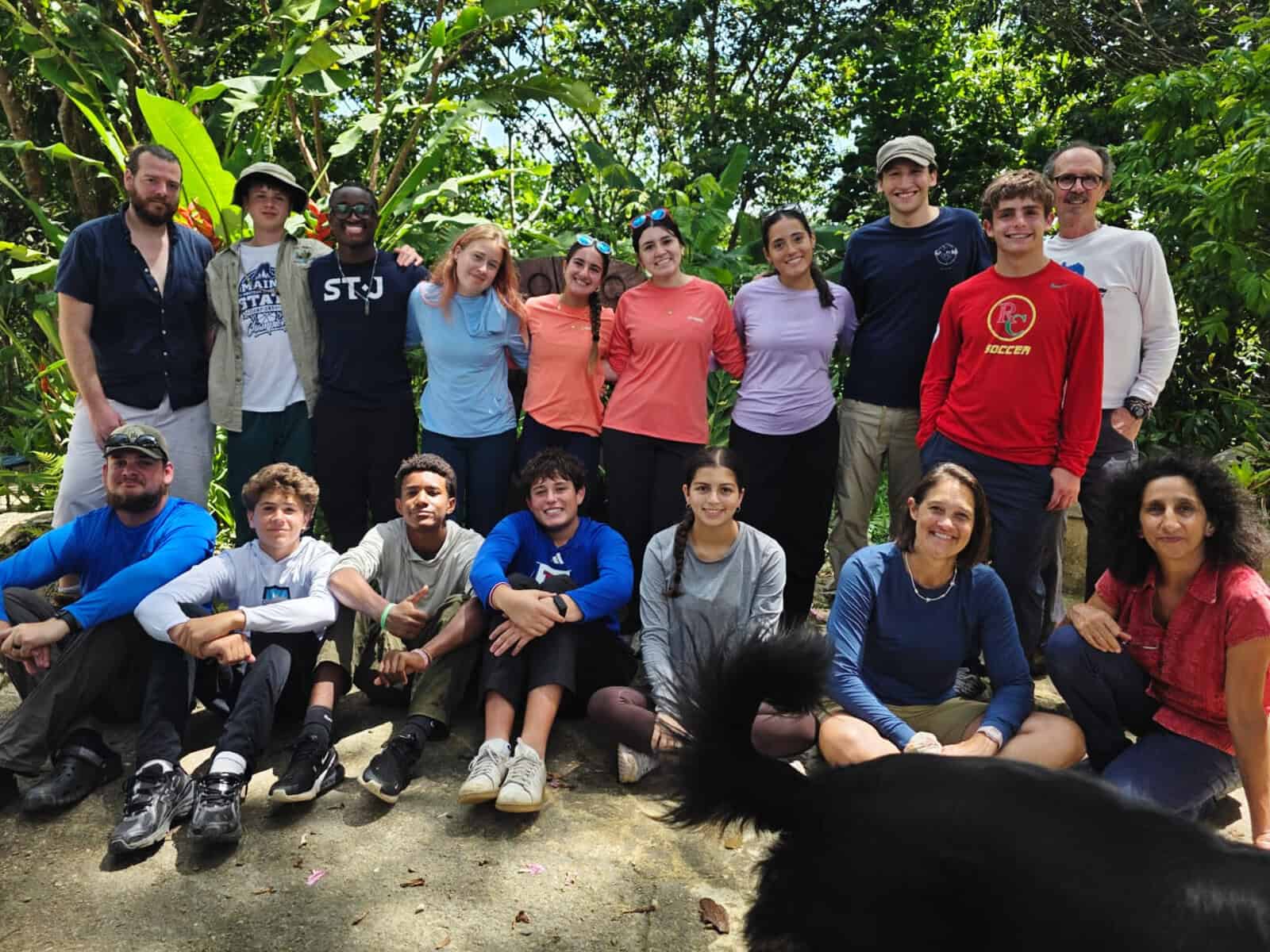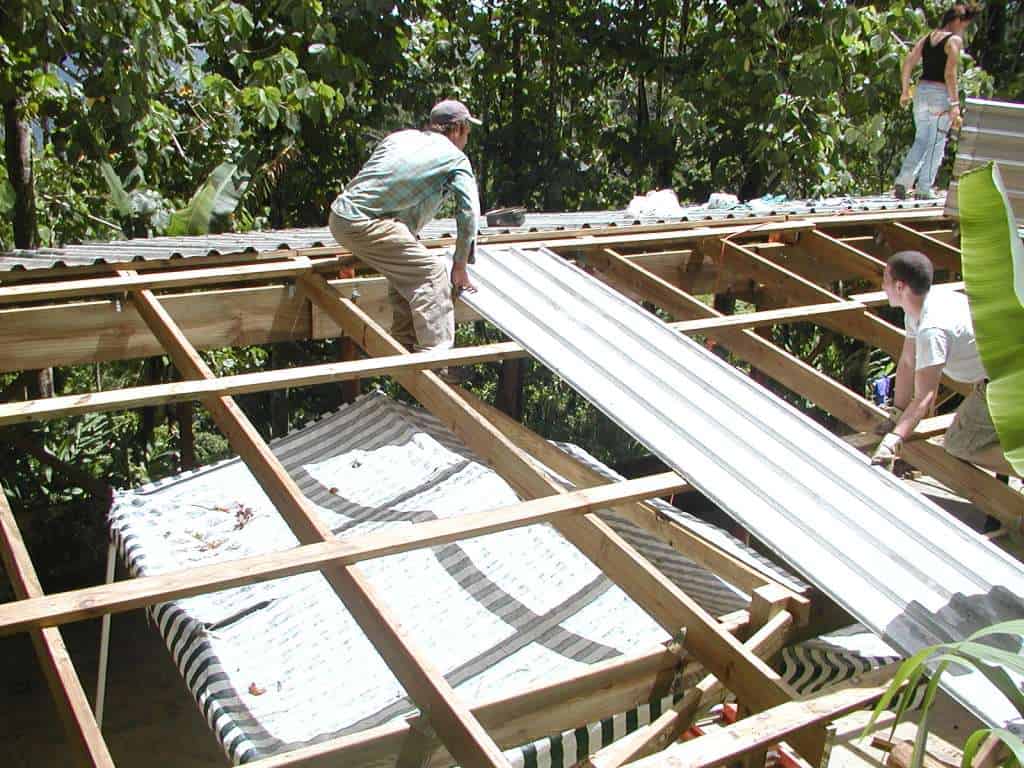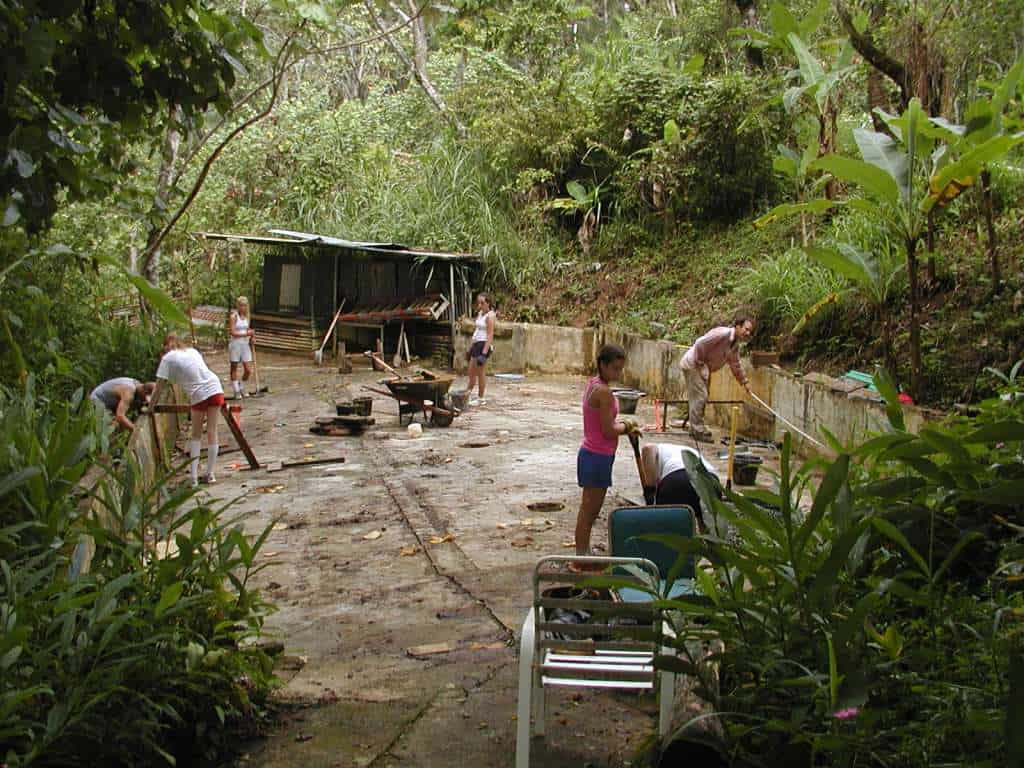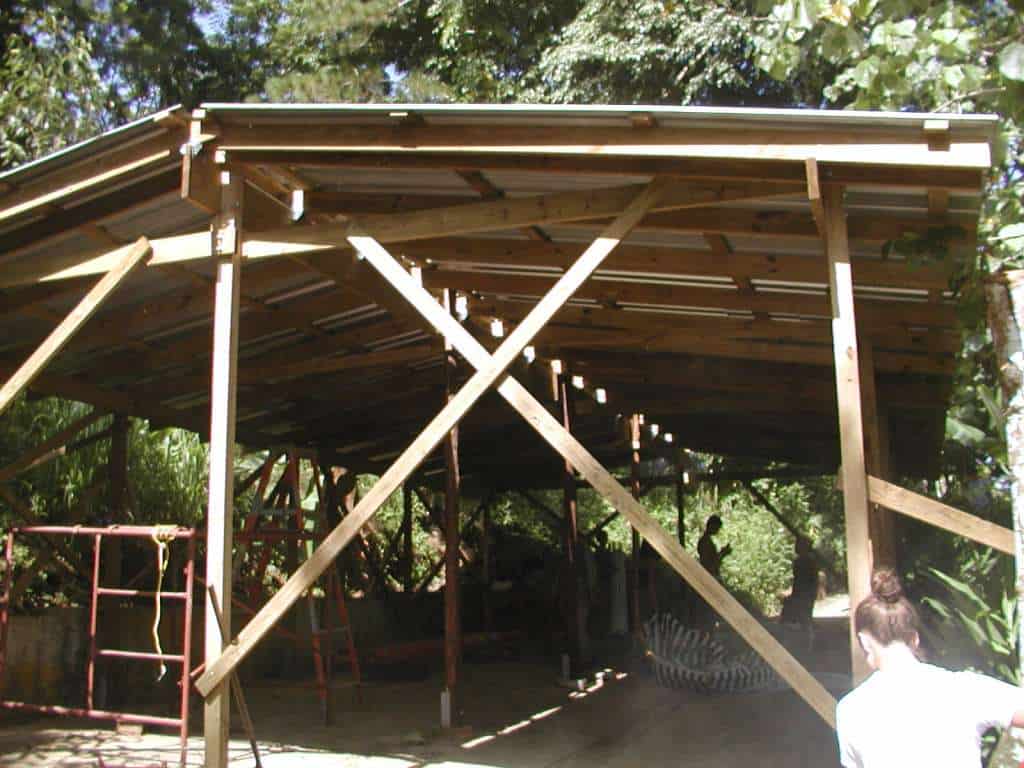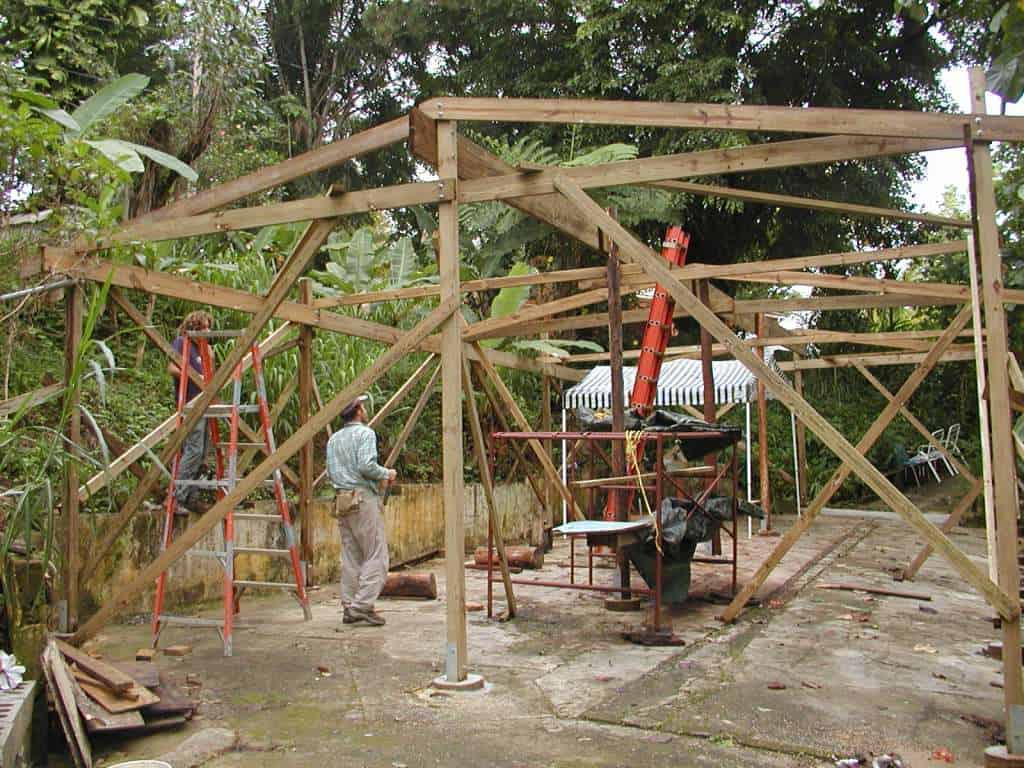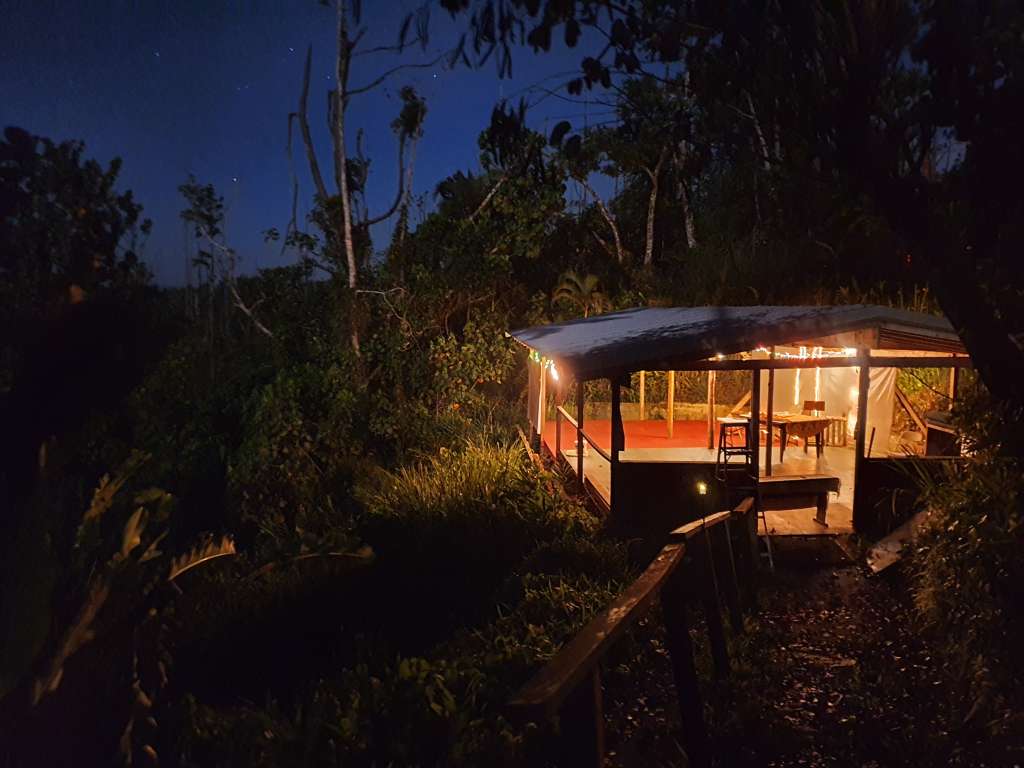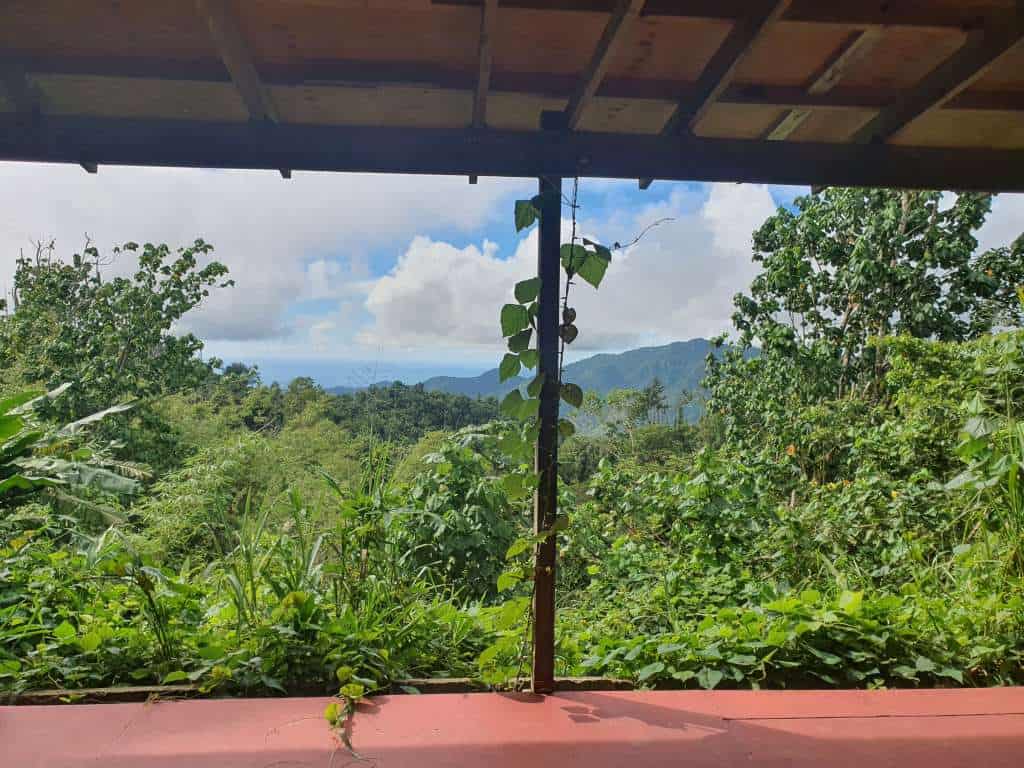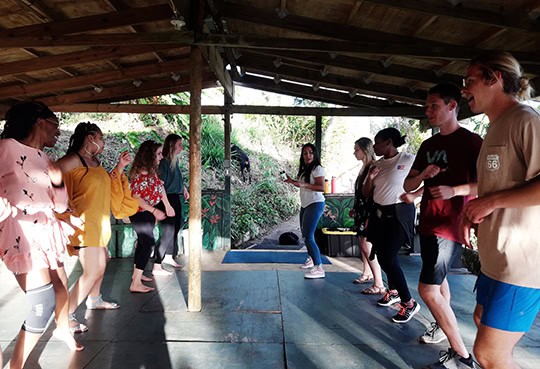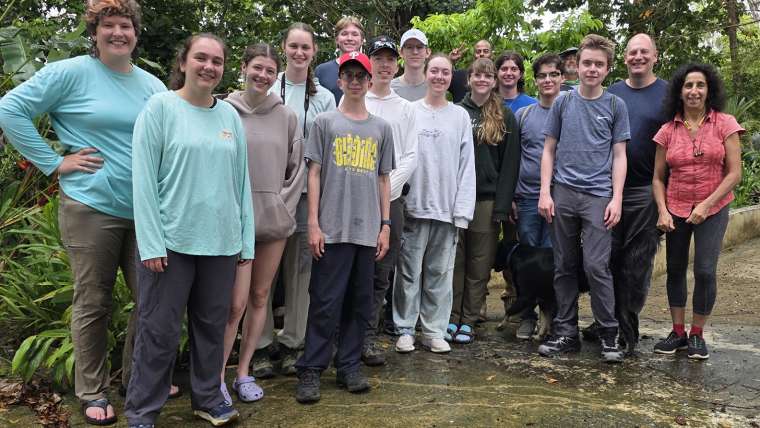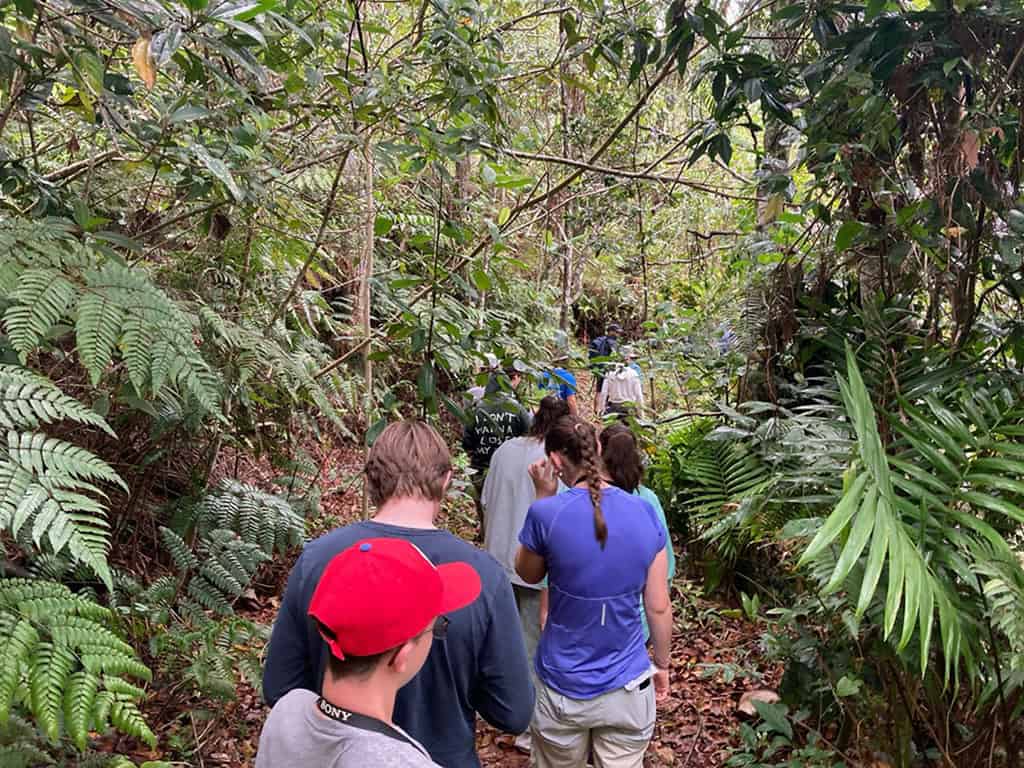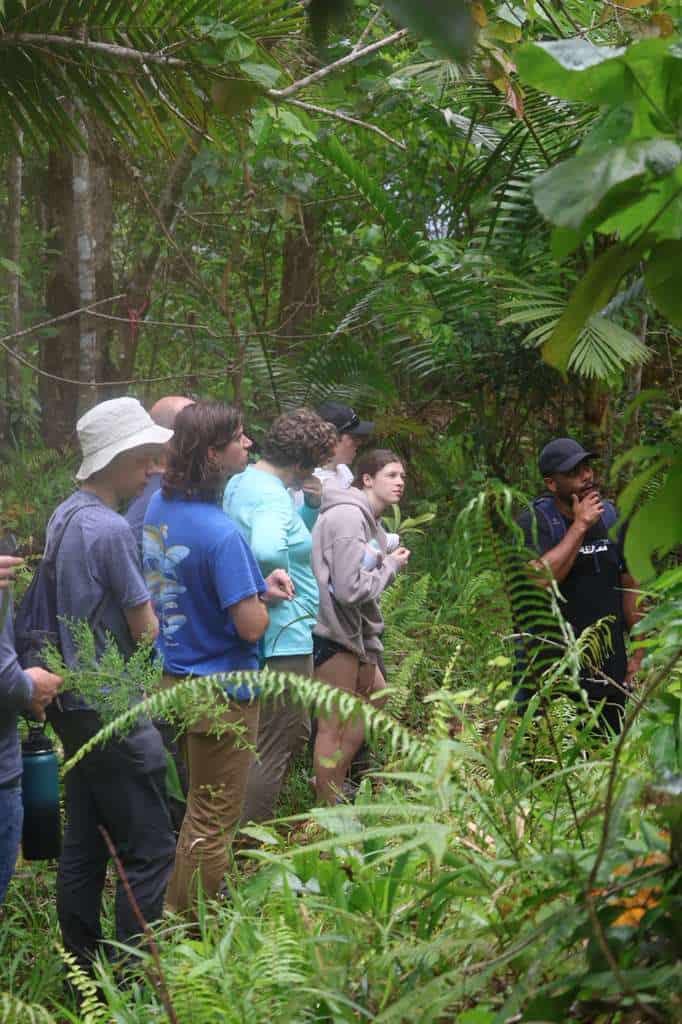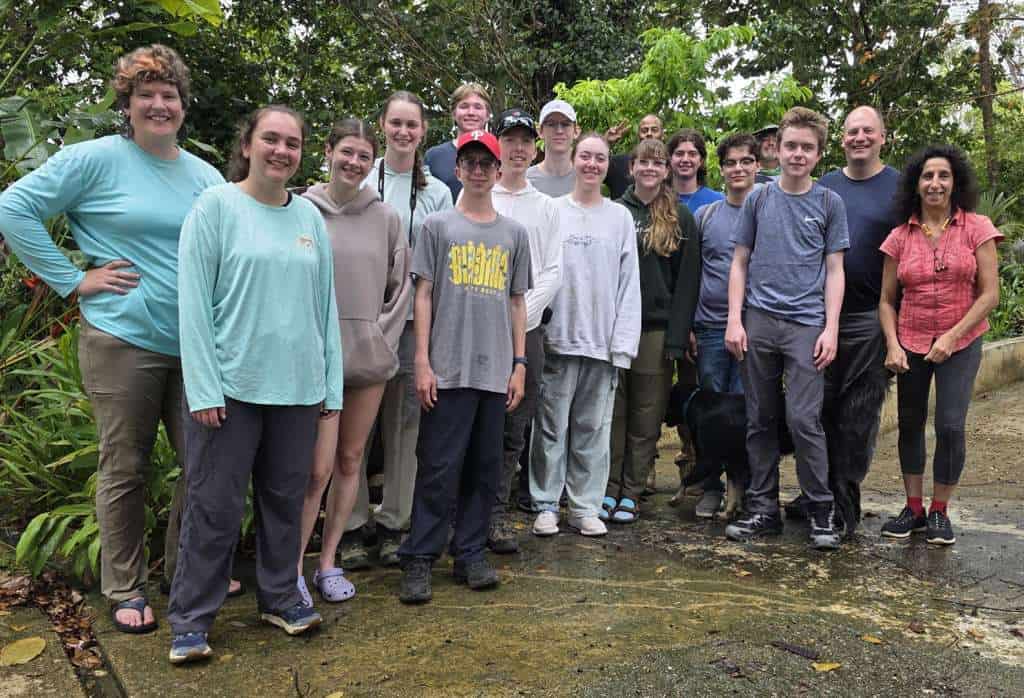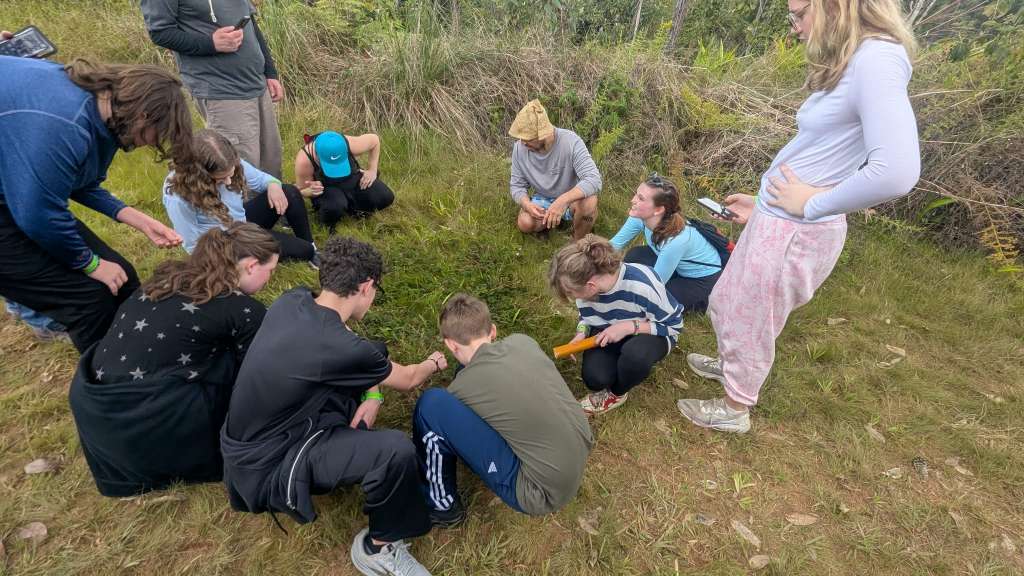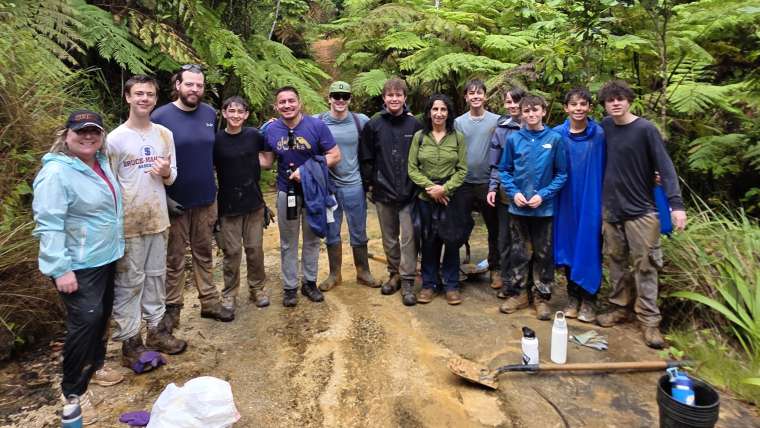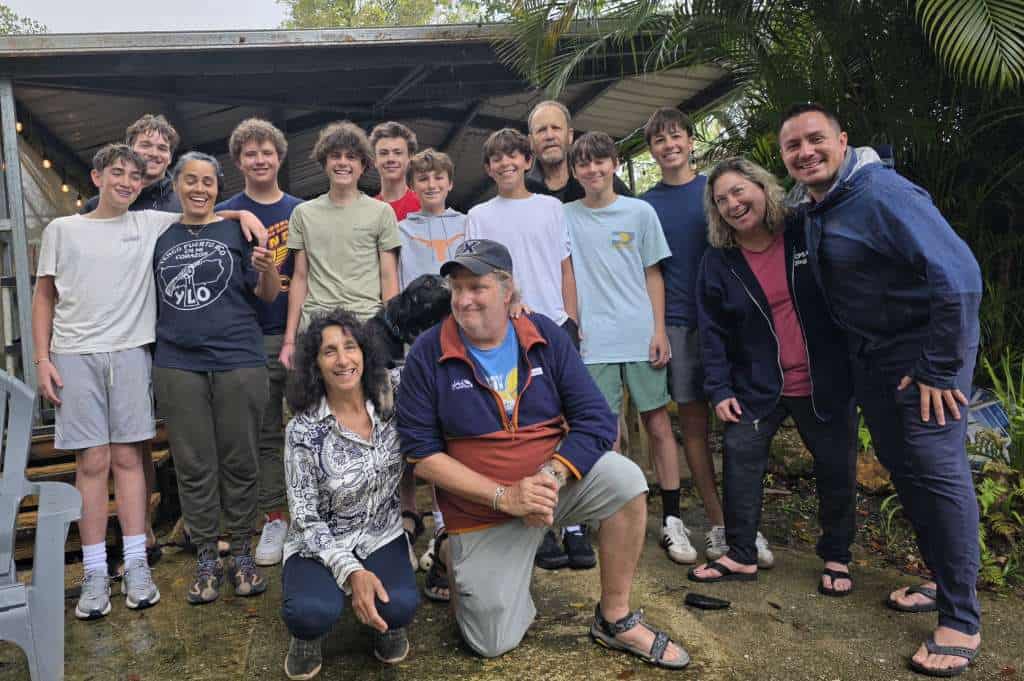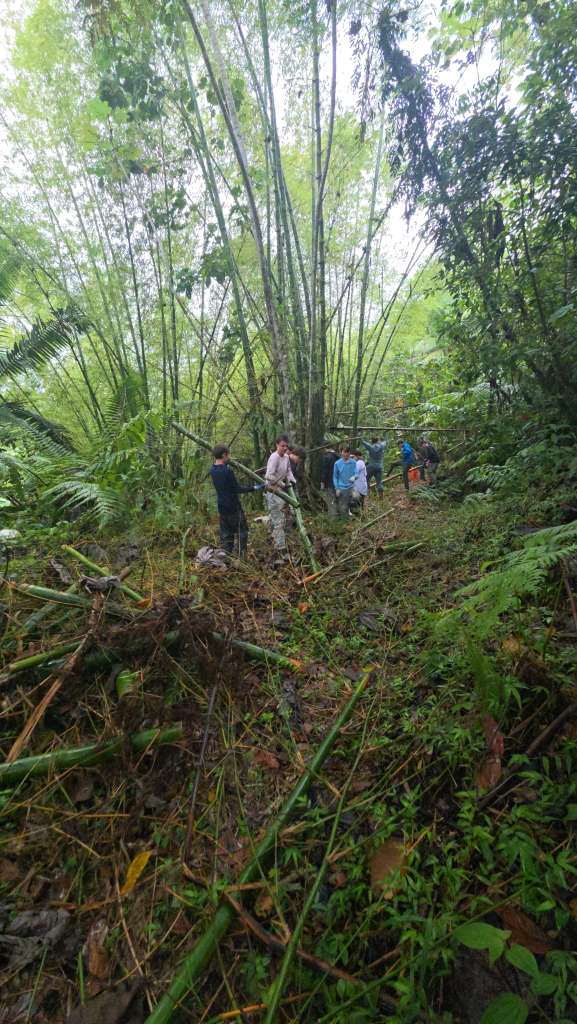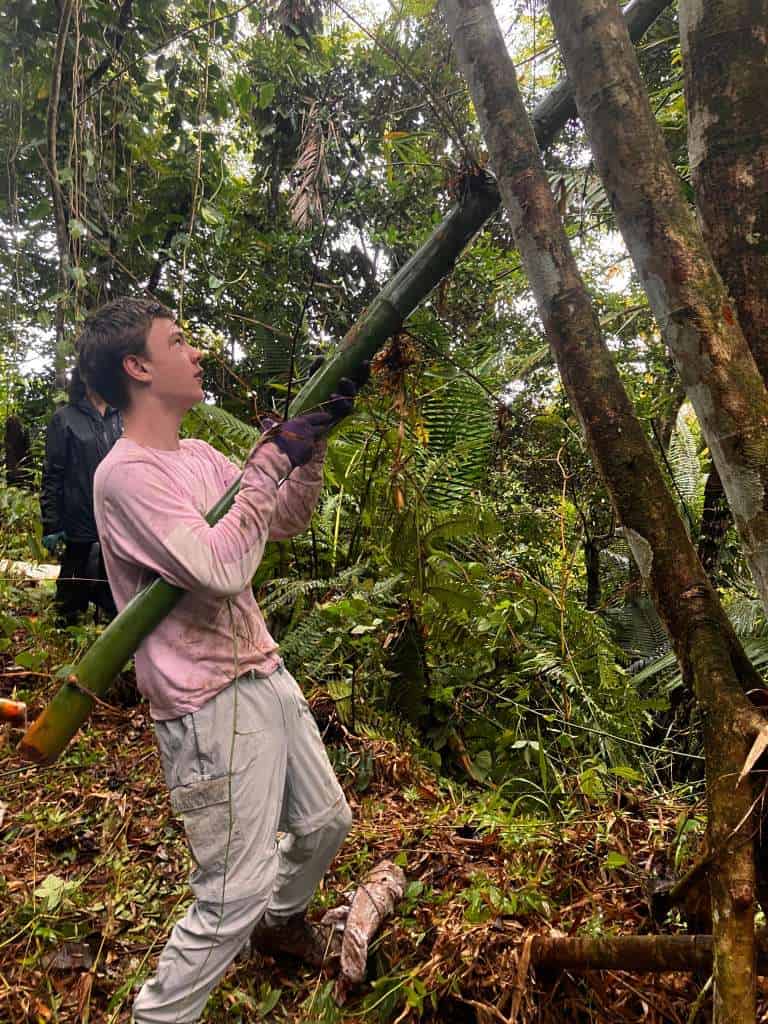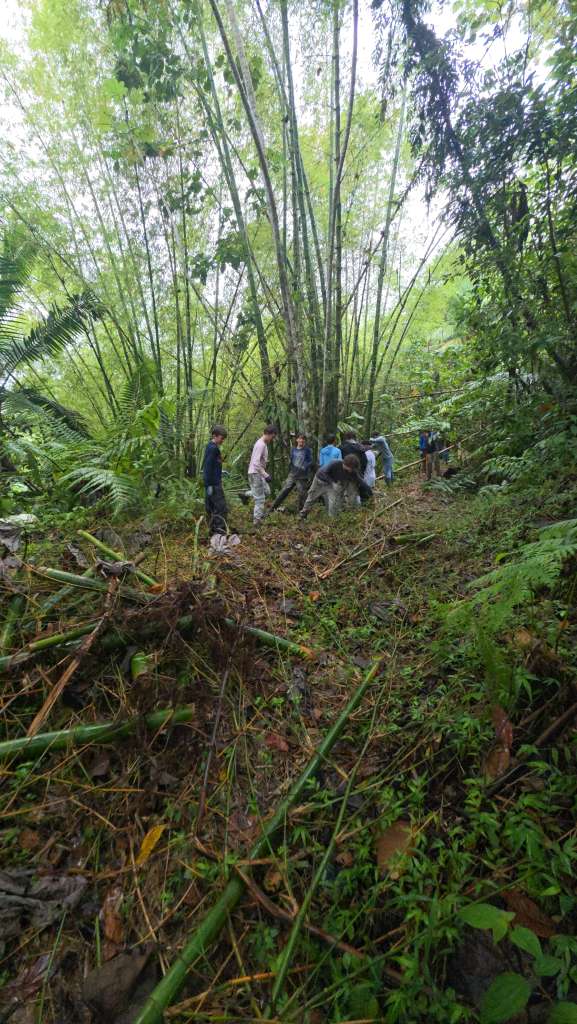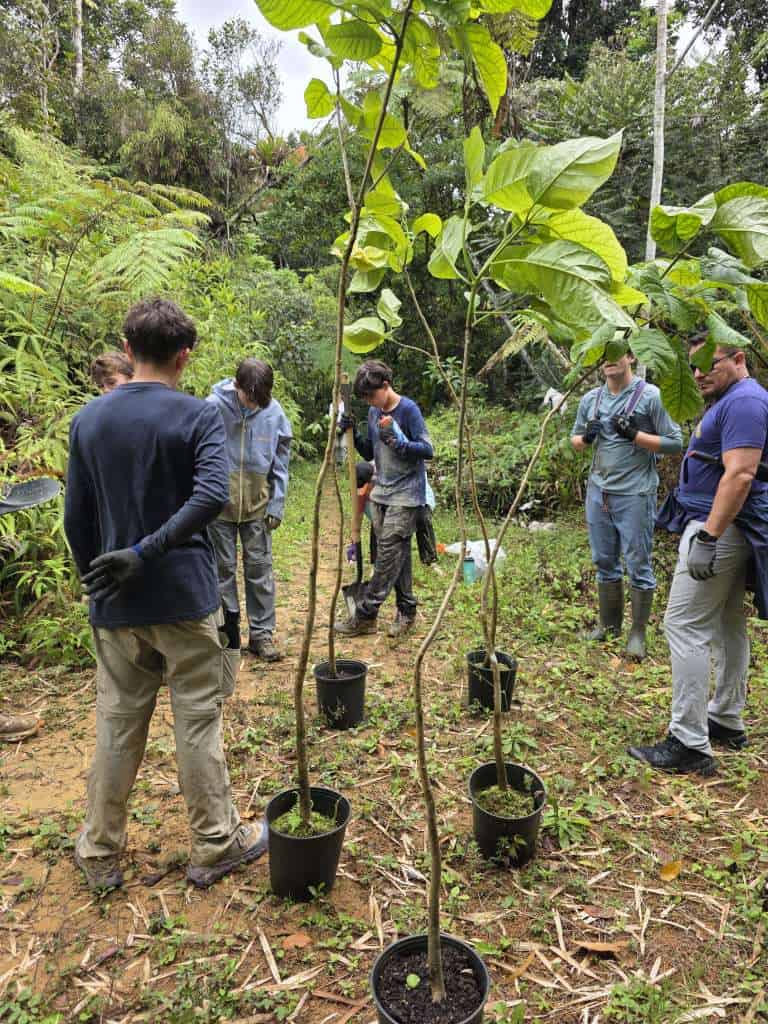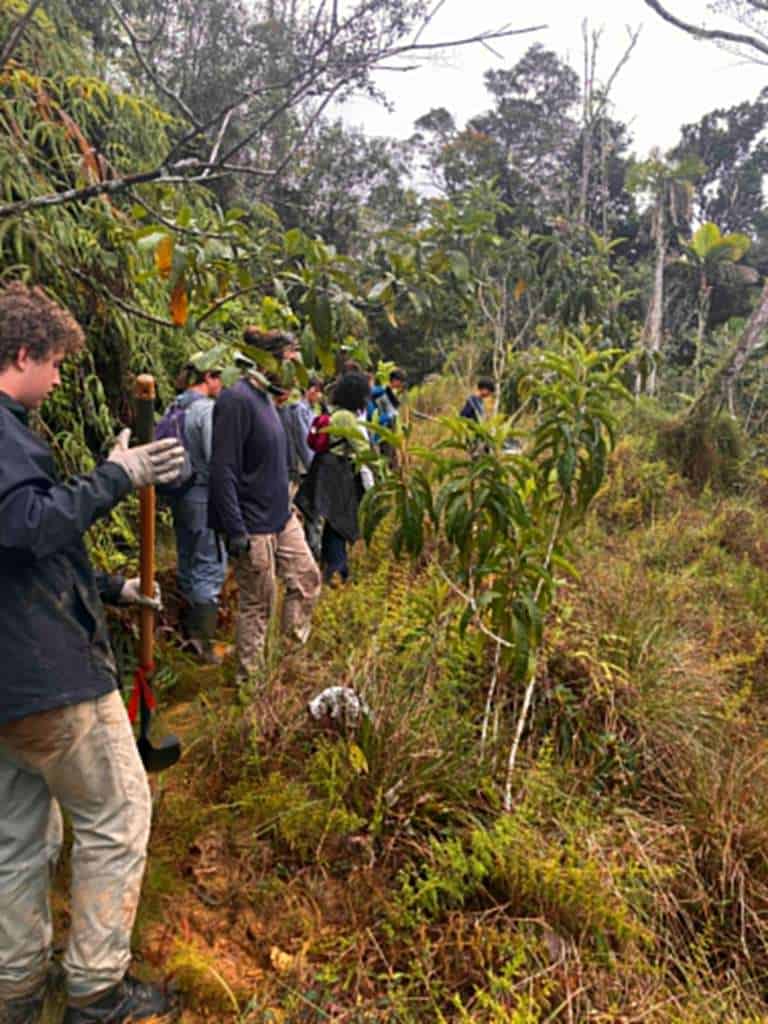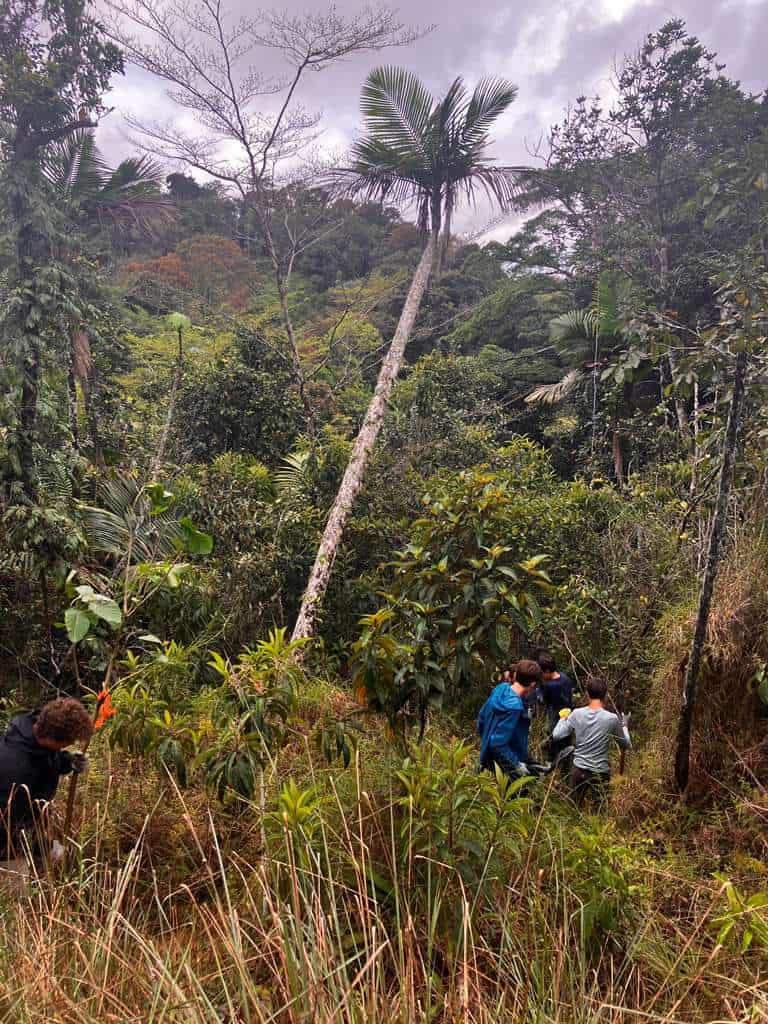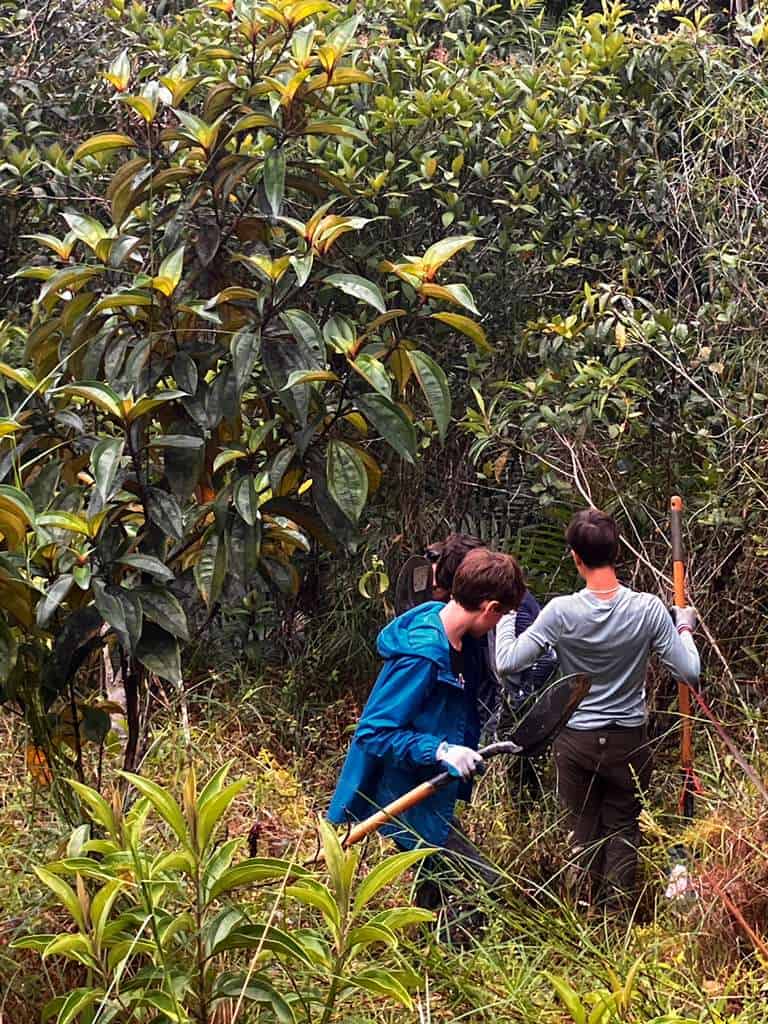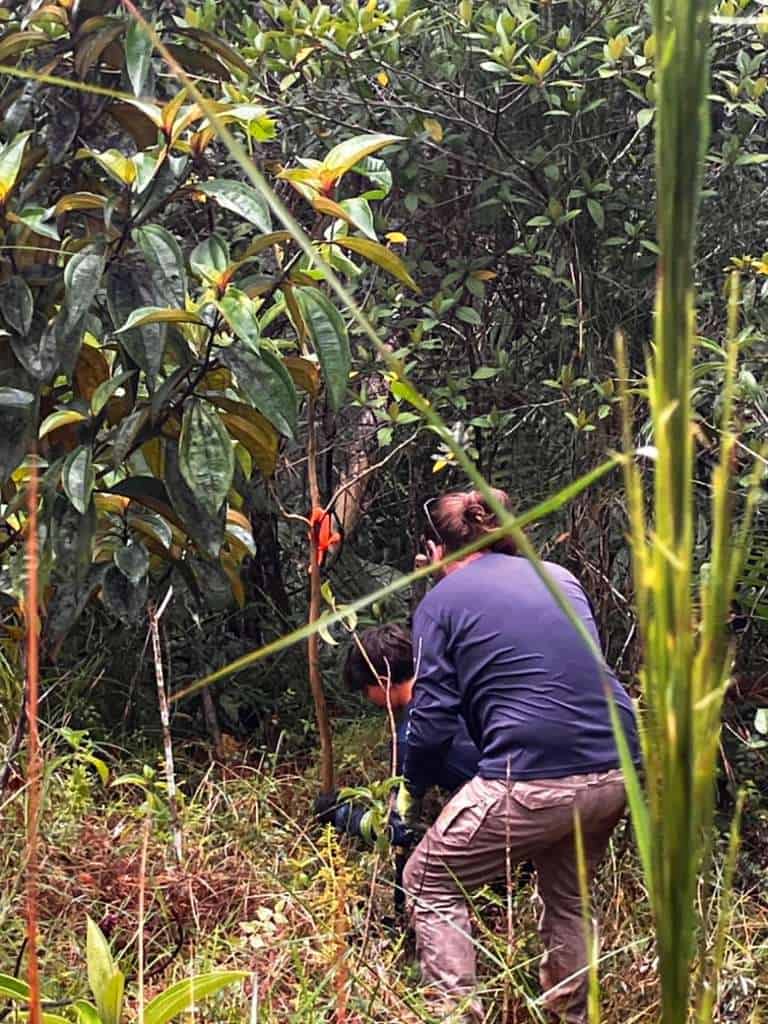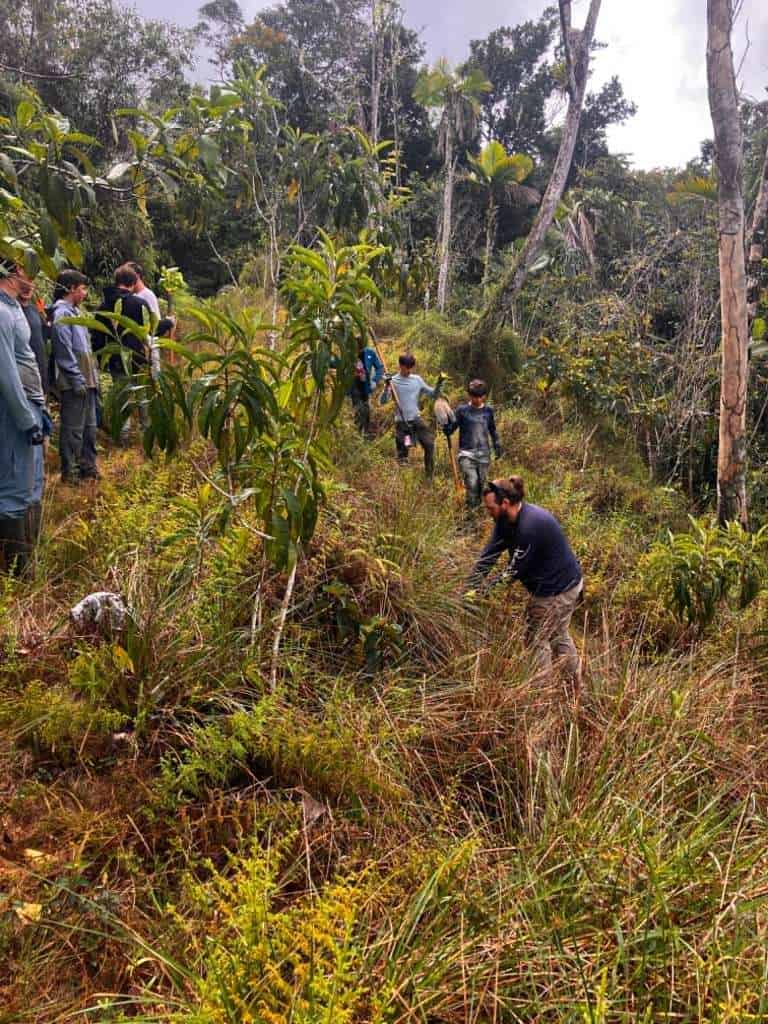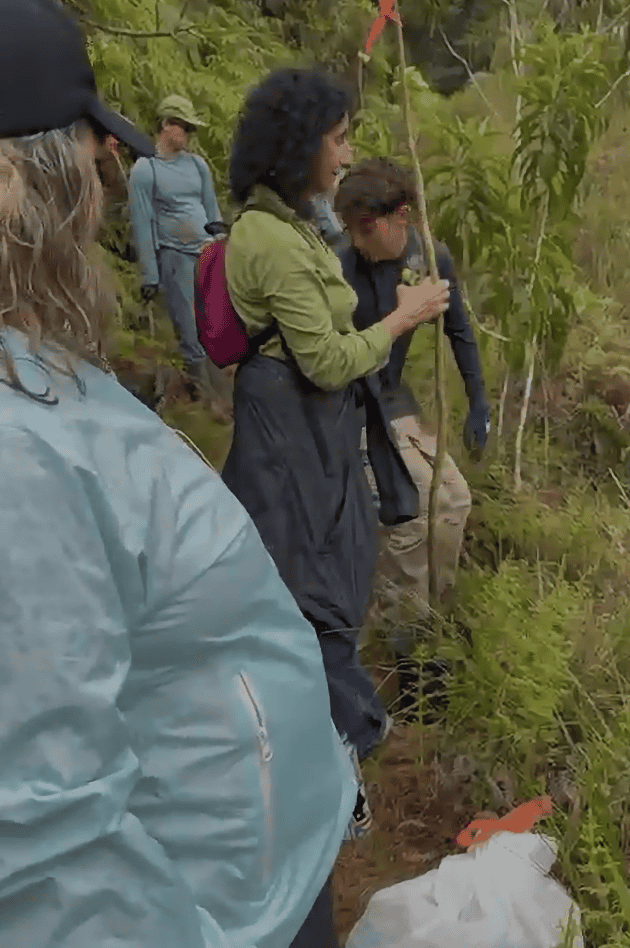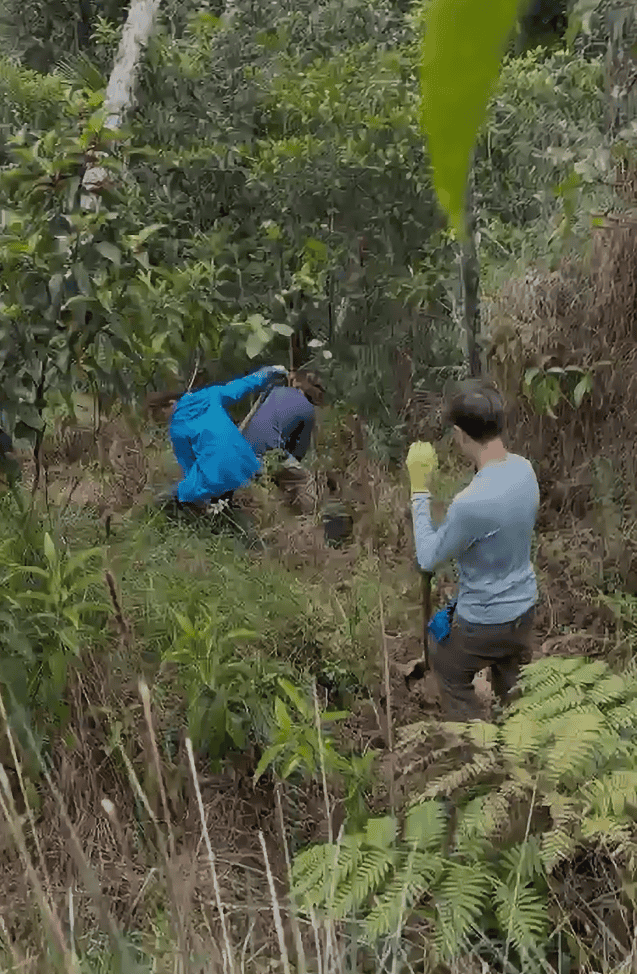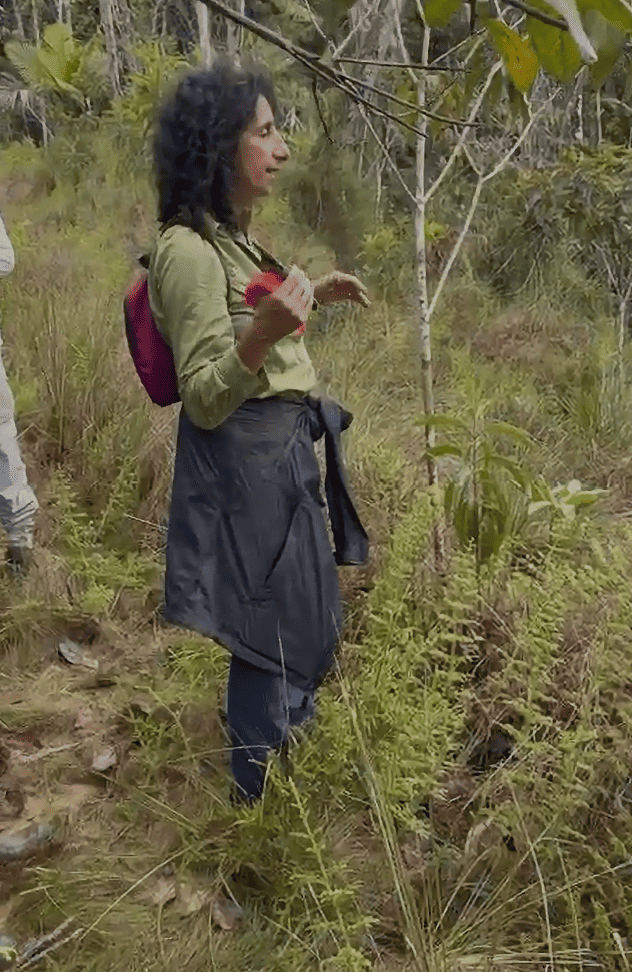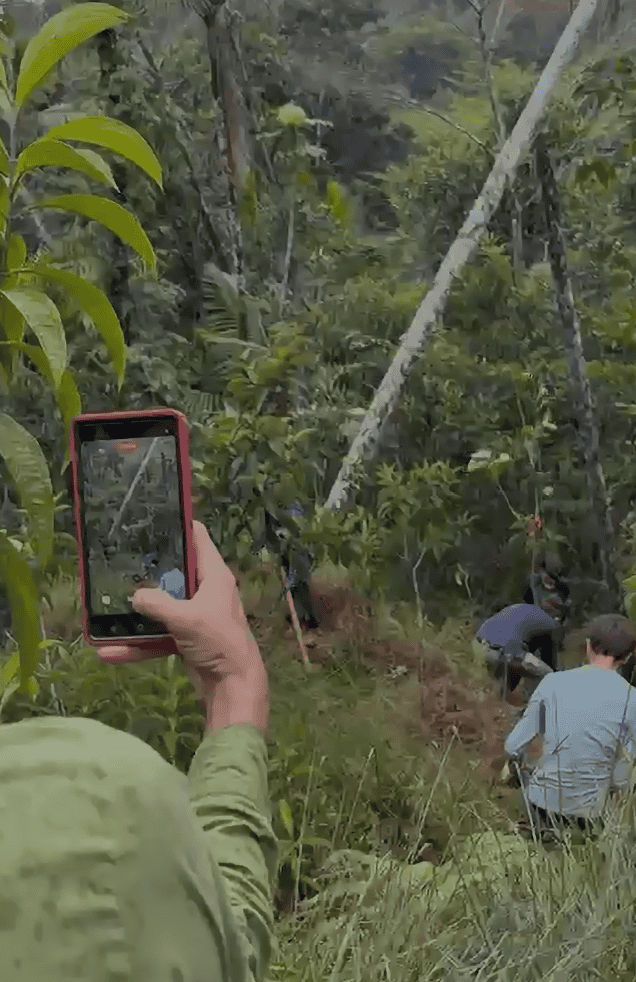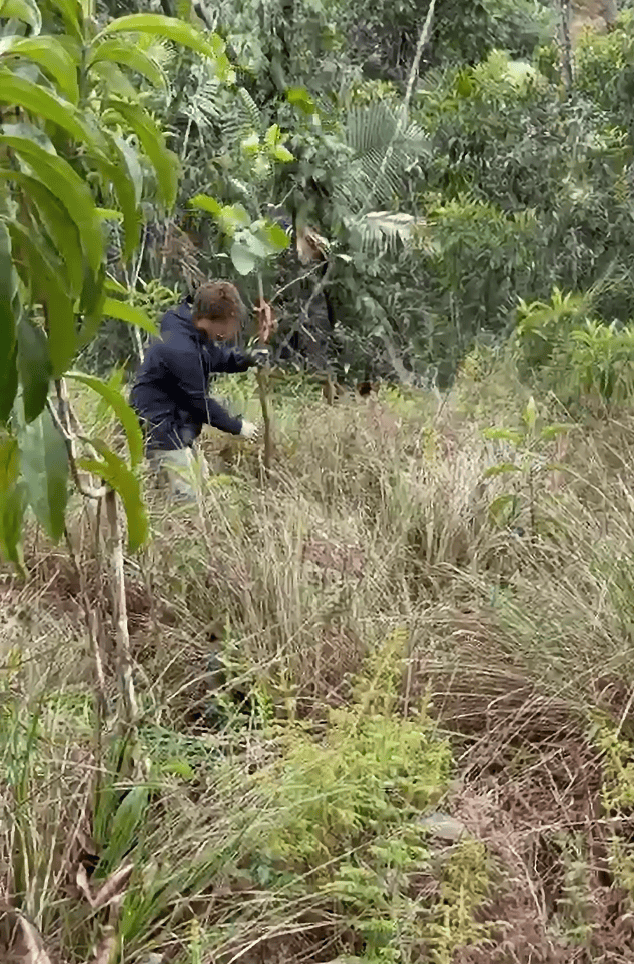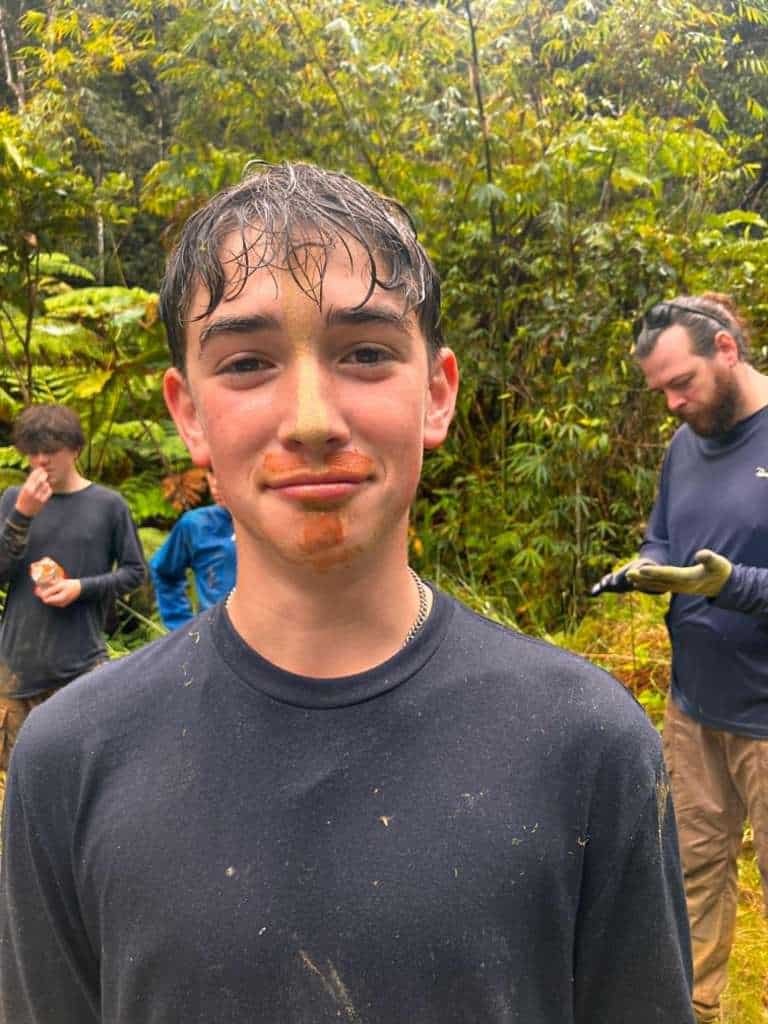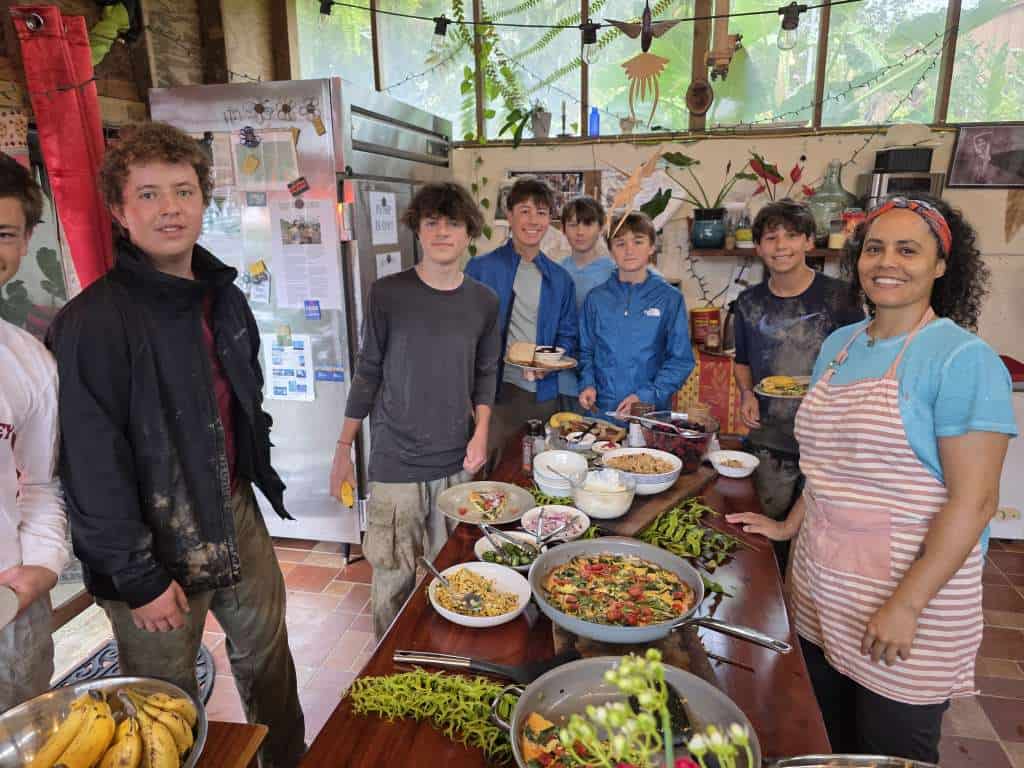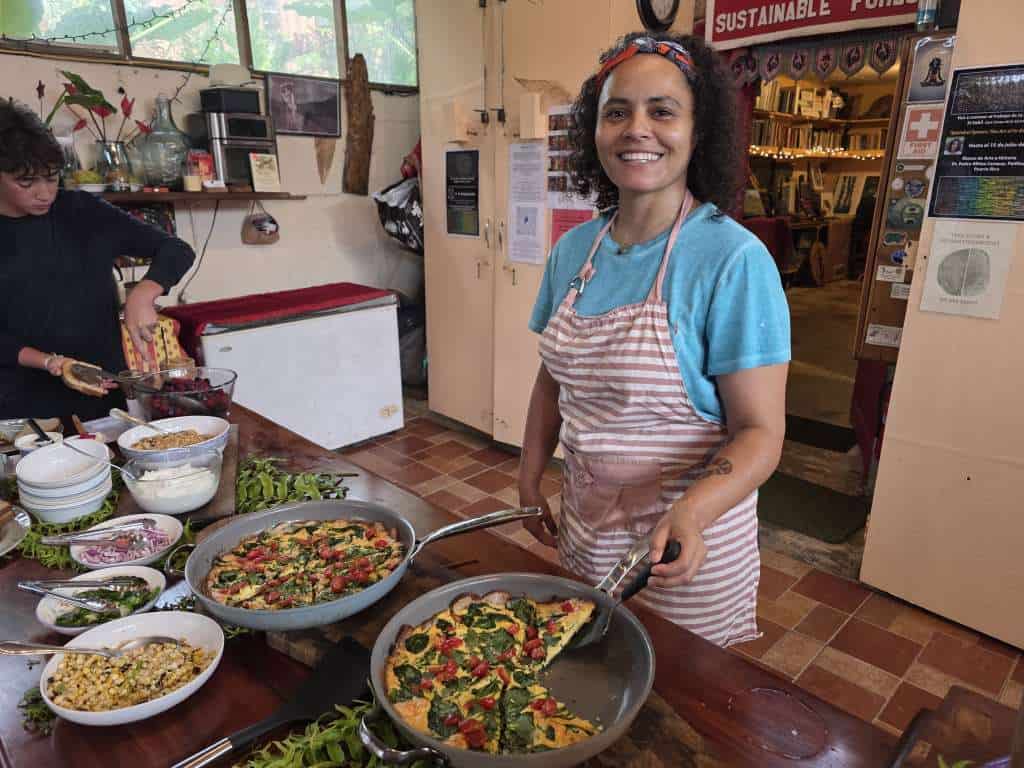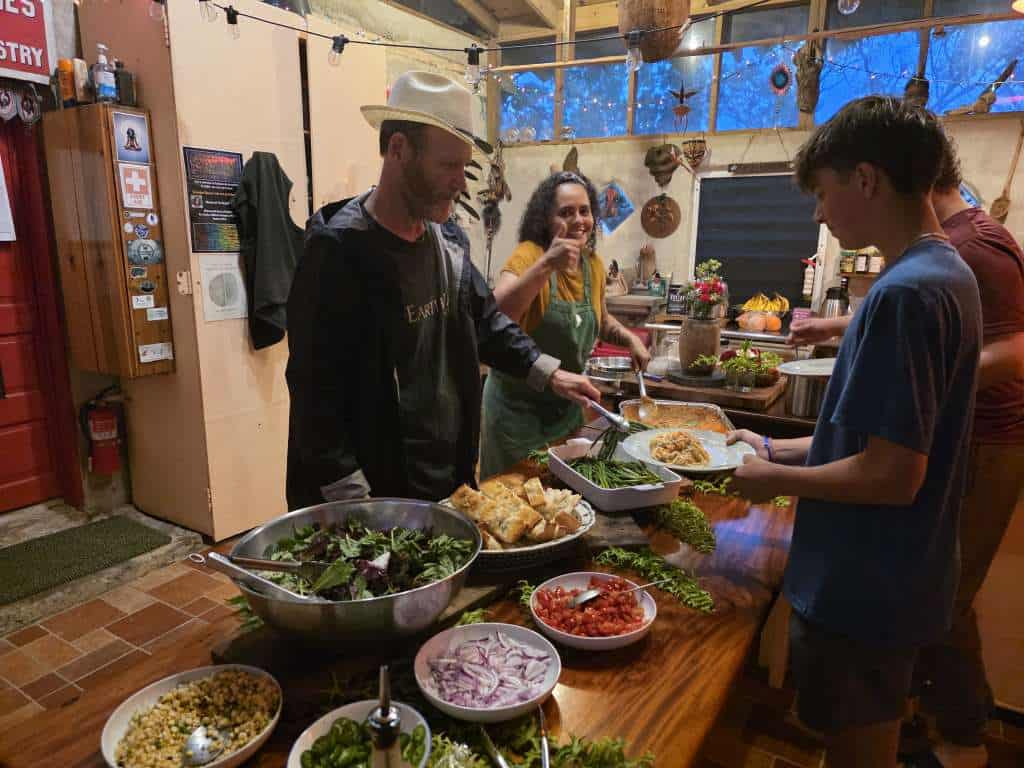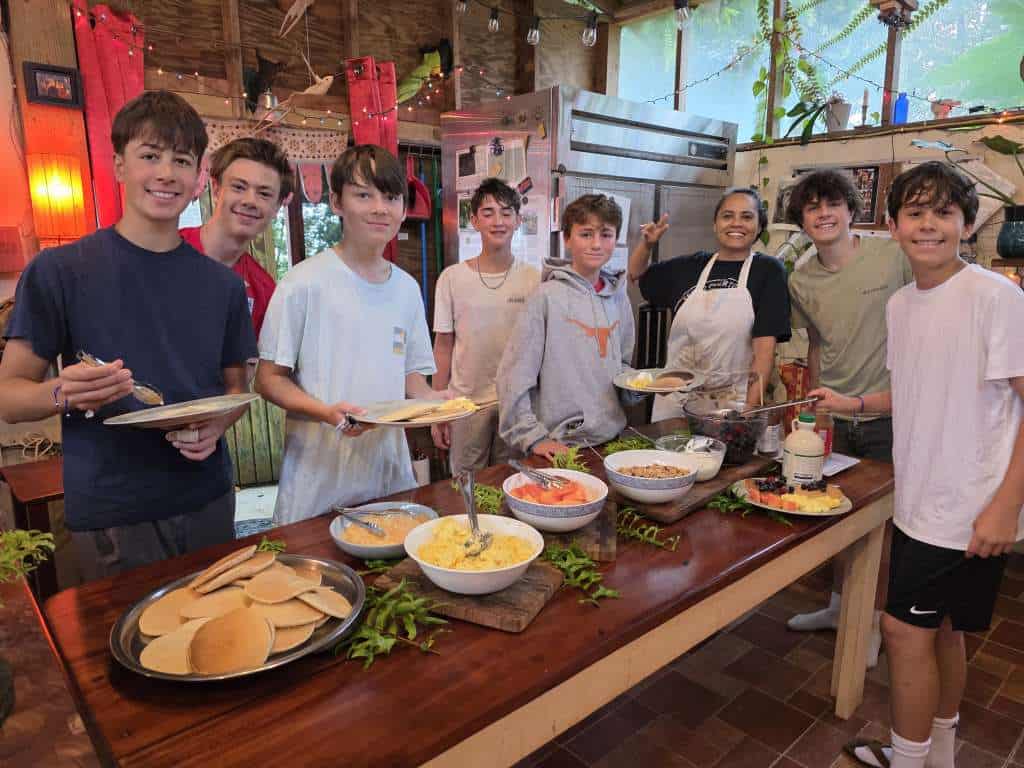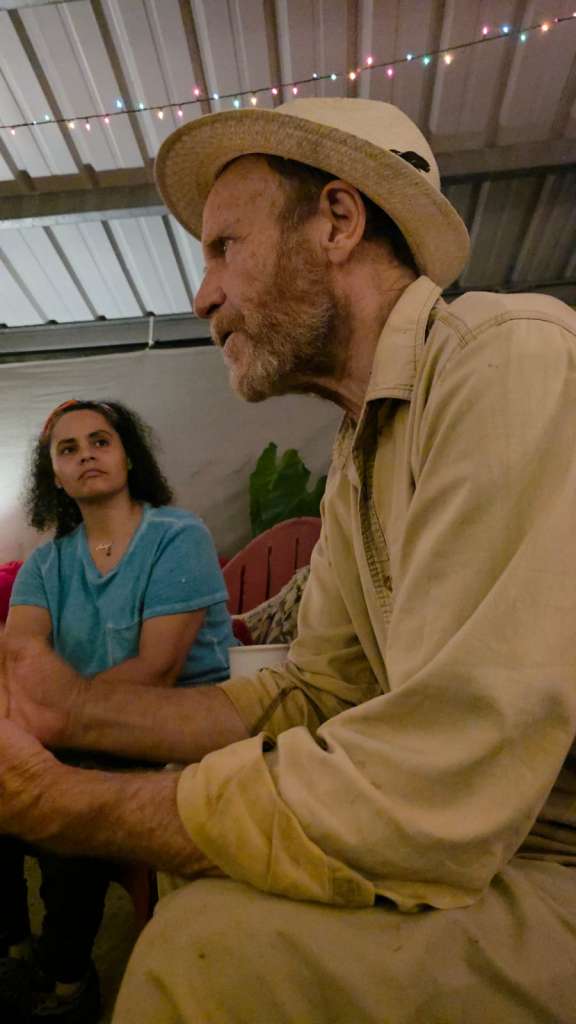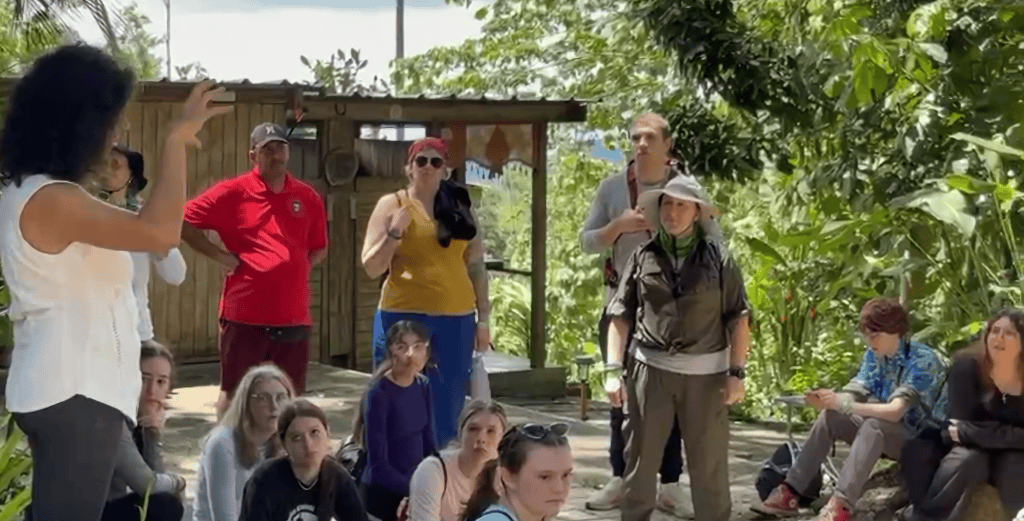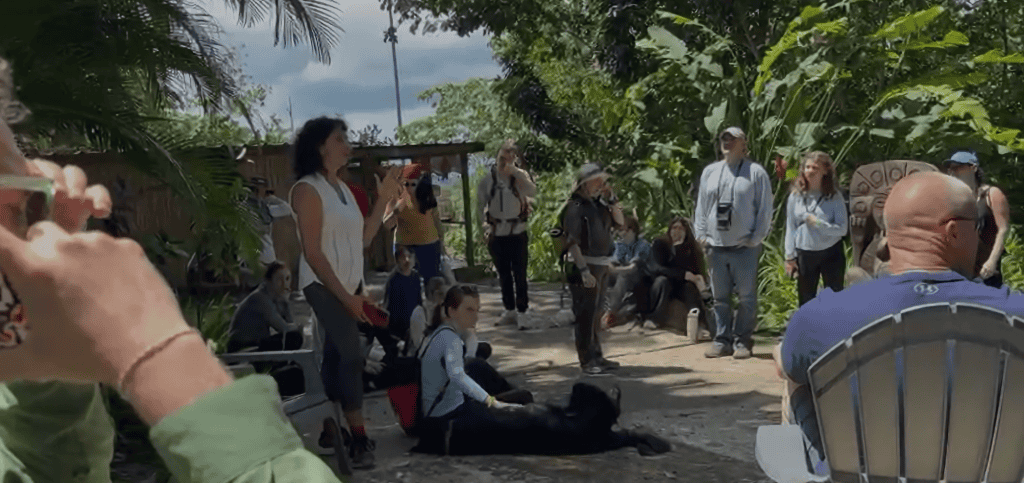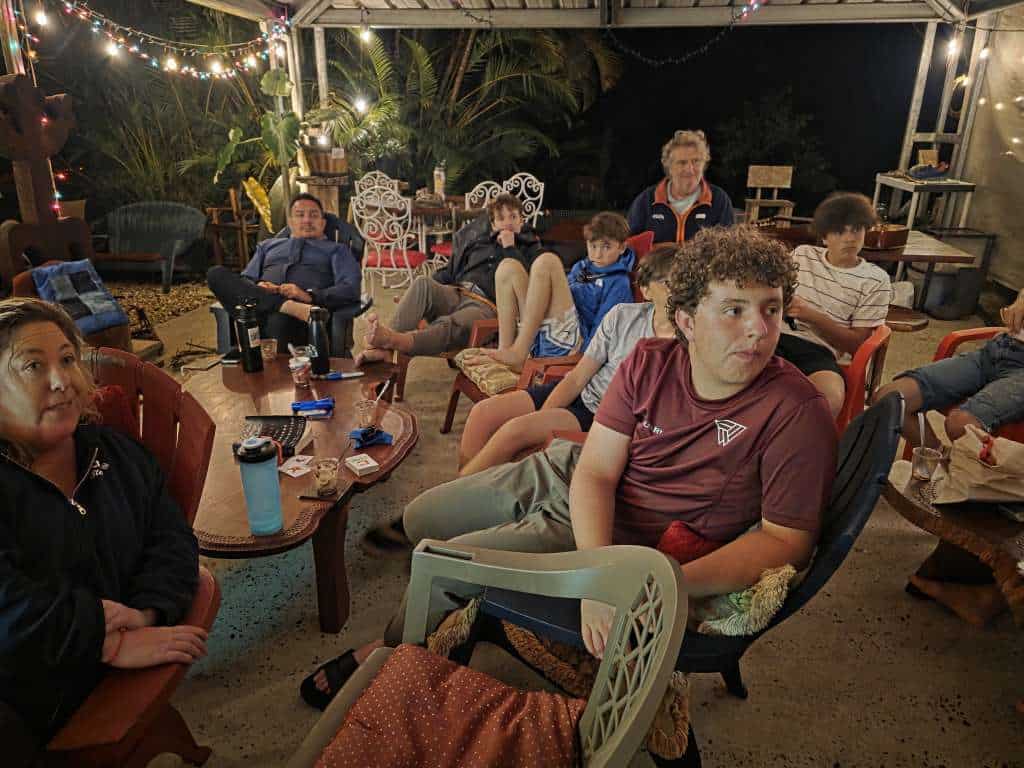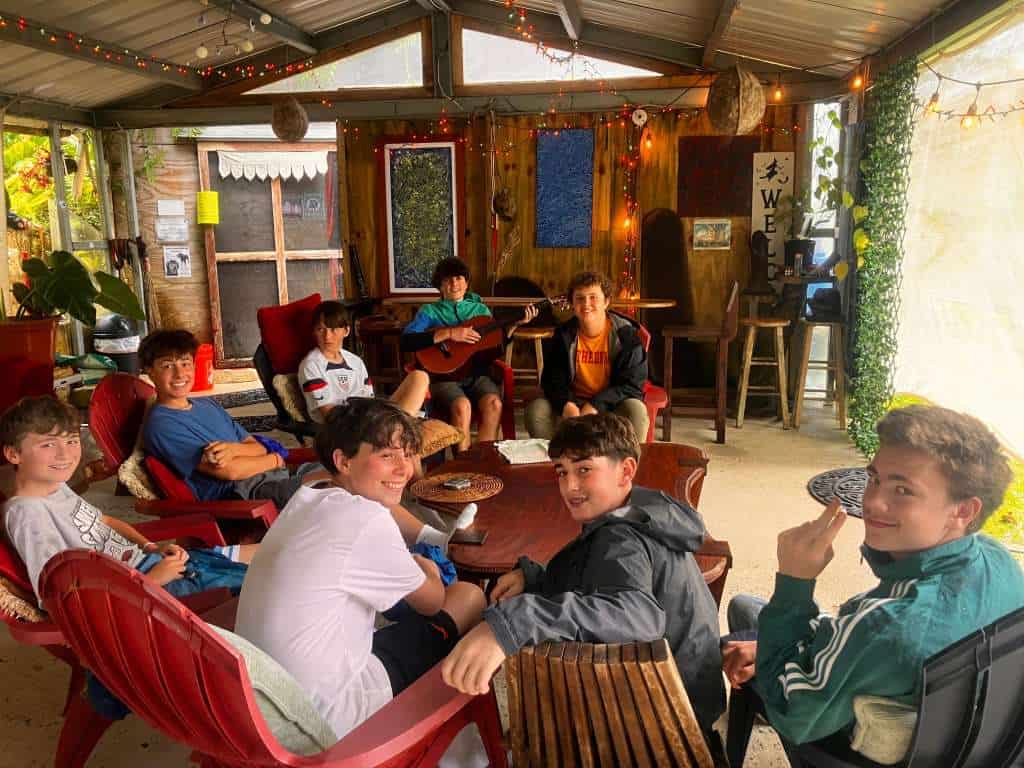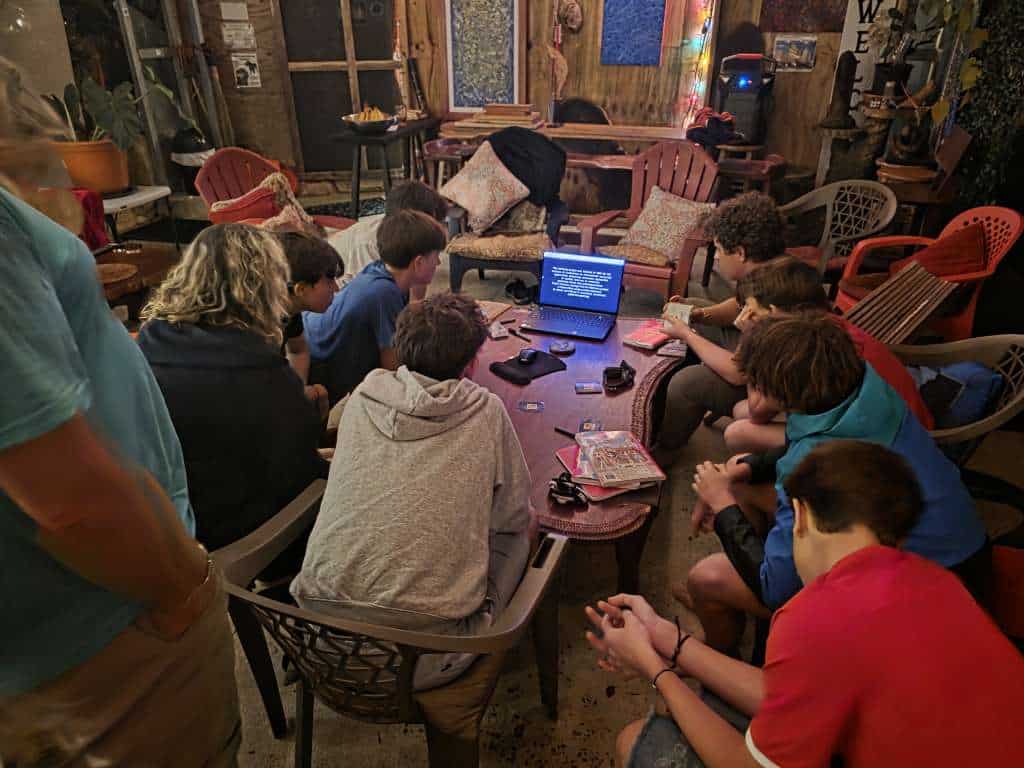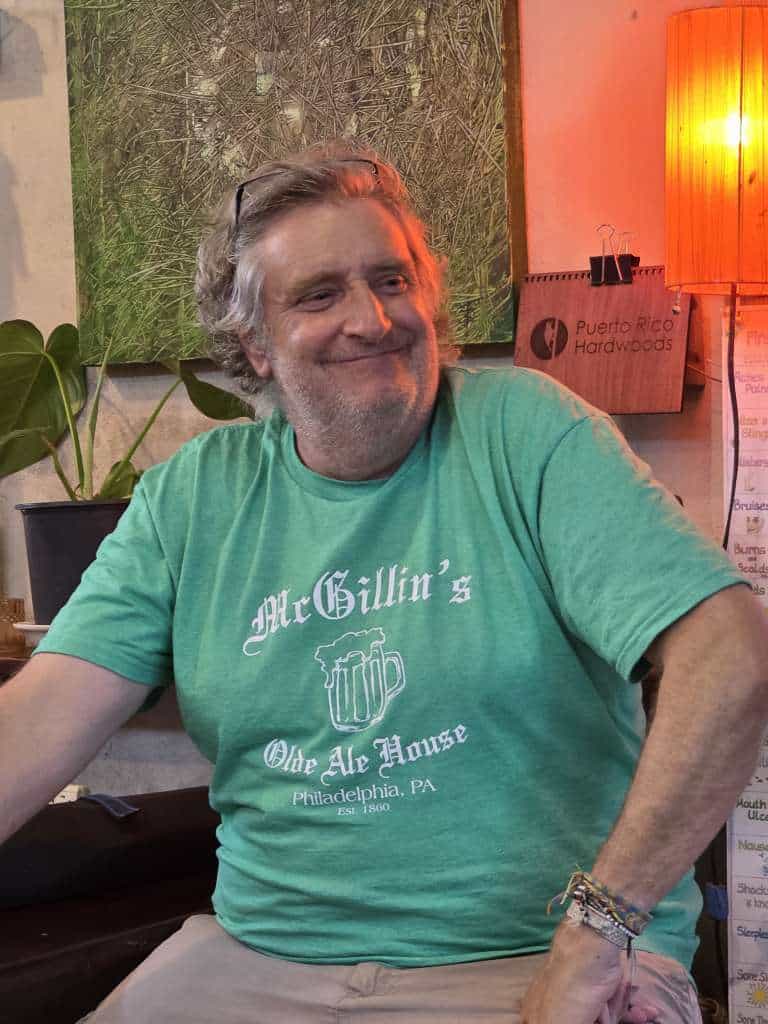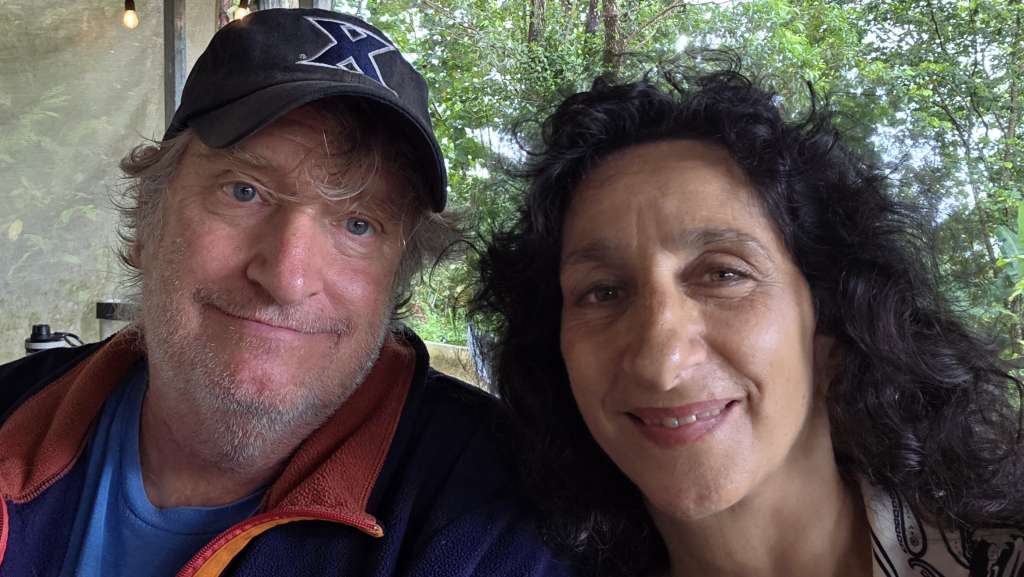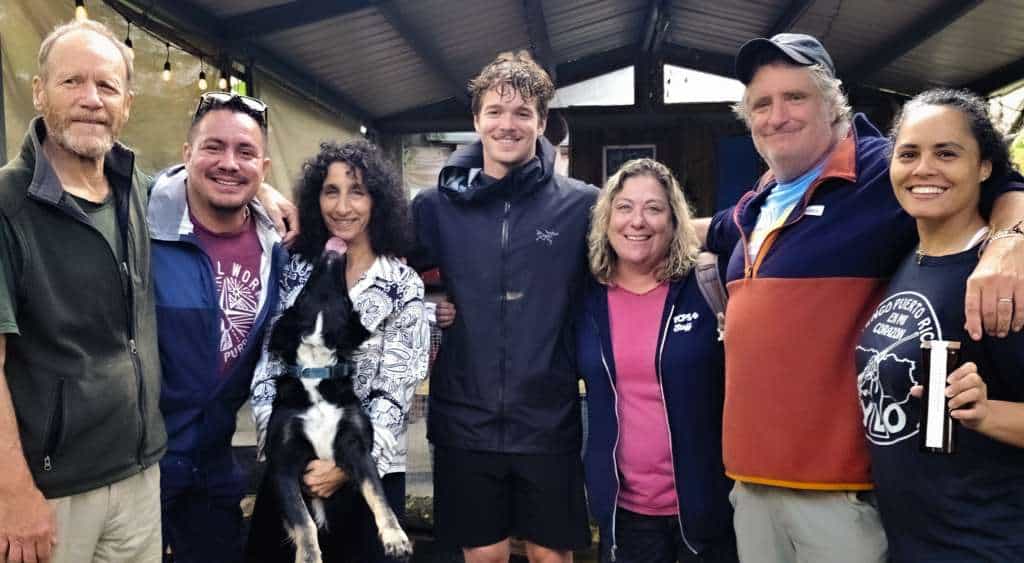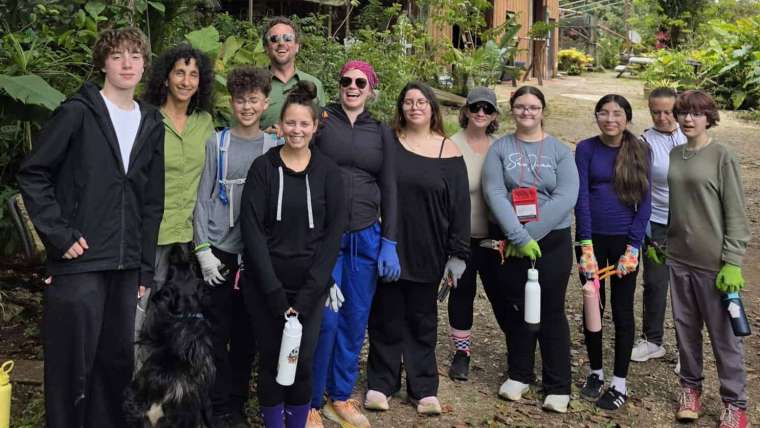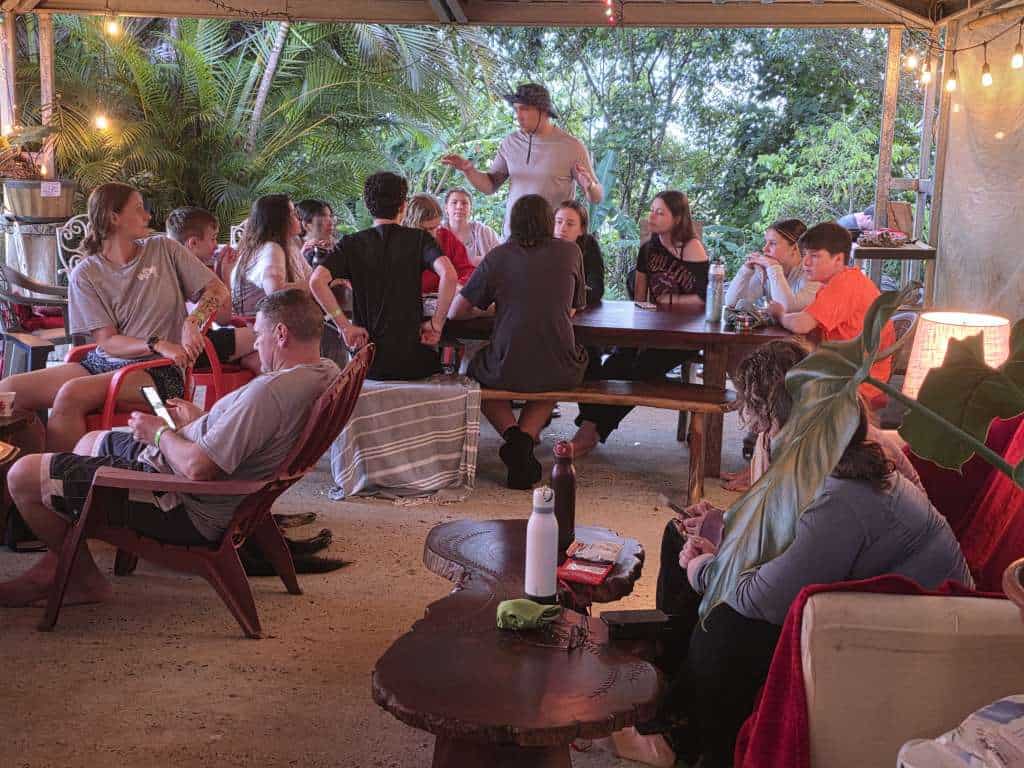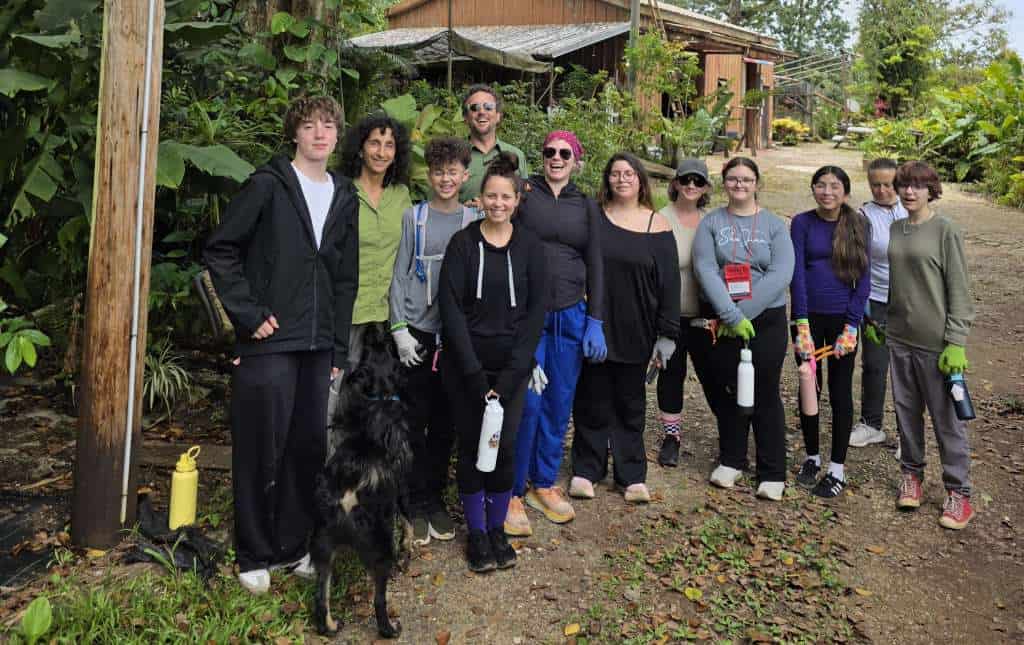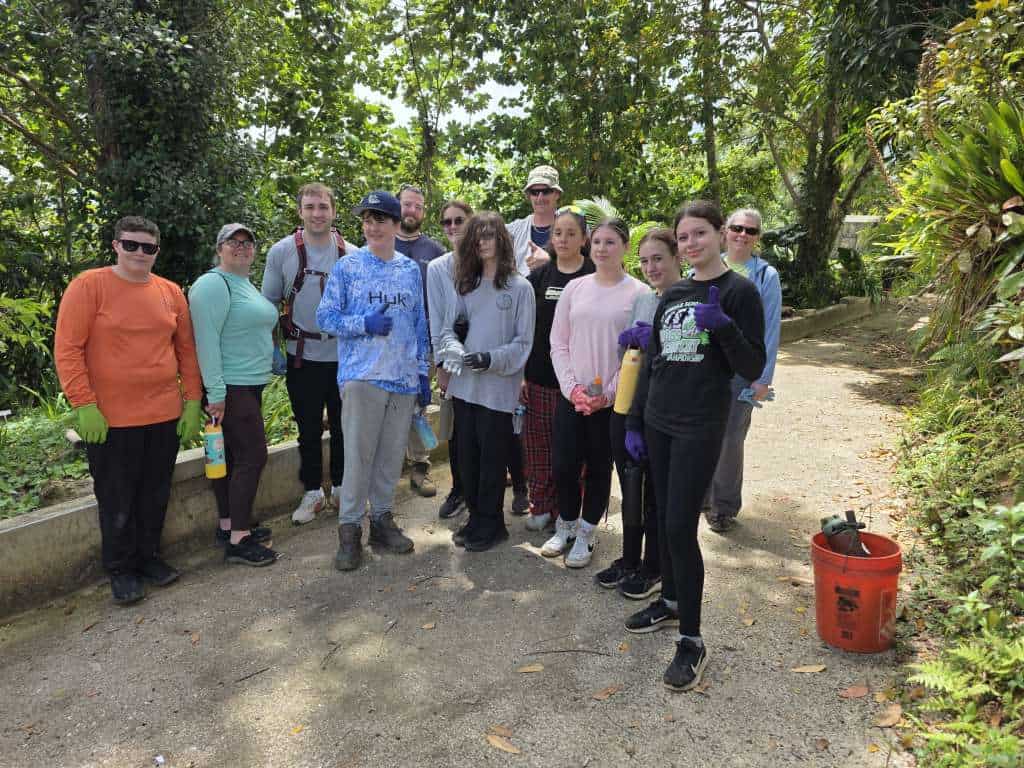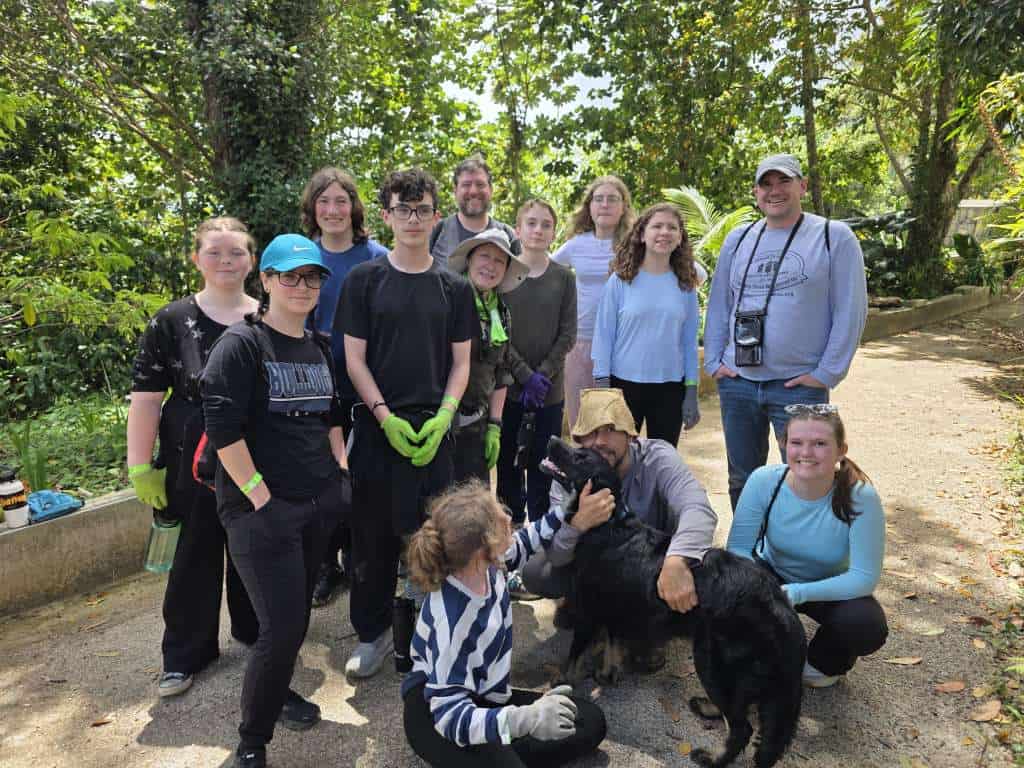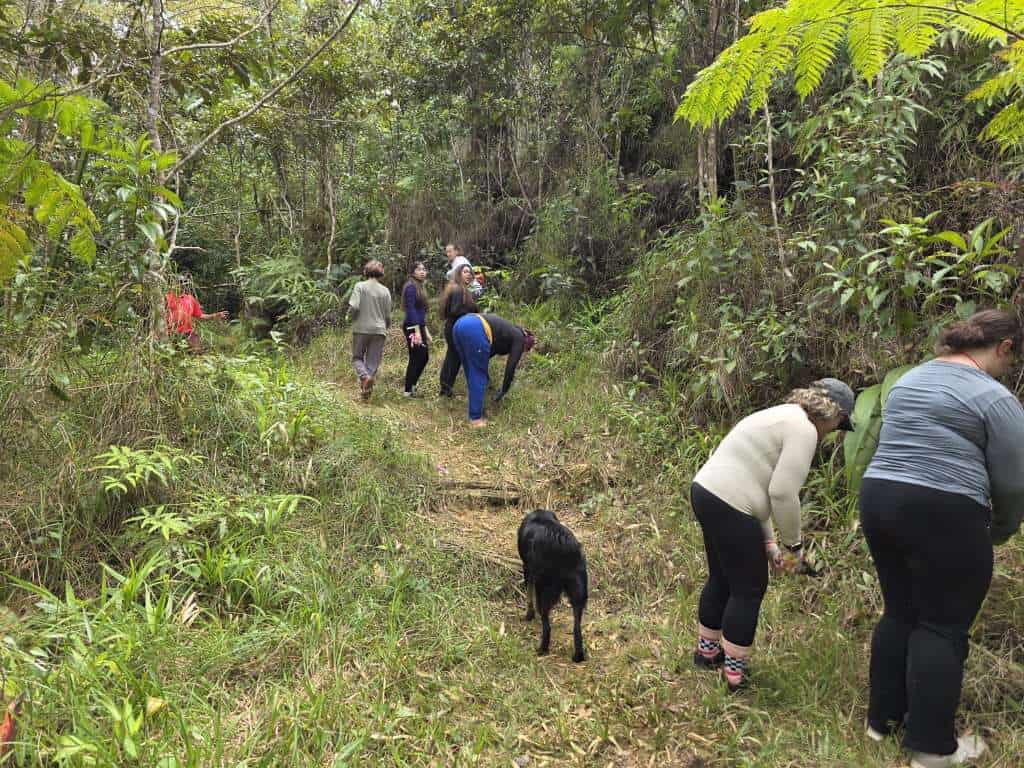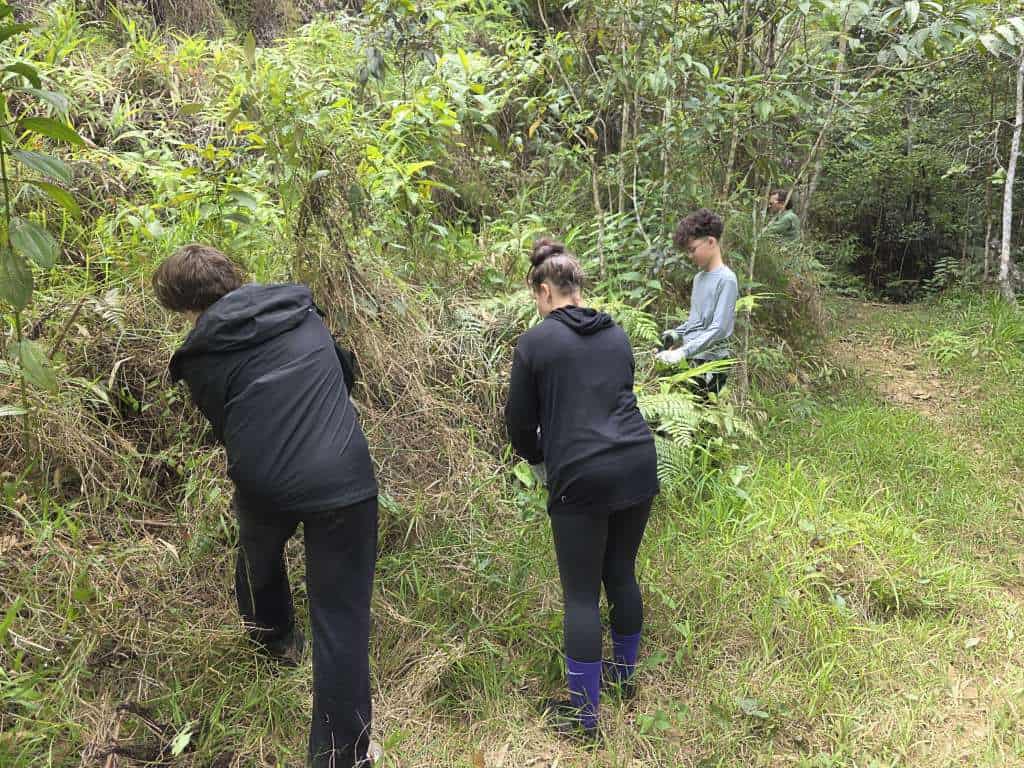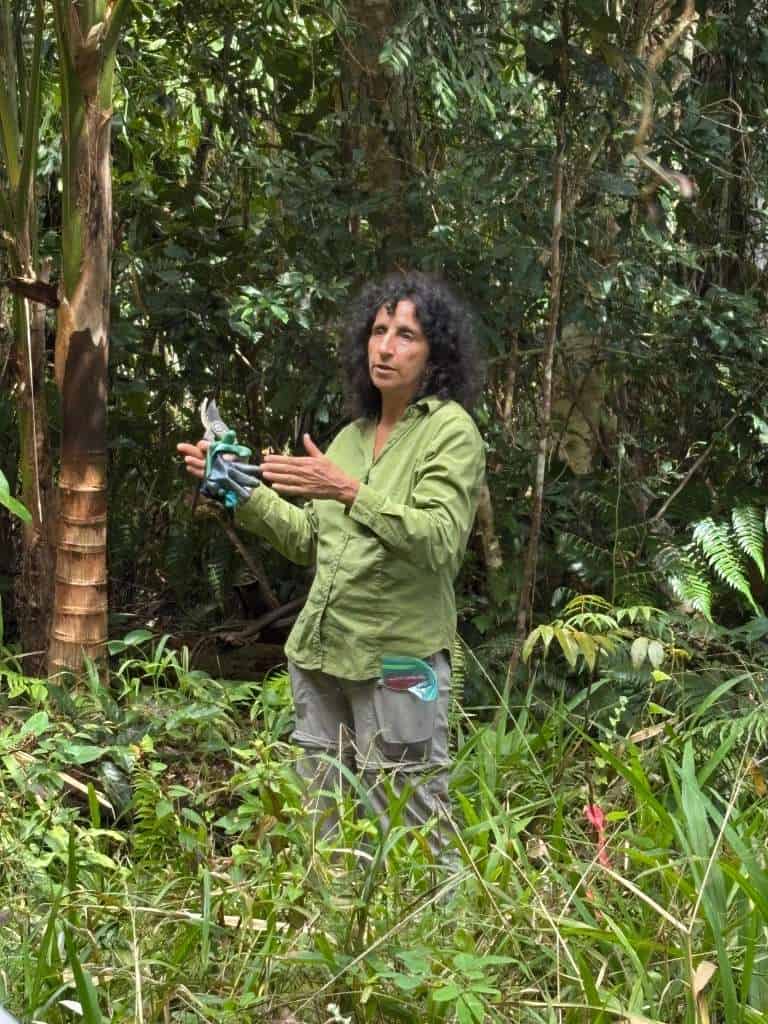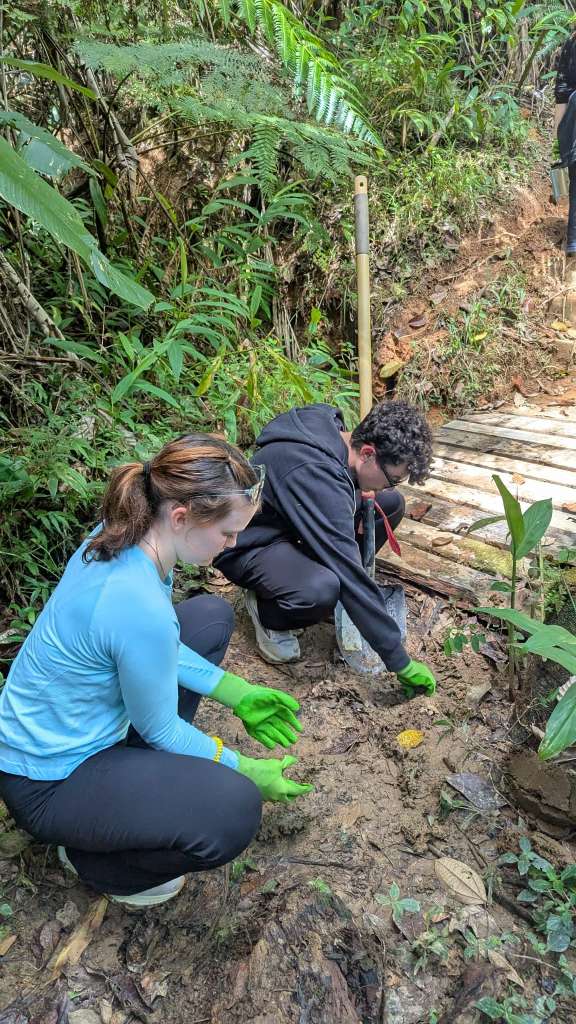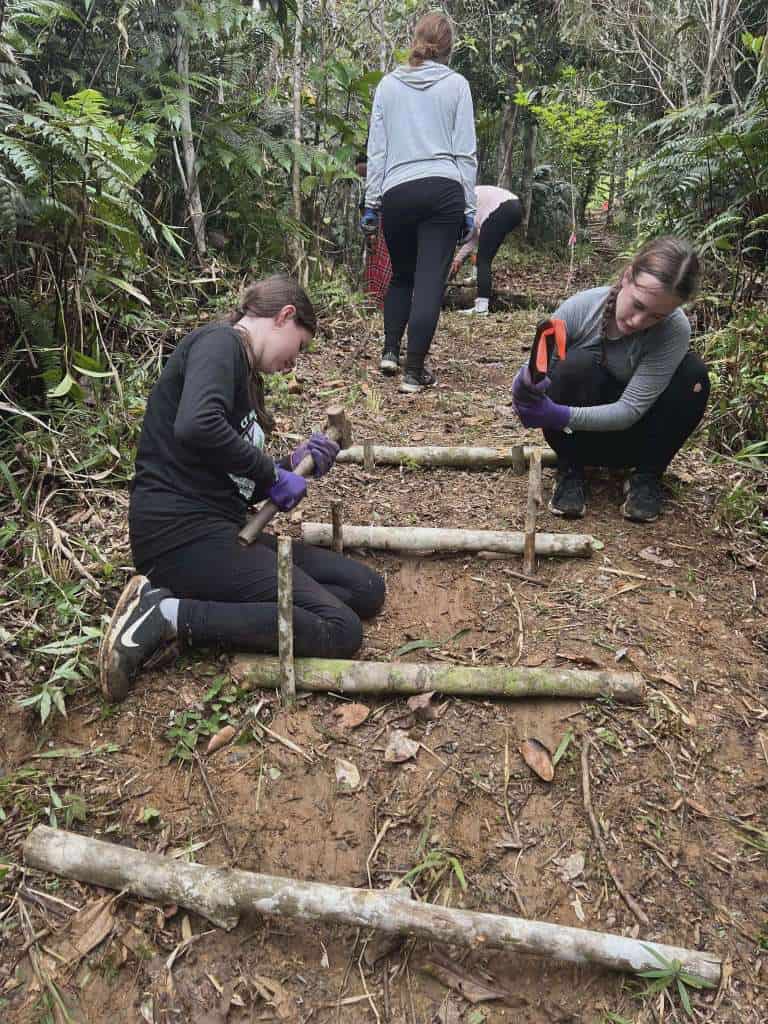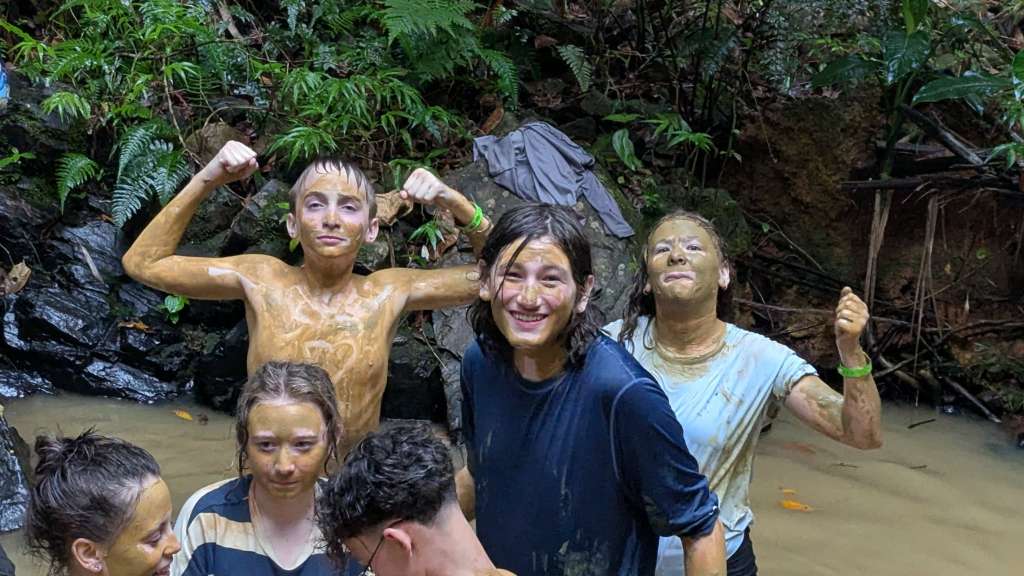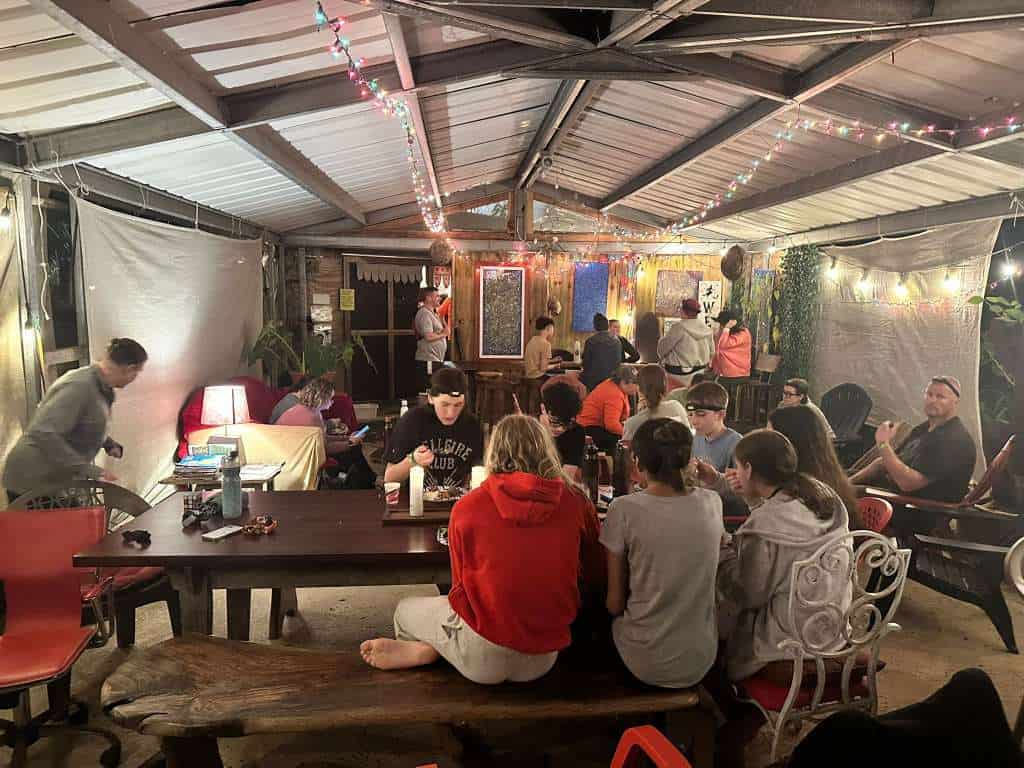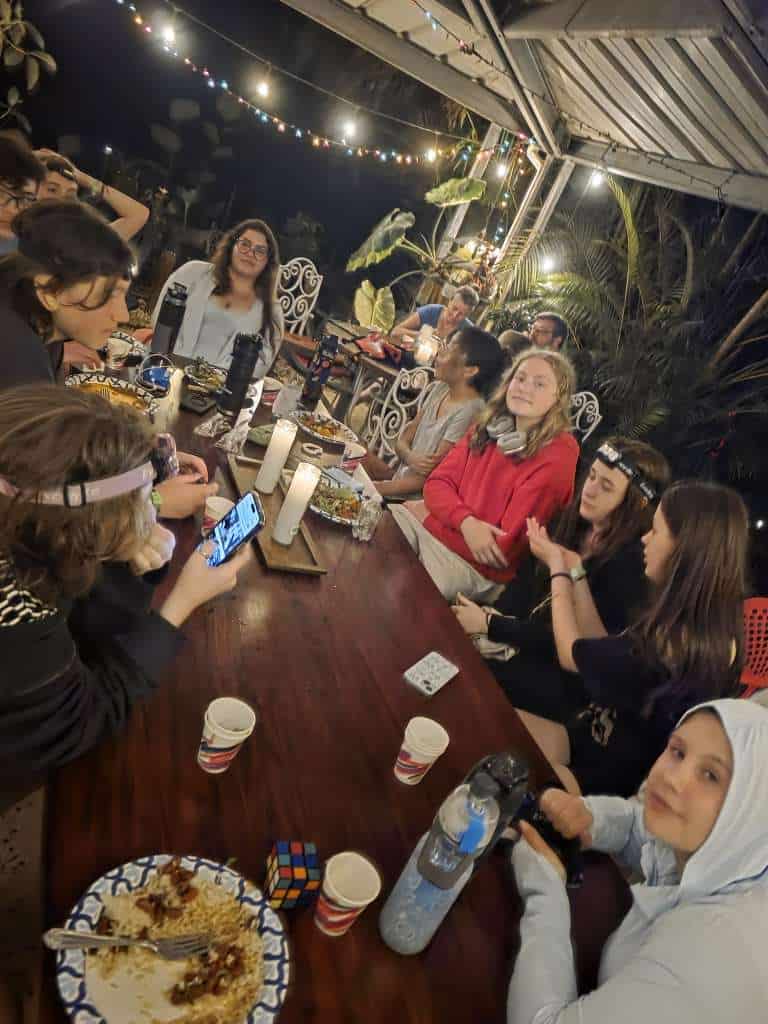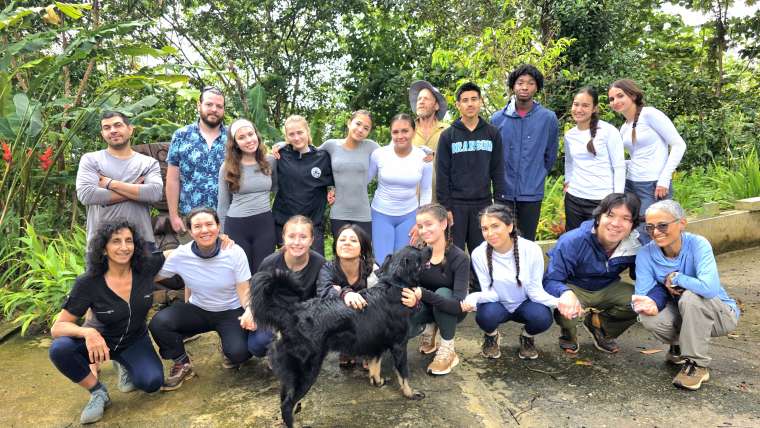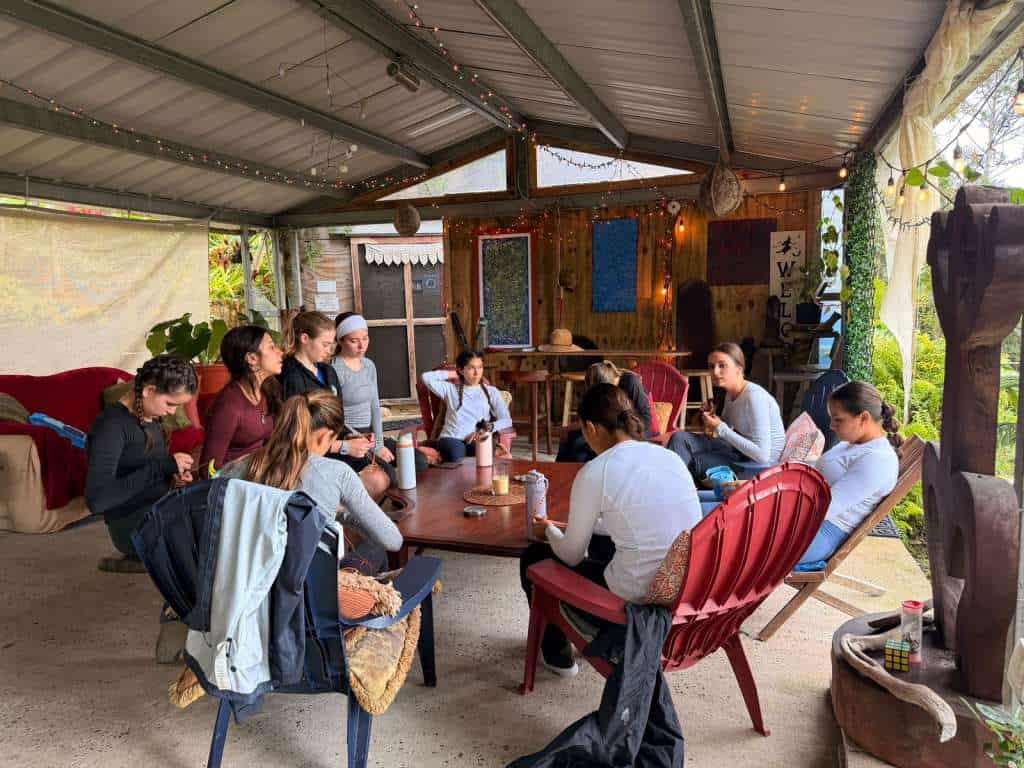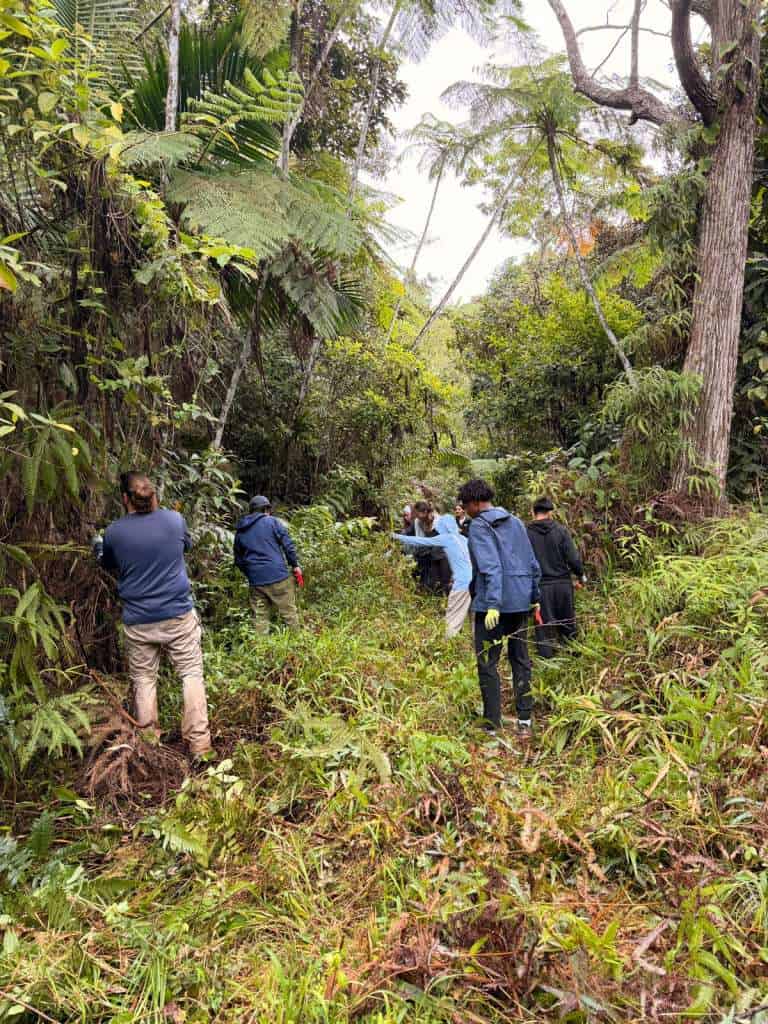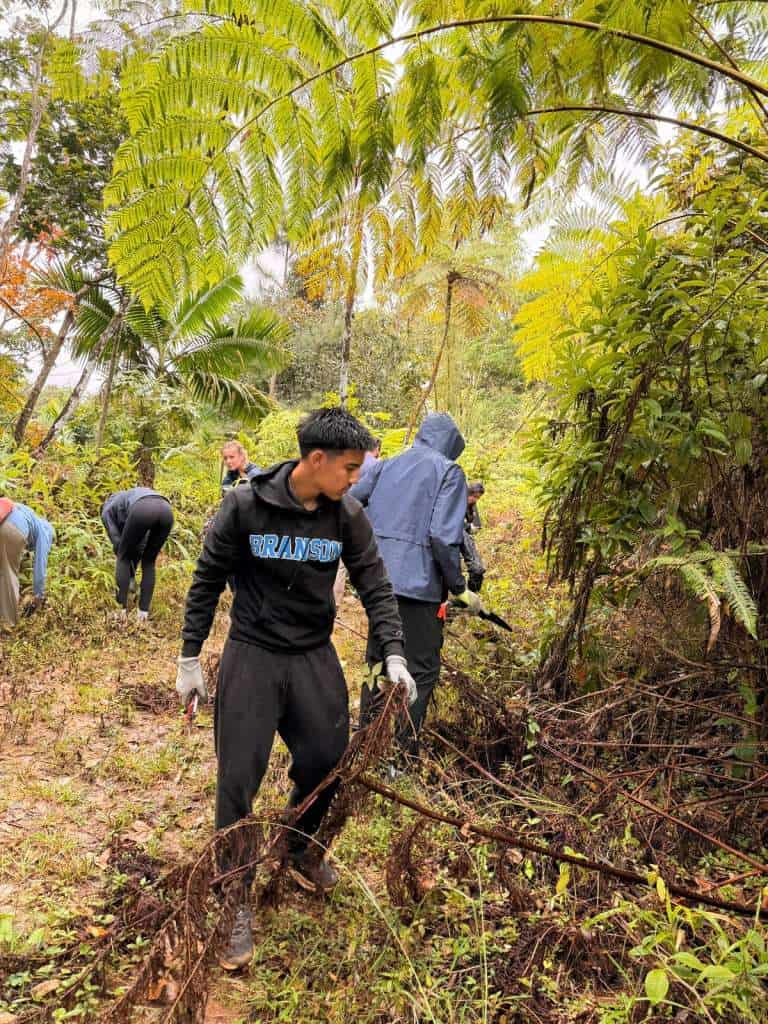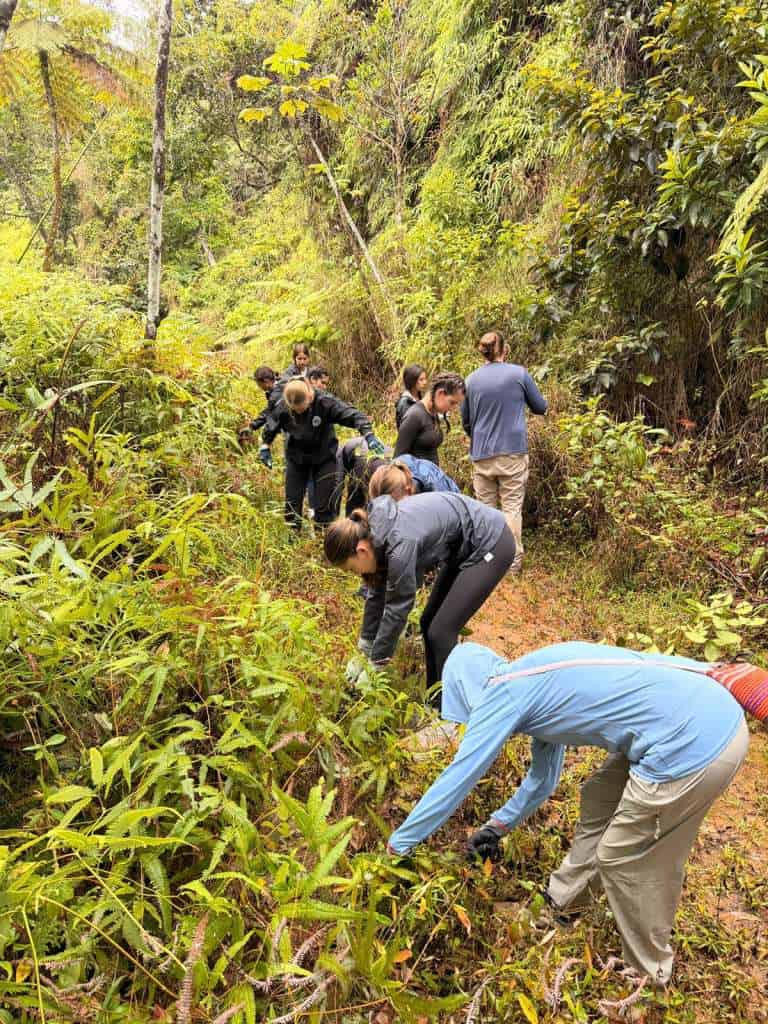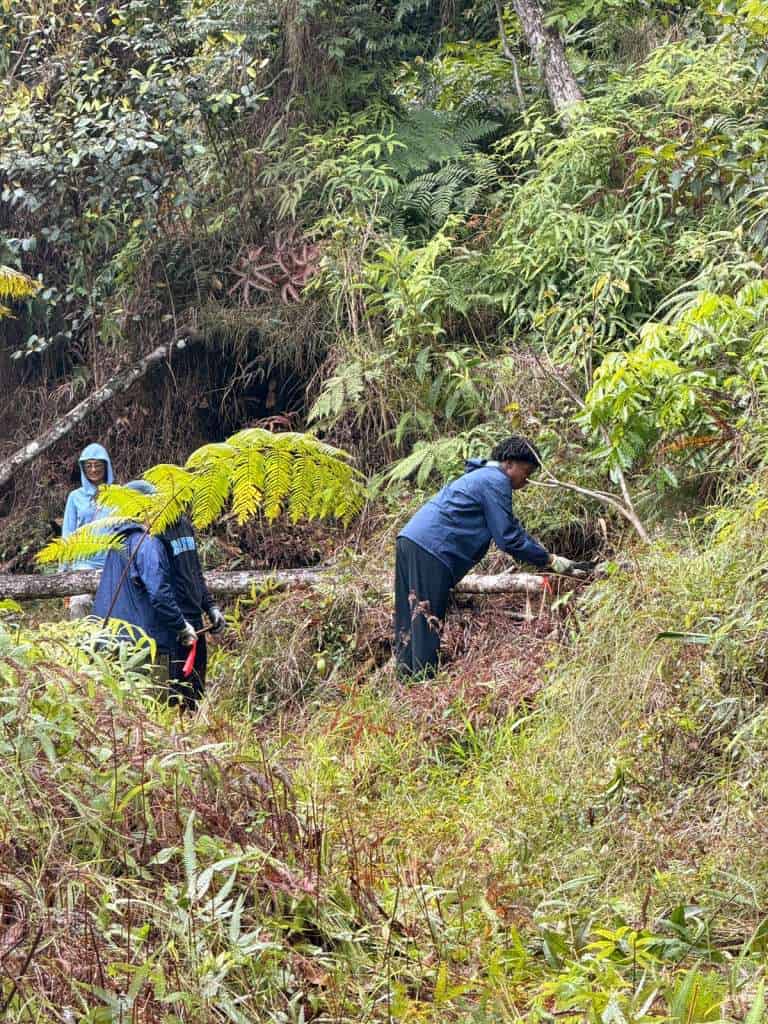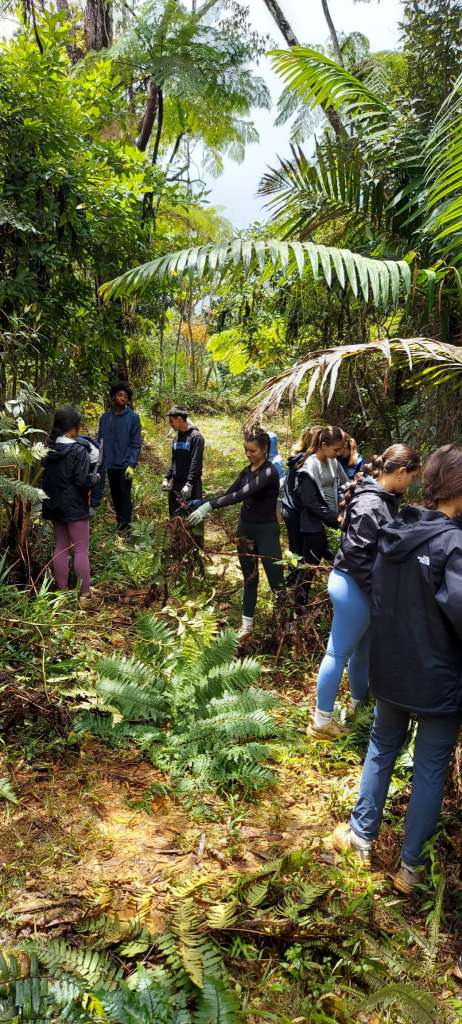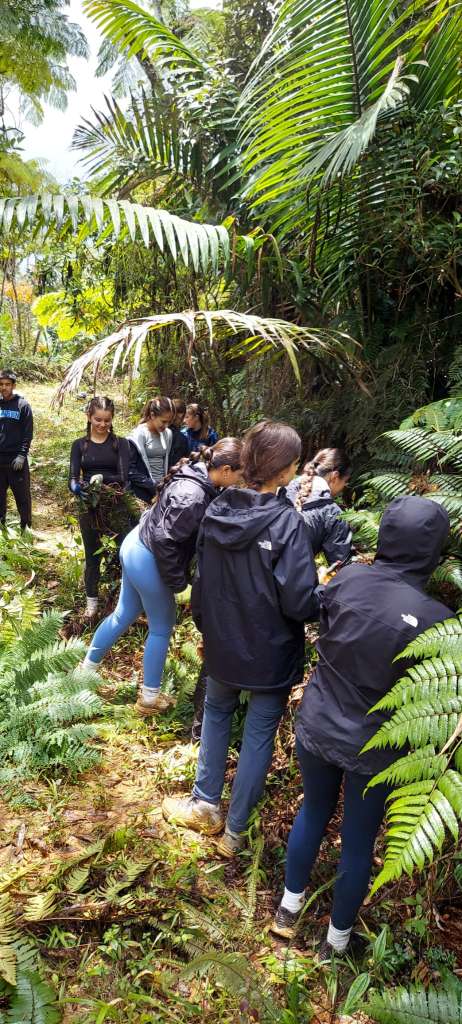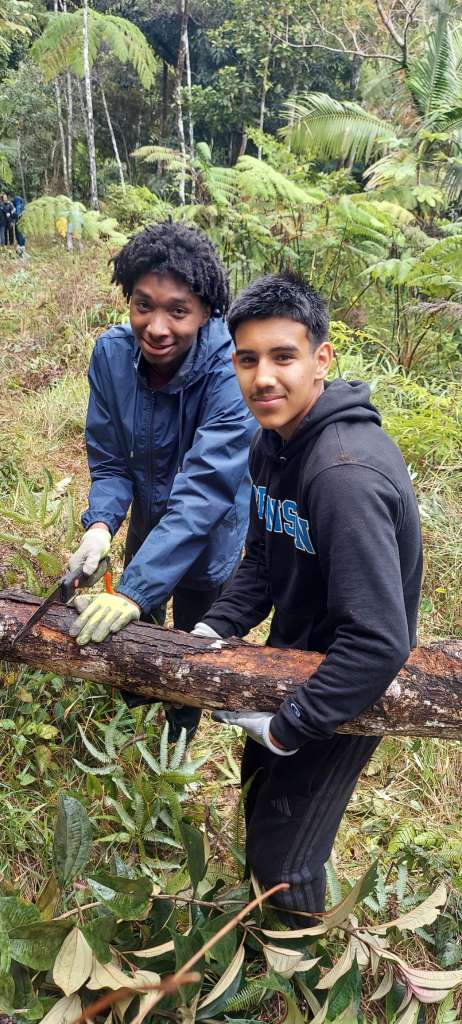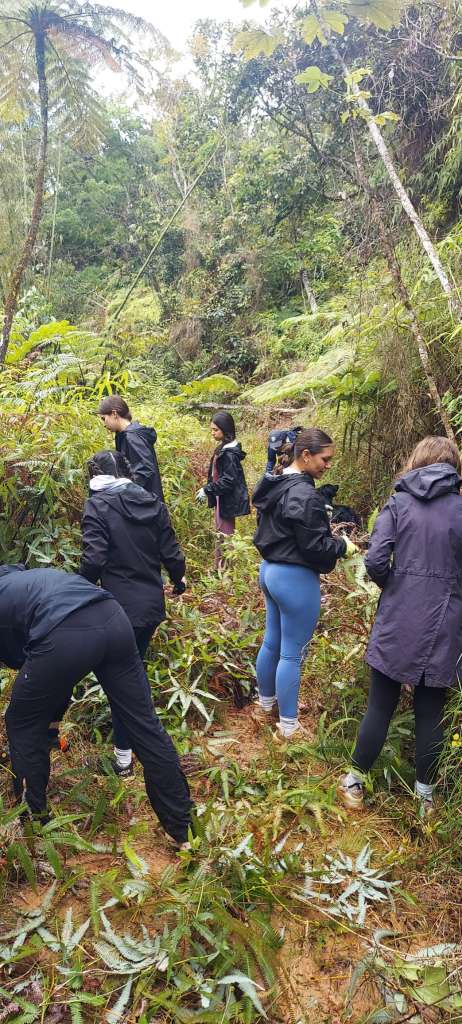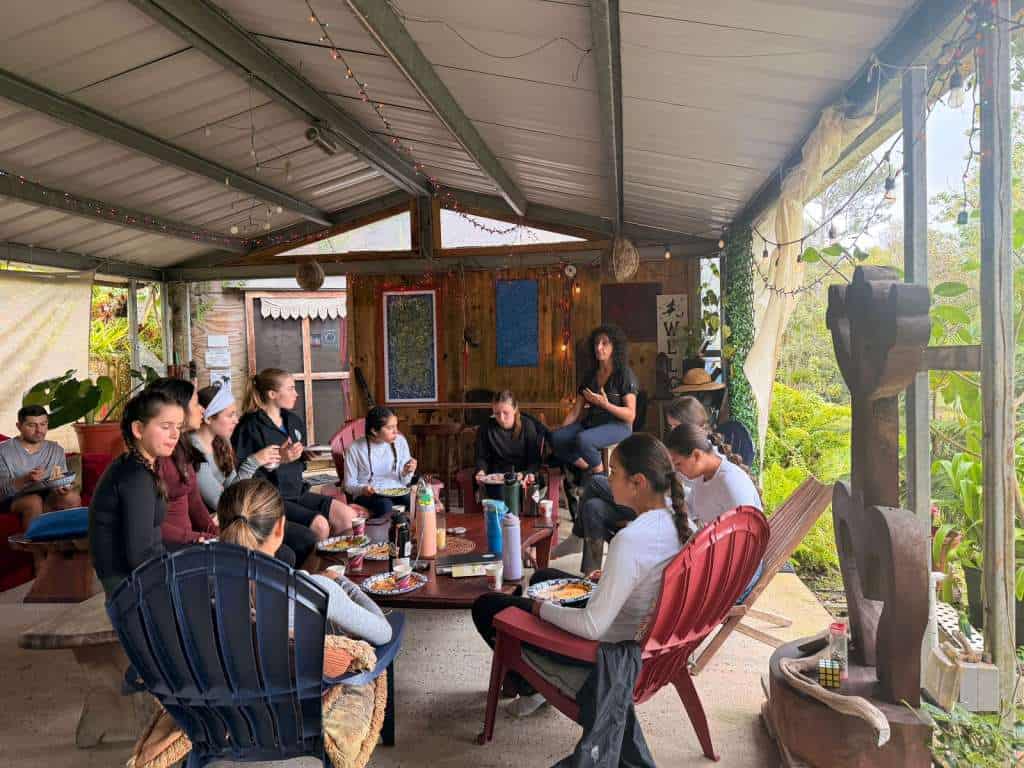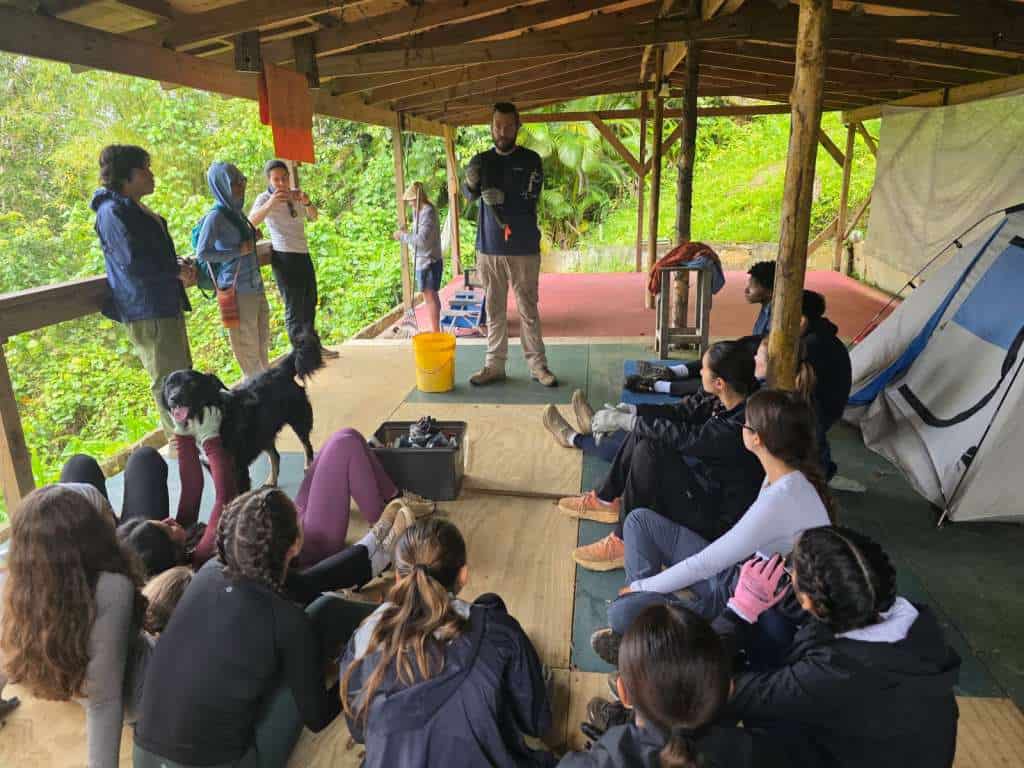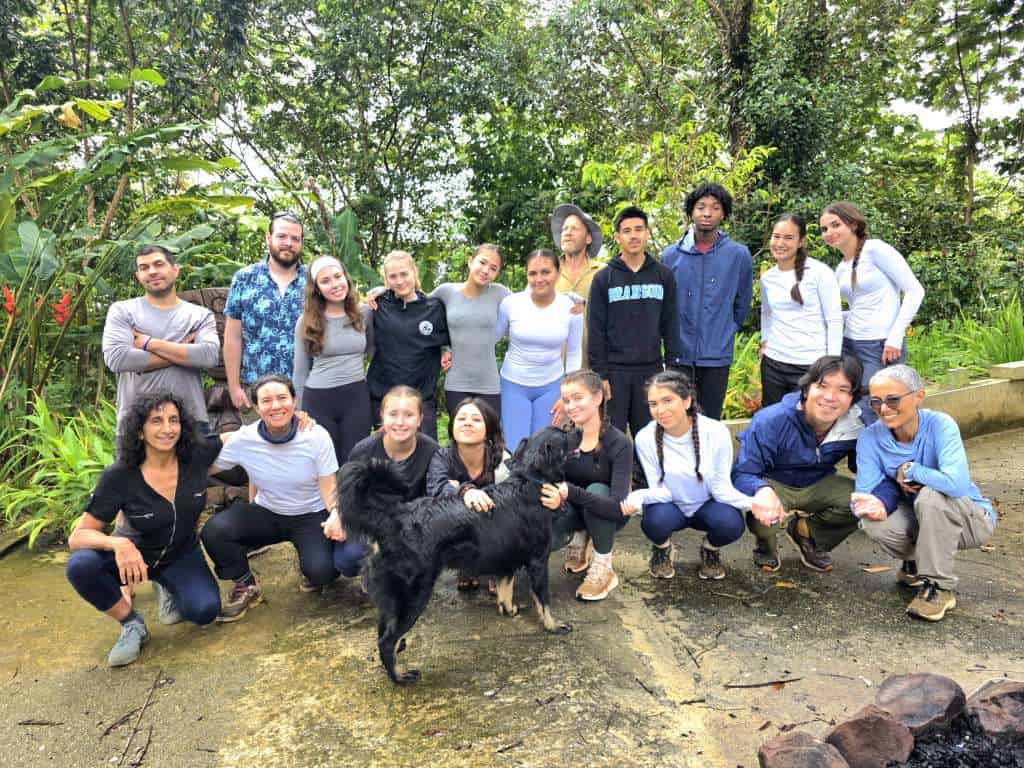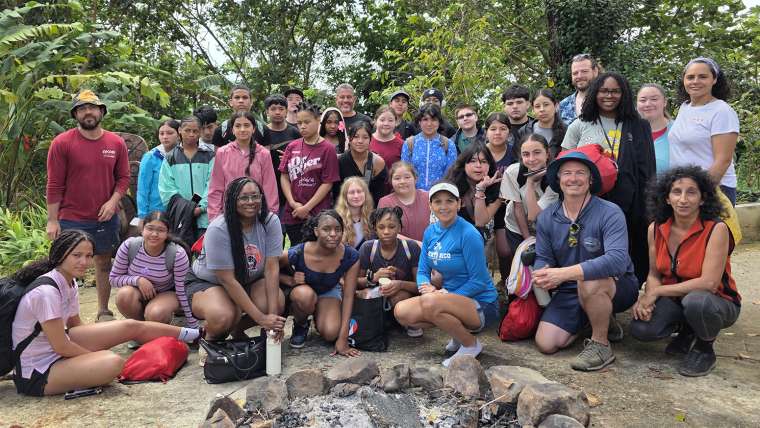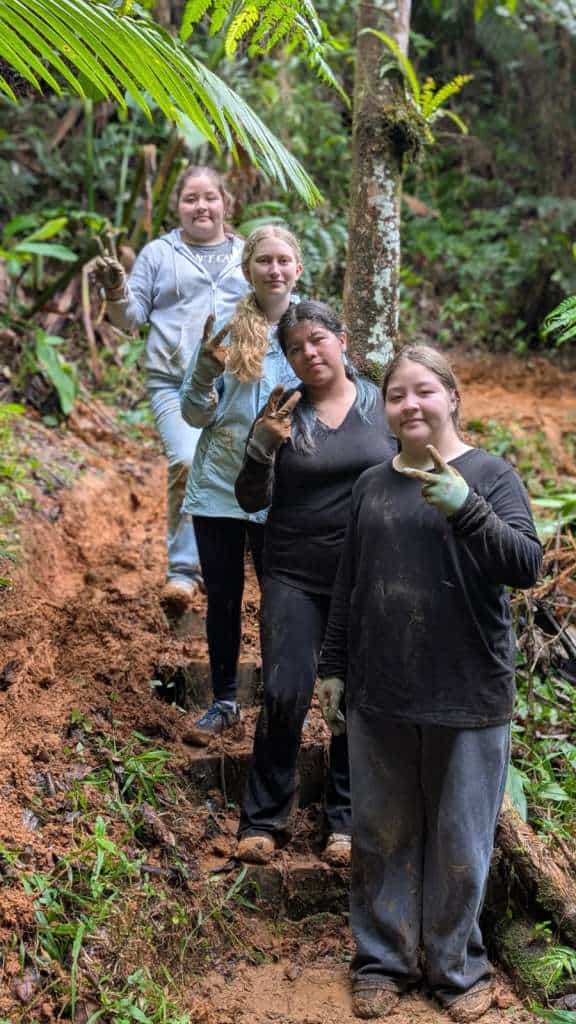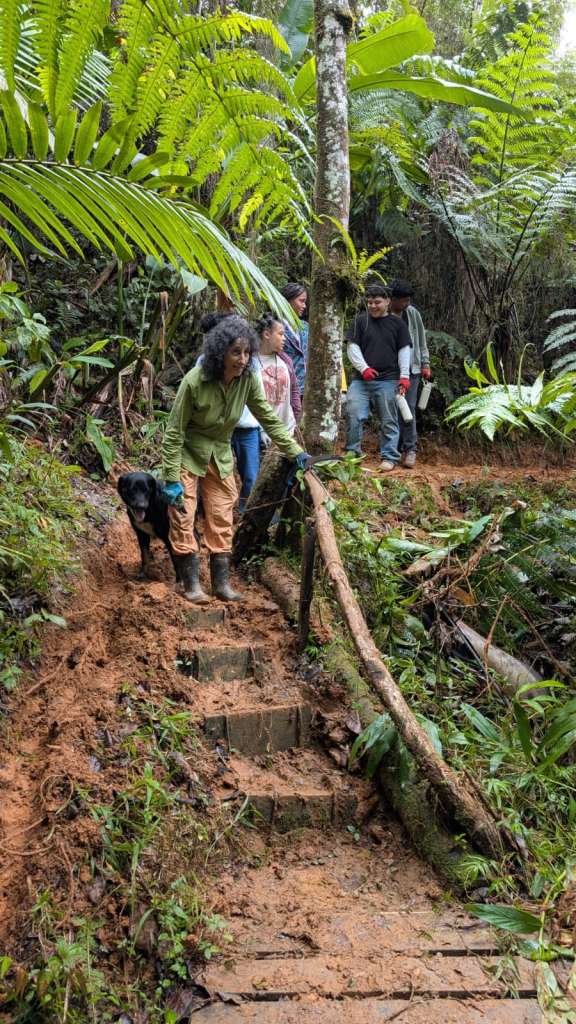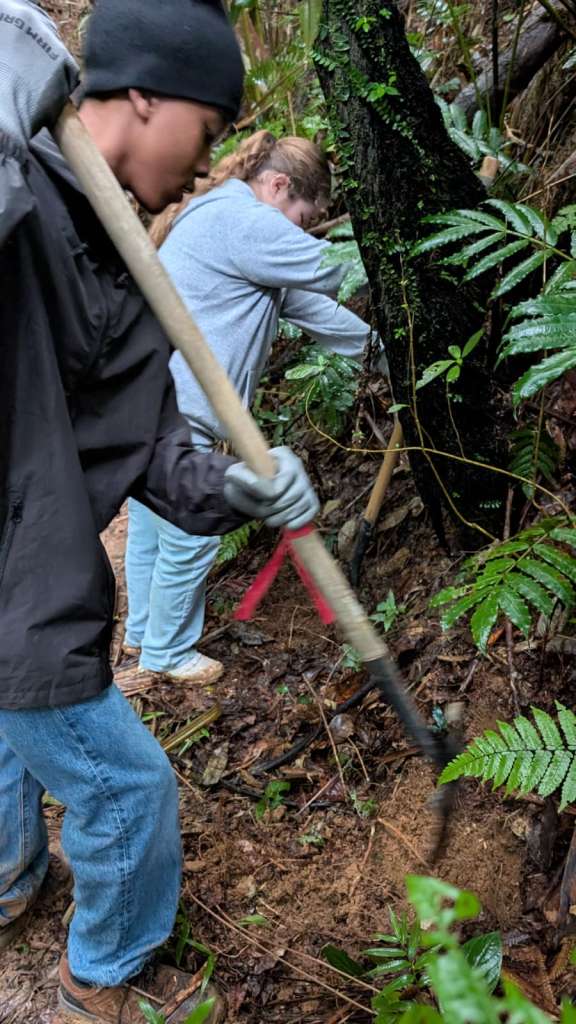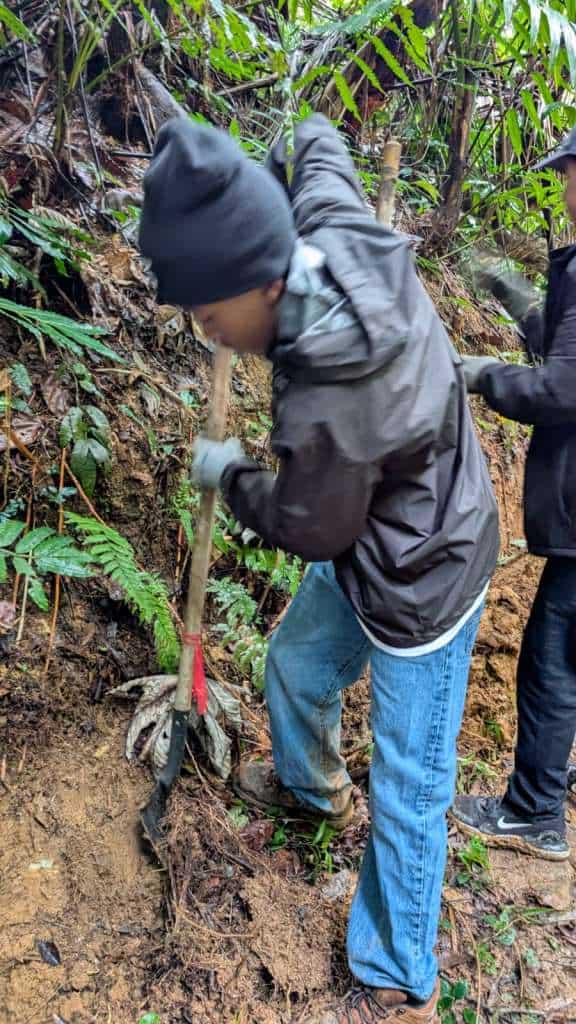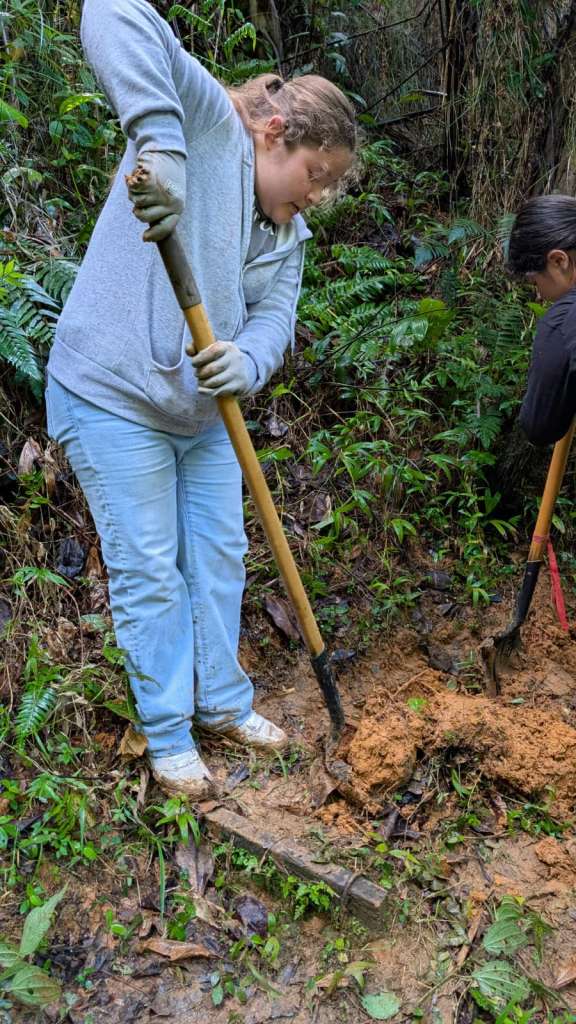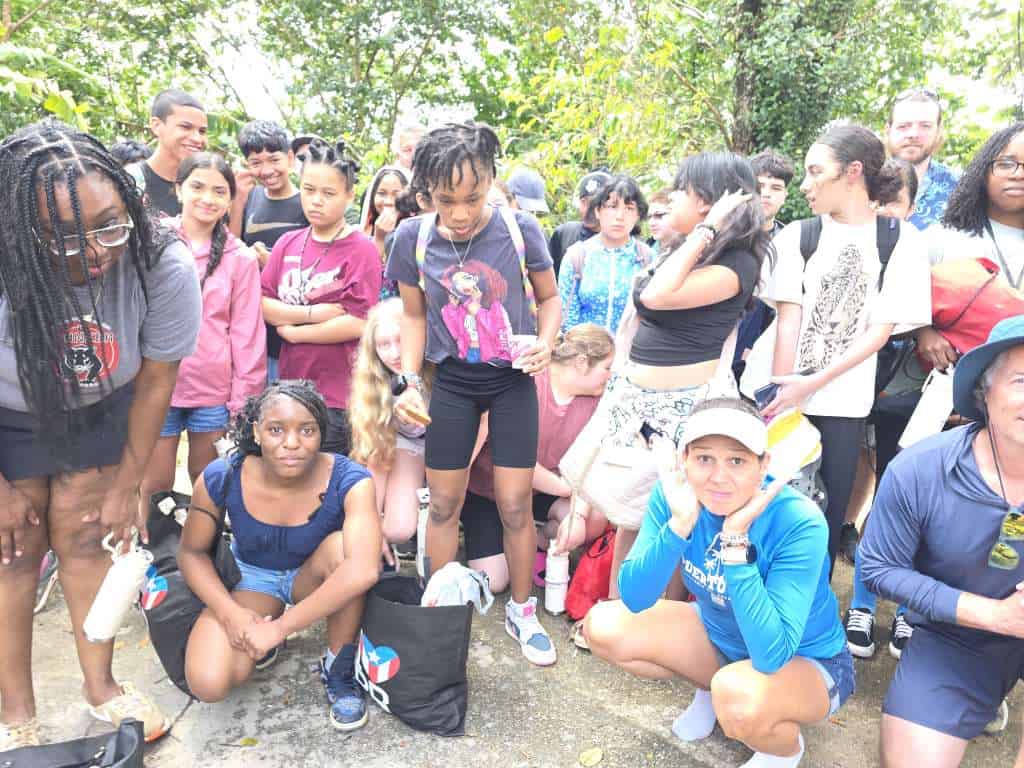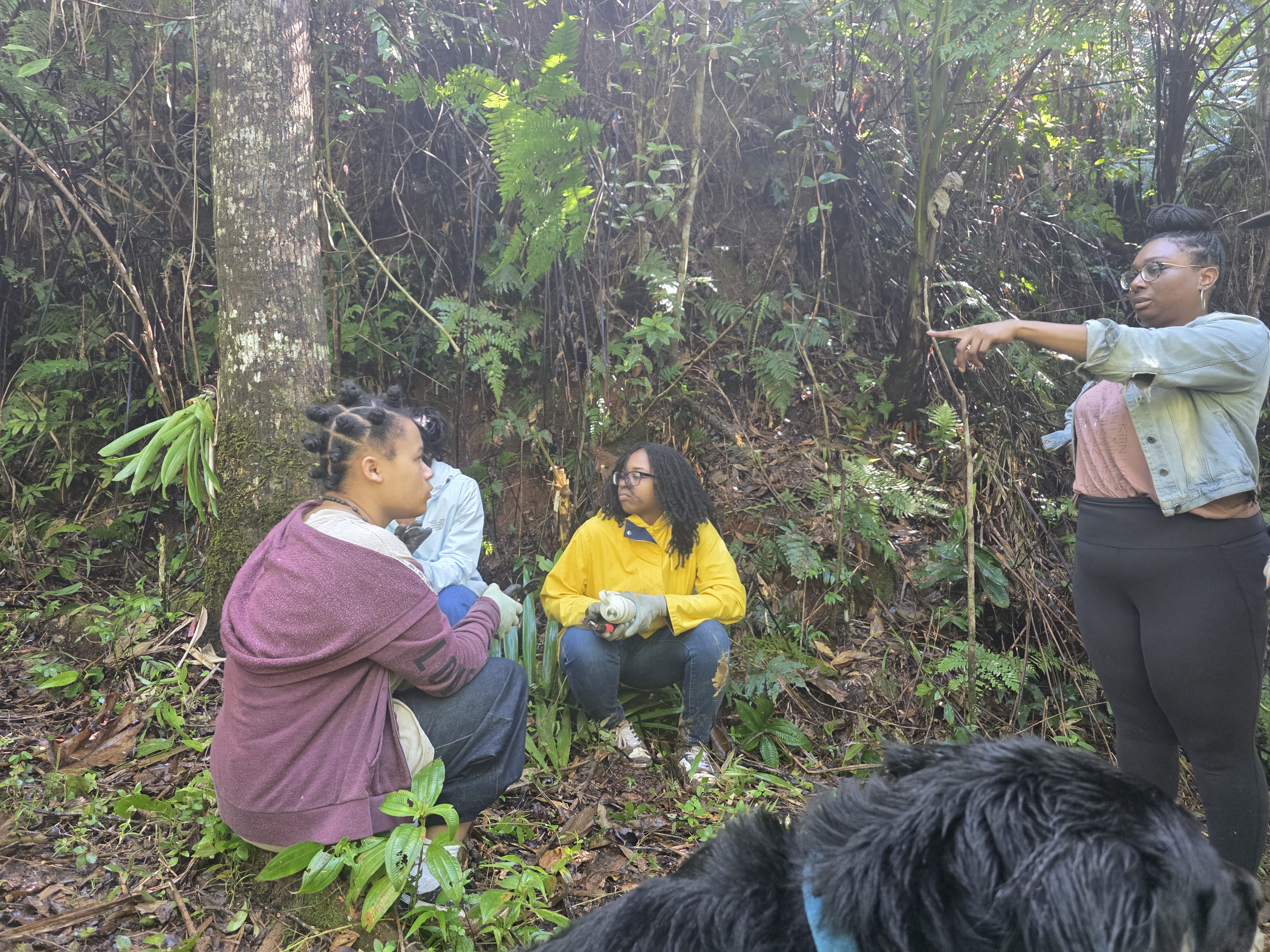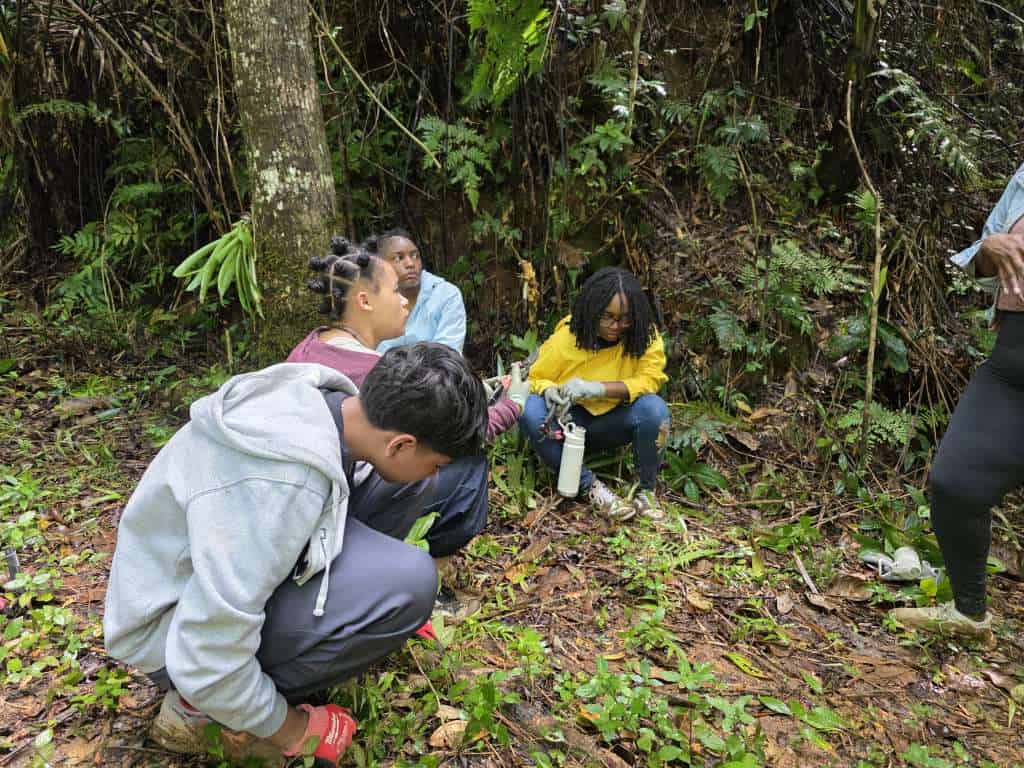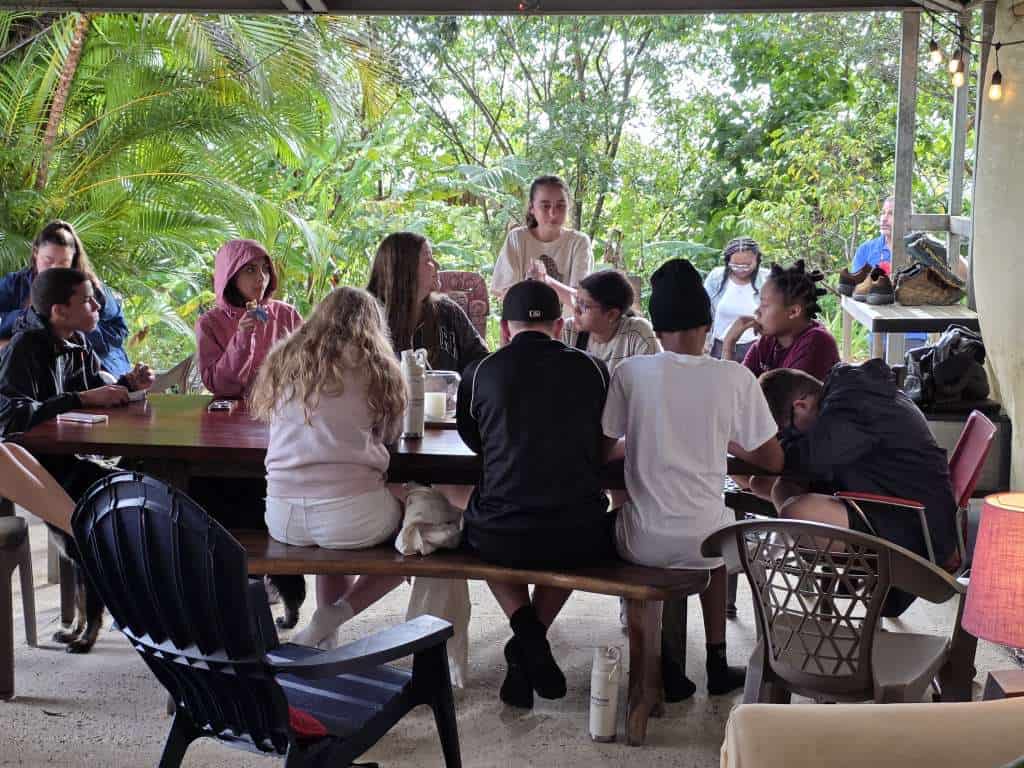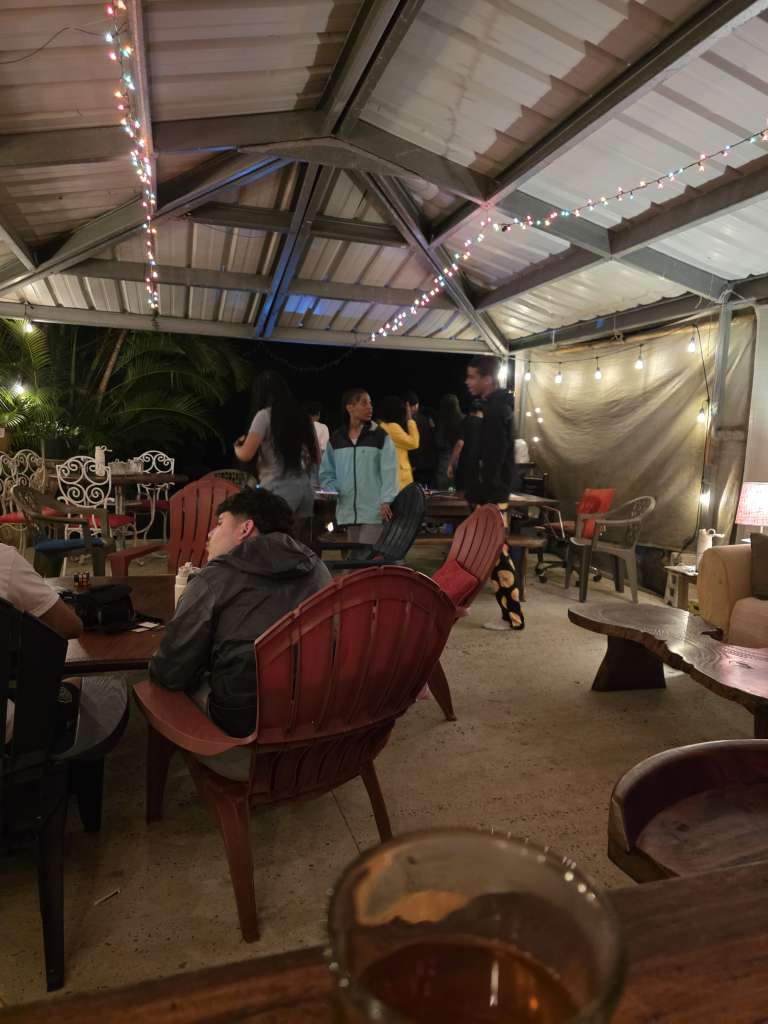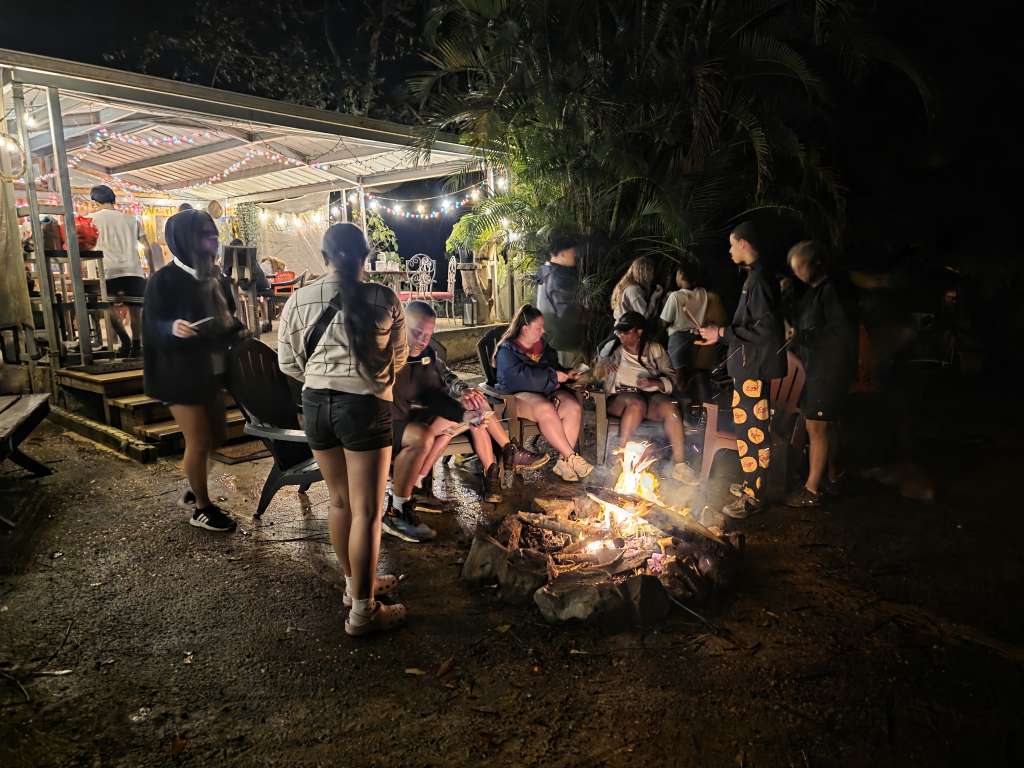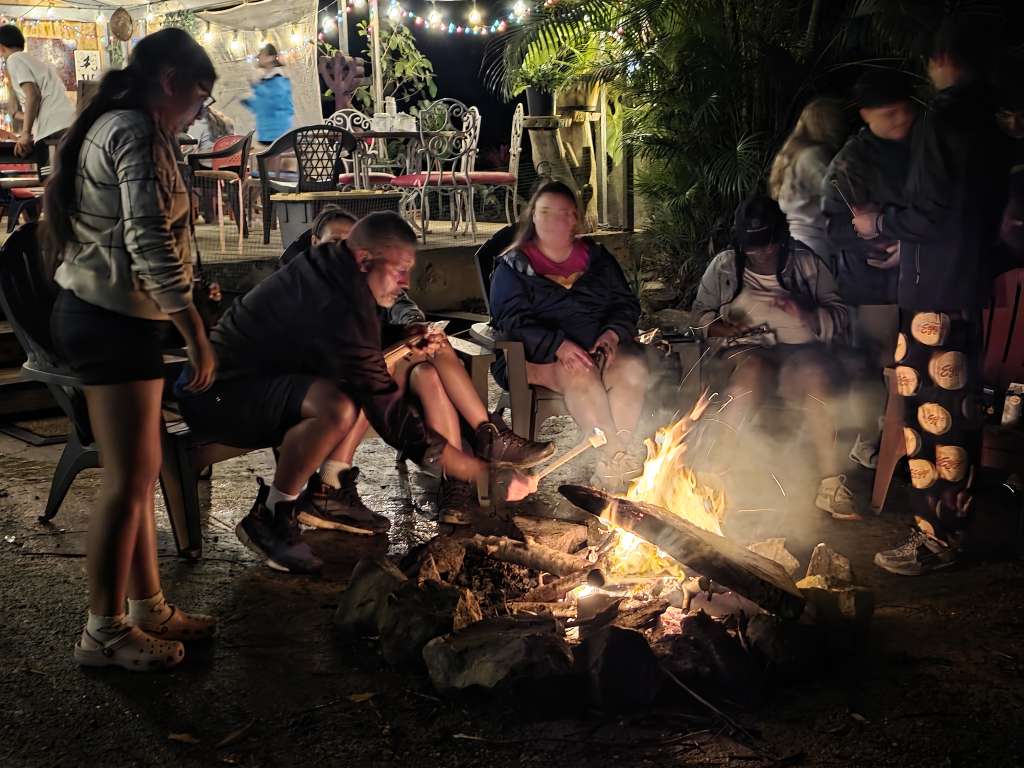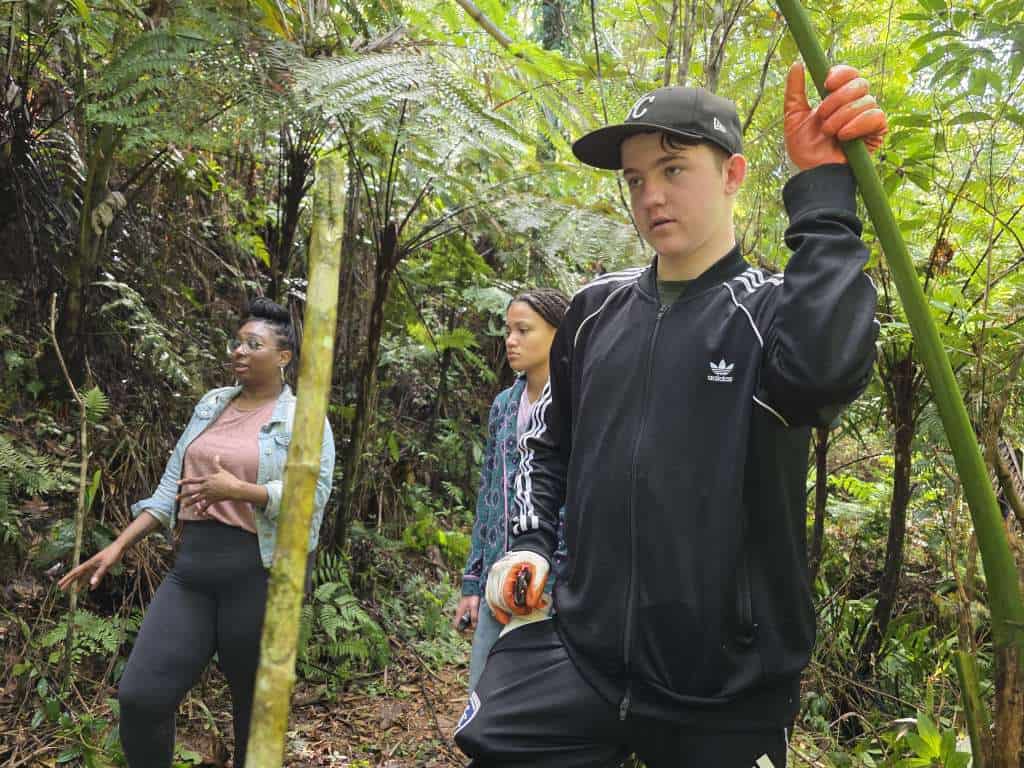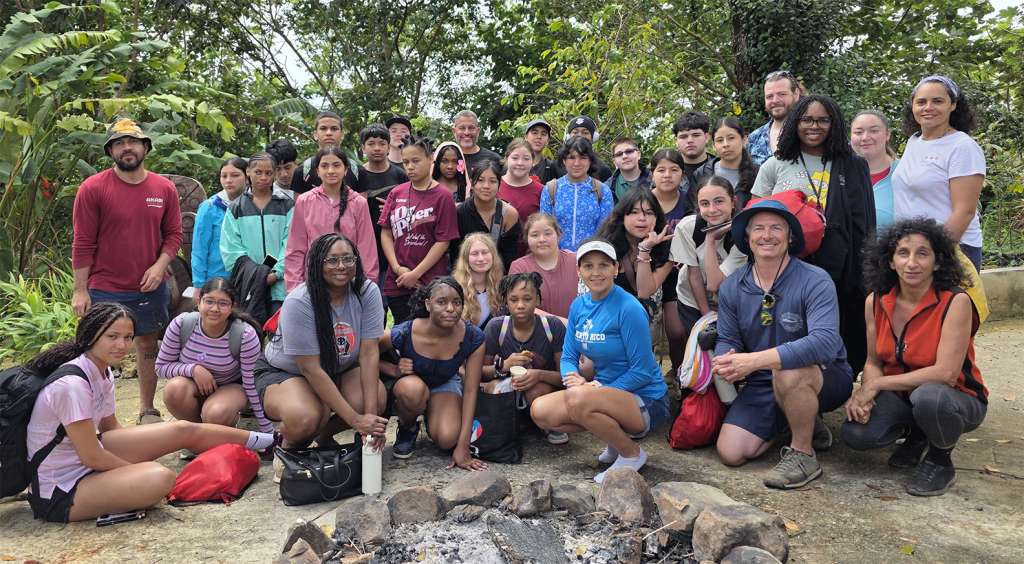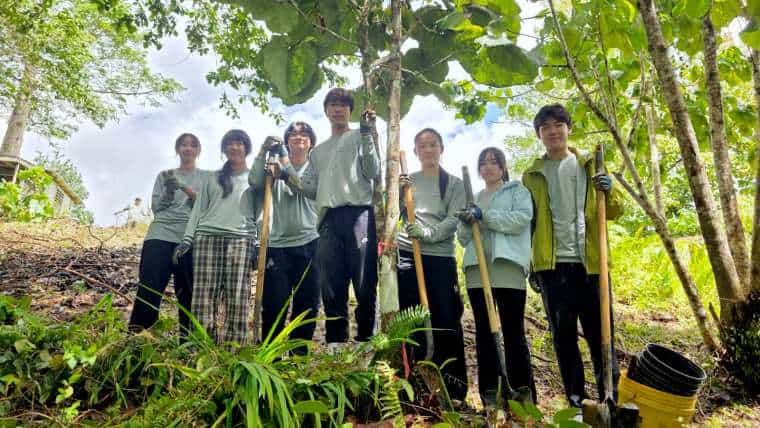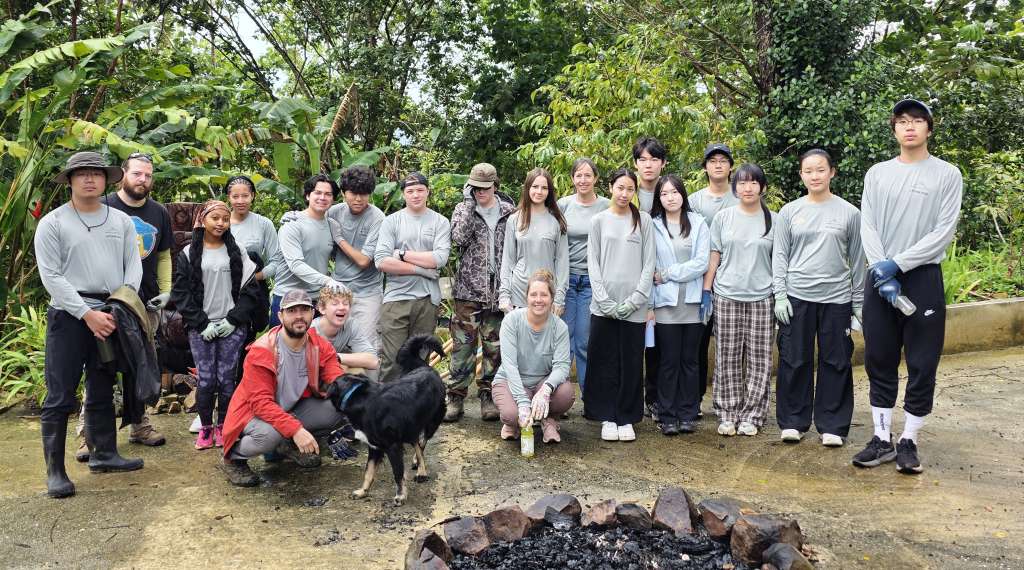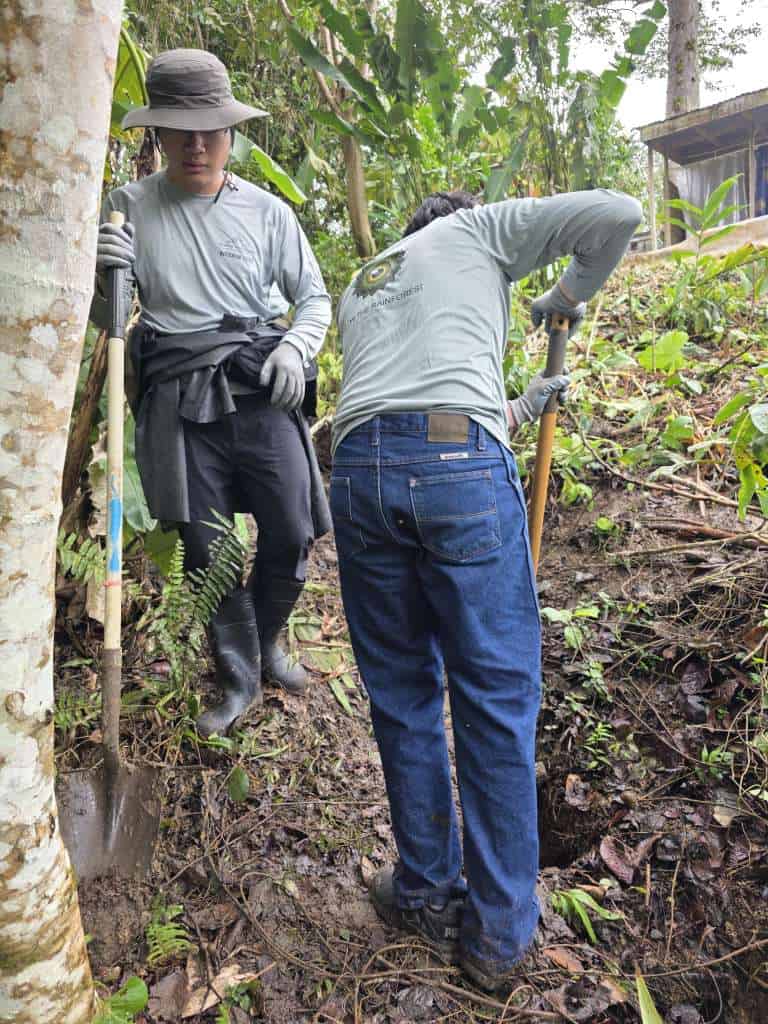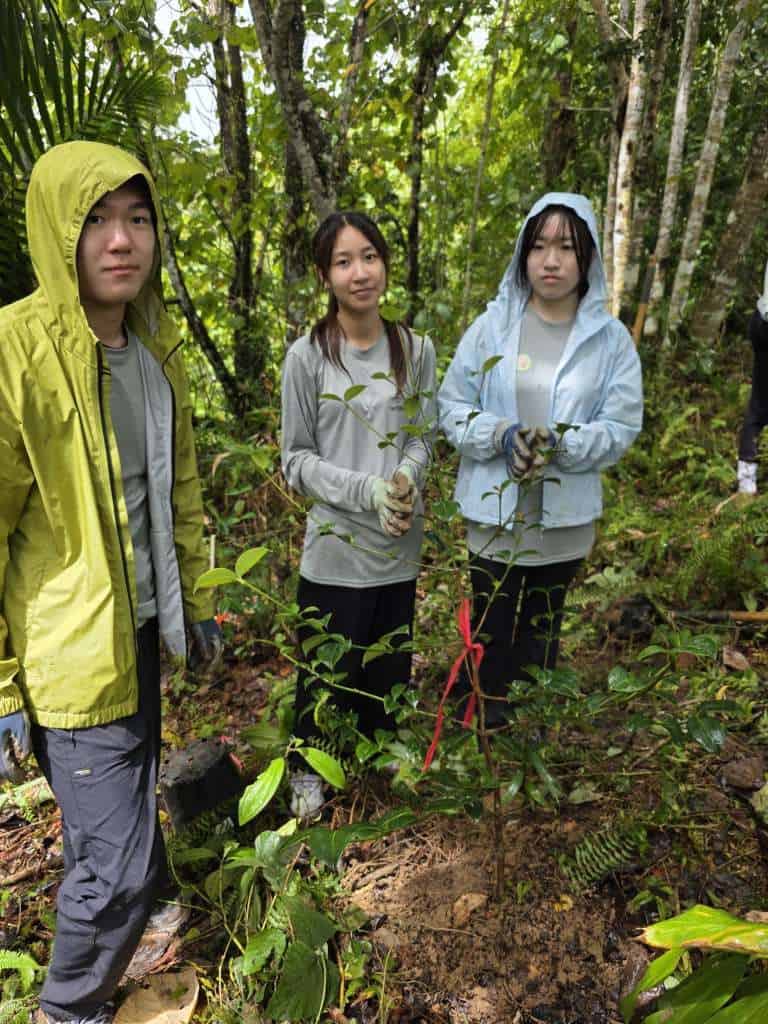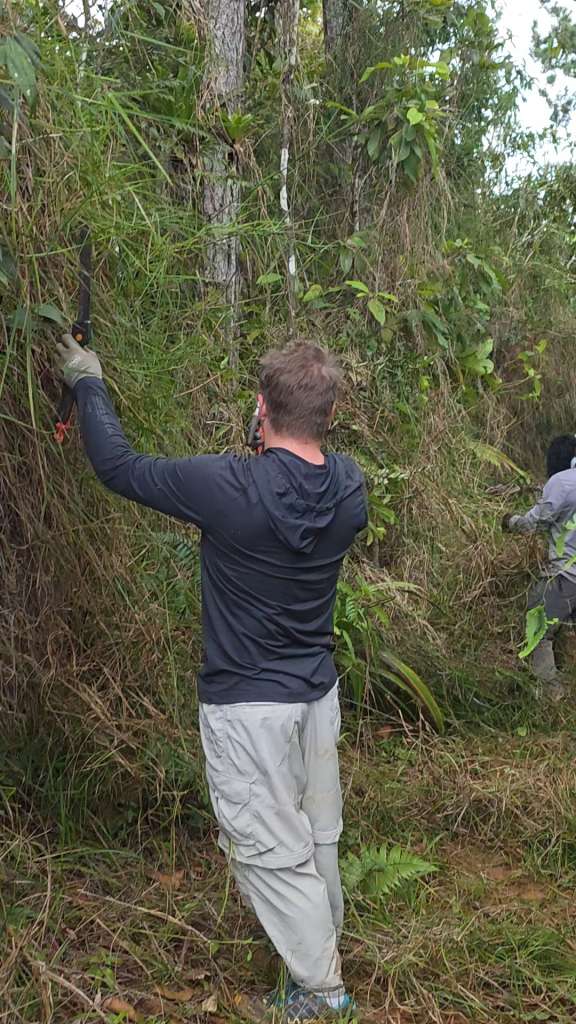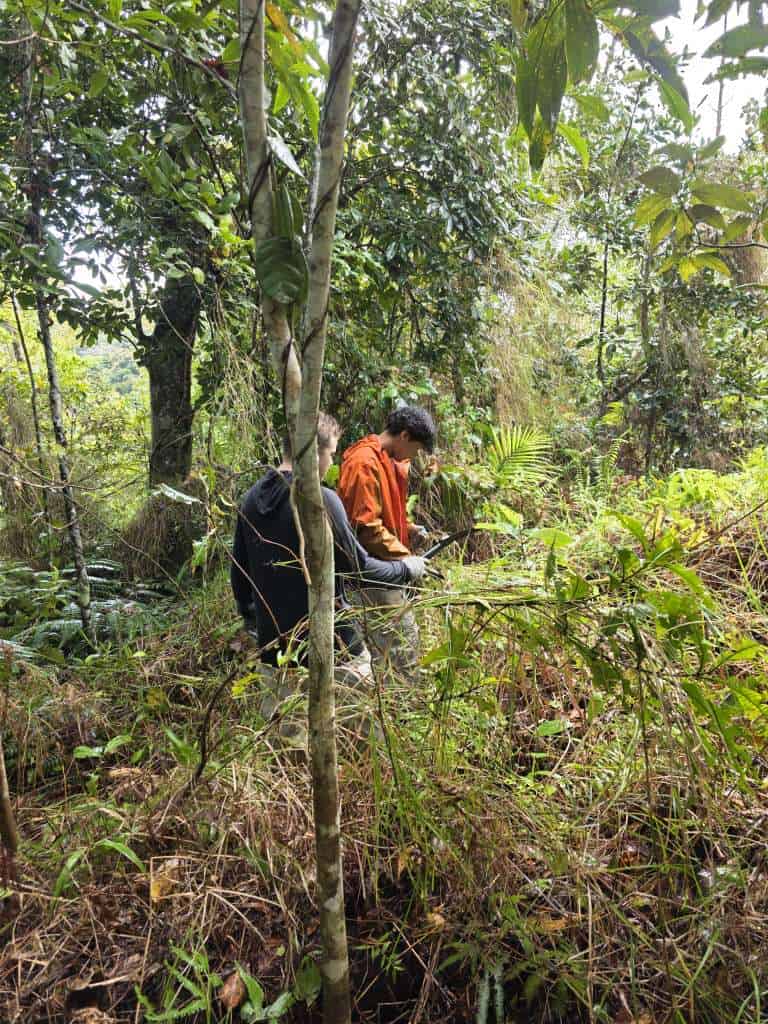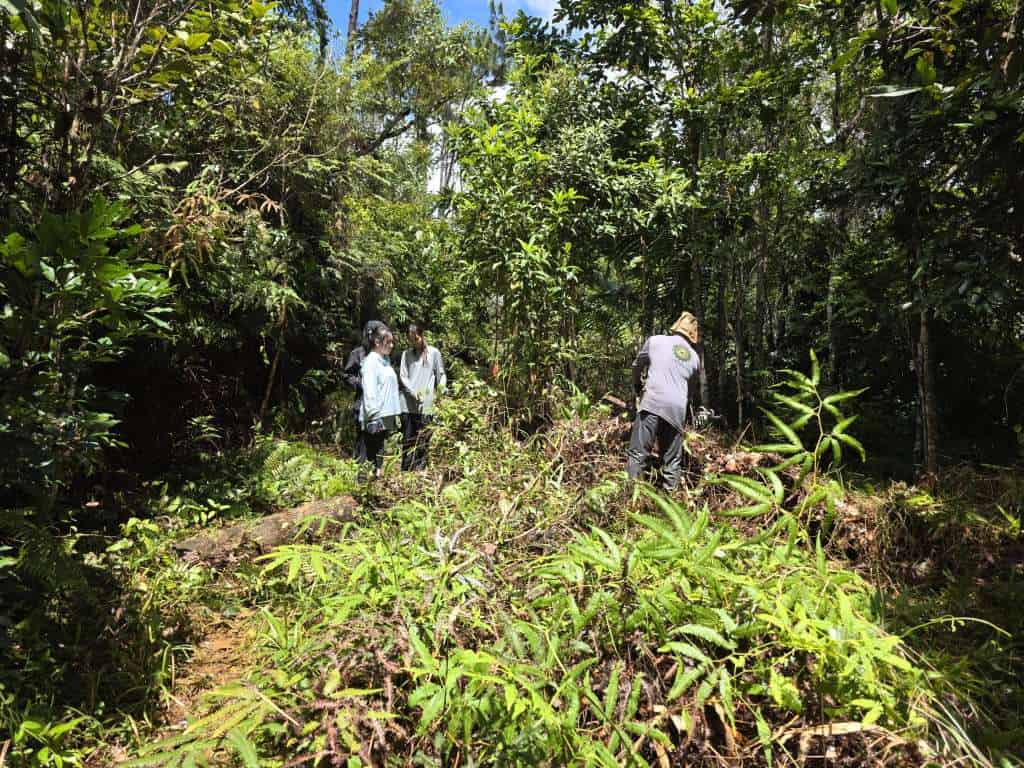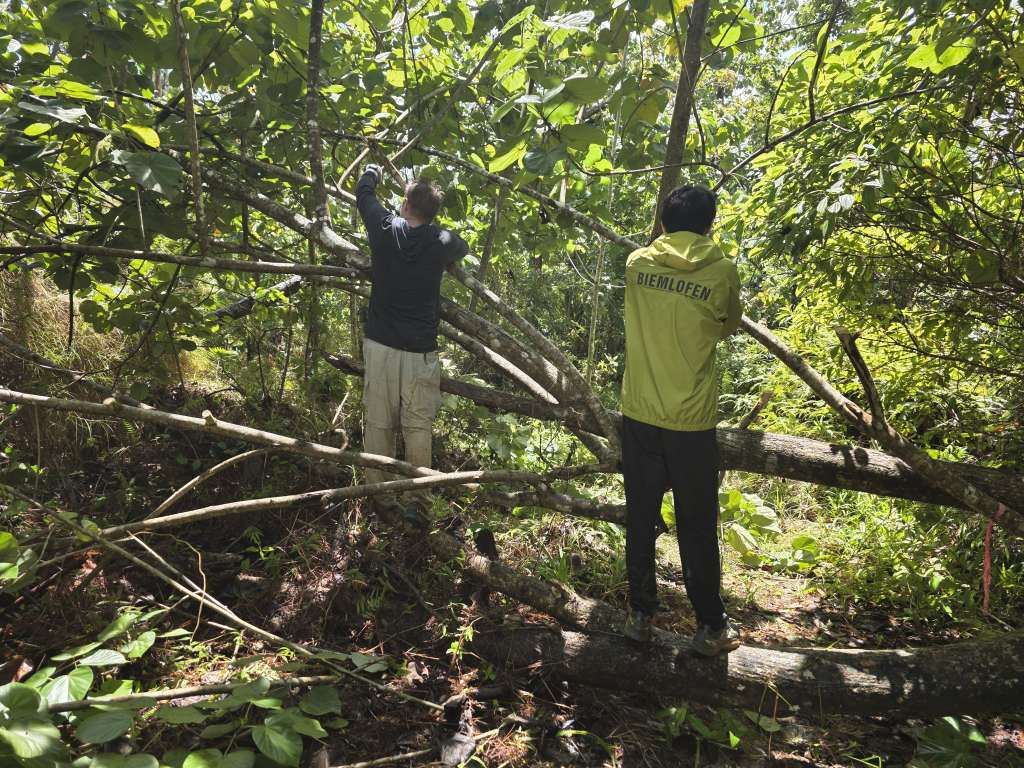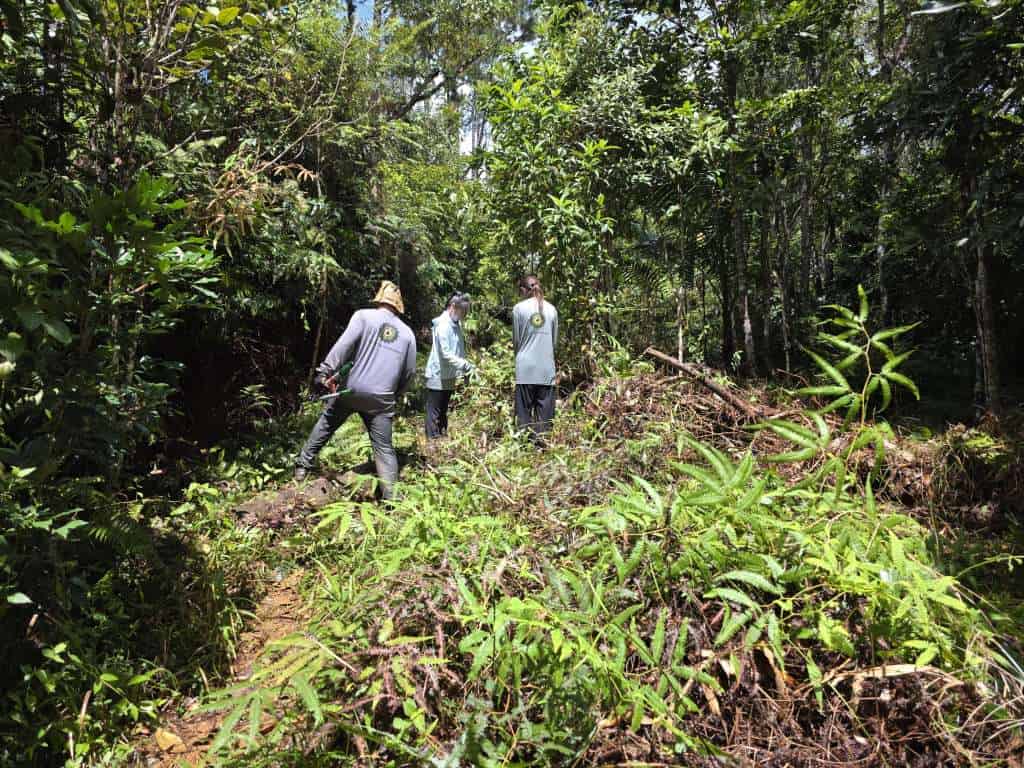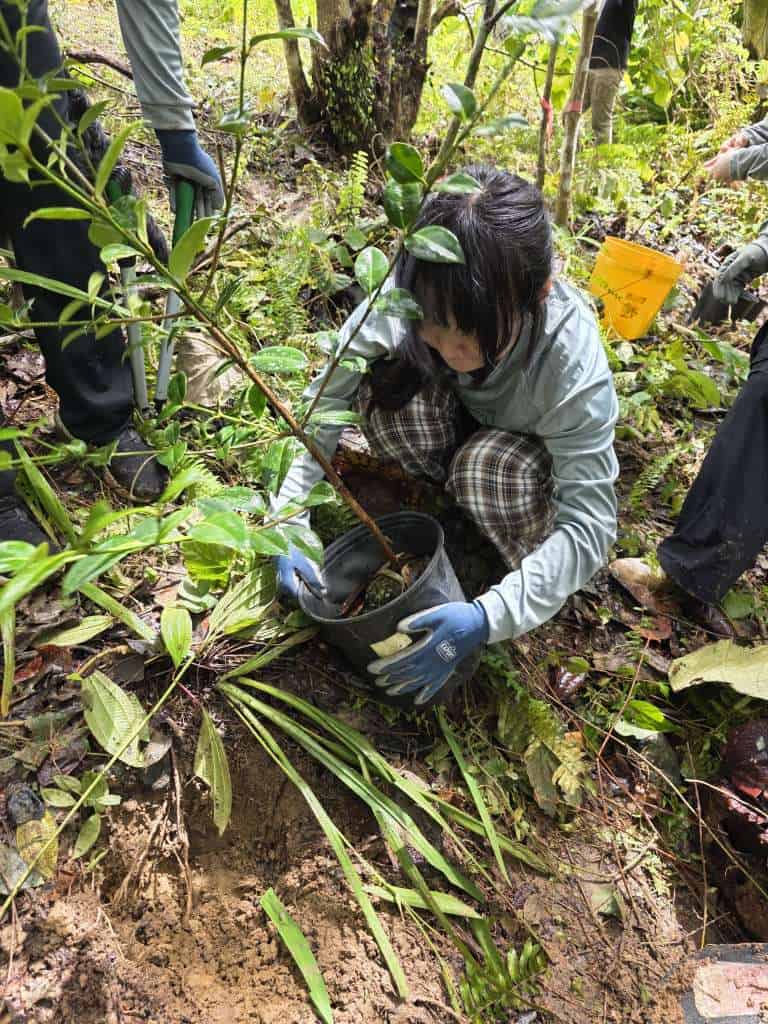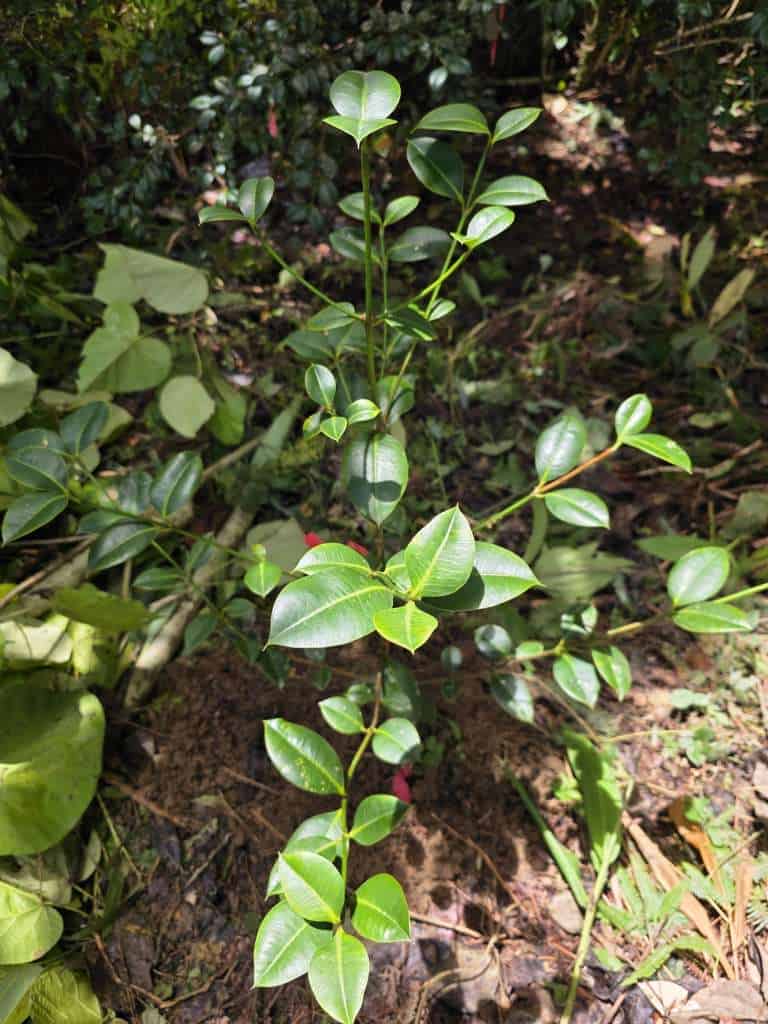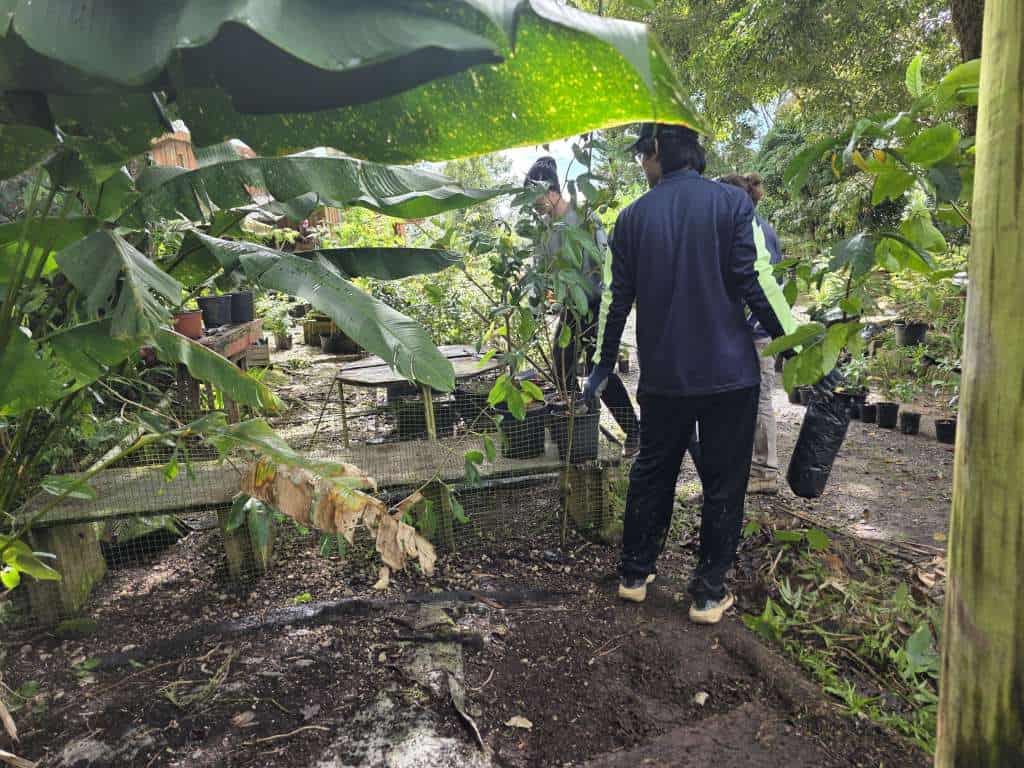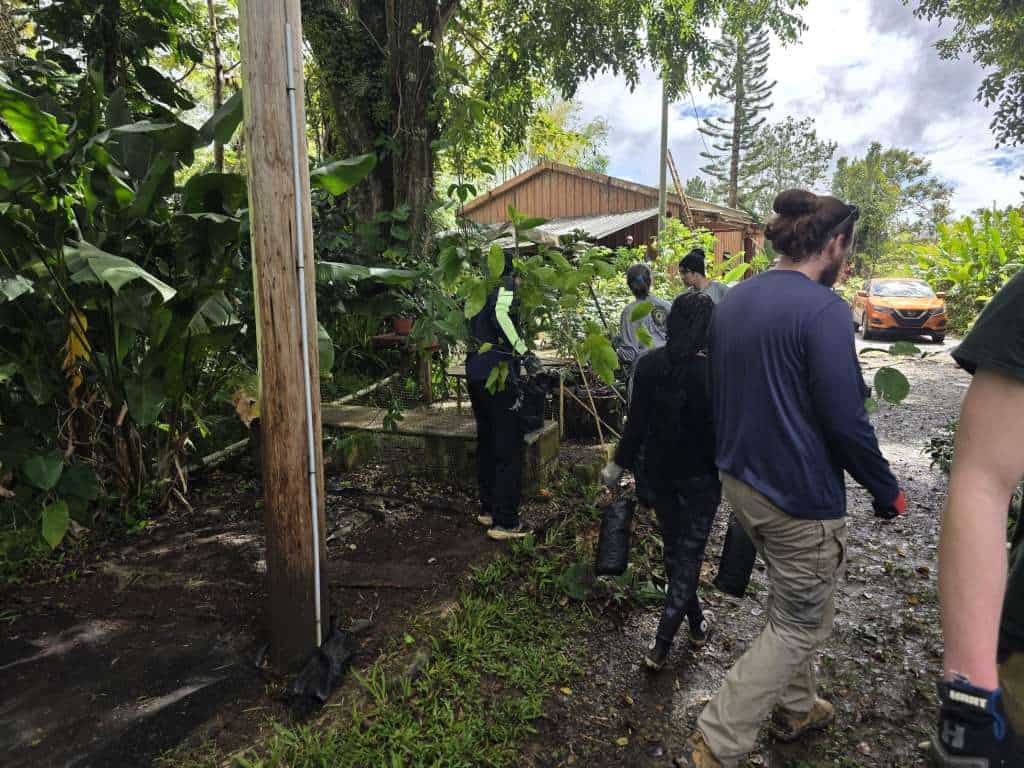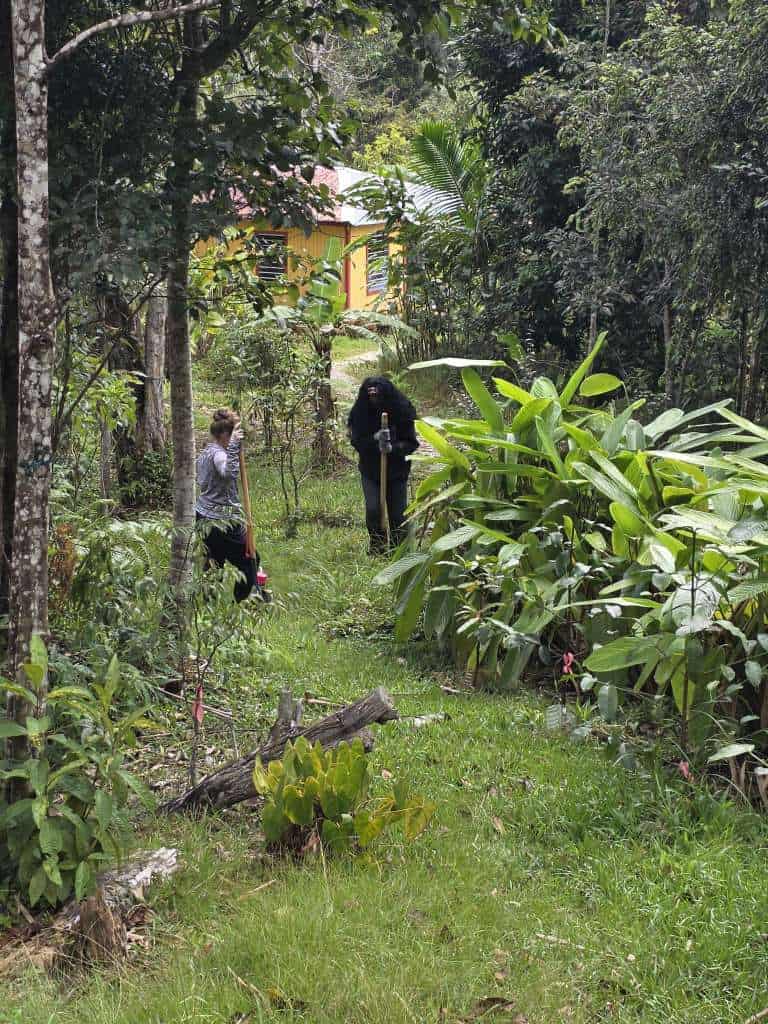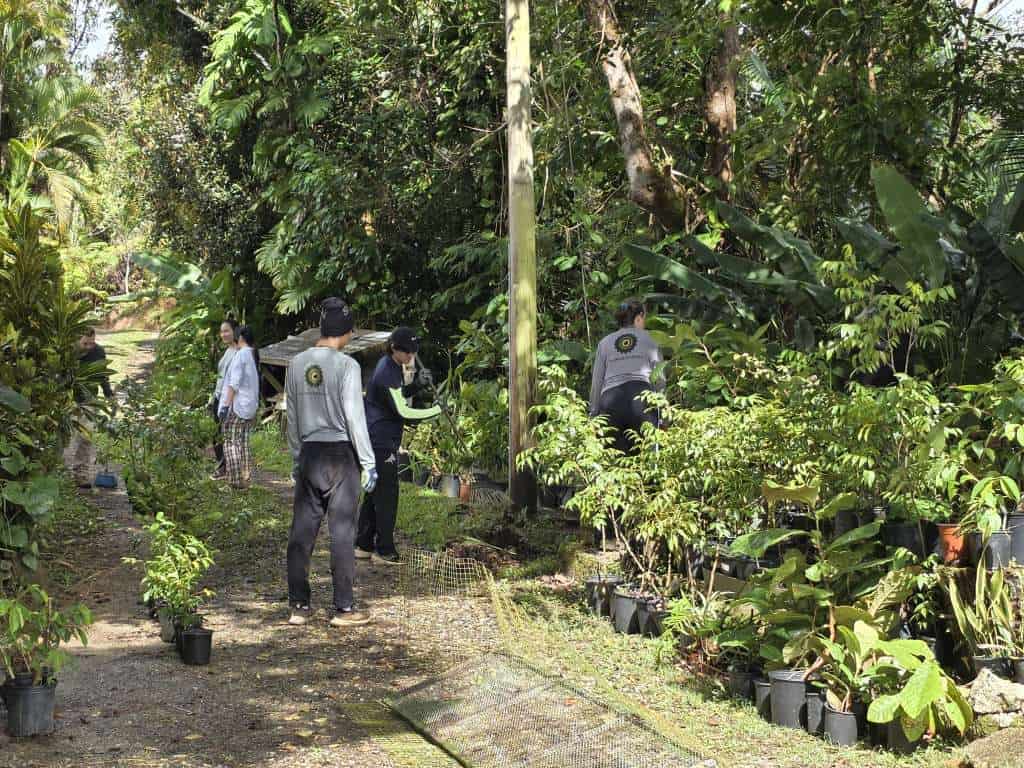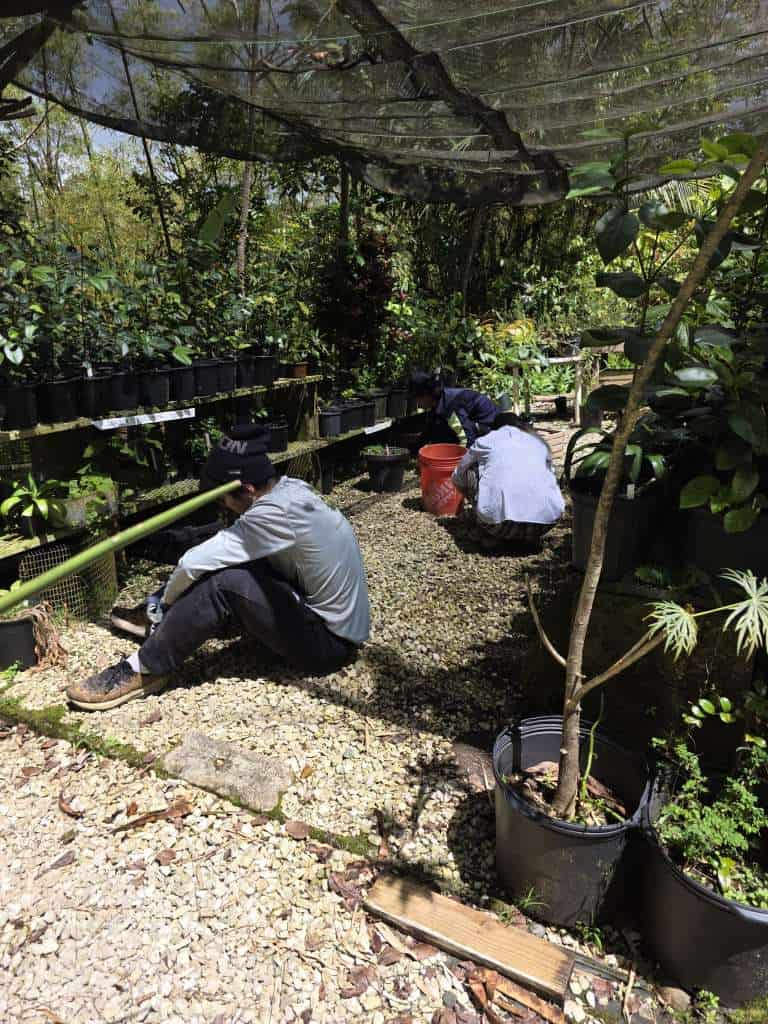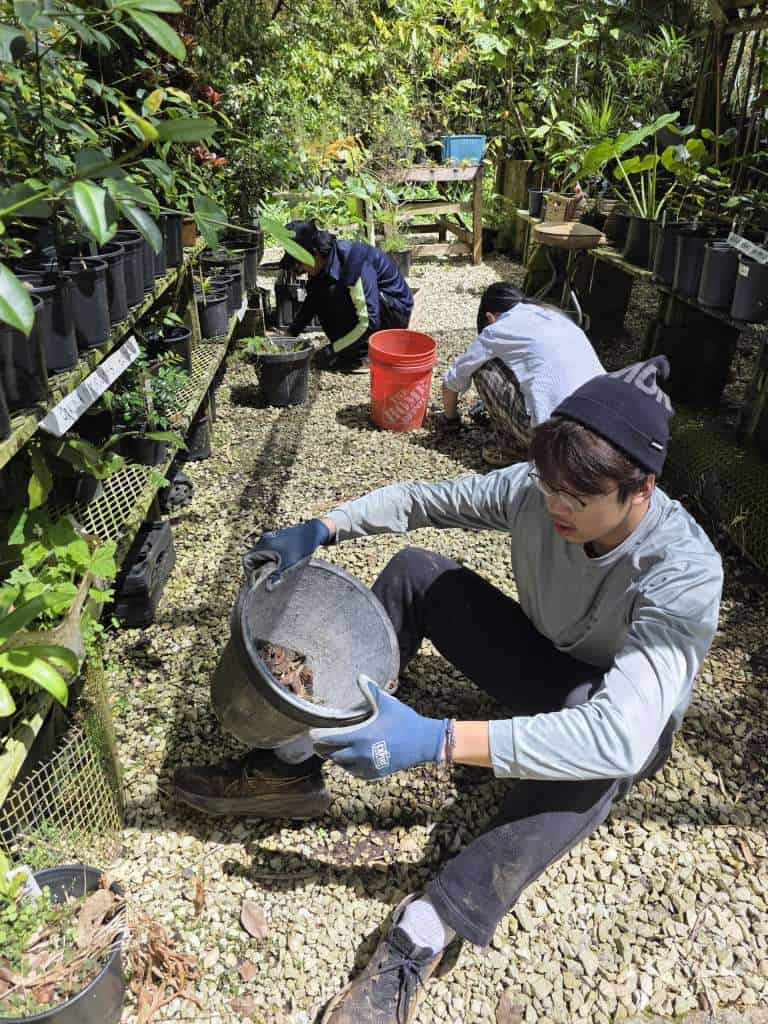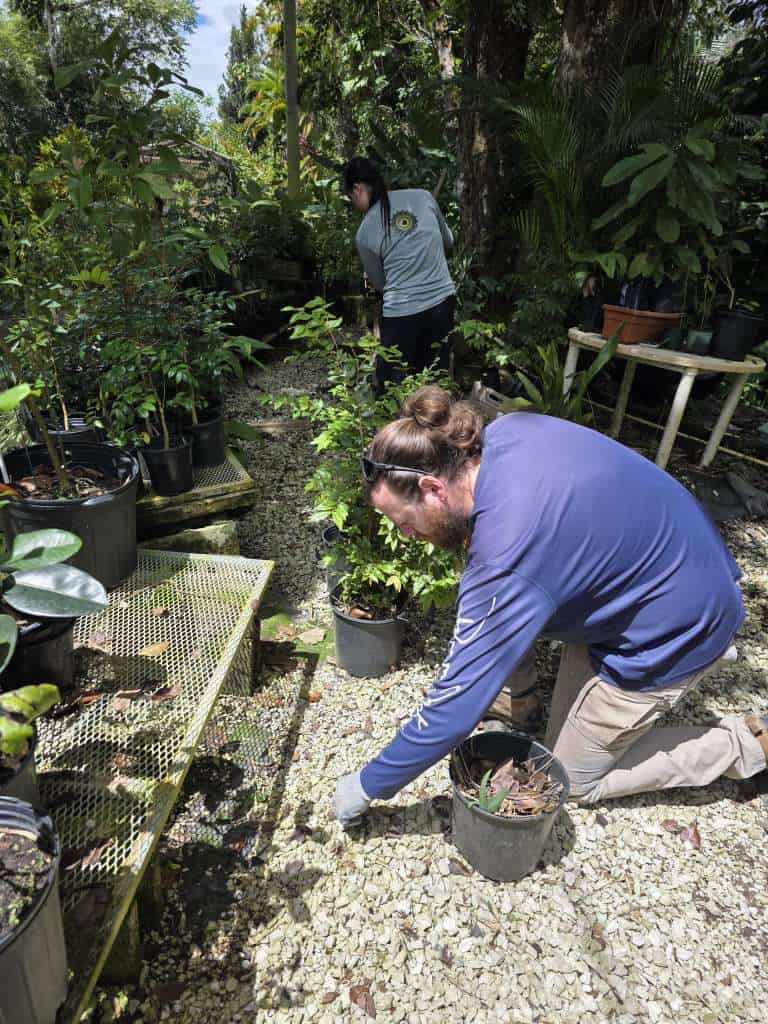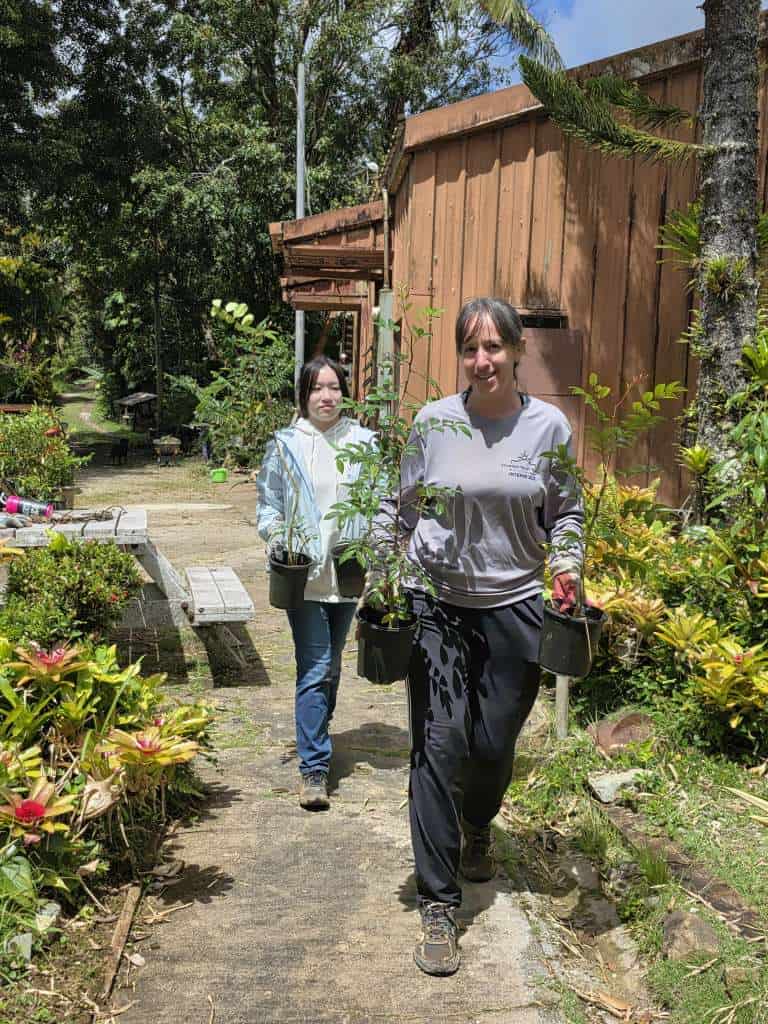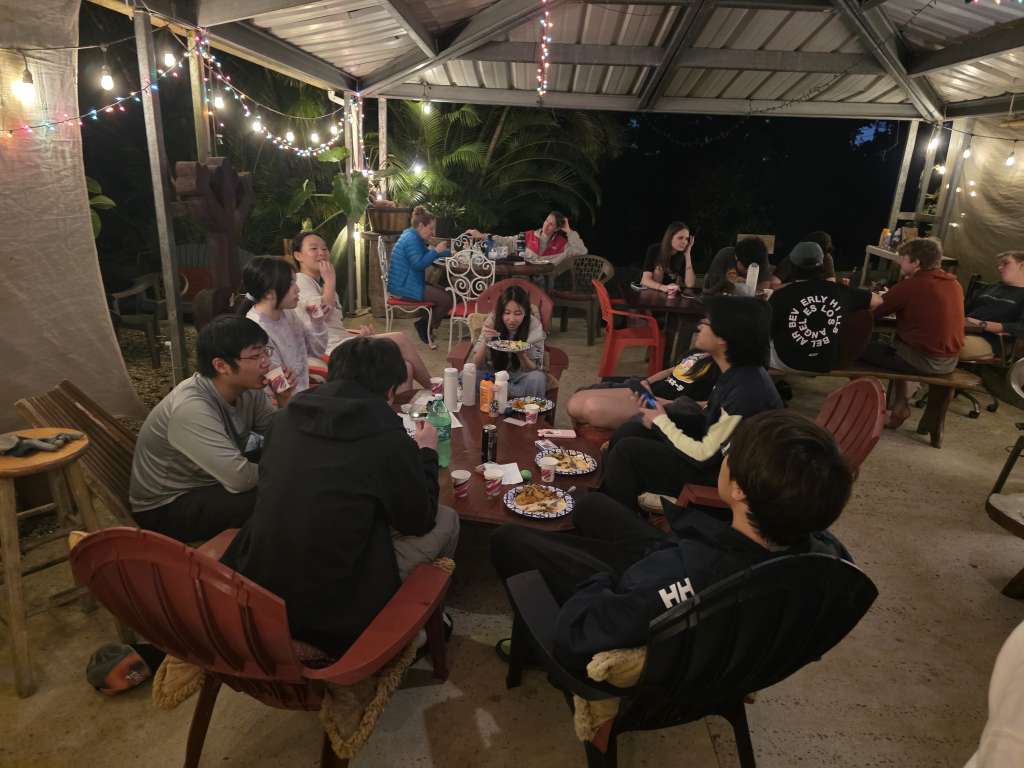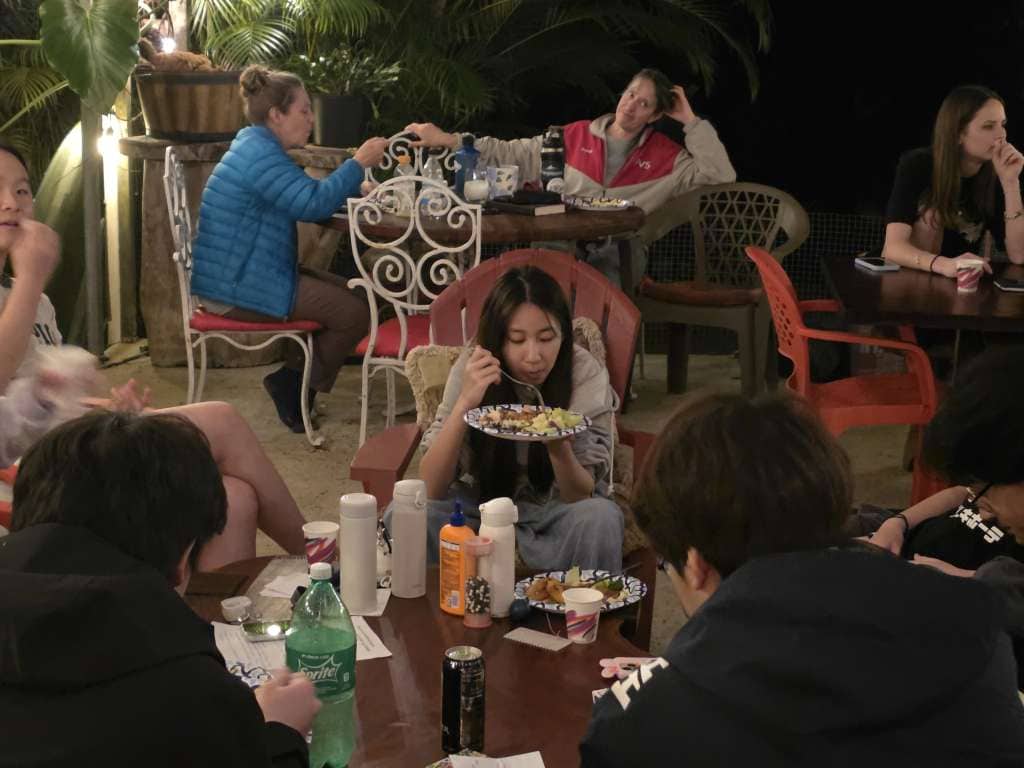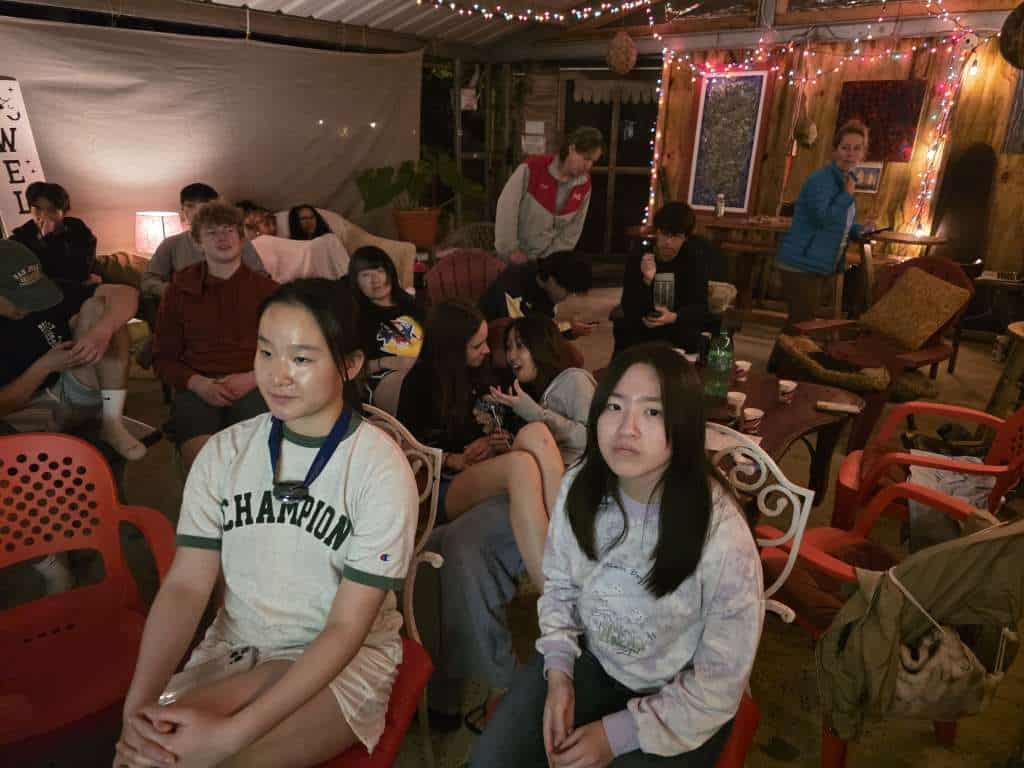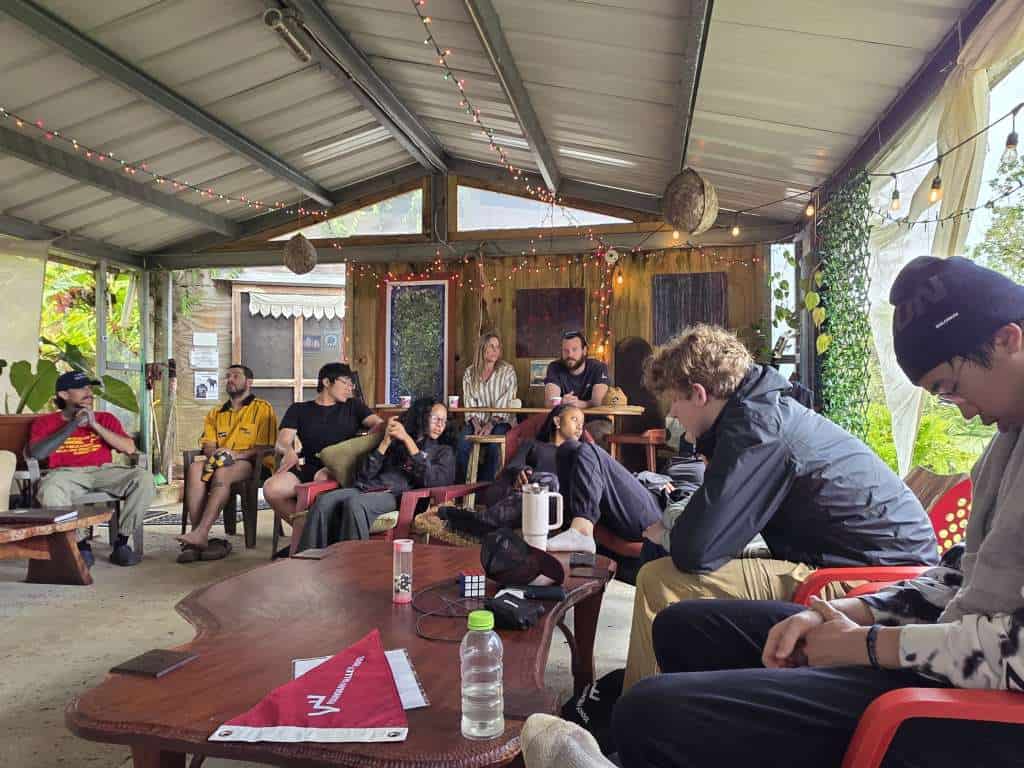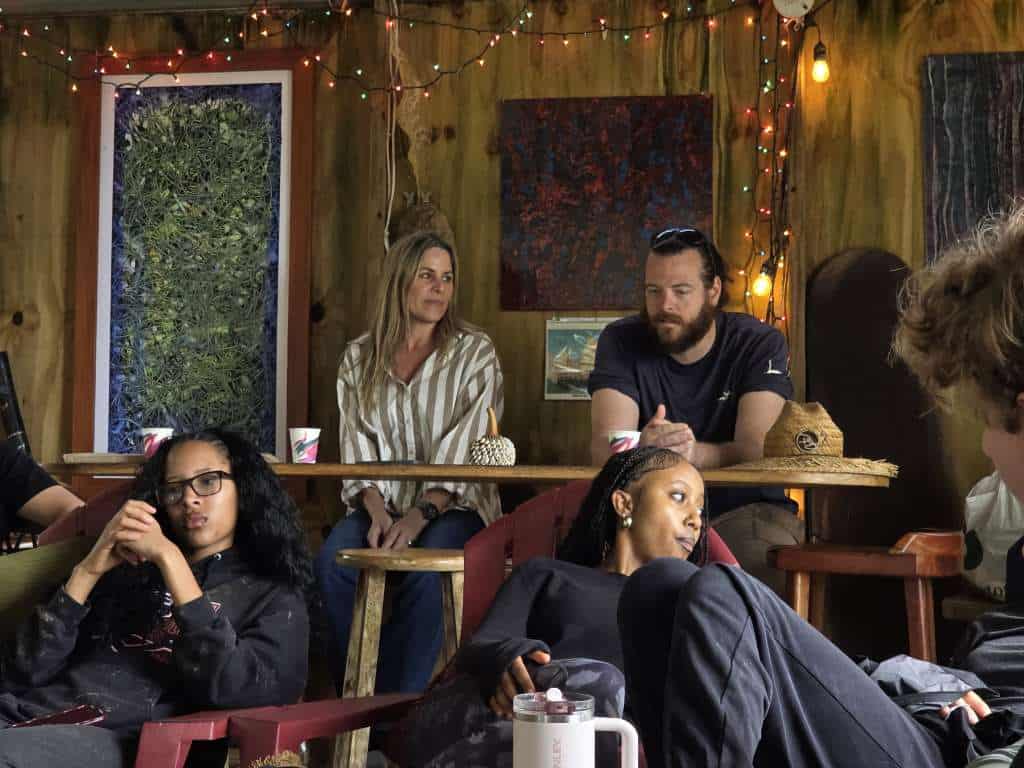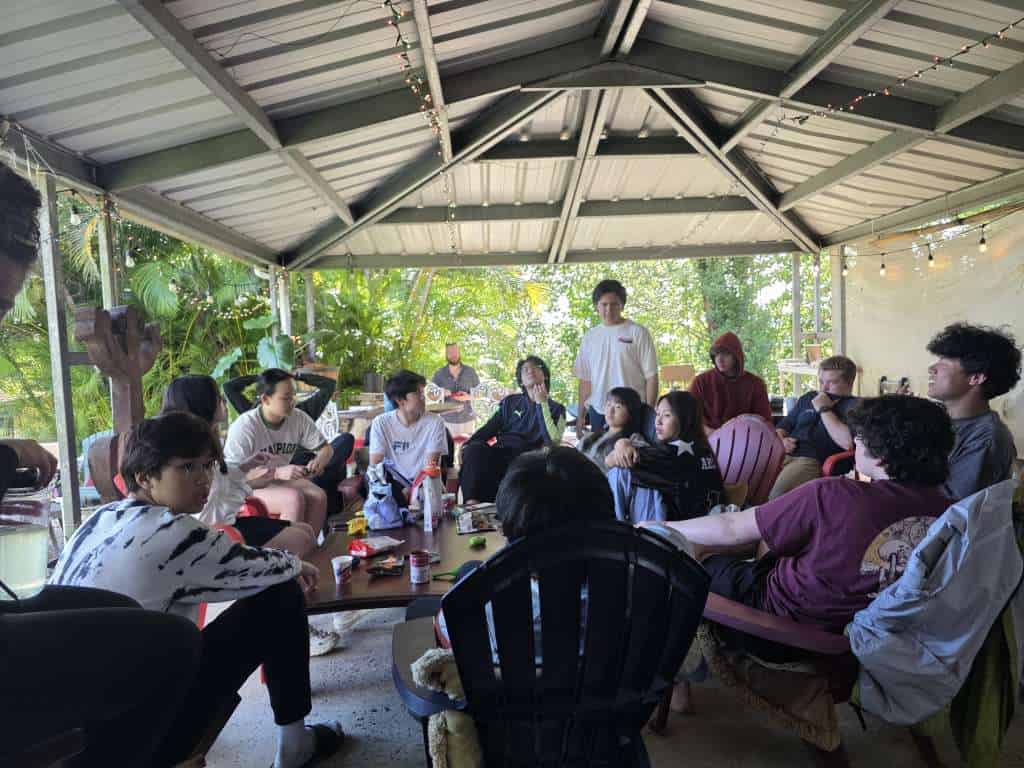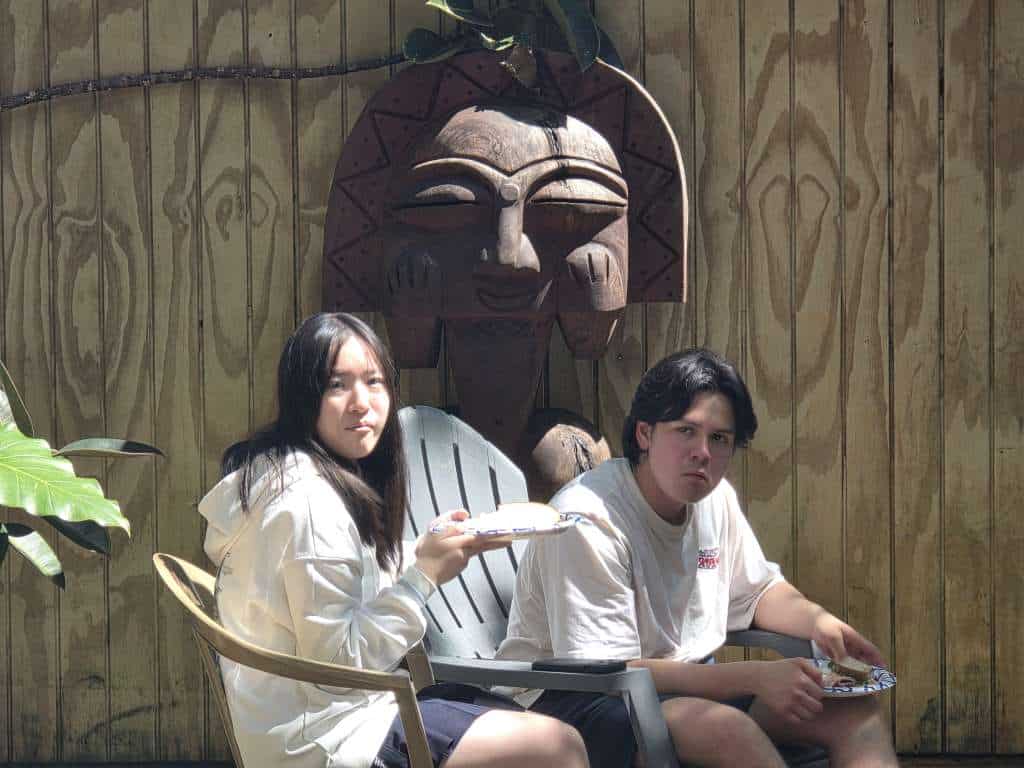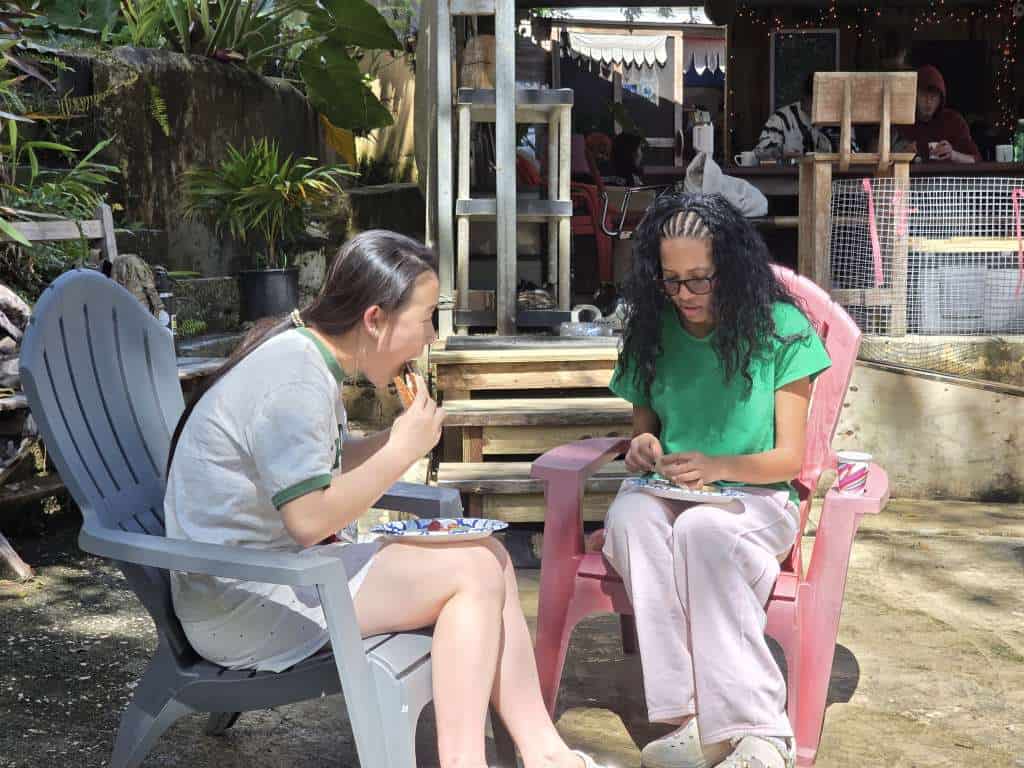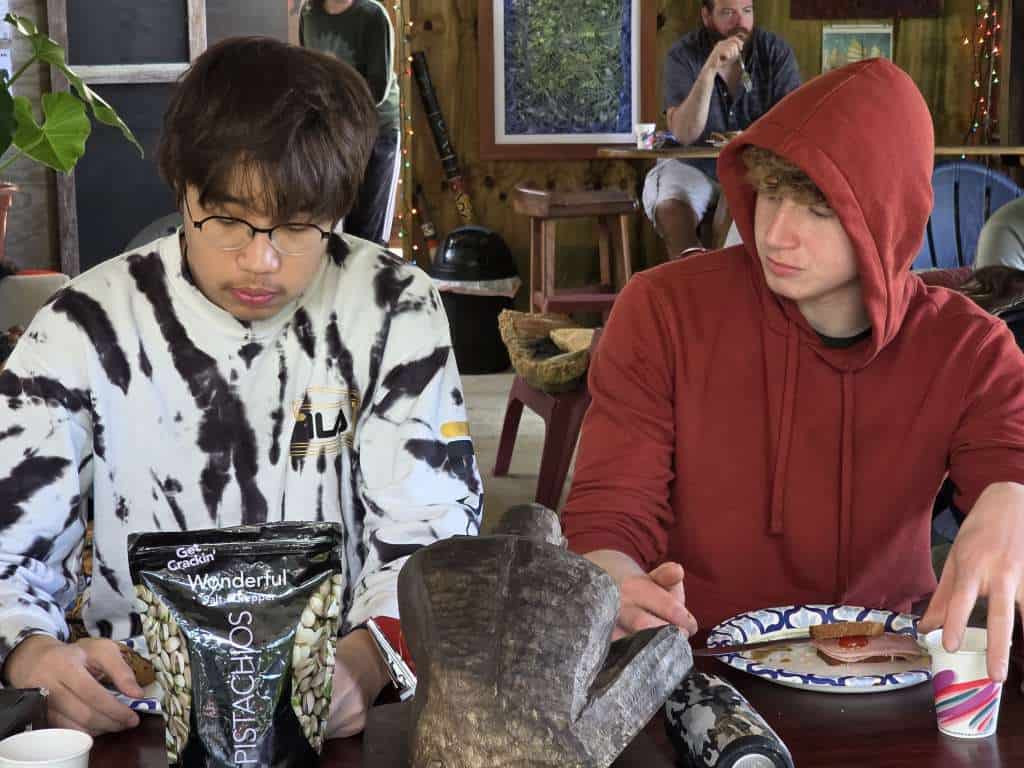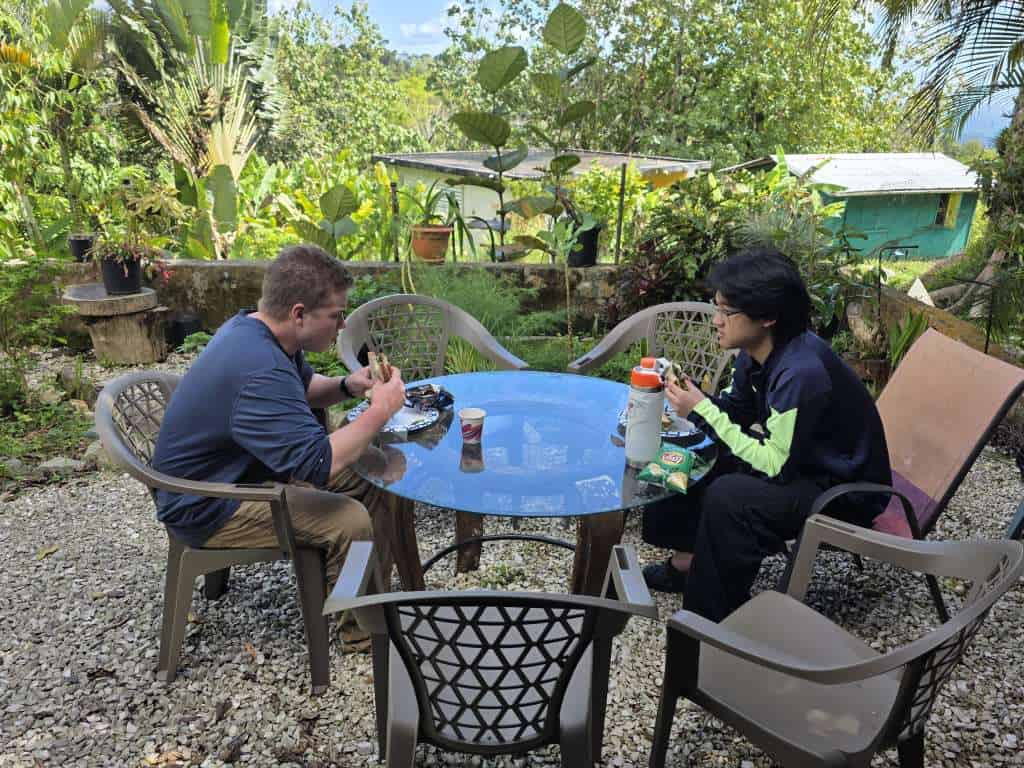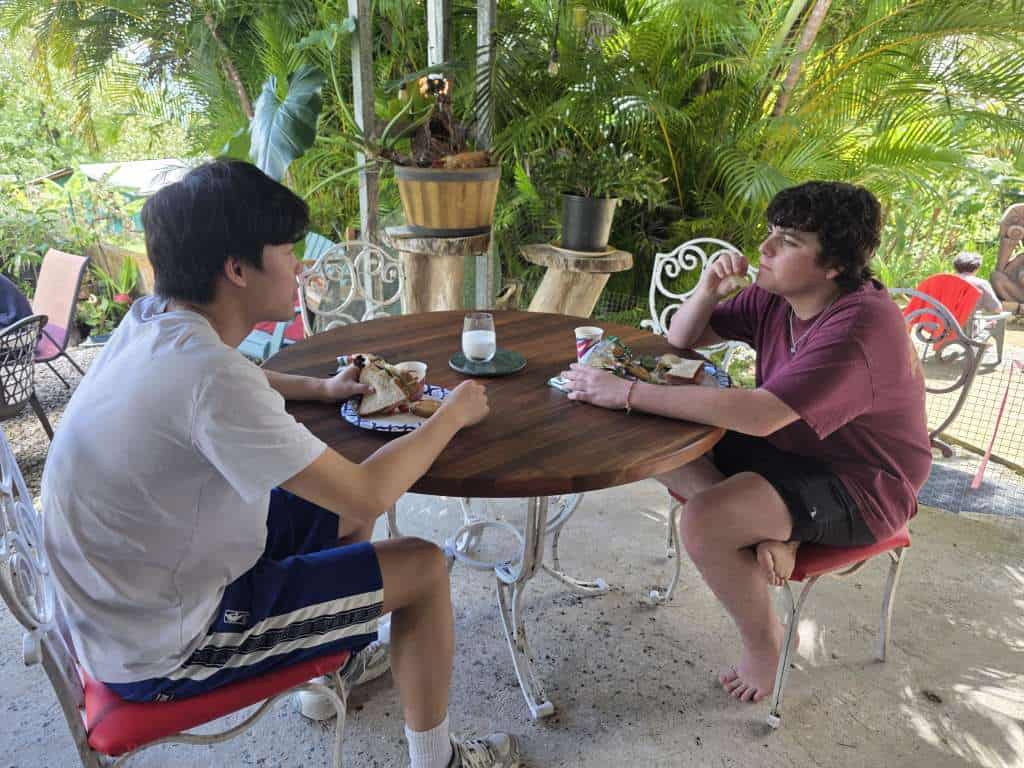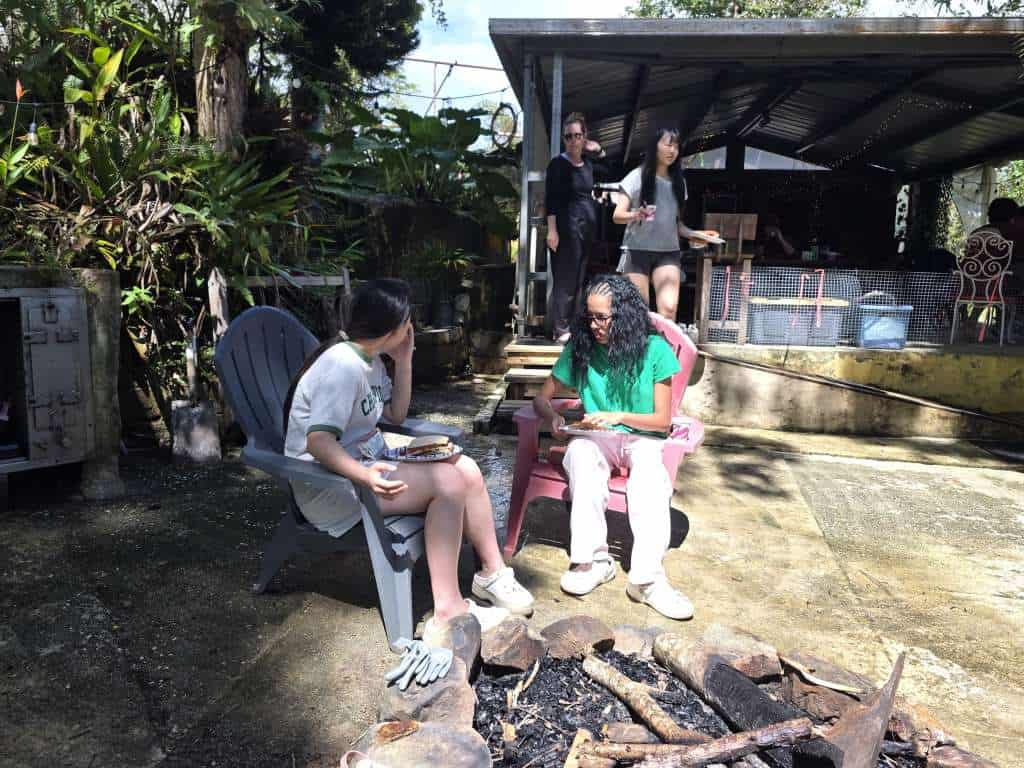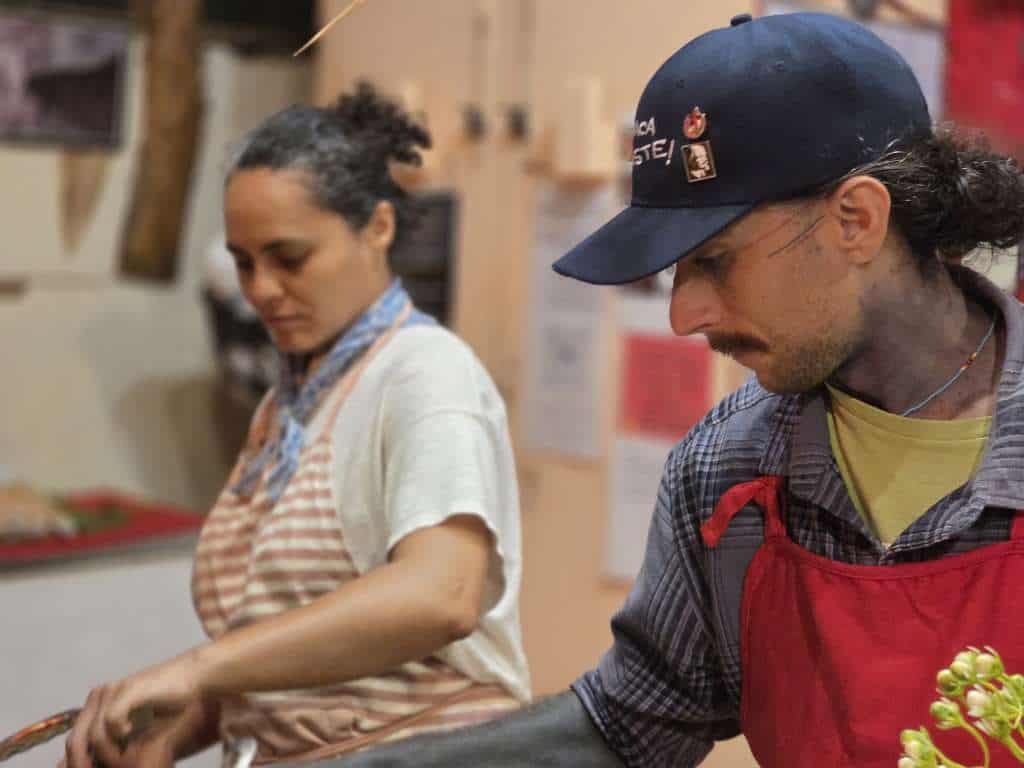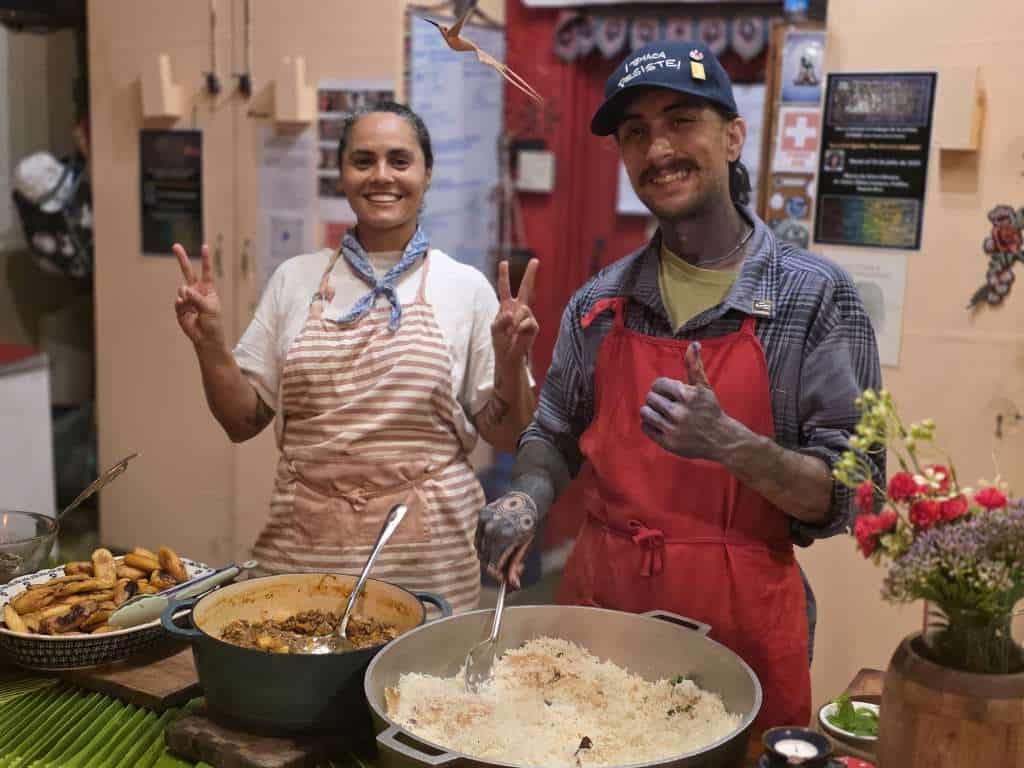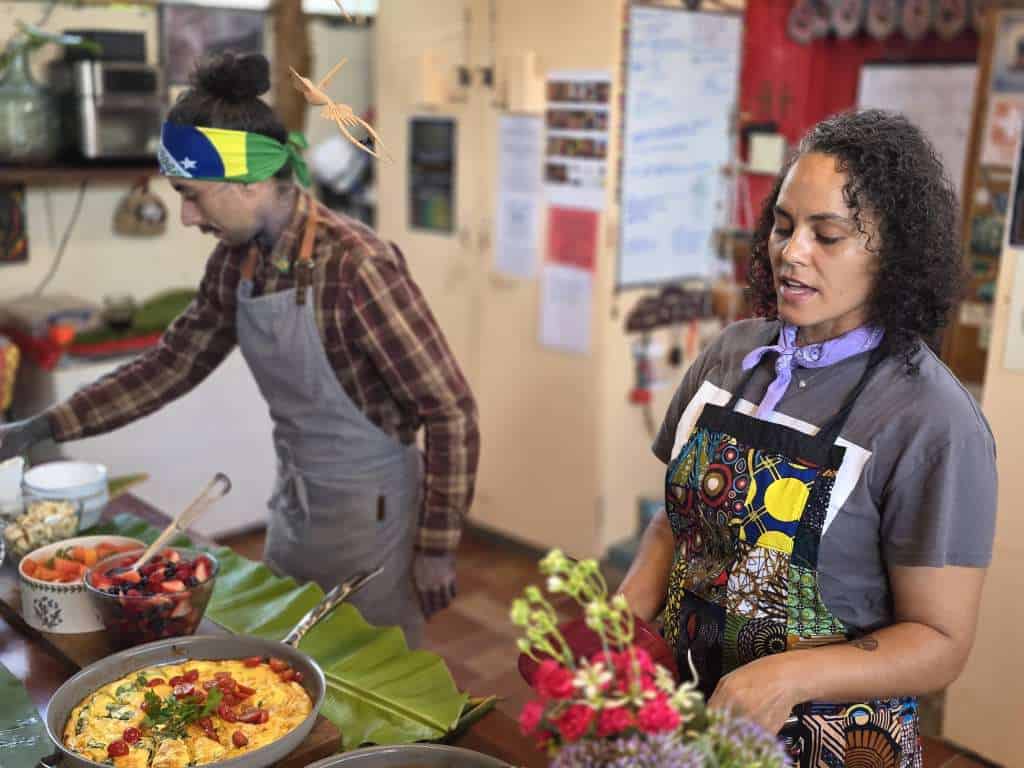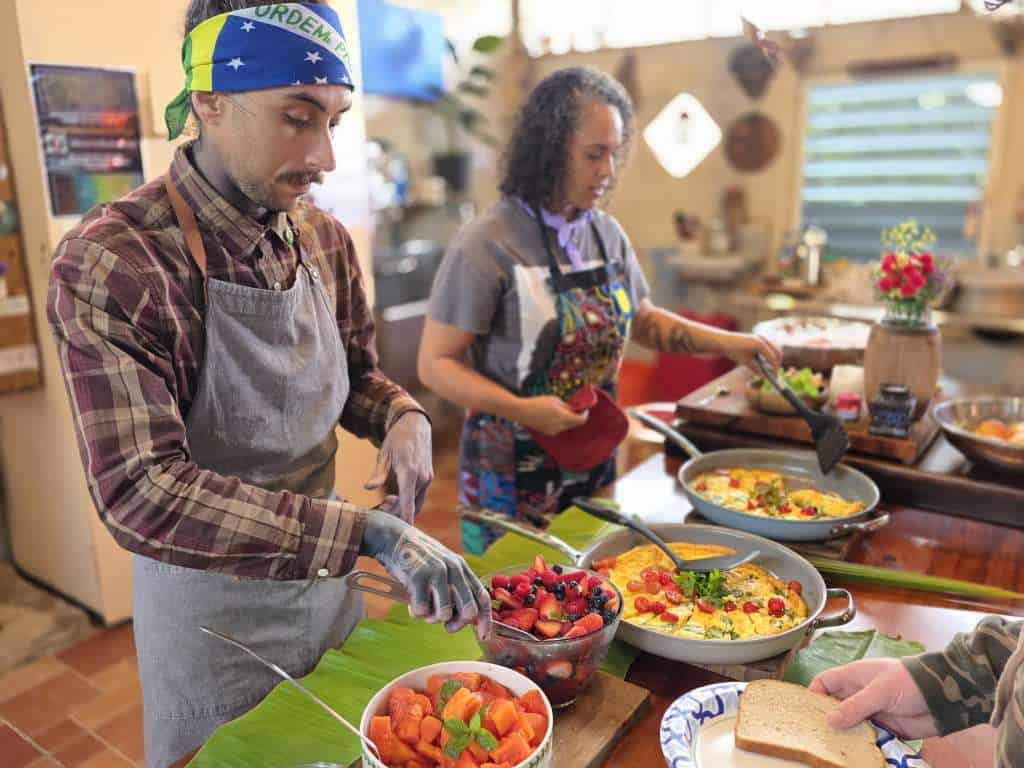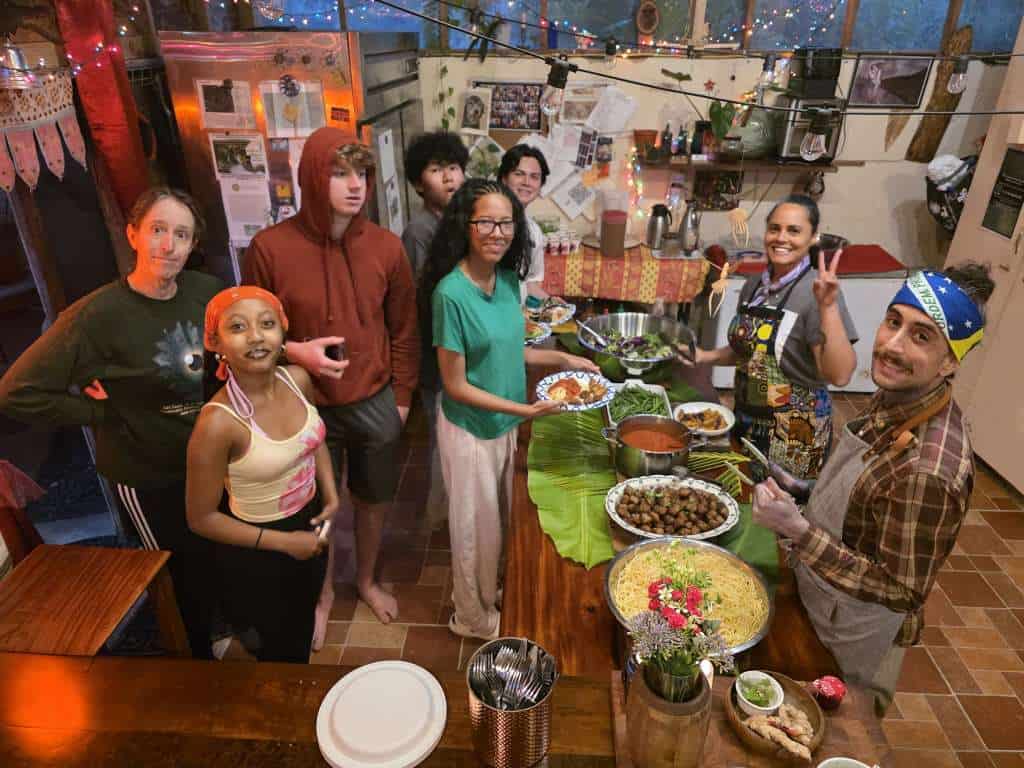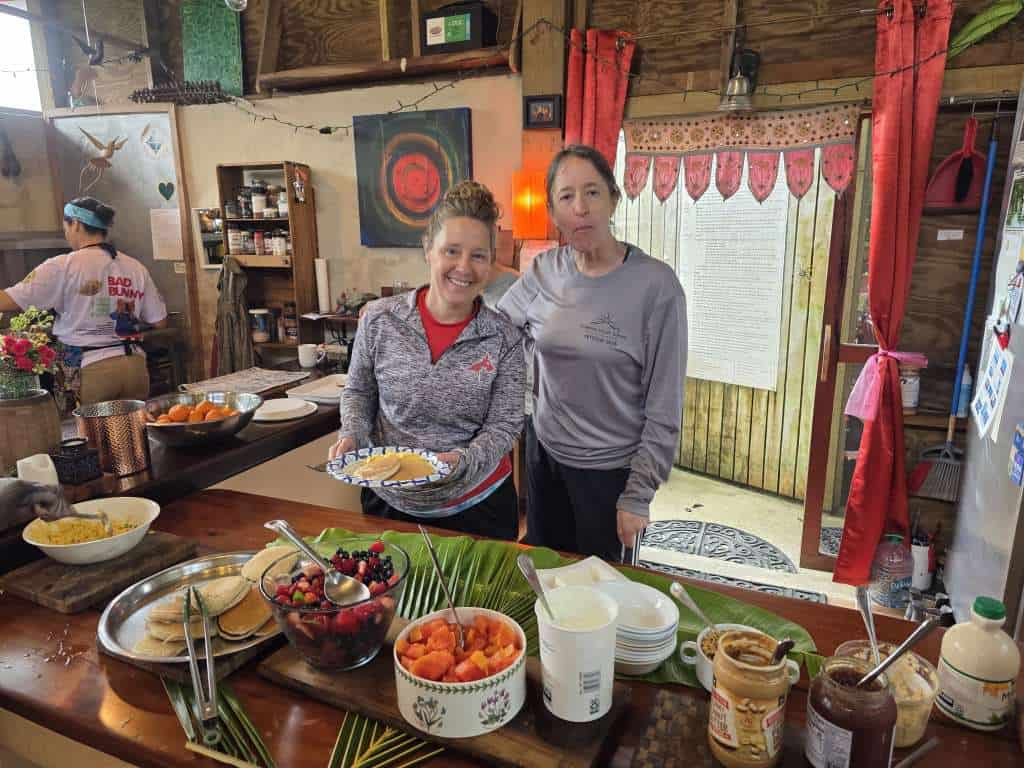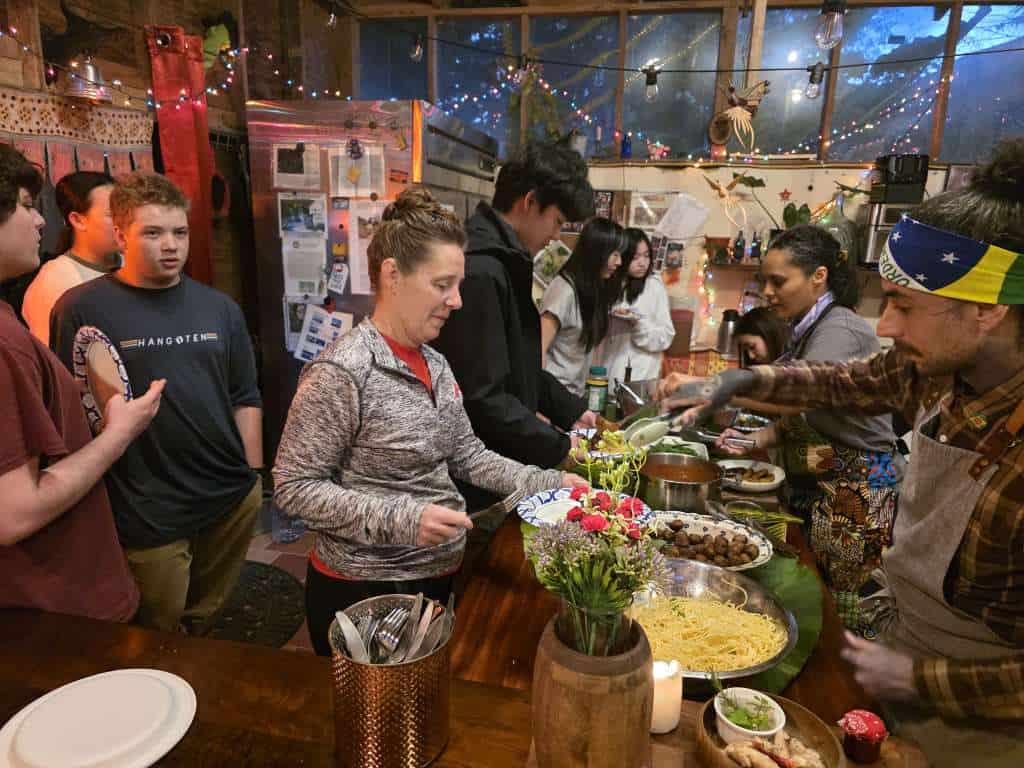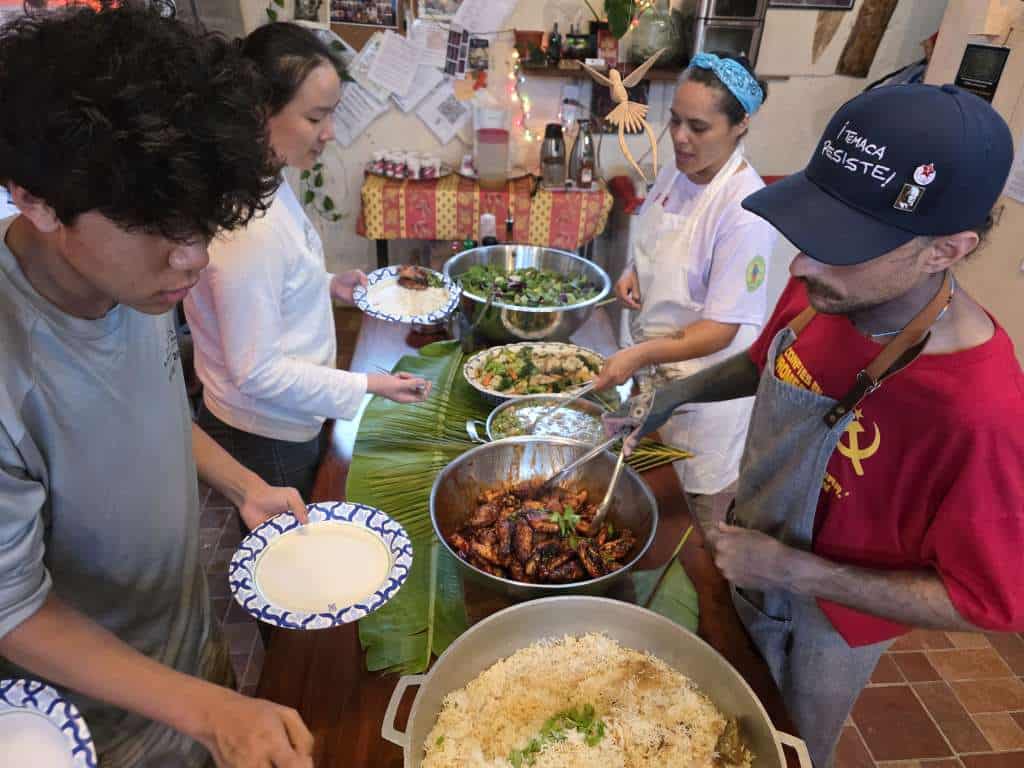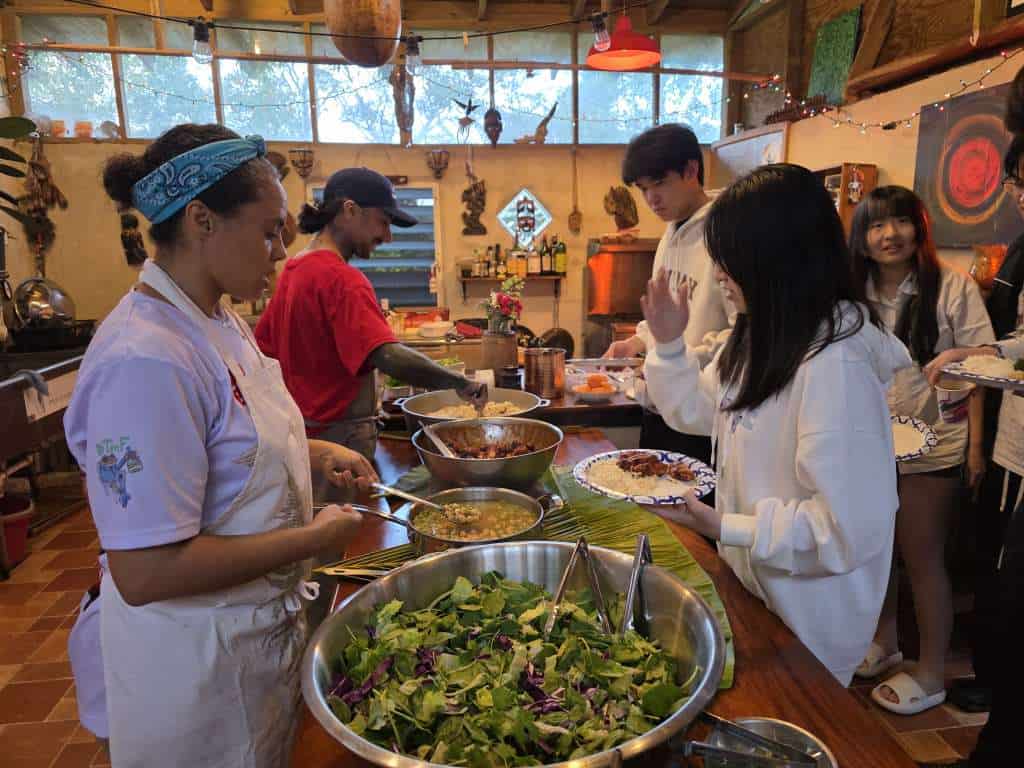
We had a large enthusiastic group with us from Charles H. Barrows STEM Academy, 21 students and 16 staff and parents for an afternoon of service and an overnight stay. They came ready to work, and that matters here. We split into three mixed teams of students and adults and moved straight onto the land.
Team Caoba
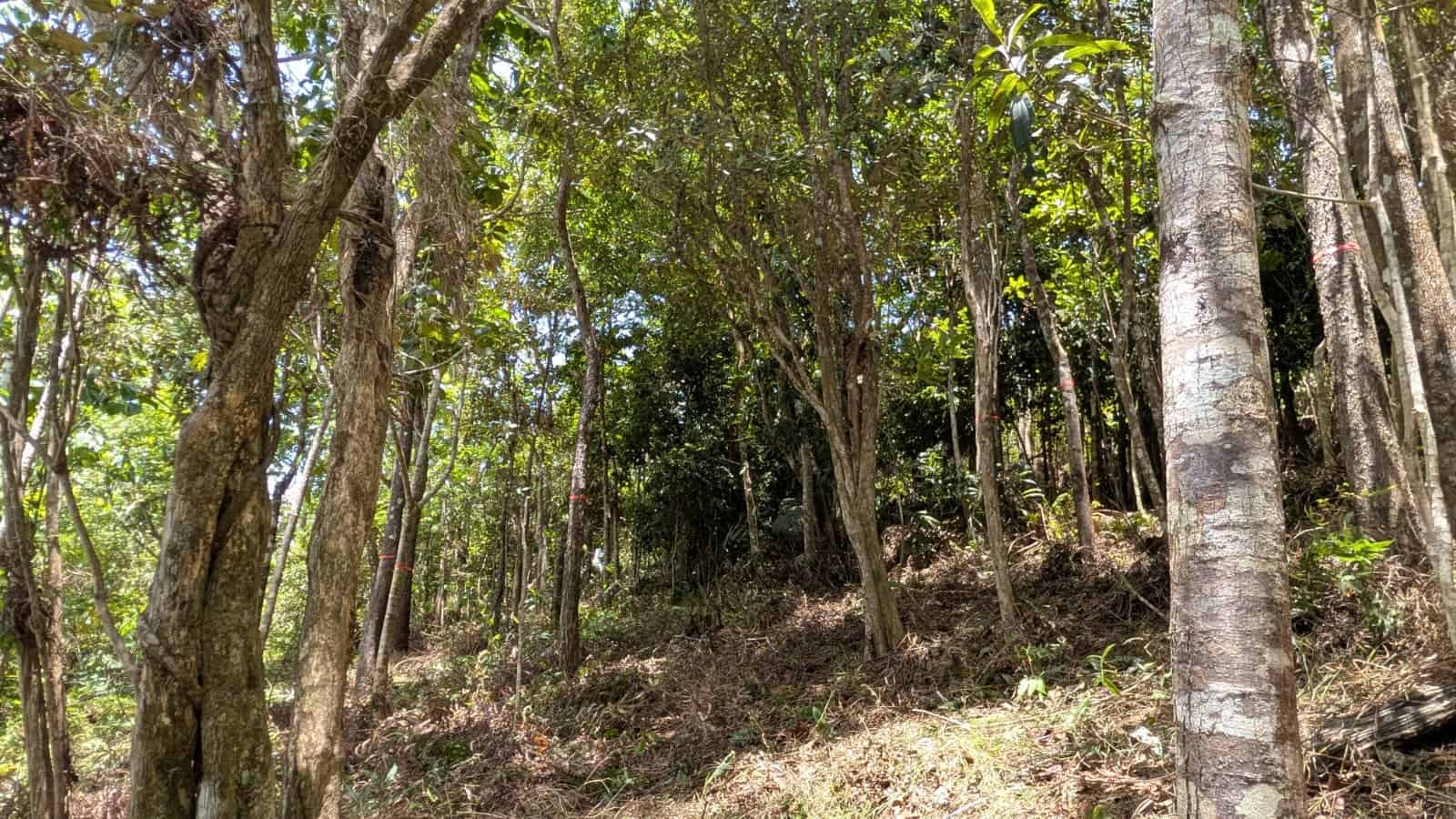
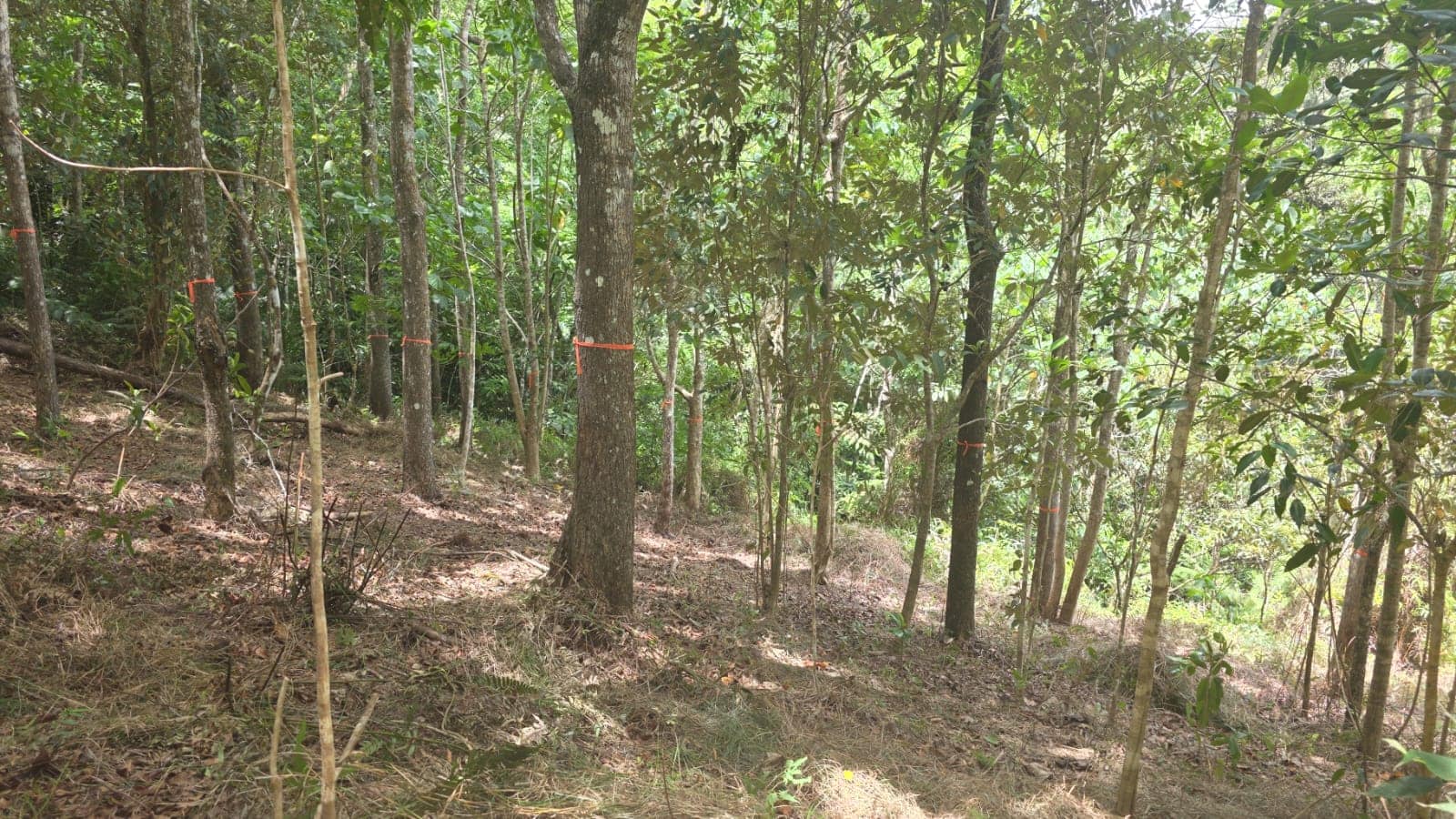
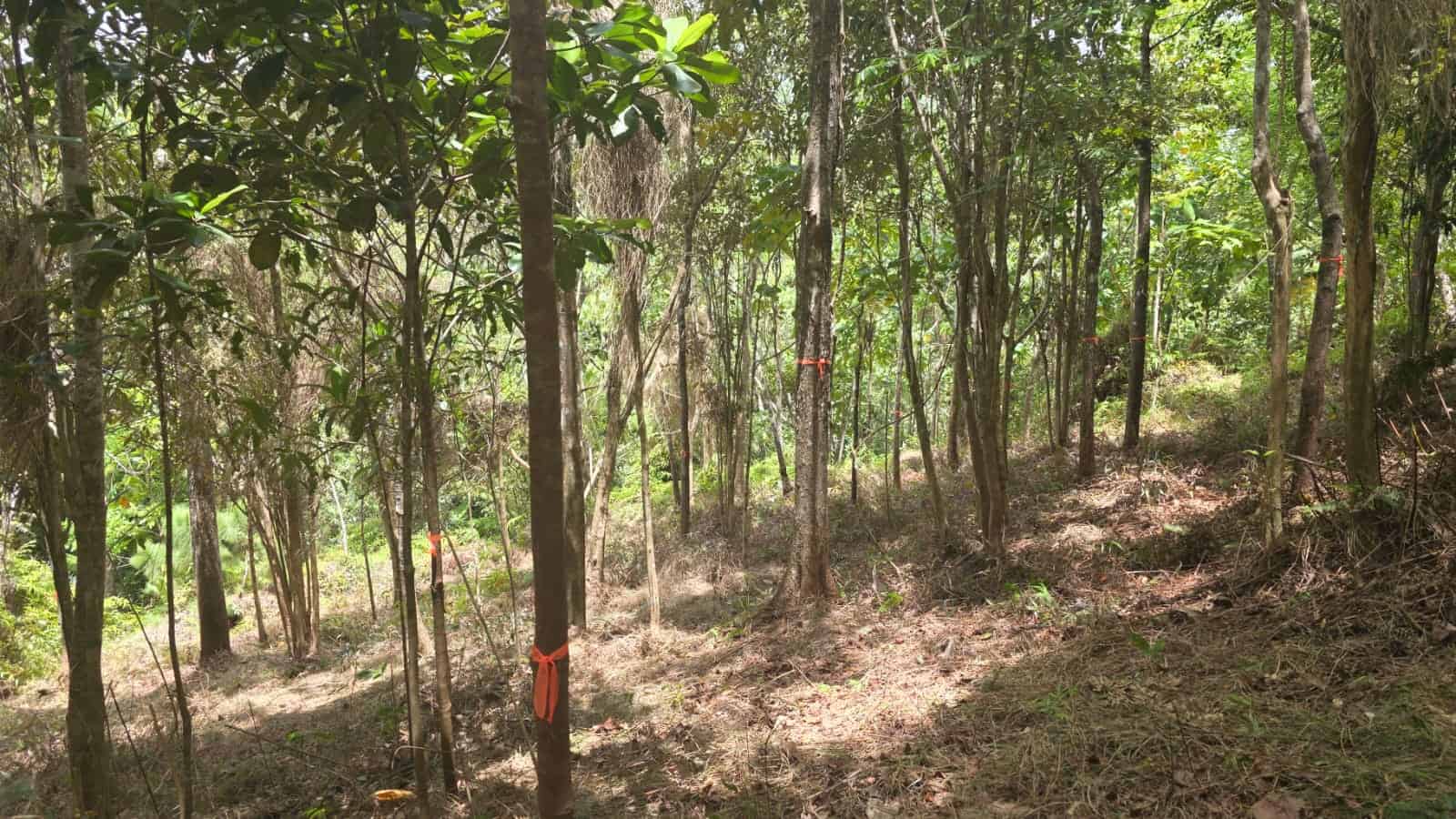
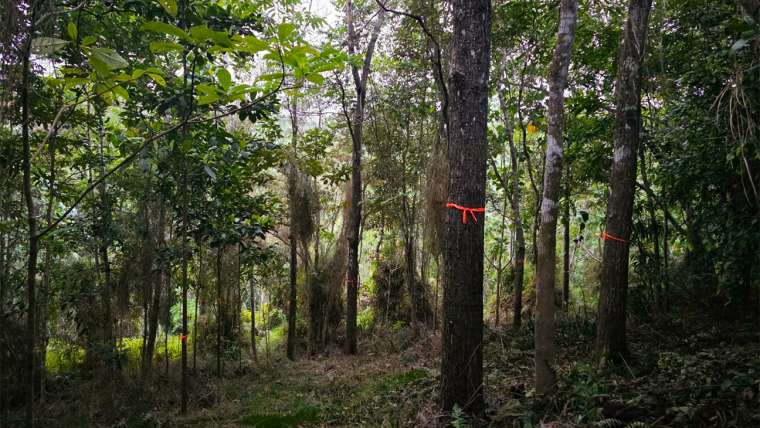
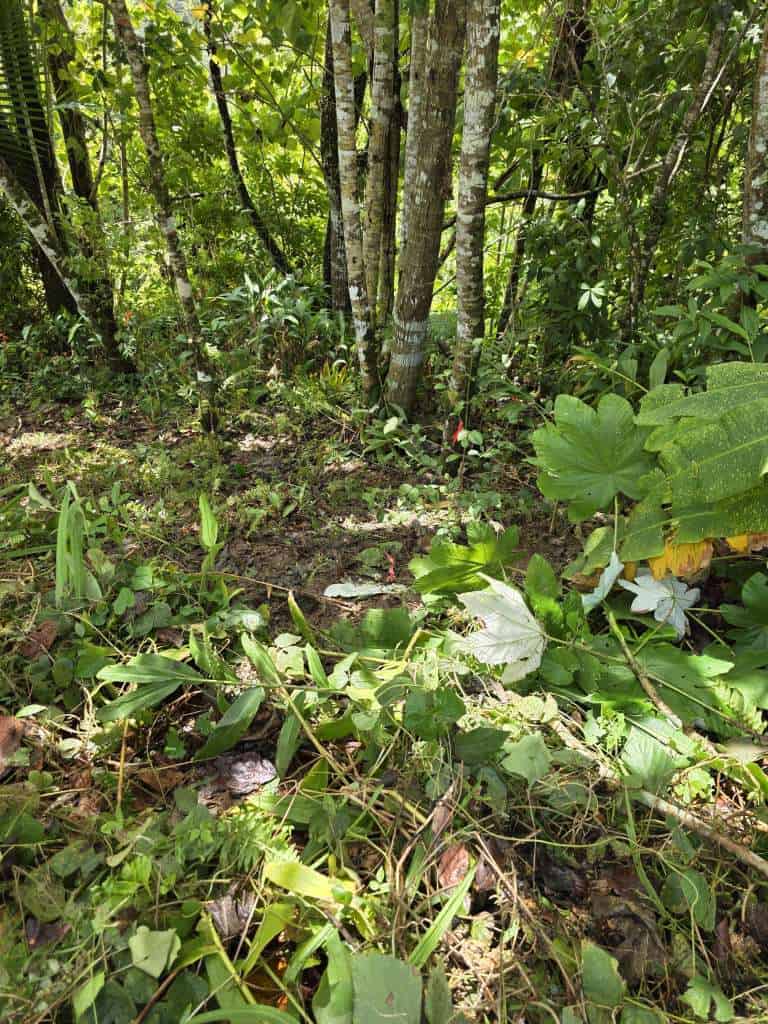
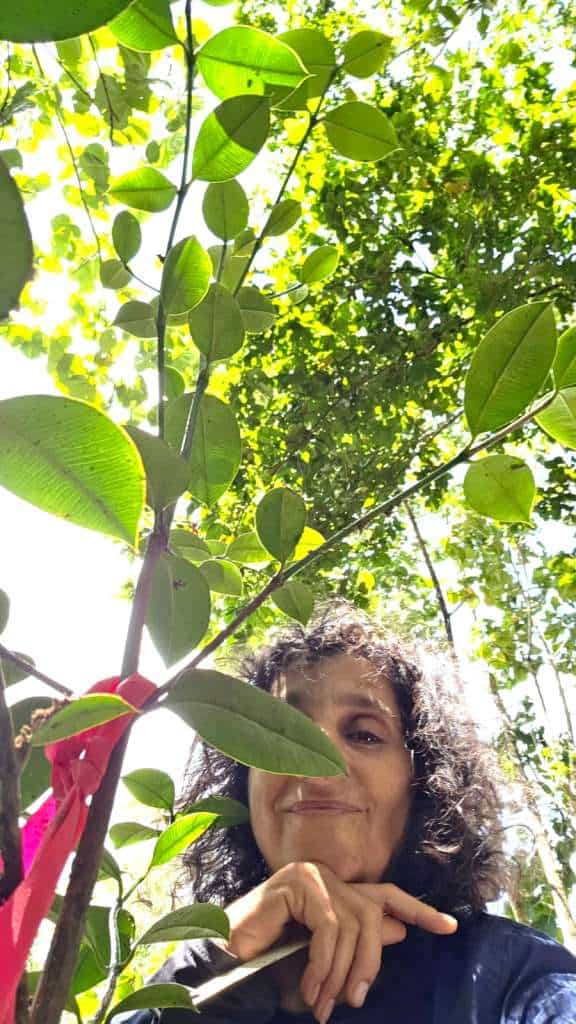
Team Caoba, led by 3t. On the slopes, teams prepared land for tree planting. This is careful work. Clearing just enough. Opening space without destabilizing the hillside. Understanding how water moves, how roots will hold, and where the next generation of trees can take hold.
Team Ausubo
Team Ausubo, led by Jon. On a steeper section, steps were built into the slope. Physical, repetitive, and precise. Each step placed to hold, to last, and to make the trail usable over time.
Team Tabonuco
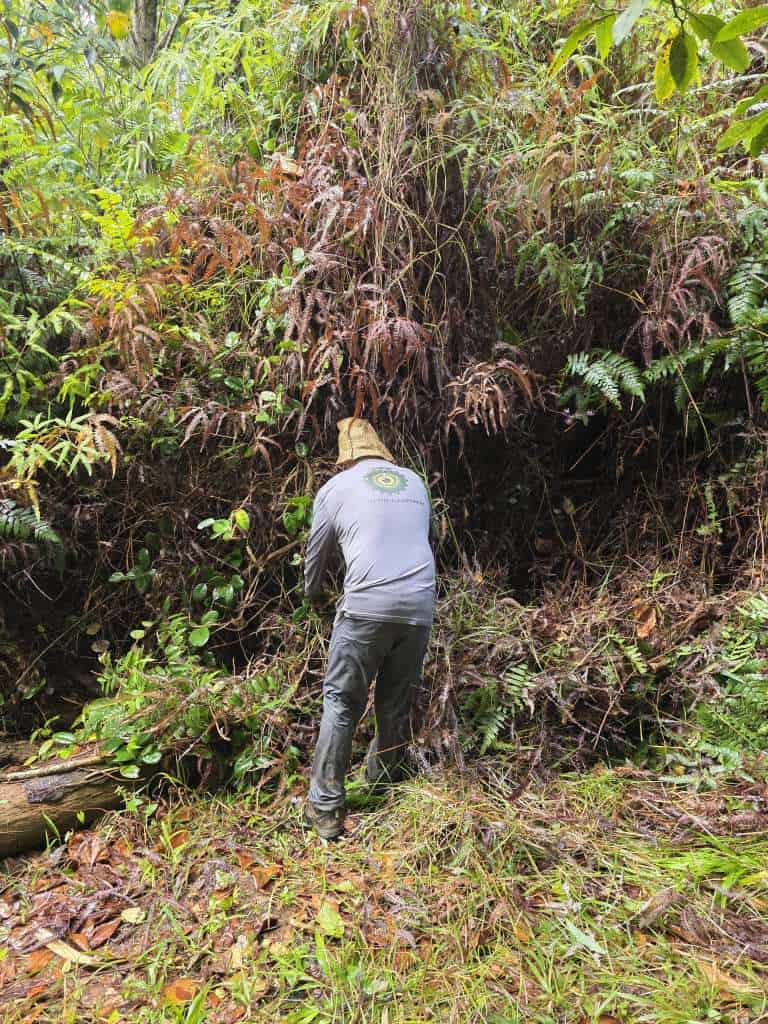
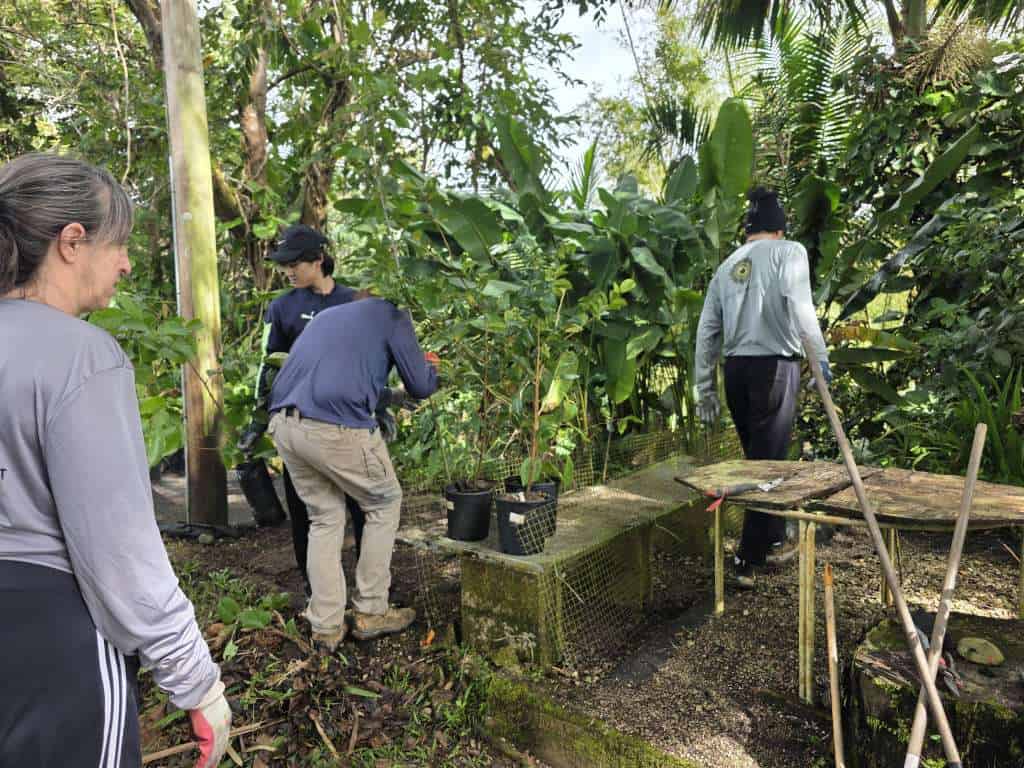
Team Tabonuco, led by Mercury. On the ethnobotanical trail, another group focused on drainage. In the rainforest, water defines everything. If it is not guided, it erodes. If it is managed, it supports the system. Students worked to open channels, move debris, and keep the trail intact.
Everyone had to pay attention. The slopes don’t allow shortcuts, you have to read the ground, watch your footing, and work together. Their STEM focus showed up in the right way, not as something separate but embedded in the work. Water flow, soil stability, structure, all of it right there in front of them. At the same time, their 3 R’s were clear. Respect for the place and each other, responsibility for the job in hand, and reflection in the moments when they stopped and looked at what they had actually done.
At Las Casas, this kind of work has lasting impact. The trail holds its shape and allows walkers to traverse the forest safely; the water moves as it should, and the land is set for the next phase of planting.
They were here a short time, but they left work behind that will keep doing its job.
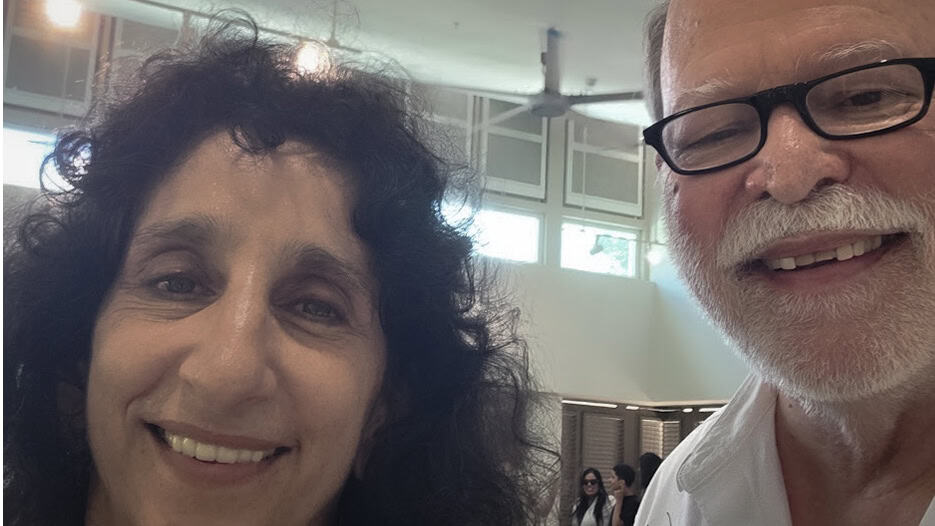
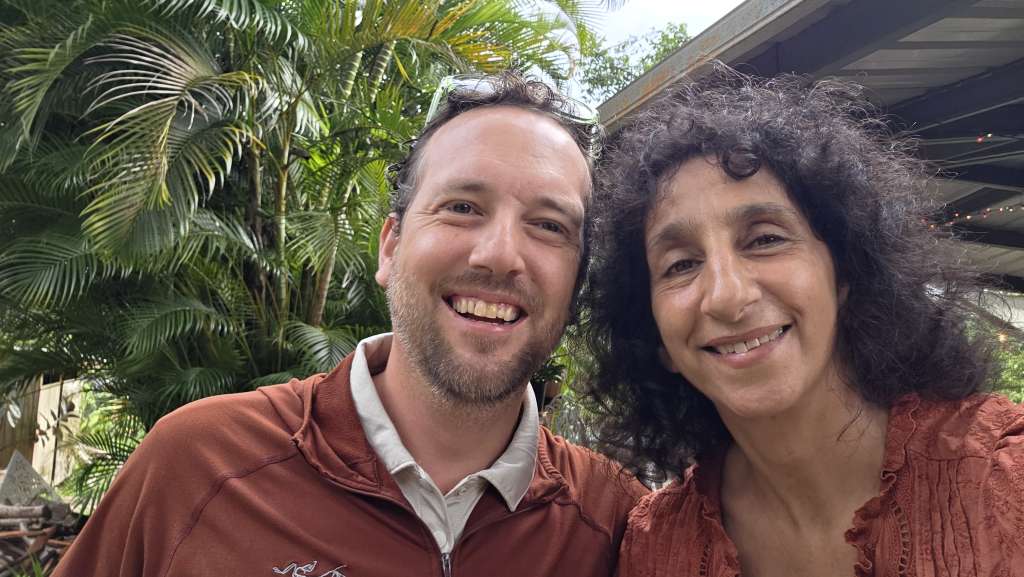
Bernardo Benetti and 3t Vakil
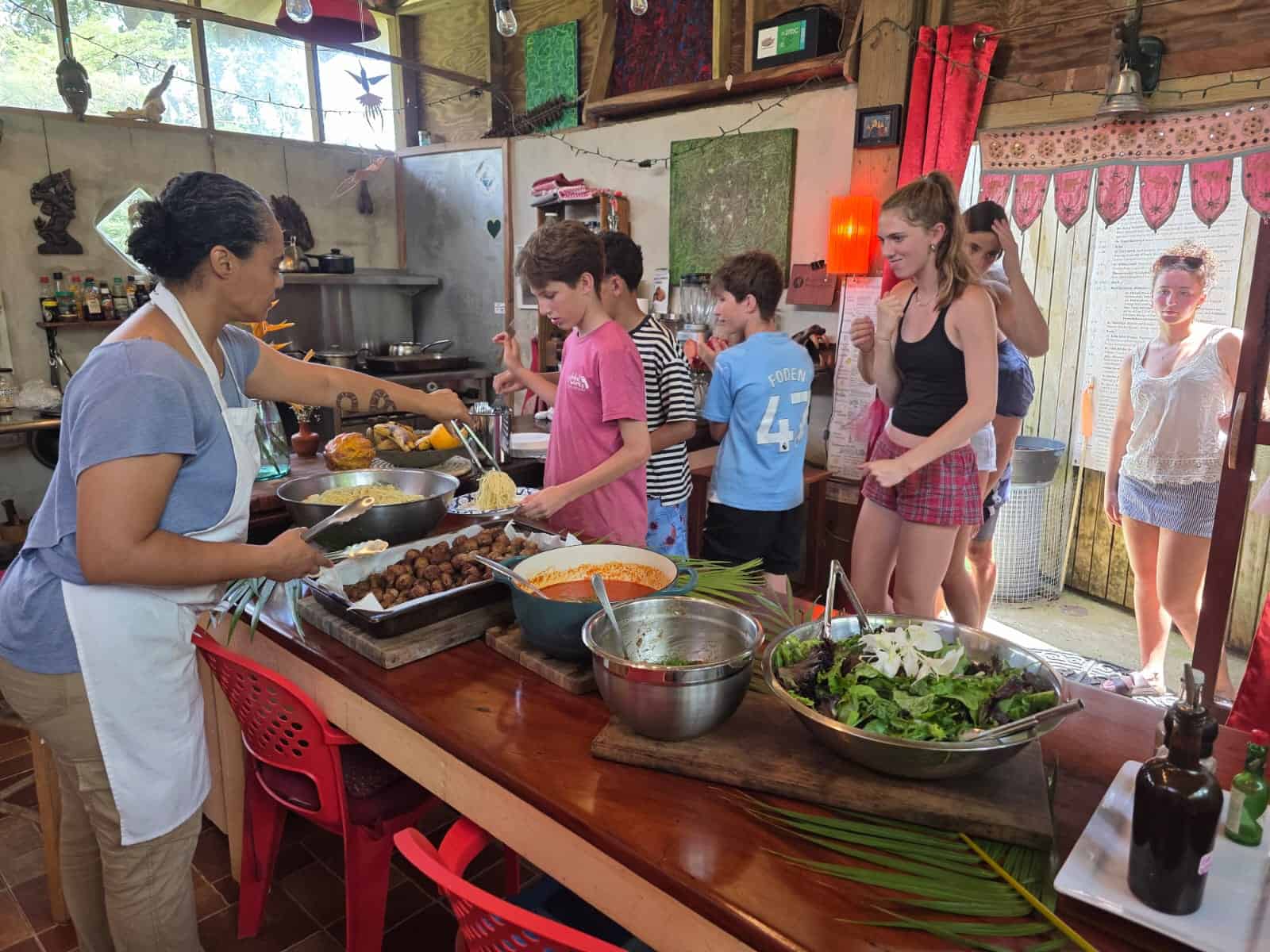
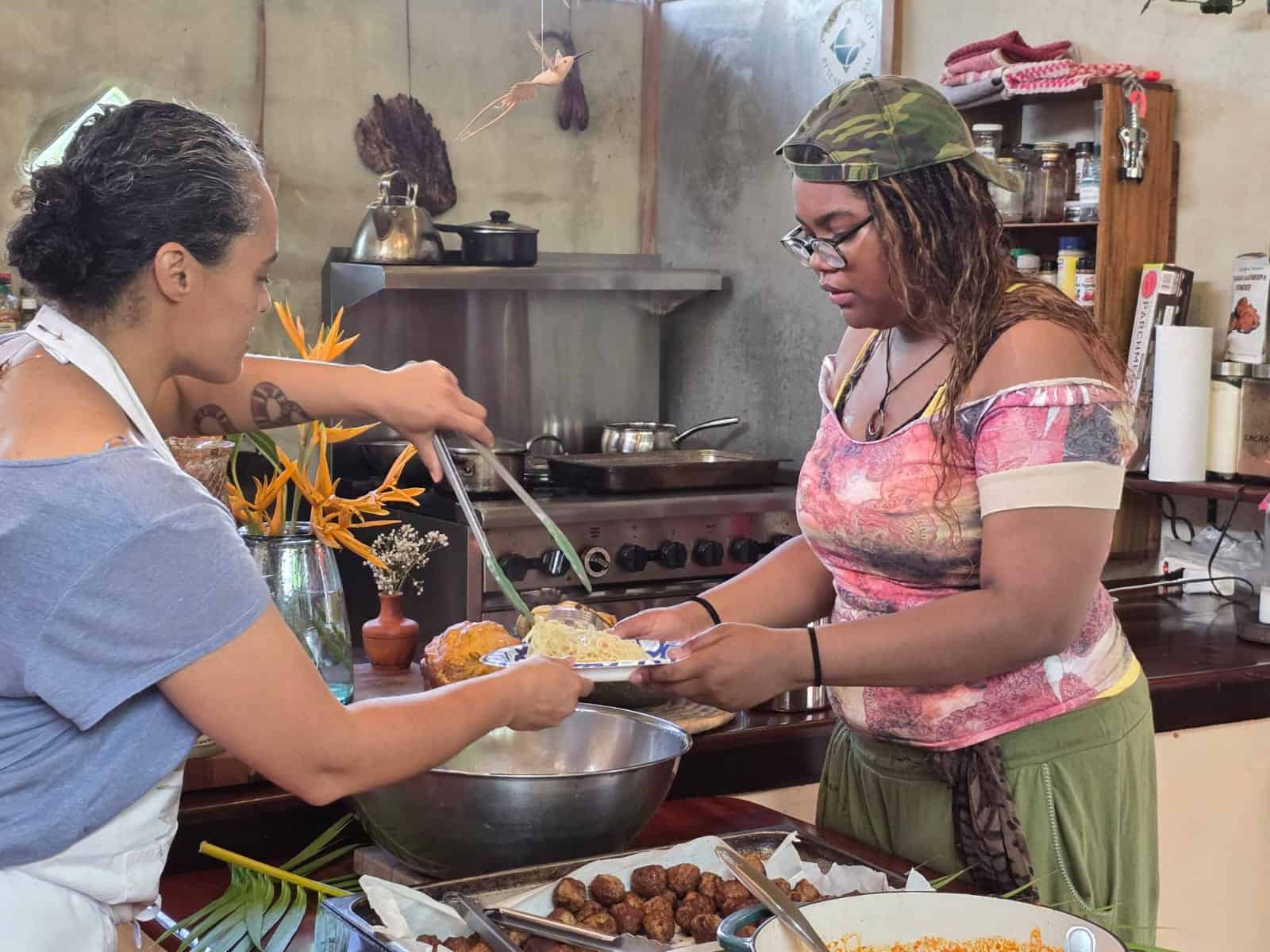
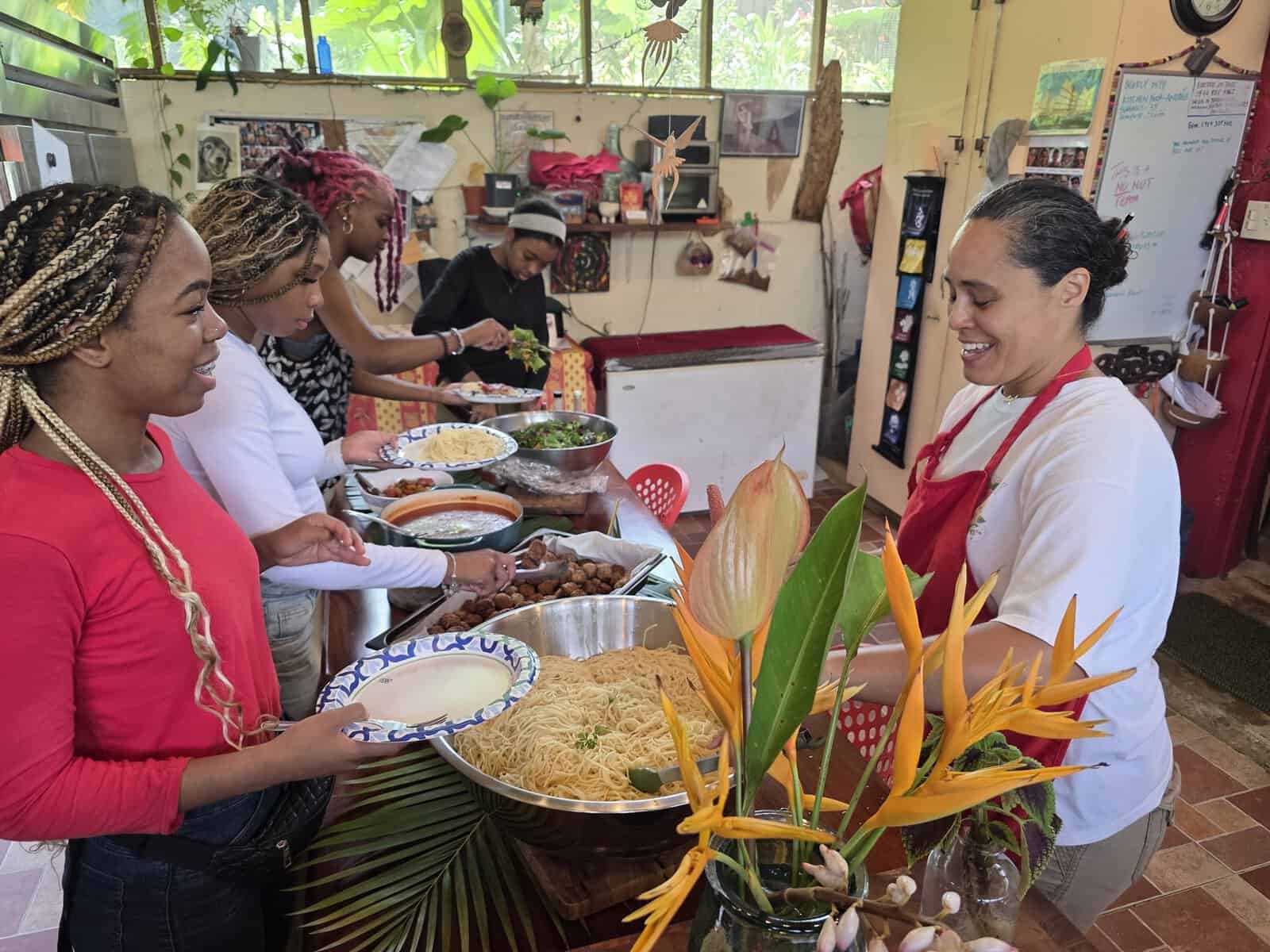
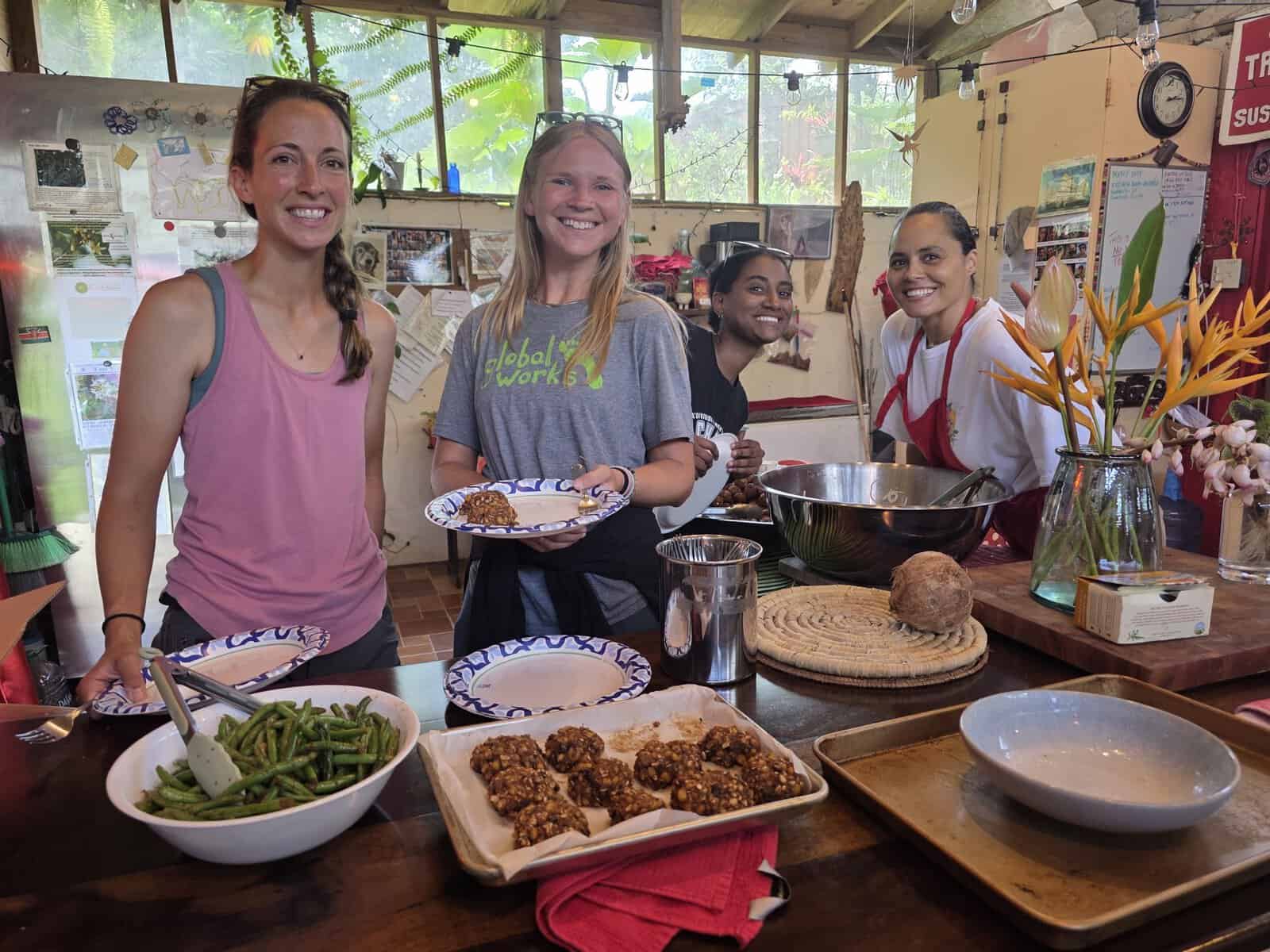
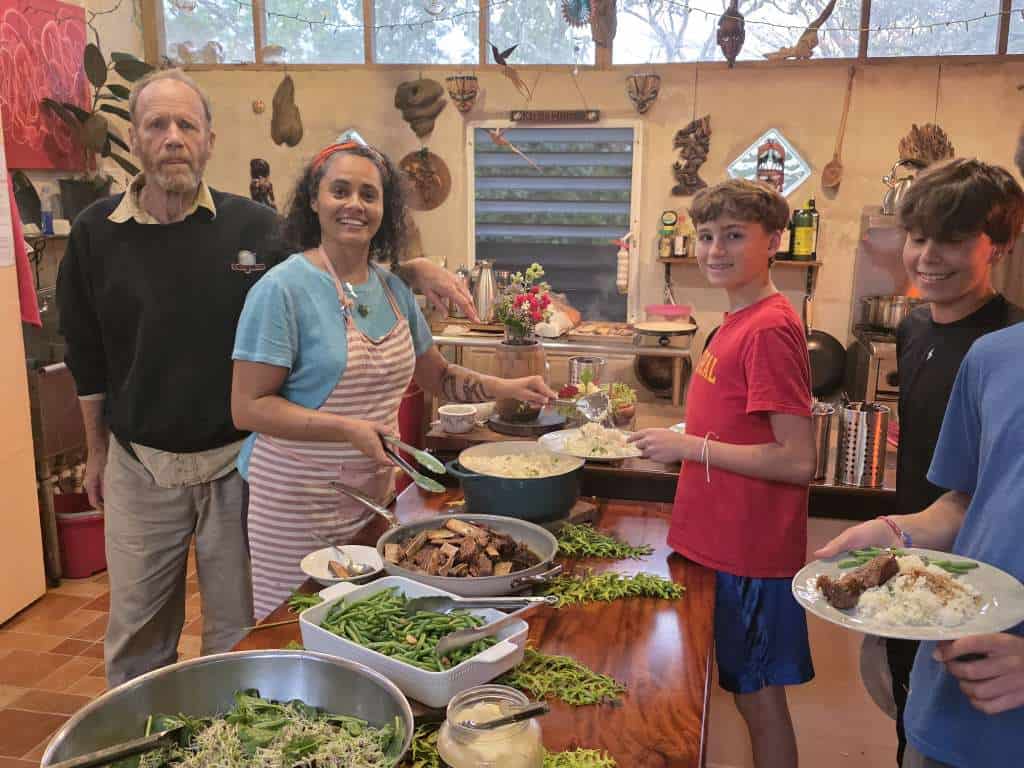
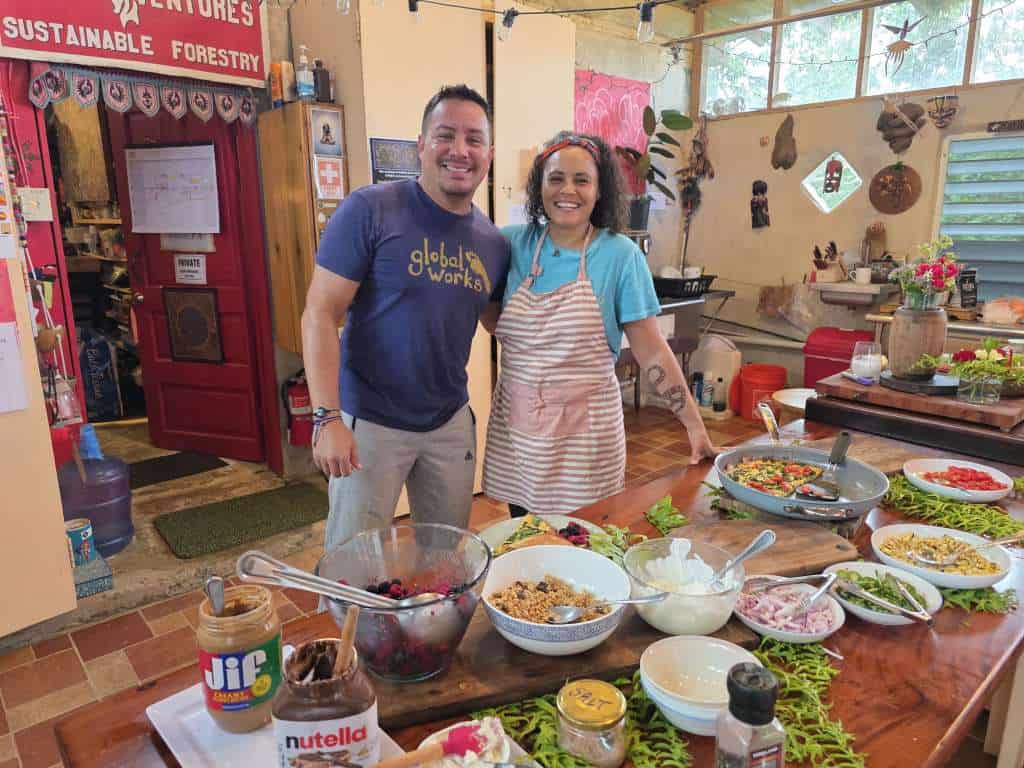
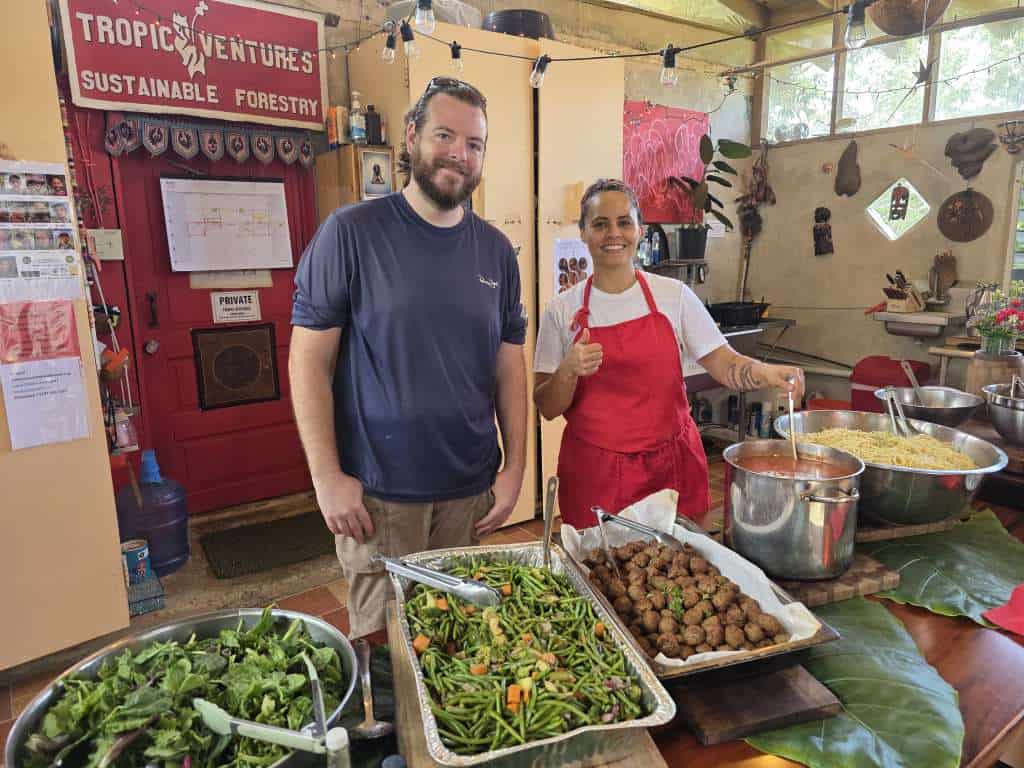
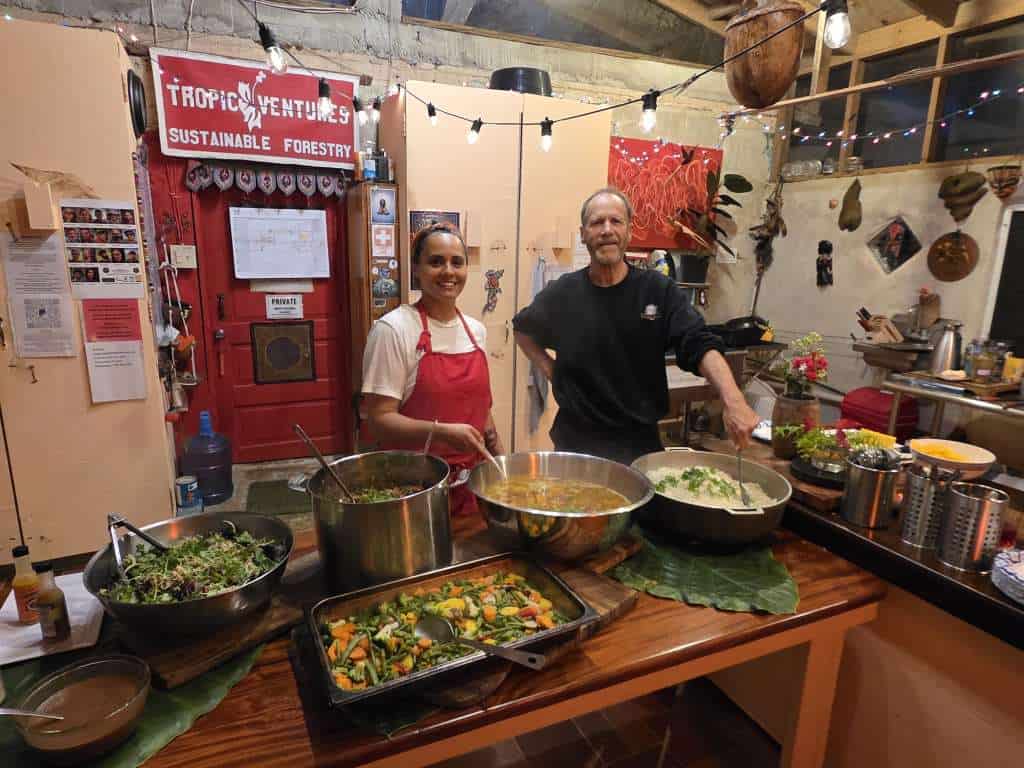
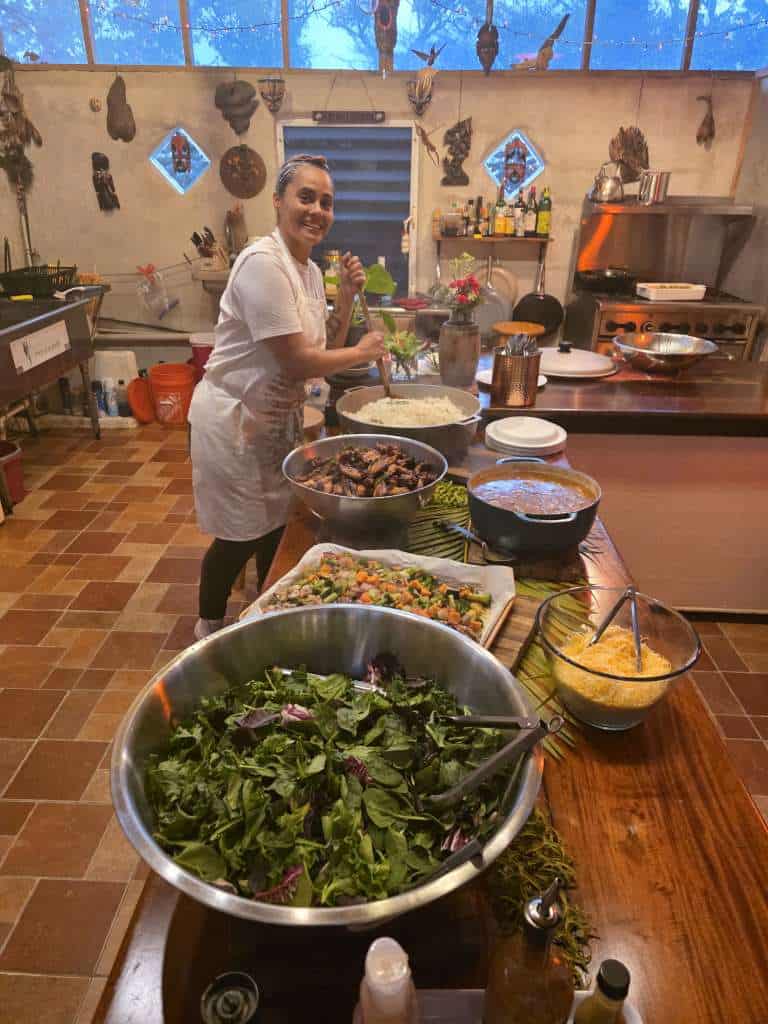
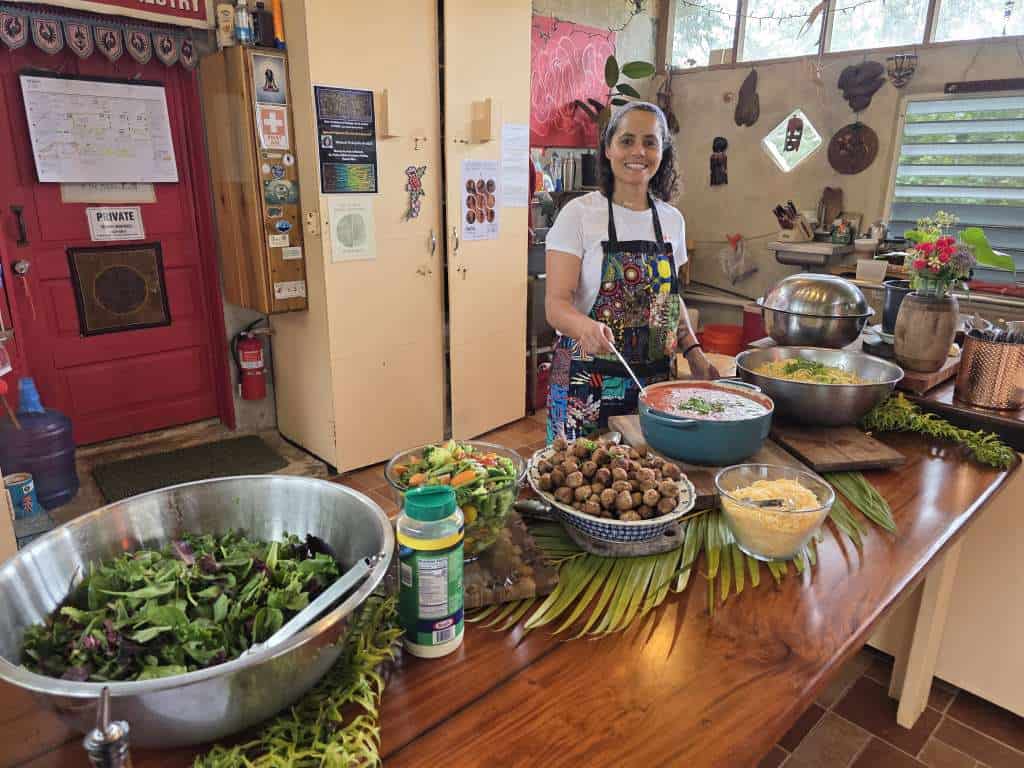
Thank you to Chef Monique Nieves for the food that kept everyone going through the day, and for taking a group out on a night walk. Thanks as well to Jon Warwick, and Mercury, artist in residence, for working alongside 3t on crew leadership, and to Gregg Dugan, writer in residence, for his work in the kitchen, and on the grounds, and thoughtful input throughout.
Appreciation to Nicole, Kim, and Nick for their steady leadership with the group, and to School Tours of America, together with Bernardo Benetti, for continuing to bring groups that show up ready to engage and do the work.
Branson School: A Day of Work in the Forest, 7th April, 2026
For a single day, 15 students (15-17 years), and staff from The Branson School, Marin County, CA, stepped into the working landscape of Las Casas de la Selva. It was a day of real service work.
They joined us on the forest road, where maintenance is constant and essential. Under the guidance of Jon Warwick, who led the crew with clarity and pace, the students got straight into it. Branches were cut back, ferns were cleared from the road edges, and bamboo was pruned where it had begun to close in. The goal was simple: keep the road open, safe, and functional in a place where growth never stops.
The work demanded attention and effort. Tools in hand, the group moved steadily along the road, learning quickly that in the rainforest, maintenance is not a one-time task. It is ongoing, physical, and necessary for everything else we do here to function.
What stood out was their willingness to engage. No hesitation. No standing back. They worked as a team, taking direction and finding rhythm in the process. This is where learning shifts. Not abstract, but grounded in action.
Back at base, 3t prepared a delicious lunch. Simple, direct, and well earned. Food really tastes different after a morning of physical work, it brings people together in a different way. Conversations and questions over lunch delved into the history of the project. Thanks to group leader, Adelina, and school staff, Sabrina and Matt. Writer, Gregg Dugan and visual artist Mercury, who are both on extended art residencies at Las Casas de la Selva, provided behind-the-scenes help with all and everything.
The visit reflects something important about Branson’s stated values: courage, kindness, honor, and purpose. These are not just ideas to talk about. They show up in how students step into unfamiliar environments, take on physical challenges, and contribute to something beyond themselves. At Las Casas, this kind of exchange matters. Students arrive for a short time, but the work they do stays. A cleared road section, a maintained path, a space that continues to function because of their effort.
About the Program
This visit was made possible through Shoulder-to-Shoulder, a program founded in 2007 to respond to a simple but urgent question: What can we do? Under the direction of Bill Cotter (director of programming), the organization connects students with real-world projects across multiple continents. What began with one school and a small group of students has grown into a global network spanning 12 sites, built on partnerships between schools, nonprofits, businesses, and philanthropists. Their focus is clear: developing ethical leaders who can navigate a complex world while balancing growth, social responsibility, and environmental stewardship. Programs like this one at Las Casas are where that intention meets action. One day. Real impact.
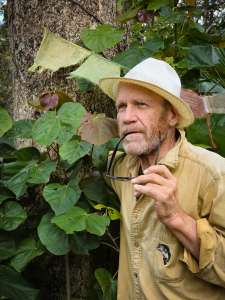
Gregg Dugan -Writer in Residence, Las Casas de la Selva, Patillas, Puerto Rico, March 2026
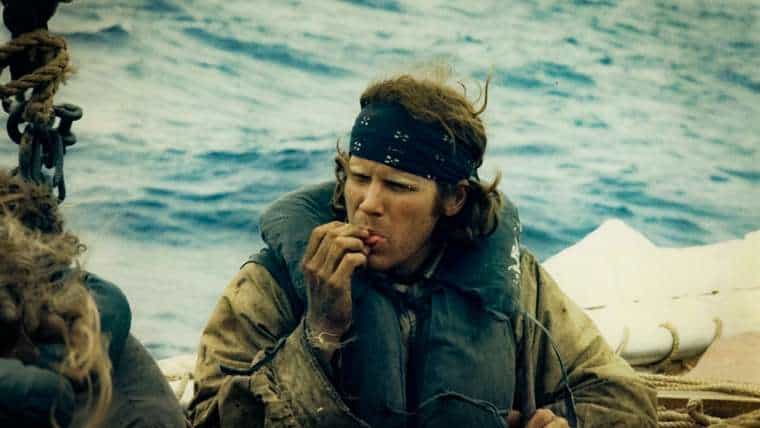
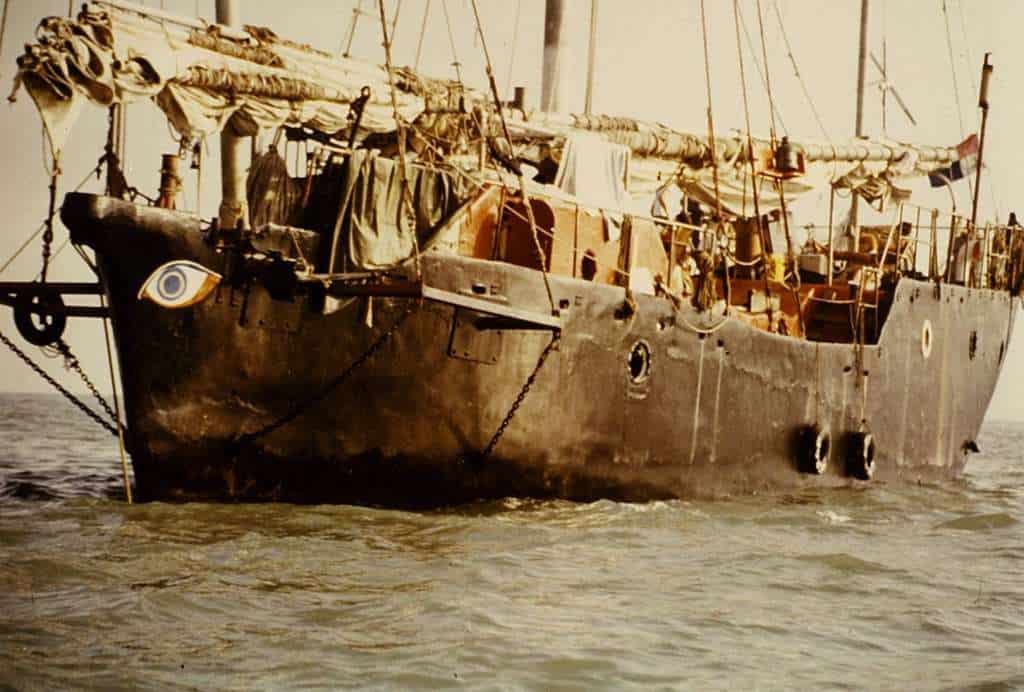
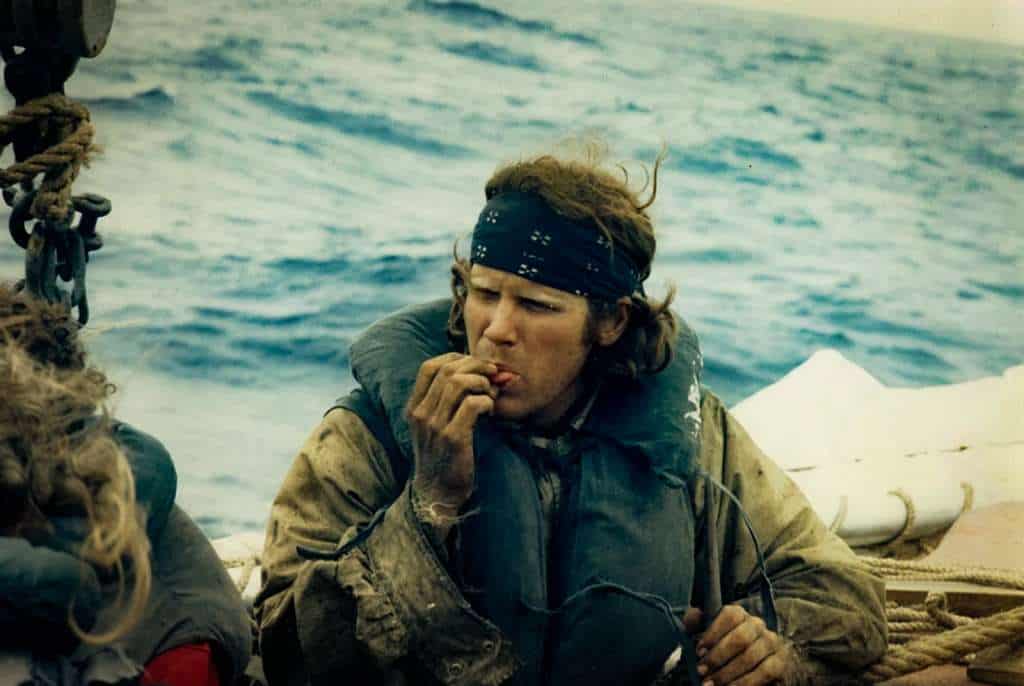
Gregg Dugan is a writer, performer, and lifelong explorer whose work moves across oceans, stages, ecosystems, and stories. In 1974, he co-built the research vessel Heraclitus, a 140-ton Chinese sailing junk in Oakland, California, and went on to serve as captain for seven years, logging over 50,000 miles of deep-sea and coastal voyaging and research across the Pacific, Caribbean, Mediterranean, Atlantic, and Indian Oceans. Along the way, the crew called in the ports of more than forty nations, often performing as the theater ensemble Studio III.
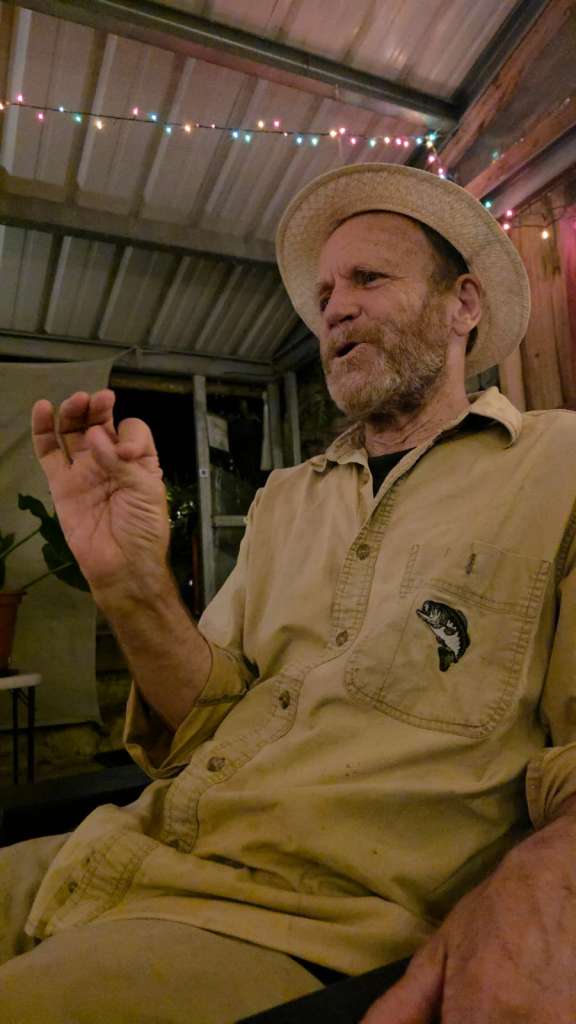
Gregg Dugan, March 2026 (Photo by 3t Vakil)
Dugan’s path continued through a wide range of cultural and ecological work. In 1980, he became director and general manager of Les Marronniers, a conference center and farm near Aix-en-Provence, France, where he hosted workshops, conferences, rehearsals, and performances while also managing orchards and working as a director, actor, and writer with the resident theater ensemble. He later toured internationally with the Theater of All Possibilities in the early 1980s. In 1985, he moved to Texas, where he served as general manager, then CEO and president of the Caravan of Dreams performing arts center in Fort Worth, contributing to its theater, music, and creative programming, and performing in over twenty productions as part of the Caravan Repertory Company. During this time, he also chaired the Fort Worth Main Street Arts Festival for four consecutive years.
From 1991 to 1993, Dugan lived on-site at the Biosphere 2, working as a tree crop specialist. He participated in field collections for the rainforest and ocean biomes and managed the rainforest greenhouses, continuing his engagement with living systems at a planetary scale.
Afterward, he founded Two Birds Productions, producing video work across diverse locations including Puerto Rico, Santa Fe, London, Egypt, New York City, Vancouver Island, and the Sonoran Desert. He wrote The Missing Links in 1998, and later completed Books I–V of the Human Race Series in 2023, a long-form exploration of human experience through narrative, place, and reflection.
Dugan is currently writer-in-residence at Las Casas de la Selva, Patillas, Puerto Rico, for a three-week writing residency, using this time in the rainforest to deepen his ongoing exploration of narrative, place, and the human condition. His presence brings a rare depth of lived inquiry, where decades of movement across disciplines converge within the immediacy of the forest.
Research Vessel Heraclitus, 1977, two years after being built.
Gregg Dugan on RV Heraclitus 1975
Dugan and 3t share a long history with the Institute of Ecotechnics that stretches across landscapes and decades, from working side by side in the organic fruit orchard at the ranch in Santa Fe, NM, to time spent together in the forest at Las Casas more than twenty years ago studying trees and coqui frogs as field leaders on Earthwatch expeditions. Their paths have continued to intersect through a shared commitment to learning by doing, grounded in lived experience rather than abstraction.
Both artists carry a deep reverence for performance, philosophy, and the unfolding of ideas through action. Their reunion at Las Casas now feels less like a return and more like a continuation of a conversation that has never really stopped.
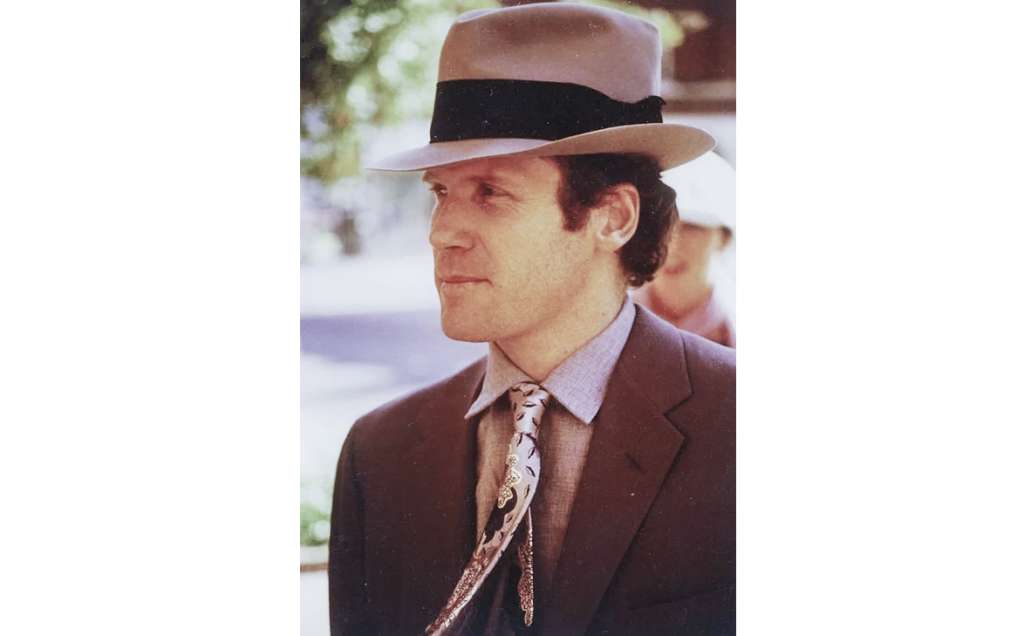
Featured photo: Dugan in Fort Worth, Texas shooting a scene for film on Ornette Coleman. 1977.
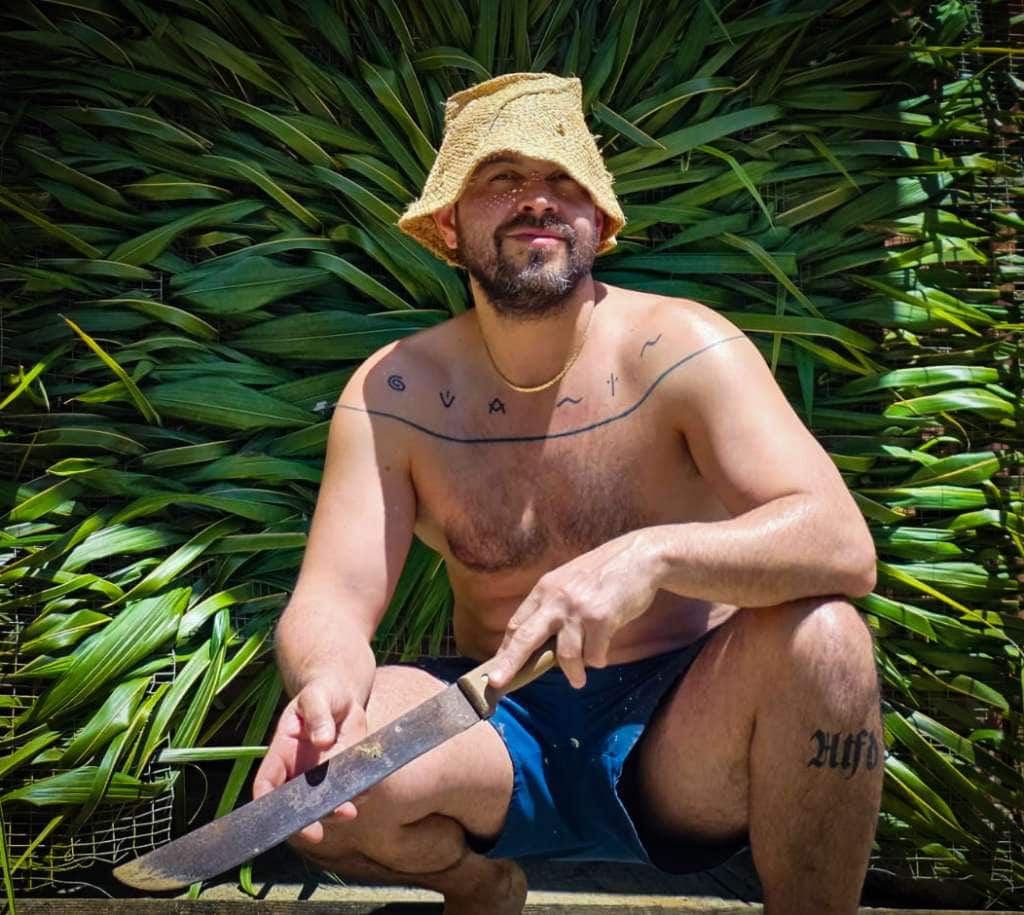
Mercury, artist in residence, Las Casas de la Selva, Patillas, Puerto Rico, March 2026
Mercury is a second-generation Boricua artist and activist based in Hartford, Connecticut, working across disciplines with a focus on site-specific installation. Their practice is situational, shaped by available materials and grounded in themes of Bori identity, language, and the urgency of the present moment. Alongside their art, Mercury engages directly with housing issues, addressing the impacts of gentrification through creative and community-based approaches.
For the past four years, Mercury has spent winters at Las Casas de la Selva, connecting with the land through both conservation work and art-making that responds to the surrounding environment. Their time here reflects a deeper process of reconnection to Puerto Rico as part of the diaspora experience.
Mercury is now developing a vision for a reciprocal residency exchange, linking diasporic artists from U.S. cities with Caribbean-based creatives. Their work moves between place, identity, and possibility, with a dream that reaches as far as outer space.
Mercury at Las Casas de la Selva, Patillas, Puerto Rico, March 2026
At a time when the world feels increasingly fractured, we are reminded why places like Las Casas de la Selva matter, and we are very glad to welcome Mercury into residence with us.
Residency here is not about retreat in the conventional sense. It is about immersion. Living inside a forest that is constantly in motion. Growth, decay, regeneration, pressure, release. The rainforest does not offer stillness so much as it offers continuity, and in that continuity there is space to think, to feel, and to respond. In moments of global unrest, the role of the artist becomes sharper. Not to explain the world, but to witness it, to translate it, and sometimes to sit with what cannot be resolved.
Having Mercury here now brings another layer of observation into the work of Las Casas, where science, forestry, and lived experience are already in dialogue. Their presence matters. Not as an addition, but as part of an ongoing process. The forest holds many forms of intelligence. Artistic practice is one of them.
We look forward to seeing what emerges.
Other work by Mercury
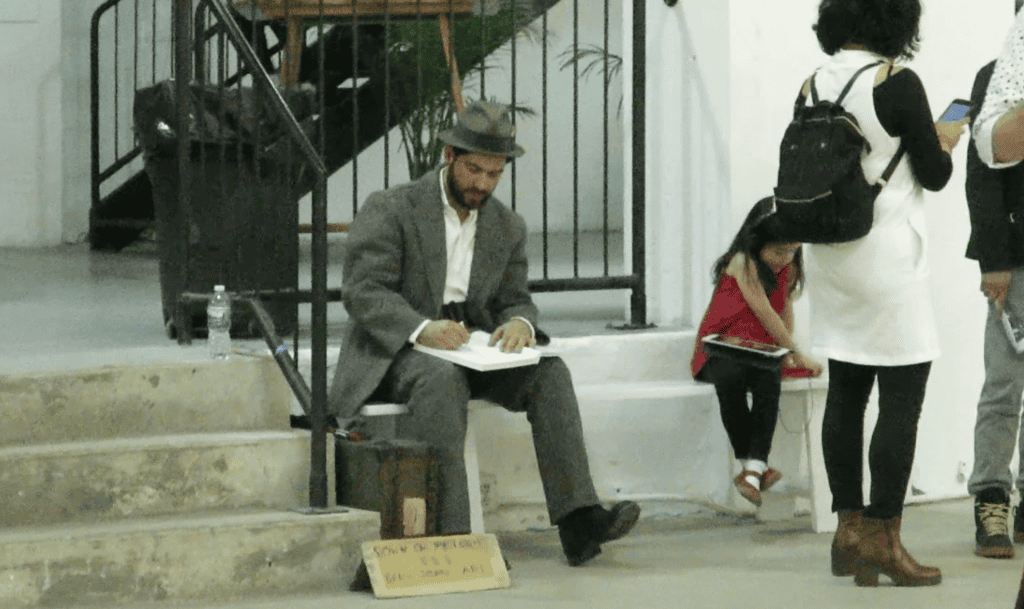
Snowball: 2016 – ongoing, Miami & New York, Performance with felt suit
Snowball is an ongoing performance in which Mercury attends art fairs throughout miami and new york wearing a handmade reproduction of joseph beuys’ felt suit. Once inside the art fair, they sit in high traffic areas peddling live drawings to passersby. Mercury neither asks permission nor announces themselves when performing this piece. Selling art at an art event without permission, even in the guise of performance, doesn’t usually go over well with organizers, so Mercury is usually escorted out by security.
Foreign Language Academy Visit | March 22–23, 2026
From March 22 to 23, we hosted 25 teenagers (13-14-year-olds) from the Foreign Language Academy in Tennessee, traveling with Vamonos Tours and accompanied by chaperone Cruz Rodriguez. The group was led by school staff Michelle Aguirre-Hill, Lauren Jenkins, Michelle Aguirre, Ruth Aguilera, and Tim Nash.
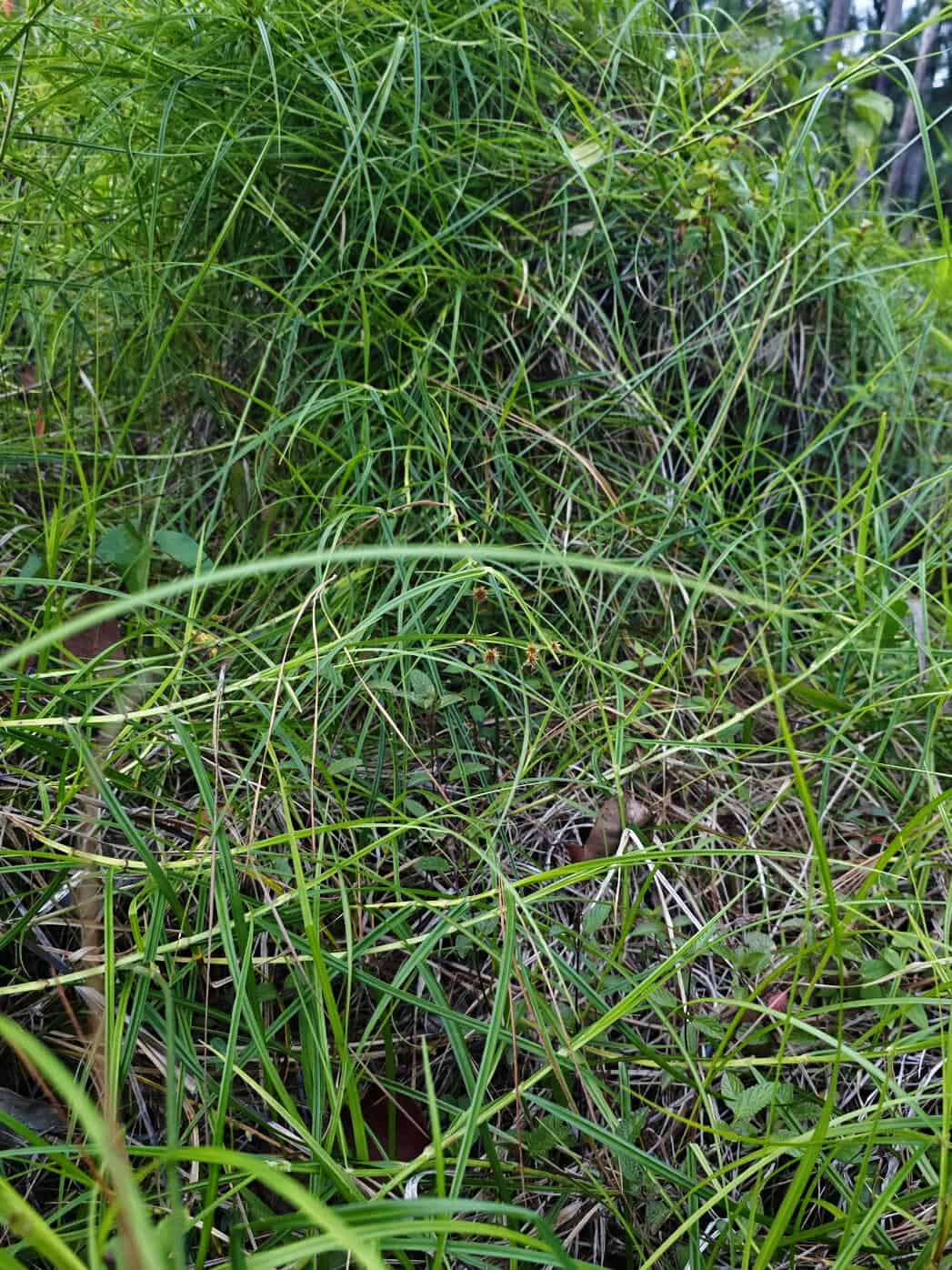
They arrived in a wet stretch of weather and went straight to work. Rain was constant, the ground saturated, and conditions demanding. The focus of the work was the Ethnobotanical Trail. Working alongside crew leaders 3t, Jon, and Mercury, the group took on essential tasks across the trail system. This included cutting back aggressive razor grass (Scleria secans), a perennial scrambling sedge in the Cyperaceae family. Since Hurricane Maria opened the canopy, increased light has driven rapid growth of razor grass and vines, making this ongoing work critical.
They also pruned along the trail corridor, opened new sections of trail, and built drainage to stabilize the path and move water effectively through the landscape.
The drainage work was especially important. In heavy rain, unmanaged water quickly damages trails, leading to erosion and long-term degradation. What they built will hold through future storms and continued use.
Despite the conditions, the group kept a strong pace. No complaints, no slowing down. Just steady work in the rain. The team stayed for two nights and, in that short time, made a clear and lasting impact on the trail system. Monique Nieves (below) kept everyone well fed with excellent meals throughout their stay.
This is the kind of work that matters here. Each group steps into something already underway, and what they contribute becomes part of a larger system that supports the forest, the trails, and those who come after. We really appreciate the effort, the attitude, and the willingness to work under real conditions.
Fountain Valley School has been coming to Las Casas de la Selva since 2013. Each group steps into work that is already underway and leaves something that continues beyond them.
This year’s visit, March 10 to 13, was a wet one; but it did not slow us down. The students were willing to stay put in the heaviest of showers.
The students got straight into practical work. A hillside drainage ditch was cleared to restore proper water flow and stabilize the slope. On another bank, they built a debris dam to slow erosion and hold soil in place. Hard, manual labor, but critical in this terrain.
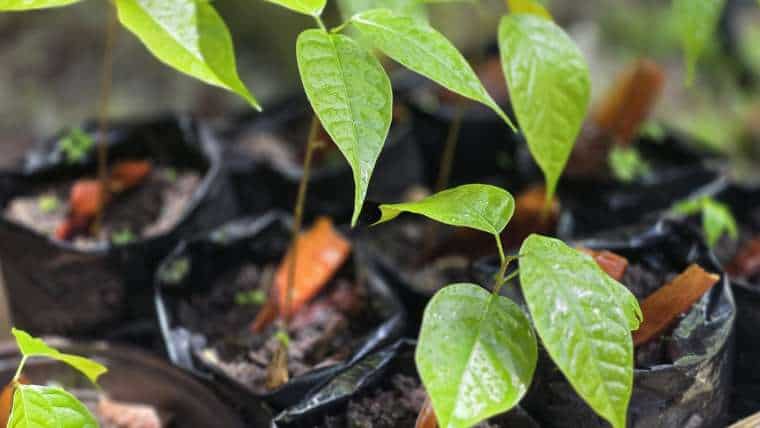
We also continued longer-term conservation work. Six Garcinia portoricensis (Palo de Cruz) were planted out. These trees come from our 2021 collaboration with Botanic Gardens Conservation International. What started as propagation in the nursery is now moving into the forest. This is multi-year work and each group becomes part of that chain.
Nursery work was carried out alongside this. Seedlings were tended and the nursery was raked of leaves and cleaned up. Drainage work on the main drive was also completed, which is essential to keeping access intact during heavy rains.
The group worked with focus and good energy throughout. Mercury and Jon led the crews with 3t, and the students were willing to take on whatever was needed. On the ethnobotanical trail, half the group worked on drainage ditches and the other half on clearing overgrowth. The work on razor grass clearing was a challenge, but all the students worked really hard and withstood the heavy downpours.
Evenings were boisterous and fun, with food and conversations, time off all devices, and the forest providing an intense peace and tranquility. An afternoon of conversations encouraged teenagers to interact with someone they had not spent much with.
Monique and Jaguey kept everyone well-fed with delicious meals. That part matters more than people realize. Happy teenagers are well-fed teenagers!!
3t, Jon Warwick, and Mercury were crew leaders. Thank you to Deb Prantl and Sue Tibbets for their continued leadership and for bringing these groups here year after year. The work gets done, but more importantly, the students leave having experienced something direct and real. And the forest holds the rest.
In 2011, Abby Zuckerman arrived at Las Casas de la Selva as a young volunteer. She was 20 years old at the time, curious, open, and ready for hard work in the rainforest. See image below. She really valued that time, and that early experience stayed with her. Years later, now a biology and environmental science teacher, Abby returned…this time with her students.
Dedham High School students came to Las Casas de la Selva for a four-day immersive stay. They arrived during a very rainy time and were quickly introduced to the reality of tropical fieldwork: heavy rains, slick trails, and humid days.
The students took on meaningful, hands-on tasks that directly support ongoing forest restoration efforts. Under the guidance of crew leaders 3t and Jon, they worked in the nursery, in the forest pruning bamboo, trimming trees, and clearing debris and razor glass from areas around saplings and new areas being prepared for new tree planting. It was real work—physical, muddy, and often challenging—but the group met it with energy, humor, and resilience.
Behind the scenes, the days were anchored by the kitchen team. MoniqueNieves and Jagüey kept everyone fed, warm, and grounded, creating a shared space where conversations from the field carried into the evenings over meals and laughter.
Despite the rain—or perhaps because of it—the experience was deeply connective. The students lived the rhythms of the rainforest, learned what ecological restoration looks like on the ground, and gained insight into what it means to work collectively in a living system that does not bend to convenience.
One of the unexpected highlights of the week was the talent show, improvised in an afternoon after a long morning working in the rain. What started casually quickly turned into a joyful, slightly chaotic celebration of creativity and courage. Students sang, played music, told stories, and performed skits, while others surprised everyone with humor and sheer nerve. Laughter echoed through the forest, barriers dissolved. In that moment, the rainforest was not just a place of labor and learning, but a shared home—alive with voices, confidence, and the kind of connection that only comes when people feel safe enough to be fully themselves.
For us, there is something especially meaningful about this visit. Abby’s return, now as an educator bringing her own students, reflects the long arc of experiential learning. What begins as a formative experience for one young volunteer can, years later, ripple outward to inspire dozens more.
We are grateful to Abby, to Dedham High School, and to every student who showed up ready to work, adapt, and engage fully with the forest—even in the rain.
Abby & 3t, 2026Monique, Jagüey, & 3t
We also extend our thanks to CruzRodriguez and Maritza from Vámonos, whose coordination and helped make this visit possible. Their care, logistics, and attention to detail ensured that the group could focus fully on learning, working, and experiencing the rainforest in a way that was both safe and deeply engaged.
Photos by 3t Vakil, and Abby Zuckerman, Feb 2026
Update from Abby:“Thrity the parents and students have not stopped raving about their experience at Las Casas and how formative and impactful it was for them. We are so lucky that you have built such a special place!”
Thank you, Abby. What makes Las Casas de la Selva special, comes from teamwork and the cumulative efforts of many people over more than forty years—staff, volunteers, students, scientists, cooks, crew leaders, and caretakers, past and present. It’s a living place shaped by shared work, persistence, and care across generations, and we’re grateful your students became part of that continuum, even if only for a short time.
Recently we had the pleasure of hosting a group of students from Comp Sci High, NY, a dynamic learning community rooted in the South Bronx that prepares young people with academic strength, computational fluency, professional skills, and real-world experience. Comp Sci High’s mission is to empower students to access college, careers, and meaningful opportunities through technology and community-based learning, building emotional, professional, technical, and civic capacities that will support success long after graduation.
What happens when students who are immersed in computational thinking and future-focused pathways step out of the classroom into a place like Las Casas de la Selva, in the rainforest? They bring curiosity, resilience, and a willingness to contribute in new, hands-on ways.
About a dozen students from diverse backgrounds, including places like Ghana, Senegal, Nigeria, and Bangladesh, joined us for a day of clearing work on our ethnobotanical trail. Together, they helped remove encroaching vegetation, making the trail more accessible for visitors and researchers alike. Their energy turned what could have been just a task into shared learning, exploring how forests grow, how trails evolve, and how collective effort shapes the land.
Guiding the group through technique, safety, and decisions in the field was Jon Warwick, whose grounded approach helped everyone engage confidently with tools and tasks. We were also joined by group organizer Bill Cotter of Shoulder 2Shoulder and school staff Dennis Pooler and James Kale, whose support ensured the day flowed smoothly and meaningfully.
In the afternoon, 3t served a nourishing lunch that gave everyone a chance to rest and reflect on the morning’s work. Conversations ranged from the forest and the history of Las Casas de la Selva, to hurricane survival. We are grateful for this group’s thoughtful participation and engagement. It was a vivid example of how young people can extend the values they learn in school – teamwork, problem-solving, and perseverance – into new environments where those skills matter in tangible, ecological ways. We look forward to future collaborations that bridge classroom learning and real-world stewardship.
Photos by 3t Vakil, Jon Warwick, Bill Cotter, Feb 2026
We were grateful to welcome a group from Rocky Mountain School to Las Casas de la Selva for a focused day of service work on our ethnobotanical trail. Days like this sit at the heart of what Las Casas represents: learning by doing, caring for place through direct action, and understanding forest systems from the ground up. The crew worked under the guidance of Jon Warwick, who led pruning and trail maintenance along sections of the ethnobotanical trail that see regular use by researchers, students, and visitors. Careful pruning is not just about access; it is about encouraging healthy plant structure, protecting sensitive understory species, and keeping the trail legible without overwhelming the forest’s own rhythms.
Students approached the work with focus and good humor, quickly finding their stride with hand tools and learning how each cut has consequences over time. Trail work in a rainforest is always dynamic. Growth is constant, and maintenance becomes an ongoing dialogue with the landscape rather than a one-time task.
By the end of the day, areas of the trail were clearer, safer, and better defined, but more importantly, the forest had been met with attentive care. These moments of shared labor leave a quiet imprint. They build relationships between people, between people and place, and between learning and responsibility. 3t provided a delicious lunch!
We thank Rocky Mountain School and staff Brittany Bergin-Foss and Sierra Aldrich, for bringing their energy and curiosity into the forest and for contributing to the ongoing stewardship of Las Casas de la Selva. Many thanks to Fernando of Carite 3.0 and to Bill Cotter of Shoulder 2 Shoulder for bringing the group to us.
Artist Ramona’s residency at Las Casas de la Selva, January 2026
Ramona’s residency project, “Community Ecologies: My neighbor is me, I am my neighbor“ grows out of a long-standing commitment to understanding human–nature relationships through slow, field-based practice. Working in watercolor and poetry, she approaches the rainforest not as scenery, but as a living community shaped by interdependence, reciprocity, and shared resilience.
At Las Casas de la Selva, her focus is on observation. Daily forest walks. Listening. Sketching. Taking notes. Paying attention to micro-ecologies and subtle interactions among species. Her practice draws equally from ecological training and artistic intuition, allowing scientific knowledge and creative expression to inform one another rather than compete.
The questions guiding her work are deceptively simple: How do rainforest communities sustain one another? How does the more-than-human nourish, support, and coexist? What can these systems teach us about our own planetary interdependence?
Ramona’s background in ecology, natural resource management, and restoration has given her deep experience within academic science. At the same time, she is acutely aware of its limitations. Scientific knowledge, as it is often communicated, remains inaccessible to many and shaped by narrow epistemologies. Her work seeks another route. Art becomes a mode of science communication that is human, embodied, and relational.
This residency is also a preparation.
Beginning in 2026, Ramona plans to undertake a visual narrative storytelling project during a walk around the world, traversing five continents. See this link for more: www.thecollectivecanvas.org She will carry this methodology with her: painting, writing, observing, and documenting community ecologies across vastly different landscapes and cultures. The artistic development she is cultivating now will guide how she tells those stories later.
Her proposed outputs include a series of paintings accompanied by poems, field notes, and an online exhibition, as well as a small workshop centered on observation and reciprocity in artistic practice. But beyond deliverables, what is being formed is a way of working that can move across borders without extracting from place.
Las Casas de la Selva offers an ideal beginning. Not as a backdrop, but as a collaborator. A place where slowing down is not a luxury, but a necessity, and where attention itself becomes a form of care. See here for more info: https://eyeontherainforest.org/artist-residencies-at-las-casas-de-la-selva/
Above: Some of Ramona’s work, Jan 2026 Ramona is actively seeking funding for her walk around the world. Please make contact if you are able to help in any way.
Pluvialis spectratum, Acrylic Paint on PVC Panel, 44” x 20”, #28 of the ‘Spandrel Spaces’ Series, 3t Vakil, 2024,
Las Casas de la Selva invites artists to spend time working quietly in a living rainforest.
This Artist-in-Residence opportunity is process-centered and low-pressure. It is designed for artists of all disciplines who want to step away from noise, deadlines, and constant output and instead focus on attention, observation, and slow practice in relationship with place.
There are no production quotas, exhibition requirements, or deliverables. Walking, listening, thinking, painting, writing, sketching, dancing, or simply being present are all valid forms of work here.
Residencies are intentionally simple and accessible. Cost:$35 per day – this covers food and operating costs. Bring what you need to create your art. We have forest products that can be used here, like wood, sticks, leaves, and vines etc. Length of stay is flexible and shaped collaboratively. Dates will depend on other groups at the project.
This residency, for any age, may be a good fit if you are:
seeking time to recalibrate or begin something new
interested in ecology, place-based work, or slow practice
comfortable working independently and respectfully in a rainforest setting
looking for inspiration
in need of peace and quiet, and contemplation
Las Casas de la Selva is a working rainforest, research site, and conservation project. Artists are guests within a larger living system and community and are always welcome to help on various projects
The residency is directed by Thrity Vakil (3t), who is herself an artist and is available for conversation, reflection, meditation, and mentoring during the stay. Engagement is informal and responsive, shaped by the needs and interests of each resident.
“Specimen 14 Rizocirca tumultuosa (Collected: August 20, 2025)” From: ATLAS OF INNER BLOOMING BIOMES – A Fictional Herbarium Catalogue of Inner and Outer Expeditions, by 3t Vakil
That Tree, Acrylic Paint on PVC Panel, 24” x 24”, by 3t Vakil, 2026
As the year turns and the forest exhales into the quiet glow of the holidays, we want to pause and send our deepest thanks to all of you—friends, collaborators, visitors, volunteers, neighbors, and fellow travelers on this long rainforest journey.
This year at Las Casas de la Selva has been one of endurance and renewal. We planted trees and ideas, held space for learning and creativity, weathered storms both literal and personal, and continued the slow, patient work of tending forest, community, and possibility. The rainforest reminded us daily that resilience is not loud—it is layered, rooted, and alive.
To everyone who walked these trails with us in person or in spirit, who supported the work, shared knowledge, lent hands, or simply kept us in their thoughts: thank you. You are part of this living system.
May the coming year bring you deep rest, renewed curiosity, good health, and moments of wonder. May your roots grow stronger, your paths stay open, and your inner forests thrive.
With gratitude and green blessings, and abundant love,
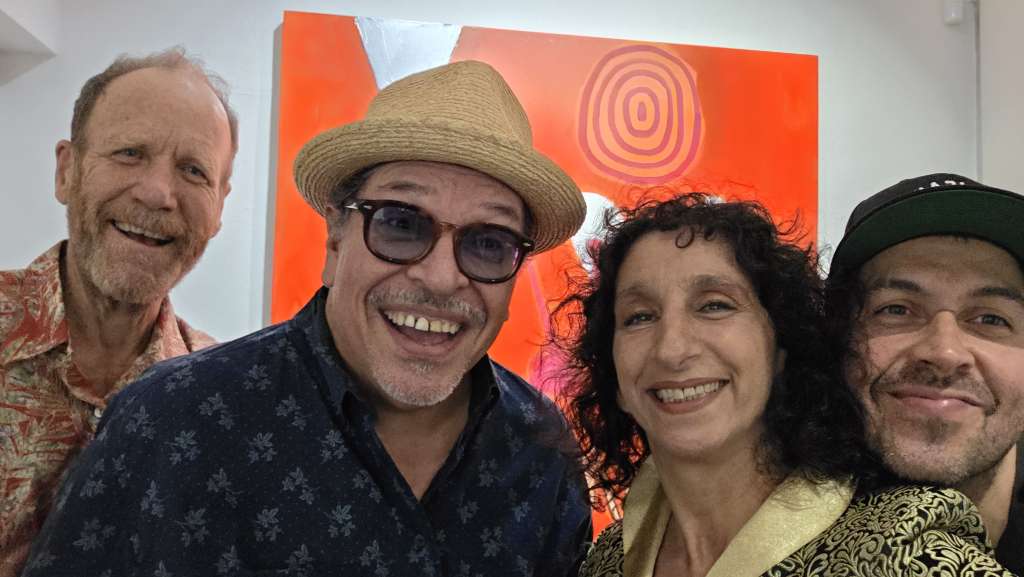
L-R: Directors of Institute of Ecotechnics, Starrlight Augustine (Synergia Ranch, Santa Fe, NM), Chili Hawes (October Gallery, London, UK), 3t Vakil (Las Casas de la Selva, PR), Dave Neita, (Poet, Education Outreach)
December 2025 Enjoy this collage of images from the year 2025.
Mushroom Foray and Fungal Bio-Blitz with Catskill Fungi, December 2025
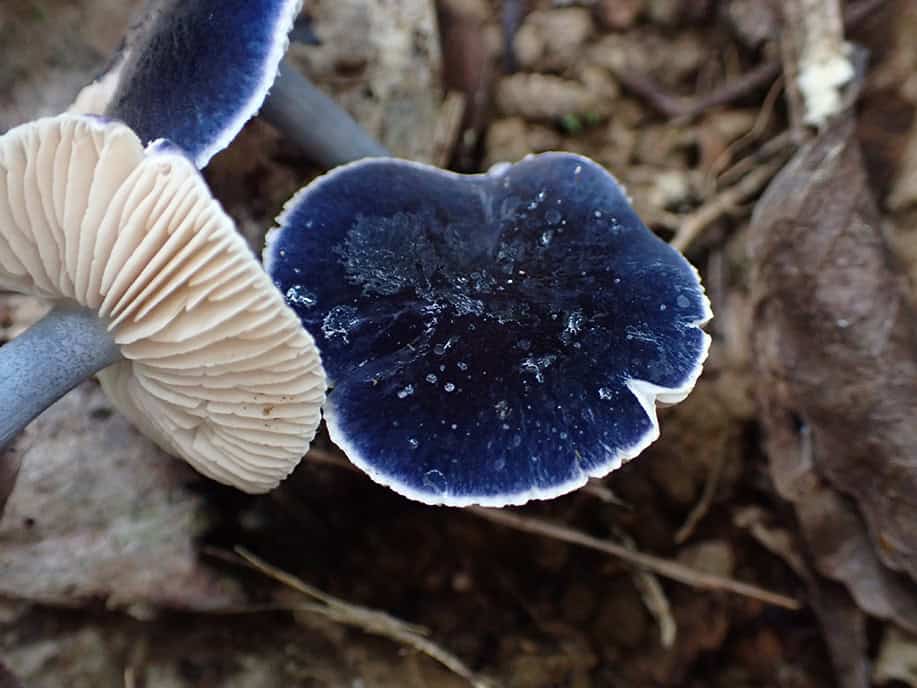
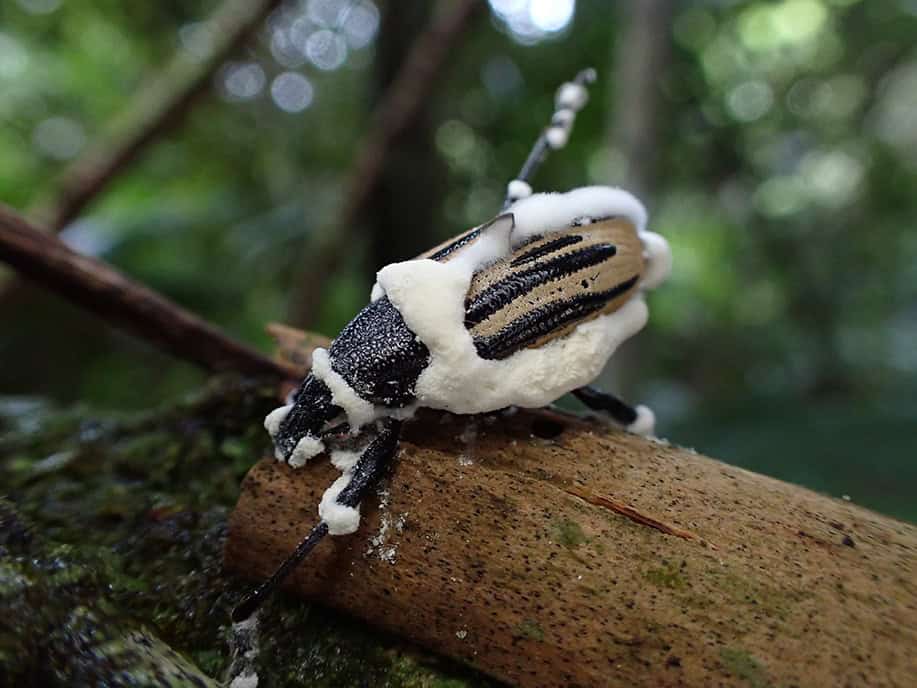
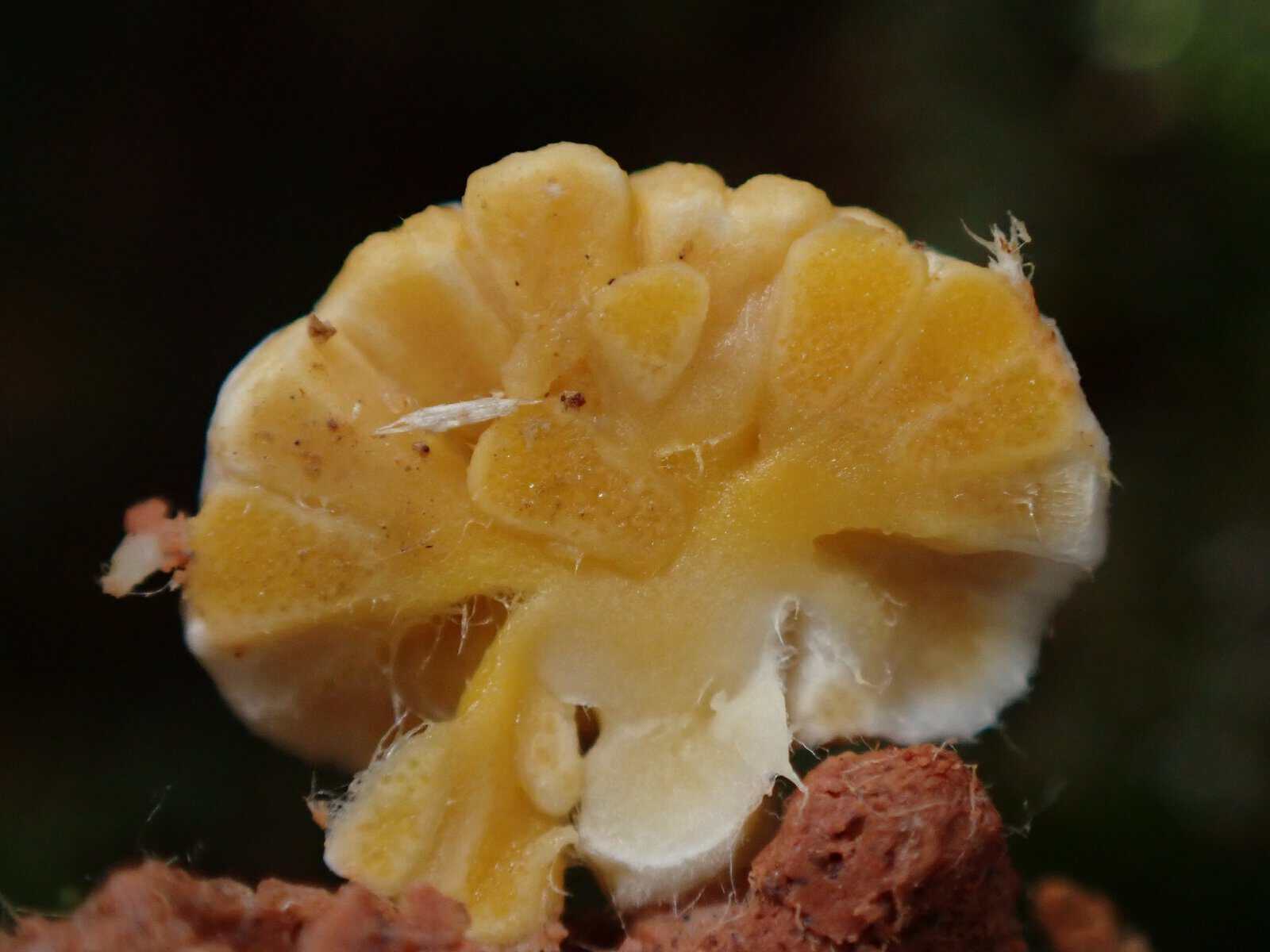
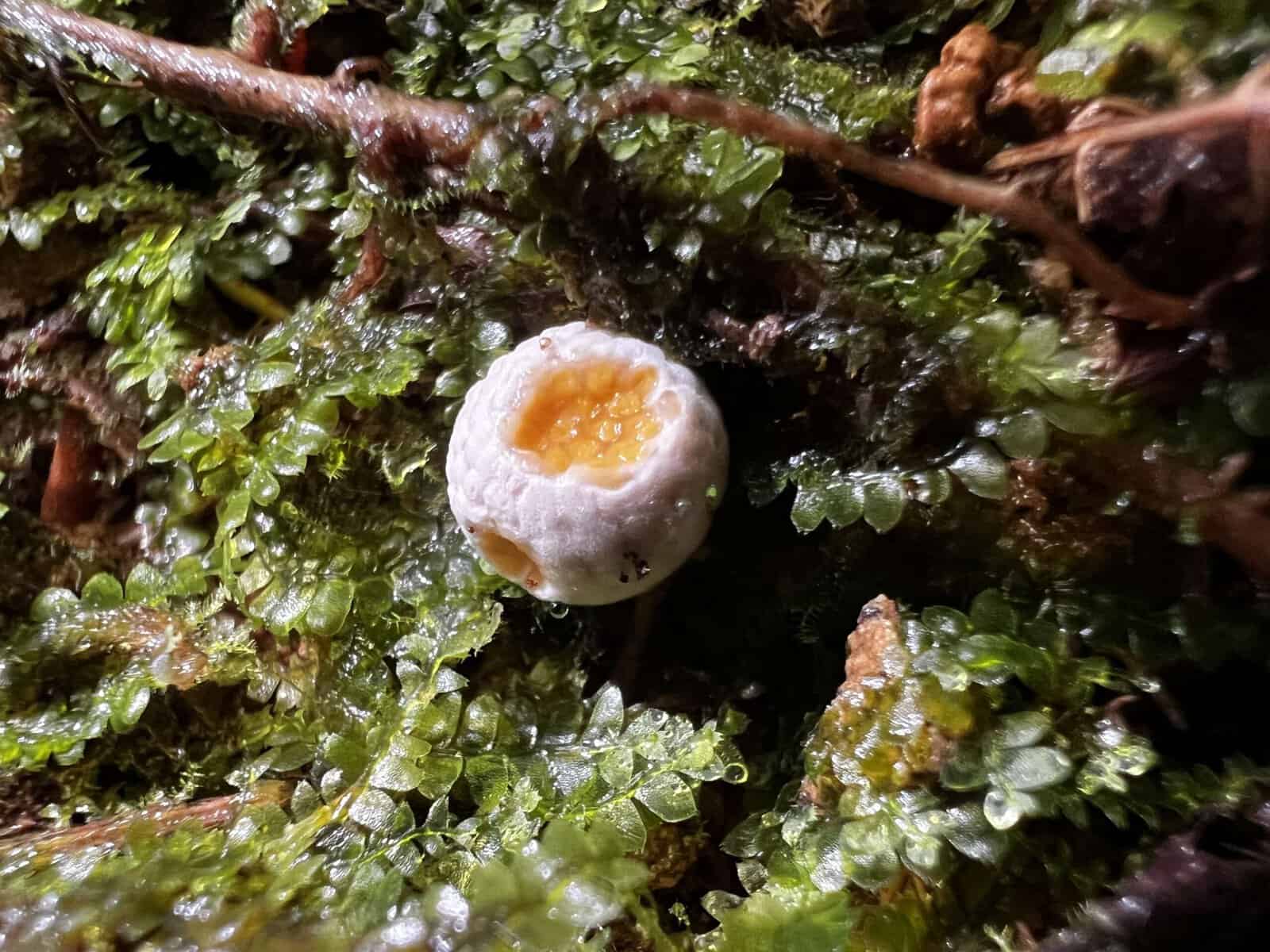
Las Casas de la Selva welcomed Catskill Fungi for a special mushroom foray and fungal bio-blitz led by Aubrey Carter,John Michelotti, Gabriela D’Elia, mycologist Kurt Miller (of the Eye On The Rainforest Botanical Team), and supported by Erwin Karl. Participants spent an evening looking at fungi under UV light and the day exploring the fungal diversity of the subtropical wet forest, learning identification skills, ecological relationships, and the importance of fungi in forest health. This event contributed to the ongoing biodiversity documentation at Las Casas de la Selva.
Gabriela D’EliaKurt MillerErwin KarlJohn MichelottiAubrey Carter
The Experts Behind the Foray
Aubrey Carter, creator of Mushroom Monday and stand-up comedian. Aubrey brings humor, accessibility, and curiosity to the world of fungi, helping audiences feel at ease with identification, ecological awareness, and community science. His creative framing of mycology makes learning fun and approachable, especially for newcomers.
Gabriela D’Elia, creator of Fungi Talk and board member of the Fungal Diversity Survey (FUNDIS). Gabriela is a mycologist, educator, and writer whose work connects ecological understanding with emotional and philosophical depth. She previously served as executive director of FUNDIS and continues to advocate for fungal conservation. Gabriela has created statewide fungal diversity projects, led campaigns such as establishing porcini as Utah’s state mushroom, and has been featured in publications including Yes! Magazine, Atmos, and Mushroom People. She guides biodiversity surveys, imagination-based mushroom walks, and educational retreats with Catskill Fungi.
John Michelotti, Founder of Catskill Fungi. John is a respected leader in North American mycology. He is the former president of the Mid-Hudson Mycological Association, co-founder of the Catskill Regional Mycoflora Project, and founder of the Gary Lincoff Memorial Scholarship. He serves as Medicinal Mushroom Committee Chair and Poison Control Consultant for the North American Mycological Association and teaches New York’s Wild Mushroom Food Safety Certification courses. John is dedicated to empowering people to engage with fungi for personal well-being, environmental stewardship, and resilient communities.
Kurt Miller, expert mycologist of Puerto Rico and community scientist. Kurt has interned with Forest Service mycologist Dr. Jean Lodge and served as a field biologist during the 11th International Mycology Congress in San Juan. He studies tropical fungal ecology, taxonomy, and rare fungal species, particularly those forming mycorrhizae with sea grape (Coccoloba spp.). He administers Fungi of Puerto Rico, leads fungal identification walks across the island, and is a FunDiS Biodiversity Database Identifier specializing in Caribbean fungi.
Erwin Karl, Mycologist and educator. Erwin specializes in field identification, ecological interpretation, and public engagement. His clear teaching style helps participants connect fungi to broader forest processes and understand their essential roles in soil formation and ecosystem function.
About Catskill Fungi: Founded and cultivated by mycologist John Michelotti and friends, Catskill Fungi is grounded in permaculture values and environmental compassion. The organization empowers people to understand fungi as food, medicine, and ecological partners through education centered on sustainable harvesting, cultivation skills, and accessible science.
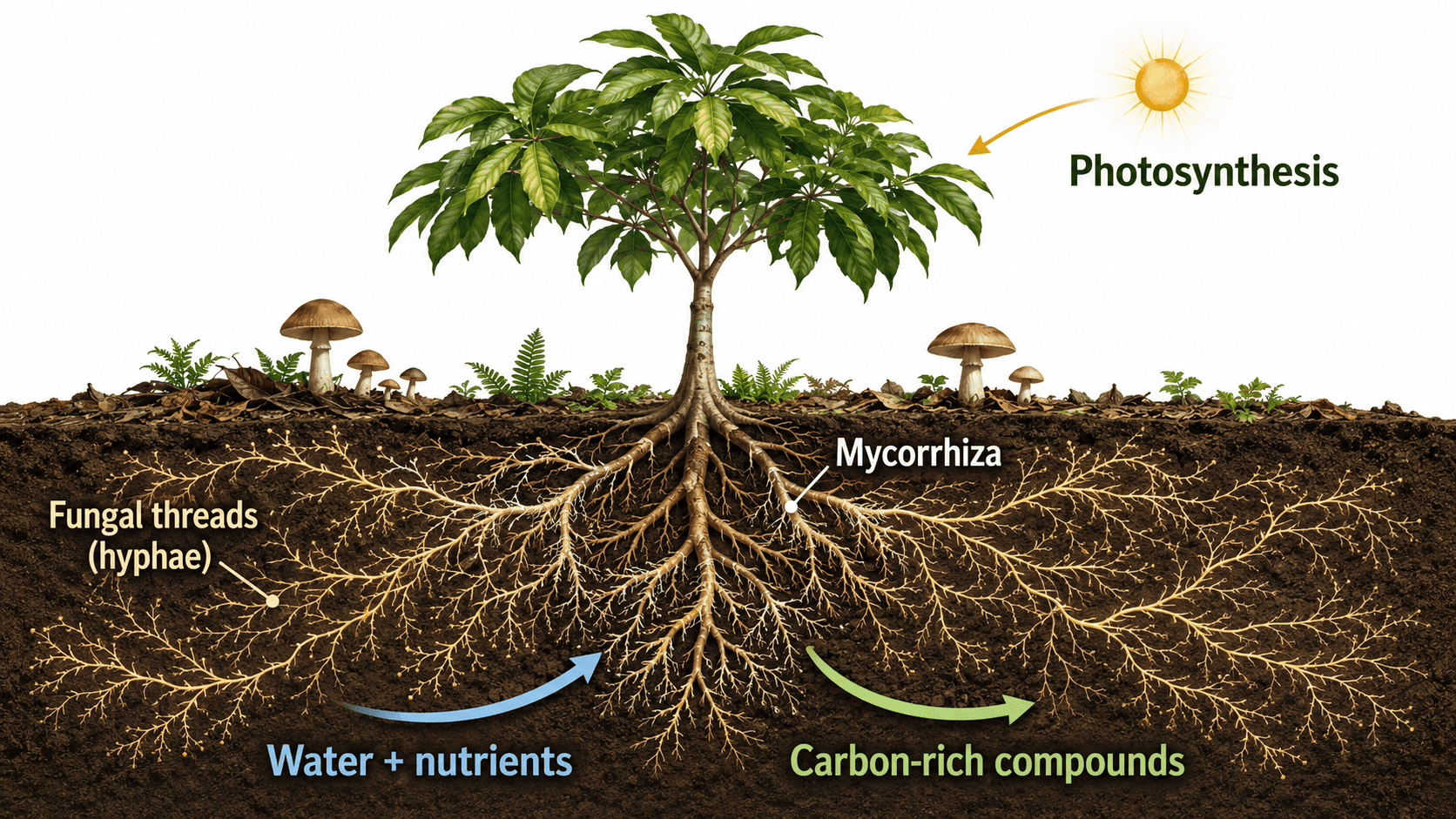
Participants explored mature tabonuco forest, regeneration zones, and enrichment areas, documenting cup fungi, polypores, mycorrhizal partners, jelly fungi, and many lesser-known species. The team emphasized sustainable practices, careful observation, and respect for the forest floor. Their combined expertise helped participants see fungi not only as identifiable species but also as active contributors to soil creation, nutrient cycling, and long-term forest recovery.
Bio-Blitz Findings
Throughout the day, the team photographed and recorded each fungal encounter, contributing several new observations to the Las Casas fungal inventory. These findings support long-term research on forest resilience, habitat complexity, and climate-related shifts in fungal communities. The bio-blitz also inspired local participants to continue studying fungi and join citizen-science initiatives that improve understanding of fungal diversity in Puerto Rico.
Strengthening Community and Ecological Insight
This mushroom foray demonstrated the power of education, curiosity, and collaboration in deepening understanding of forest systems. Catskill Fungi’s approach aligned seamlessly with the mission of Eye On The Rainforest, bringing together science, community engagement, and ecological awareness. We thank Aubrey Carter, Gabriela D’Elia, John Michelotti, Erwin Karl, and Kurt Miller for an inspiring and informative time. Their leadership strengthened our educational outreach and contributed to valuable ecological documentation for the region. Las Casas de la Selva looks forward to future forays and expanded collaboration in fungal research and conservation.
Great thanks to Monique Nieves for the wonderful food, Bam Bam for his kitchen help, Jon Warwick for help around the homestead, and Potin for maintenance, and to 3t for organizing and documenting. See 3t’s Album of this event : https://photos.app.goo.gl/N9UJ38cbA9EyAR8e9
Field Trip for Botanical Specimen Collection, Flowering Plant Taxonomy Course, UPR Río Piedras (BIOL 5495), Las Casas de la Selva, Patillas. September 27, 2025
Students from the UPR Río Piedras Flowering Plant Taxonomy course spent an afternoon collecting botanical specimens at Las Casas de la Selva under the guidance of Professors James Ackerman and Eugenio Santiago.
We were thrilled to host a Day Service group of 19 energetic teens and 4 dedicated Globalworks staff at Eye On The Rainforest! It’s a full-circle moment—Globalworks teens helped break ground on our Ethnobotanical Trail all the way back in 2003, and this visit brings that legacy back to life.
Who Was Here
Crew Leader Jon Warwick took charge with enthusiasm, guiding the teens through every step of their work on the trail.
GlobalWorks Leaders: Warm thanks to Lauren, Jorge, Sarah, and Anthony, whose presence and support uplifted the entire group.
What We Accomplished
Over several hours of steady effort, the crew strengthened sections of the trail, creating drainage ditches and pruning undergrowth away from the trail—the backbone that makes exploration safe and accessible. After working hard in the heat and humidity and with the challenge of razor grass, everyone refueled with a wholesome lunch back at the homestead. Seeing those teens come together to repair our trail was a powerful reminder of how service and nature intertwine.
The Globalworks Difference
Globalworks isn’t just a travel company—they’re a community builder. As described on their website, they make “intentionally crafted itineraries” designed to encourage resilience, leadership, confidence, self-reliance, and curiosity in teens. They’re committed to immersive community service.
See : globalworkstravel.com Their model of blending service, reflection, cultural exchange, and adventure provides an enriching backdrop for experiences like ours—and it’s clear that this isn’t just travel, but travel with purpose.
Full Circle, Full Hearts
Hosting Globalworks again on the Ethnobotanical Trail feels deeply meaningful. From 2003 to today, these partnerships help not just our environment but also the growth of young people who return home more capable, connected, and confident. We’re proud to collaborate with them, and to know that these trails, built by teamwork and care, will continue to educate and inspire. (Teenagers grow up and return to volunteer again, now with their own teenagers!!!)
Thank you to Jon, Lauren, Jorge, Sarah, Anthony, and every one of the 19 teens—and of course, a big shout-out to 3T for keeping everyone fueled with a great lunch. Here’s to many more years of partnership, growth, and active service in the rainforest!
Through the Storm: New Research Highlights Forest Vulnerability in Puerto Rico, June 2025
(a) Tracks for some of the more recent storms to impact the island of Puerto Rico; and (b) aerial photos showing Las Casas de la Selva before and after the storm. Photo credit: Thrity Vakil.
We’re proud to share the publication of a powerful new peer-reviewed article by Michael W. Caslin, co-authored with Madhusudan Katti, Stacy A. C. Nelson, and Thrity Vakil, in the MDPI journal Land (July 2024). The study—“Tabonuco and Plantation Forests at Higher Elevations Are More Vulnerable to Hurricane Damage and Slower to Recover in Southeastern Puerto Rico”—is a milestone not just in forest research, but in Michael’s personal journey as he nears completion of his PhD.
This is no armchair science. Michael has spent years on the ground at Las Casas de la Selva in Patillas, Puerto Rico, conducting fieldwork under challenging and often extreme conditions. From muddy mountain slopes to tangled understories, he painstakingly gathered data across 75 forest plots—returning again and again, rain or shine, to document how forests have responded to the brutal force of Hurricane Maria.
Using 360° photography, virtual reality analysis, and spatial modeling tools, Michael’s research paints a clear picture: higher-elevation forests, especially those dominated by native tabonuco trees or plantation species, are more vulnerable to hurricane damage and are slower to recover. These findings are essential for shaping future forest management and climate resilience strategies in Puerto Rico and beyond.
And best of all, the publication in the journal “Land” published by MDPI (Multidisciplinary Digital Publishing Institute), is open access, meaning anyone can read it, with no subscriptions or paywalls in the way.
MDPI (Multidisciplinary Digital Publishing Institute) It is a publisher of open access scientific journals, founded in 1996 and based in Basel, Switzerland.
Congratulations, Michael—for your unwavering commitment, your brilliant fieldwork, and this important scientific contribution. We’re honored to have supported your work at Las Casas de la Selva.
360◦ photography360◦ photography
Michael Caslin and Prof Madhusudan Katti in the Las Casas forest, 2023
L-R: Alfredo Lopez, George Locascio, Larry Birdflask, Michael Caslin, and Prof Madhusudan Katti, 2023
20122014
Michael Caslin first arrived at Las Casas de la Selva as a volunteer with the Earthwatch Institute’s citizen science program in 2012, returning again in 2014—two formative trips that sparked a deep and lasting passion for tropical forests. Immersed in the rhythms of the rainforest and the hands-on work of sustainable forestry, Michael quickly stood out for his curiosity, commitment, and keen observational skills. Those early experiences planted the seeds for what would grow into a decade-long journey of research, culminating in his doctoral work. What began as a volunteer project evolved into a personal mission: to understand how forests endure, adapt, and recover in the face of increasingly extreme climate events.
Update: 12 December 2025 – Michael graduated from NC State University with a PhD in Forestry and Environmental Resources. Bravo, Dr. Caslin!
Behind the Brush: A Two-Month Conversation between 3t Vakil & Gessie Houghton on The Spandrel Spaces Series (art inspired by life in the rainforest). June 2025
🎤 Interview by Gessie Houghton, October Gallery | Blog by 3t Vakil
After nearly two months of exchanging thoughts across oceans, I’m delighted to share a conversation that has left me feeling seen in ways few interviews ever have. Art writer Gessie Houghton of the October Gallery—the London space that helped shape my early journey—recently interviewed me about Spandrel Spaces, the series that has emerged, almost ferally, from the tangled aftermath of climate upheaval and personal transformation.
Gessie didn’t just ask questions—he excavated. He dug through the outer layers of paint and daily life until we were talking about the pulse beneath it all: awe, process, memory, and the liminal zones that birth something new.
“All I wanted to do was paint — as though my very life depended on it.” — 3t Vakil, on painting after Hurricane Fiona
The interview begins with Fiona. After that storm, I wasn’t just exhausted. I was altered. I describe it in the interview as an “awe-ma”—a term that emerged spontaneously, because what I felt wasn’t trauma. It was a kind of cracked-open reverence. Everything in my world—mud, roots, wreckage, sky—was vibrating with some larger, ferocious intelligence. And I just wanted to respond to it. With a brush. With color. With a hand that moved faster than my mind.
“At night… I become the willing recipient of a universal download.” — on the creative process
We talked about how these paintings come—fast, sometimes within a single night. Gessie was stunned when I told him I’d made 71 pieces between April 2024 and January 2025. But I couldn’t stop. Not when the muse was breathing down my neck and whispering secrets in the form of gestures, textures, and botanical phantoms. These aren’t tidy paintings. They’re events. Surges. They’re the visual equivalent of listening hard to the rainforest, and letting it speak through you.
“The emergent forms could exist in tension with themselves… The canvases didn’t need a center or even a fixed orientation.” — on letting go of traditional composition
What I loved most about Gessie’s approach was that he didn’t flatten my work into just one narrative. We spoke about the ways each piece evolves—not from a concept, but from a collision of sensation, intuition, and movement. Sometimes a brushstroke that was meant to be canopy becomes root. Sometimes what I think is emergence becomes descent. That’s the beauty of the Spandrel: it exists in the margin, the byproduct, the evolutionary detour. Just like me.
“Spandrel Spaces… are important arenas where the marvellous begins to manifest.” — on naming and the concept behind the series
We even talked about naming—how every title in Spandrel Spaces carries the echo of a botanical genus/species. It’s part taxonomy, part poetry. Part invented Latin, part metaphysical joke. Naming, for me, is a way to anchor mystery—not to resolve it, but to give it a place to stand.
I hope you’ll take time to read the full piece. It’s generous, layered, and full of unexpected turns—just like the series itself. Thank you, Gessie, for drawing this out of me. And to those of you who’ve been following the work from the shadows or the sidelines: here’s your backstage pass.
See you in the spandrel space.
—3t
Gerard Houghton is a writer, art-critic and videographer based in London. Graduating from Churchill College, Cambridge, he spent two years in West Africa working as an interpreter. In 1980, he moved to Japan where he taught Literature and Linguistics at two of Japan’s more prestigious universities. On his return to London, in 1994, he became Director of Special Projects at October Gallery, a central-London gallery specializing in contemporary art from around the planet. As well as writing essays, articles and catalogues he has edited a number of publications on the many international artists October Gallery represents.
This June, we had the pleasure of meeting two incredible groups of teenagers through the inspiring organization Shoulder to Shoulder—a nonprofit based in Colorado that brings students into global service learning experiences. With 14 students in each group, these visits brought a vibrant mix of energy, curiosity, and heartfelt engagement to the rainforest at Las Casas de la Selva.
On June 12th, the first group arrived, eager to dive into learning about sustainable forestry, conservation, and life in a tropical rainforest. These young people from all over the US—many of them visiting Puerto Rico for the first time—spent the day exploring the land, asking deep questions about our work, and reflecting on how our mission resonates with their own values and sense of purpose.
Then, on June 15th, a second group joined us—this time from Thayer Academy from Boston. They were guided on an immersive walk through the forest by Erid Román Rosario, who brought the ecosystem to life through stories about its flora, fauna, and the regenerative practices we’ve developed over the decades. Eric is part of a new wave of passionate young people stepping into leadership roles here.
We’re especially excited to be encouraging Erid, who is beginning to explore our forests in depth and share that knowledge through guided walks. After many years of 3t leading tours, it’s deeply rewarding to see the next generation stepping up. This not only supports our work at Las Casas de la Selva, but it also ensures that the knowledge, care, and spirit of the project continue to grow beyond a single person’s efforts.
These visits are exactly why we do what we do—because when young people step into this forest, when they stand on this land and breathe in the humid air of resilience, they begin to understand something vital about the relationship between humans and nature.
Huge thanks to the Shoulder to Shoulder team, group leaders Brian Sweeney and Adelina Valle Martinez, the teachers and leaders who accompany these students, and to the young people themselves—who showed up with open minds and generous hearts.
We hope they carry a piece of this forest with them wherever they go.
Shoulder to Shoulder’s mission is to nurture “ethical leadership” by placing students shoulder‑to‑shoulder with grassroots nonprofit leaders tackling real-world issues—like climate change, gender equality, food security, healthcare, and Spanish-language immersion. If you know a motivated middle or high schooler eager to grow through service, Shoulder‑to‑Shoulder might just be the transformative journey they need.
Great news for art enthusiasts and nature lovers! Due to popular demand, the exhibition “Spandrel Spaces: The Art of In-Between” by artist Thrity Vakil (3t) at the Museo de Arte e Historia Dr. Pedro Albizu Campos in Patillas has been extended until July 15th, 2025.
Don’t miss this captivating collection that beautifully explores vibrant intersections between ecology, botanically inspired forms, consciousness, and abstract expression. Thrity’s paintings highlight intricate patterns influenced by rainforest biodiversity and invite viewers to reflect deeply on humanity’s profound relationship with nature. Each piece engages ecological themes, drawing parallels between botanical structures, environmental sustainability, and metaphysical contemplations.
Experience this unique fusion of botanically inspired artistry, ecological awareness, philosophy, and creative vision. We warmly invite you to immerse yourself in the intricate beauty and ecological depth of “Spandrel Spaces: The Art of In-Between.“
Please let 3t know by email if you would like a personal tour of the exhibition for individuals or groups (3t@3tvakil.com). Paintings from the series can be purchased online at: 3tvakil.com/shop.
All paintings in this series: Medium: Acrylic Paint on PVC Panel, Size: 44” x 20” To learn more, visit the website: 3tvakil.com.
Houghton University Students Explore Sustainability and Science
We were delighted to welcome Dr. John M. Rowley, Professor of Chemistry and Director of Science Honors at Houghton University, NY, and his enthusiastic students to Eye on the Rainforest. Their visit featured an insightful guided walk through our lush forest led by 3t, exploring rich ecological interactions and deepening their understanding of tropical forest sustainability and conservation.
The students from Houghton University are diving into exciting research projects this May, covering important topics such as microclimate under the canopy, vegetation health near human developments, invasive plant species, and mangrove ecosystems. Our forest serves as a valuable natural laboratory, particularly for their investigations into microclimates and vegetation dynamics.
We look forward to hosting the Houghton team again in 2026 for more tailored research opportunities, continuing our meaningful collaboration and shared passion for environmental stewardship and education. Thank you, Dr. Rowley and students, for your visit—we’re inspired by your commitment to exploring and protecting tropical forests!
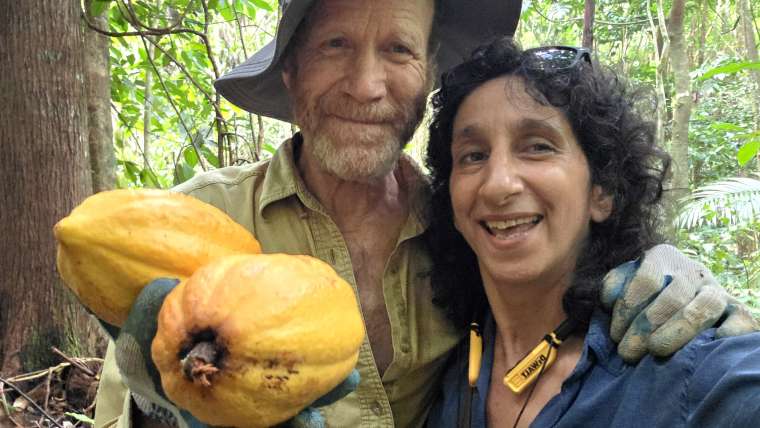
During their visit, the group experienced some tropical delights firsthand. The students got to open a cacao pod (Theobroma cacao) and tasted for the very first time the sweet, fruity pulp surrounding the seeds—seeds that will eventually be transformed into chocolate. Additionally, everyone enjoyed sampling the uniquely flavorful Guanabana, also known as Graviola (Annona muricata), immersing their senses further into the rich biodiversity of our rainforest.